
Board Meeting Etiquette: A Guide for International
You've reviewed the board pack, rehearsed your recommendation, and joined the meeting ready to contribute. Then a director cuts across your opening, the chair moves to the next issue before your point lands, and a colleague repeats your idea later as though it were new. Nothing in that sequence looks dramatic, yet each moment changes how the room assesses your authority.
Board meeting etiquette is not merely about courtesy. It governs access to the conversation, the quality of challenge, and the visibility of your judgment. For international professionals, the difficulty is often greater because turn-taking, interruption, silence, eye contact, and disagreement carry different meanings across cultures and meeting formats. A polished contribution must work in the room, on the screen, and in the procedural record.
Why Board Meeting Etiquette Determines Your Influence
You can be thoroughly prepared and still lose influence if you misread the room. A director who speaks first, speaks longest, or interrupts confidently may appear influential, but volume alone rarely produces sound governance. Observational board research links even participation and inclusiveness with higher perceived board effectiveness, which supports a more disciplined approach: structured turn-taking, explicit invitations to quieter directors, and balanced airtime across the room (board participation research).
The practical implication is straightforward. Your objective isn't to dominate discussion. It's to make your judgment easy to hear, easy to evaluate, and difficult to overlook.
Read the invisible rules
Native executives often recognize small signals without consciously naming them. They notice when the chair has finished framing an issue, when a senior director is inviting challenge, and when a pause means “continue” rather than “stop.” International professionals may interpret the same pause as disagreement or may wait so long for a formal invitation that the conversation moves on.
Use these habits to participate deliberately:
- Claim a clear purpose: Open with the decision or risk you want the board to address, rather than with background that others already know.
- Wait for a complete thought: Interrupting to correct a detail can make you appear reactive, even when your information is accurate.
- Use silence strategically: After making a recommendation, pause. Let the chair and directors process the point instead of weakening it with immediate qualification.
- Make credit visible: If someone builds on your idea, connect it back to the original decision frame without sounding territorial.
Practical rule: Authority comes from helping the room decide, not from proving that you have the most to say.
Board meeting etiquette also protects procedural legitimacy. Minutes should record what was done, not what was said, including the date, time, place, meeting type, attendees, quorum, motions, and exact actions, while generally omitting personal opinions and most discussion detail (governance guidance on minutes). That distinction matters because minutes become the official record after approval. Your contribution should therefore be clear enough to shape the decision, but not phrased as a demand that every exchange be preserved as a transcript.
If you're working deliberately on how to increase your influence at work, treat etiquette as a communication system. Resources on strategic tools from Coachful can also help you examine preparation, self-awareness, and follow-through without reducing executive presence to performance tricks.
Strategic Preparation Before You Enter the Room
Preparation isn't complete when you've read the board packet. Effective directors prepare for the decision, the people, the timing, and the format. Harvard-based board research found little evidence that the number of meetings per year correlated with board performance, while attendance and director preparedness showed a positive relationship with effectiveness (Harvard board effectiveness research). The message is practical: more meetings won't compensate for weak preparation.
Separate information from decisions
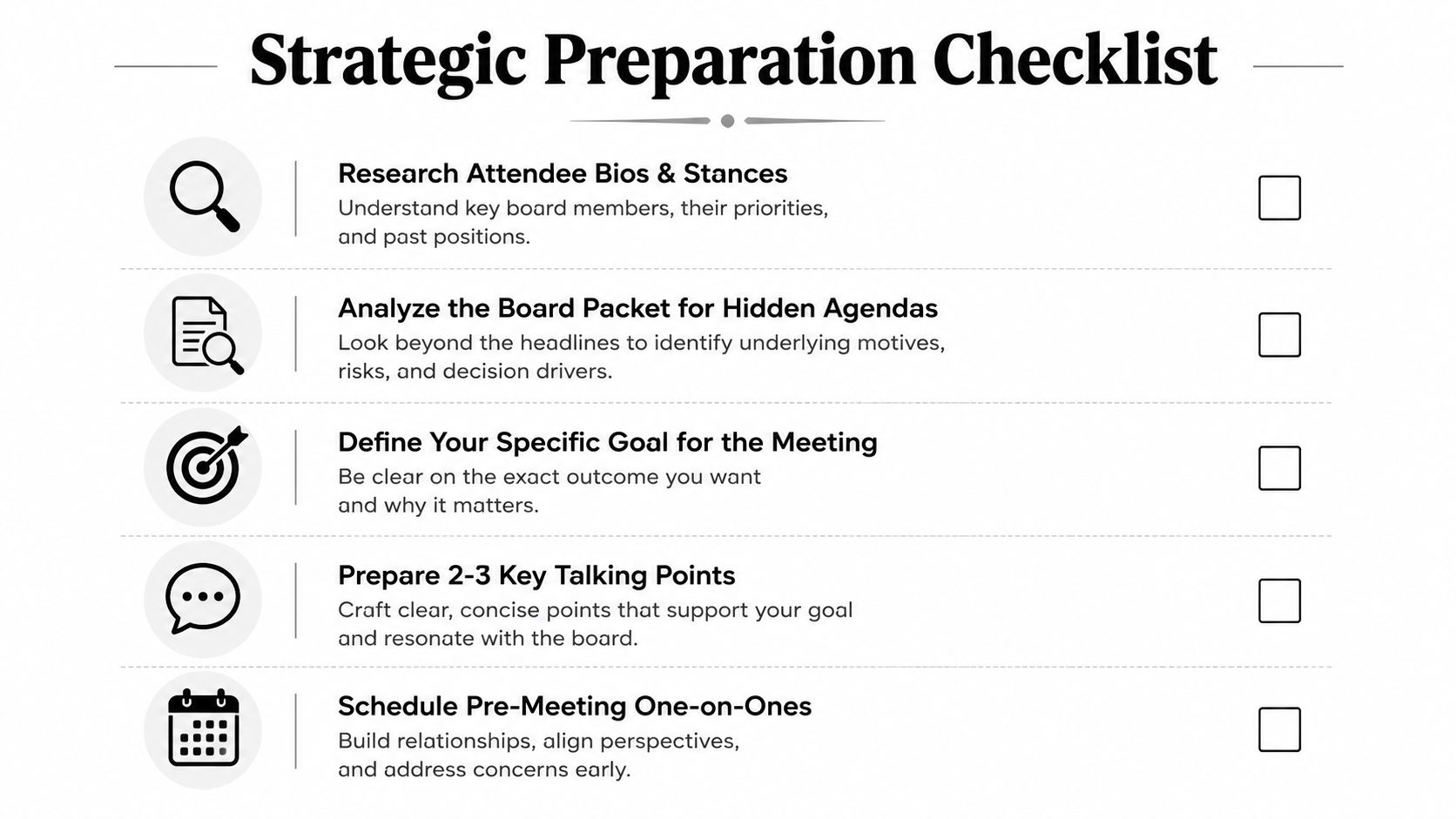
Start by marking every agenda item as one of three things: information, challenge, or decision. A report may look informational while setting up approval of a budget, appointment, acquisition, or risk position. Identify the exact decision language you expect to hear, then prepare one question that tests the assumptions behind it.
Review the agenda in sequence. Typical board agendas state when and where the meeting occurs and list items such as call to order, approval of prior minutes, officer reports, committee reports, old business, new business, and adjournment (board agenda structure). This structure helps you predict when the room will be procedural and when it will need judgment.
Next, map the participants:
- Decision owners: Who has formal authority, and who strongly influences the chair?
- Technical voices: Which director can expose a weak assumption quickly?
- Quiet specialists: Who may contribute valuable insight only if invited?
- Potential allies: Who has previously supported the principle behind your recommendation?
Pre-meeting conversations can be useful, but don't turn them into private lobbying. Use them to clarify context, surface legitimate concerns, and ensure your proposal is understandable. The formal meeting should remain the place where the board deliberates and decides.
Prepare for the hybrid disadvantage
A hybrid room creates unequal visibility. In-room participants can exchange glances and read small shifts in posture, while remote directors may disappear behind a muted microphone, a frozen screen, or a crowded gallery view. Prepare a concise verbal signal for entering the discussion, such as, “I'd like to add one risk to that recommendation,” and use the platform's hand-raise function when available.
Test your camera, microphone, documents, and connection before the meeting. Arrange your screen so you can see the chair and the active speaker, not only the presentation. If you manage a demanding schedule alongside contract work, systems that improve scheduling for freelancers can help protect preparation time. You should also rehearse the structure of your contribution using guidance on how to structure a presentation, especially if you'll need to speak across uneven audio and attention conditions.
Commanding the Room from the Moment You Arrive
Presence begins before your first substantive comment. The way you enter, greet people, choose your seat, and settle your materials gives others an early impression of whether you're ready to participate as a peer.
Arrive with enough time to check the room and technology without creating a performance around your arrival. Greet the chair and key directors directly, but don't spend the opening minutes trying to impress everyone. A calm greeting, an organized workspace, and attentive listening communicate more authority than excessive warmth or hurried networking.

Use physical space without theatricality
Choose a seat that gives you a clear view of the chair and the main participants. Avoid hiding behind a screen, a large stack of papers, or a remote workstation that prevents others from seeing your face. In a hybrid meeting, place the camera at eye level, frame your shoulders and face clearly, and keep your gaze close to the lens when making a key point.
Your posture should be stable rather than rigid. Keep both feet grounded, shoulders relaxed, and hands visible when you gesture. Excessive movement can signal nervousness, while a frozen posture can appear defensive. If you tend to speak quickly under pressure, mark deliberate pauses in your notes with a visible symbol.
Open with decision language
Your first intervention should orient the room. Compare these openings:
- “I just wanted to share a few thoughts about the proposal.”
- “The decision today is whether we accept the growth assumption. I support the proposal if we add a clear review trigger.”
The second version is stronger because it names the decision, states a position, and introduces a condition the board can evaluate. It doesn't require a dramatic voice or an aggressive posture.
Use short sentences at the start. Let the room adjust to your pace. If the chair asks for your view, don't begin with an apology, a long history, or a disclaimer about your imperfect English. Start with the judgment you want remembered, then provide the evidence.
Pause after the sentence that matters most. A pause gives your idea a boundary.
A director who speaks with authority doesn't fill every silence. They allow the chair to respond, watch for recognition, and re-enter only when they can move the decision forward. Practical work on body language for leaders can help you refine the physical signals that support this verbal discipline.
Communicating with Authority During High-Stakes Discussions
High-stakes discussion exposes the difference between confidence and forcefulness. Forcefulness pushes for attention. Confidence makes the reasoning easier to follow.
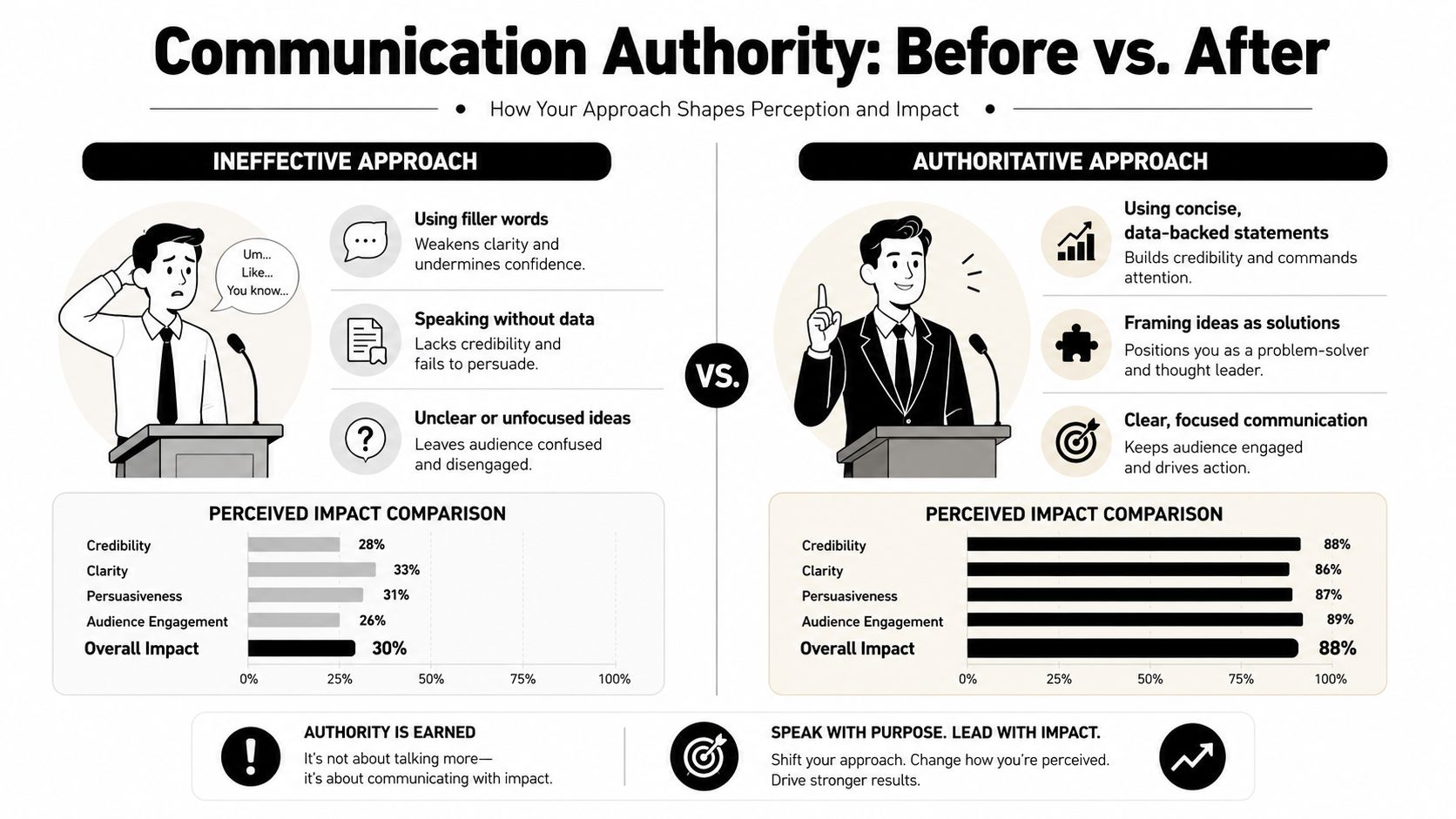
The weakest pattern usually includes a soft opening, several filler phrases, an unstructured explanation, and a conclusion that arrives too late. The stronger pattern states the issue, names the implication, and proposes an action. It also leaves room for challenge.
Compare the patterns
| Less effective pattern | More authoritative alternative |
|---|---|
| “I'm not sure, but maybe we could consider…” | “My recommendation is to approve the proposal with this control.” |
| “Sorry to interrupt.” | “I'll complete the point, then I'm happy to come to you.” |
| “There are lots of things to think about.” | “The decision turns on two risks, cost exposure and execution capacity.” |
| “I don't agree with that.” | “I see the issue differently because the assumption changes the downside.” |
| “Does that make sense?” | “The implication is clear: we need a decision on ownership before approval.” |
These phrases aren't scripts to recite mechanically. They are examples of a useful sequence: position, reason, implication, invitation. For example, “I recommend delaying approval because the reporting control isn't defined. That leaves the board unable to monitor the risk. I'd like the committee to return with an owner and reporting cadence. What concern would you want addressed before then?”
Handle interruptions cleanly
When someone interrupts, don't compete for volume. Keep your expression neutral, let the person finish if the interruption is legitimate, then return with a precise bridge: “I'll address that point, but I want to finish the recommendation first.” If the chair moves on, use the next natural opening: “Before we close this item, there's one unresolved risk I want recorded.”
If your point is overlooked and another person restates it, avoid public credit-taking. Say, “Yes, that builds on the option I proposed earlier. The additional question is whether we're prepared to assign ownership today.” You preserve the connection while advancing the decision.
Use disagreement to improve the decision: Challenge the assumption, not the person.
Invite others into a strong idea when resistance is political rather than analytical. “What would make this workable for operations?” is more productive than defending every word of your proposal. It turns a personal contest into a shared design problem.
For professionals refining pace, pronunciation, and vocal control, professional voice training can support the delivery needed for concise boardroom interventions.
Here's a short visual reminder of how vocal choices can affect presence:
Navigating Cultural Differences in Global Boardrooms
International boardrooms contain several etiquette systems at once. One director may treat direct disagreement as intellectual respect. Another may consider public opposition unnecessarily confrontational. A third may expect the chair to invite them before they speak. None of these responses automatically indicates confidence, competence, or commitment.
The mistake is to treat your own communication norm as neutral. Instead, separate adaptation of delivery from abandonment of identity. You can become more explicit about your recommendation without copying another culture's level of interruption or emotional display.
Diagnose before adapting
Watch how the chair manages turns. Does the chair invite views individually, or does discussion open informally? Do directors challenge ideas directly, or do they use questions and conditional language? Does silence signal reflection, disagreement, or deference?
Then adjust one variable at a time:
- Directness: State your conclusion early, then offer context for colleagues who prefer a more relational approach.
- Hierarchy: Address the chair's role respectfully, while still making your independent judgment visible.
- Formality: Match the room's level of protocol in greetings and procedure, but keep your language plain.
- Disagreement: Frame challenge around evidence, assumptions, and consequences rather than personal authority.
- Silence: Allow thinking time, especially when remote participants may need extra processing time because visual cues are limited.
Avoid jargon, idioms, and unexplained acronyms. A phrase that feels efficient to one group can exclude another, particularly when directors are operating in a second language. A brief explanation often increases authority because it shows command of the idea rather than reliance on insider vocabulary.
Make hybrid inclusion deliberate
Video removes many of the cues people use to negotiate status. A remote director may not know whether a pause means they can speak, while an in-room participant may begin talking before the remote audio reaches the group. The chair should name the next speaker, monitor the chat and hand-raise signals, and periodically invite remote perspectives.
You can help by saying, “I'd like to hear the remote directors before we settle this,” or, “I'm going to pause so anyone joining virtually can add a view.” These interventions don't reduce efficiency. They protect the quality of challenge.
For a broader framework on managing cultural differences at work, focus on curiosity and explicit expectations rather than assumptions about nationality. International communication coaching, including cross-cultural communication training, should help you preserve your authentic judgment while making that judgment legible to different audiences.
Building Lasting Influence Through Strategic Follow-Up
The meeting ends when the chair adjourns, but your influence continues through the record, the commitments, and the relationships that follow. A strong contribution becomes more valuable when people can see what it changes.
Start with procedural accuracy. Minutes should capture the essentials, including the date, attendees, discussion context, and decisions, and governance guidance recommends concise language rather than jargon or a verbatim account (board minutes guidance). Draft minutes should remain marked as draft until the board formally approves them. During the meeting, confirm that motions, votes, roll-call counts or ballot totals where applicable, and the time of adjournment are clear (board governance tips).
Follow through without self-promotion
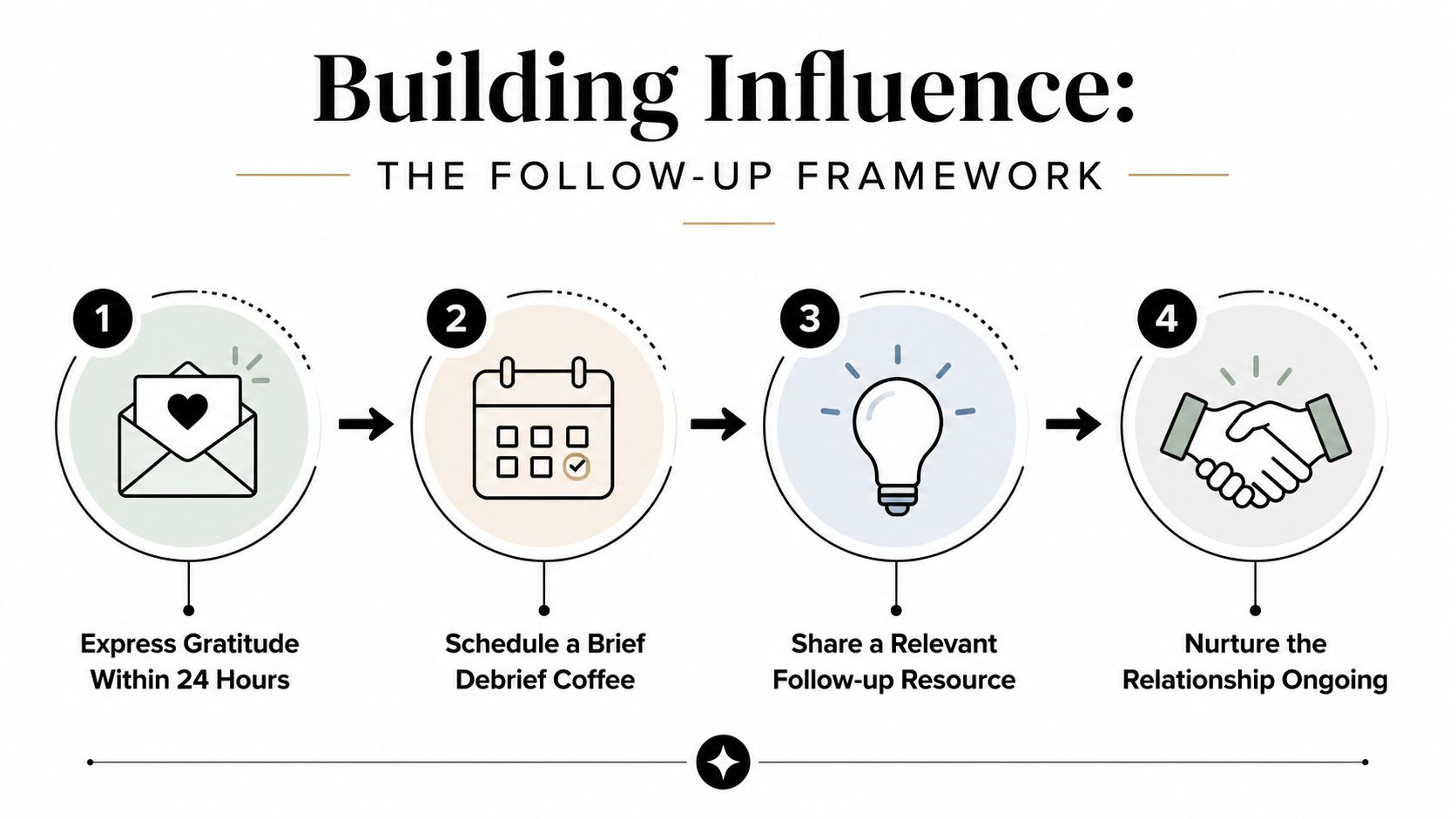
Send a brief message to people who own relevant actions. Don't recap your brilliance. Confirm the decision, your commitment, and the next useful step.
A practical follow-up can include:
- Decision: “My understanding is that the board approved the revised risk review.”
- Ownership: “I'll send the requested analysis to the committee chair.”
- Dependency: “The analysis will need the updated operating assumptions from finance.”
- Timing: “I'll circulate the document before the next review.”
If you disagree with the final decision, support the board's collective action once the decision is made, subject to your legal and fiduciary obligations. Don't attempt to reverse the outcome through private lobbying after the vote. If you have a serious concern, use the organization's proper governance channel and document it appropriately.
Build relationships through relevance
Follow-up conversations should have a reason. Ask a director how they're thinking about an issue you discussed, share a relevant resource, or offer a concise introduction that supports the board's work. Keep the exchange proportionate. Frequent, empty contact makes you visible in the wrong way.
The Gravitas Method is a 12-week one-on-one executive presence coaching program for international professionals who want to communicate with more authority and influence at senior levels. Coached by Nikola, it covers vocal authority, strategic framing, executive body language, and high-stakes communication, with pricing of $8,200 paid in full or $9,000 across three installments.
Use the same discipline after the meeting that you used inside it. Keep commitments visible, close loops before they become reminders, and make your next contribution easier for the board to understand.
If hybrid boardroom dynamics, interruptions, or unclear delivery are limiting your influence, Intonetic offers executive presence coaching focused on vocal authority, strategic framing, body language, and high-stakes communication. Start with the free Executive Communication Assessment to identify the specific communication habits that affect how senior decision-makers hear you, then visit Intonetic to explore the next step.