
Professional Voice Training: Unlock Your Vocal Authority
You know the pattern. You're sharp, prepared, and usually the person with the strongest analysis in the room. Then the meeting starts. Someone interrupts you. You make a good point and it lands flat. A less informed colleague repeats the same idea ten minutes later and suddenly everyone pays attention.
For many international professionals, that gap isn't about intelligence or even content quality. It's about delivery. More specifically, it's about whether your voice signals steadiness, authority, and seniority before people have fully processed your words.
That's where professional voice training matters. Not as polish for performers, and not as a cosmetic attempt to erase personality, but as a practical leadership skill.
What Is Professional Voice Training and Why It Matters Now
Professional voice training is the deliberate practice of using breath, resonance, articulation, pacing, and vocal recovery to make your speaking voice more effective under real-world pressure. In business, that means sounding clear in a board update, stable in a negotiation, and credible when you need people to trust your judgment quickly.
Many people confuse this with public speaking tips. Public speaking usually focuses on message structure, storytelling, slides, and audience engagement. Professional voice training focuses on the instrument delivering that message. If your voice tightens, rushes, fades, or strains, even strong content loses force.
A lot of high performers wait too long to address this. They assume they just need more confidence, or that listeners will eventually get used to their style. That's rarely how senior environments work. People form judgments fast, and vocal cues shape those judgments early.
It's not about sounding theatrical
The goal isn't to sound like an actor or broadcaster. It's to make your natural voice more functional and more authoritative.
That usually means working on things like:
- Reducing unnecessary tension so your voice doesn't sound squeezed or breathless
- Building steadier airflow so longer sentences don't trail off
- Improving clarity so people don't ask you to repeat key points
- Using pauses intentionally so important ideas carry weight
If you speak often in virtual settings, the stakes get even higher. Audio compression, bad room acoustics, and fatigue flatten vocal impact. If you're also trying to build an AI-ready podcast studio, the same fundamentals matter because microphone quality can't fix weak vocal habits. It only reveals them more clearly.
It's also a health issue
This is the part many professionals overlook. Voice training isn't only about persuasion. It's also about durability.
A Journal of Voice study on work-related vocal complaints found that up to 53% of professionals who rely on their voice for work show clinical signs of vocal complaints. That should change how executives think about speaking. If your calendar is full of presentations, interviews, team calls, and stakeholder conversations, your voice is part of your workload.
Practical rule: If your throat feels tired after routine meetings, your technique is costing you more than you think.
For many professionals, the first useful shift is simple. Stop treating your voice as a fixed trait and start treating it as a trainable leadership tool. If you want a deeper foundation on that idea, this guide on using your voice with more impact is a strong place to continue.
The Core Techniques for Vocal Authority
A commanding voice isn't one skill. It's a system. When one part is weak, the whole impression drops. I usually have clients think about it as building a high-performance machine. Breath is the engine. Resonance is the amplifier. Articulation is the precision tool. Pitch and pacing are the control panel.
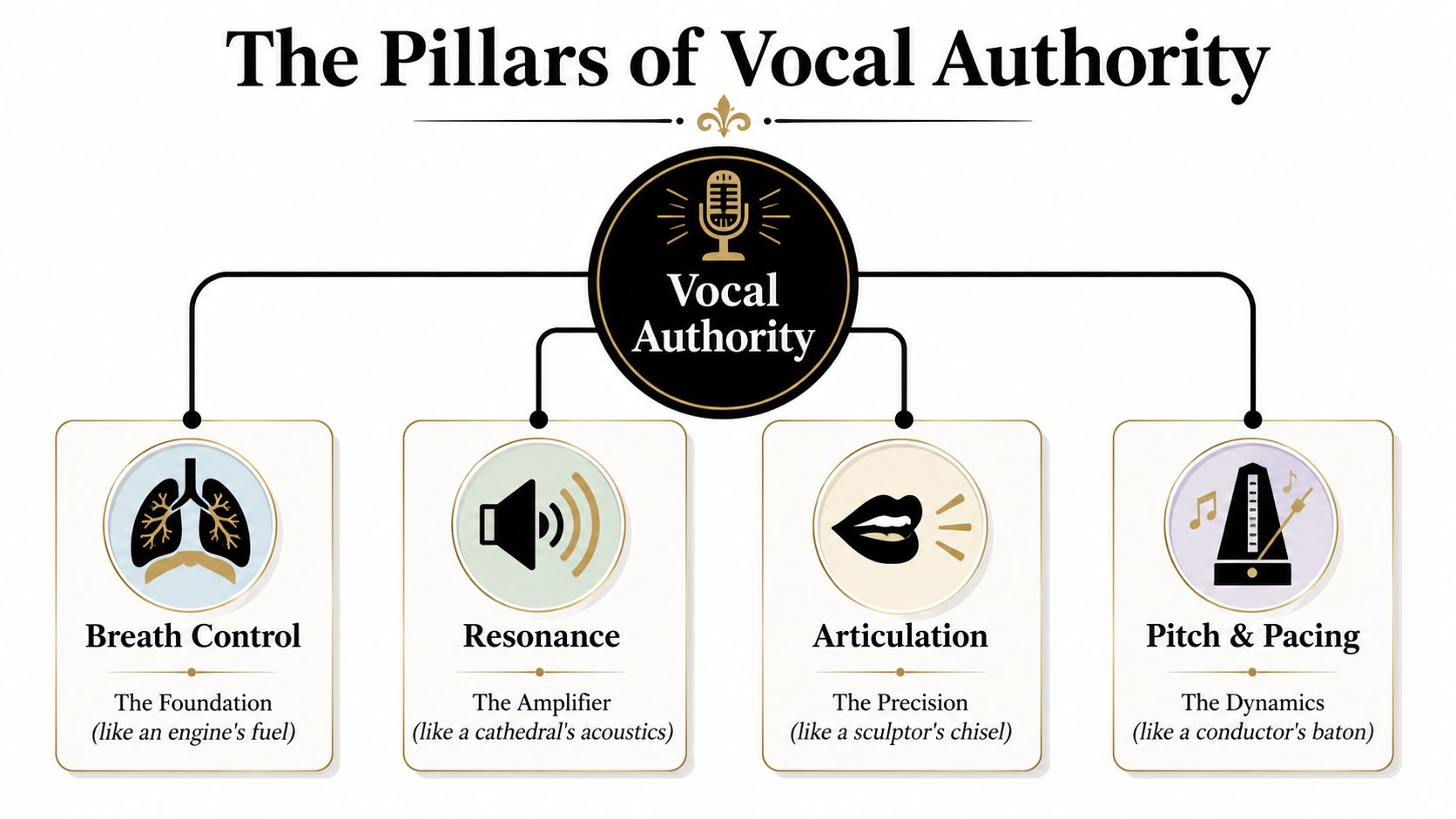
Breath control is the engine
Without stable breath support, people push from the throat. That creates a strained, thin sound and makes sentences collapse at the end. In executive settings, that often reads as nerves, even when the speaker is fully competent.
Good breath control doesn't mean taking giant dramatic inhales. It means managing airflow so your voice stays steady across a thought.
Common mistake: breathing high into the chest and starting to speak before the breath has settled.
What works better:
- Lower, quieter inhalation
- Starting on supported airflow instead of on tension
- Speaking in thought groups instead of rushing through the full sentence
Resonance is the amplifier
Resonance is what gives a voice depth and carry. It's the difference between sounding trapped in your throat and sounding like your voice has space around it.
People often try to create authority by pushing volume. That backfires. Loud isn't the same as resonant. A resonant voice feels easier to listen to and usually travels better, even at moderate volume.
A useful cue is to aim for vibration and ease, not force. If your jaw, tongue, or neck are working too hard, resonance usually drops.
A strained voice asks the room for permission. A resonant voice assumes the room is listening.
Articulation is the precision
Articulation shapes whether people catch your meaning on the first pass. For international professionals, frustration often builds. They've done the work, they know the answer, but fast or blurred speech reduces comprehension at the exact moment they need precision.
This isn't about over-pronouncing every syllable. It's about clean consonants, stable vowels, and enough mouth movement for the message to remain intelligible under pressure.
Try diagnosing yourself with three questions:
- Do people ask you to repeat numbers, names, or key terms?
- Do your final consonants disappear when you speak quickly?
- Does your clarity drop when you're challenged or interrupted?
If the answer is yes to any of those, articulation deserves focused practice.
Pitch and pacing create authority
Pitch variation keeps you from sounding flat, but pacing usually matters more for perceived seniority. A senior leadership communication analysis on business executive voice training notes that inconsistent pacing and failure to pause before key ideas are primary reasons non-native English professionals are perceived as less credible, more than pitch or accent. Strategic pausing is a learned authority skill.
That finding matches what experienced coaches see every week. Professionals often try to prove fluency by speaking quickly. The result is the opposite of authority. Speed can sound defensive. Silence, used well, sounds deliberate.
Common pacing errors include:
- Rushing the setup and slowing only after the point is lost
- Filling every gap with “um,” “like,” or repeated phrases
- Landing the key message without a pause before it
If you want a practical framework for improving these mechanics, this guide to vocal technique and voice training breaks them down in a useful way.
Who Benefits Most from Voice Training
Not everyone needs the same level of vocal work. The professionals who benefit most are usually the ones whose roles already depend on influence, judgment, and visible leadership. Two groups stand out.
Senior leaders who need gravitas
Executives don't get evaluated on information alone. People assess whether they seem composed, trustworthy, and worth following in uncertain moments. Voice plays a major role in that assessment.
A summary of Sylvia Hewlett's Center for Talent Innovation research on executive presence reports that senior leaders assign 67% of executive presence to gravitas, compared with 28% for communication and 5% for appearance. That matters because gravitas is not abstract. In practice, people hear it through steadiness, restraint, timing, and vocal control.
A leader with strong content but weak vocal command often sounds less senior than they are. The opposite also happens. A leader with average content but a measured, grounded delivery can dominate attention.
International professionals whose expertise is being discounted
This group often carries a hidden burden. They are operating in a second language, managing complex content, and reading room dynamics at the same time. When delivery slips, colleagues often misread the problem. They assume uncertainty, lack of polish, or weaker leadership potential.
The underlying issue is usually narrower and more fixable. Rhythm may be off. Pauses may disappear. Stress placement may make key ideas harder to catch. None of that means the speaker should “lose their accent.” It means they need clearer vocal patterns for high-stakes English communication.
What matters most: the room should spend its energy evaluating your idea, not decoding your delivery.
Why the return is disproportionate
For both groups, small gains produce outsized professional effects. A cleaner opening statement can change how a board update starts. Better pacing can make a recommendation sound more considered. Less strain can help a leader stay persuasive deep into a demanding day.
Voice training pays off fastest when the professional is already strong on content and role competence. At that point, delivery isn't a side issue. It's often the last visible barrier between solid performance and senior-level credibility.
Choosing Your Professional Voice Training Format
The right format depends on what problem you're solving. Some people need individualized correction because they're preparing for investor meetings, promotion panels, or media appearances. Others need structured repetition and enough practice to stop falling back into old habits.
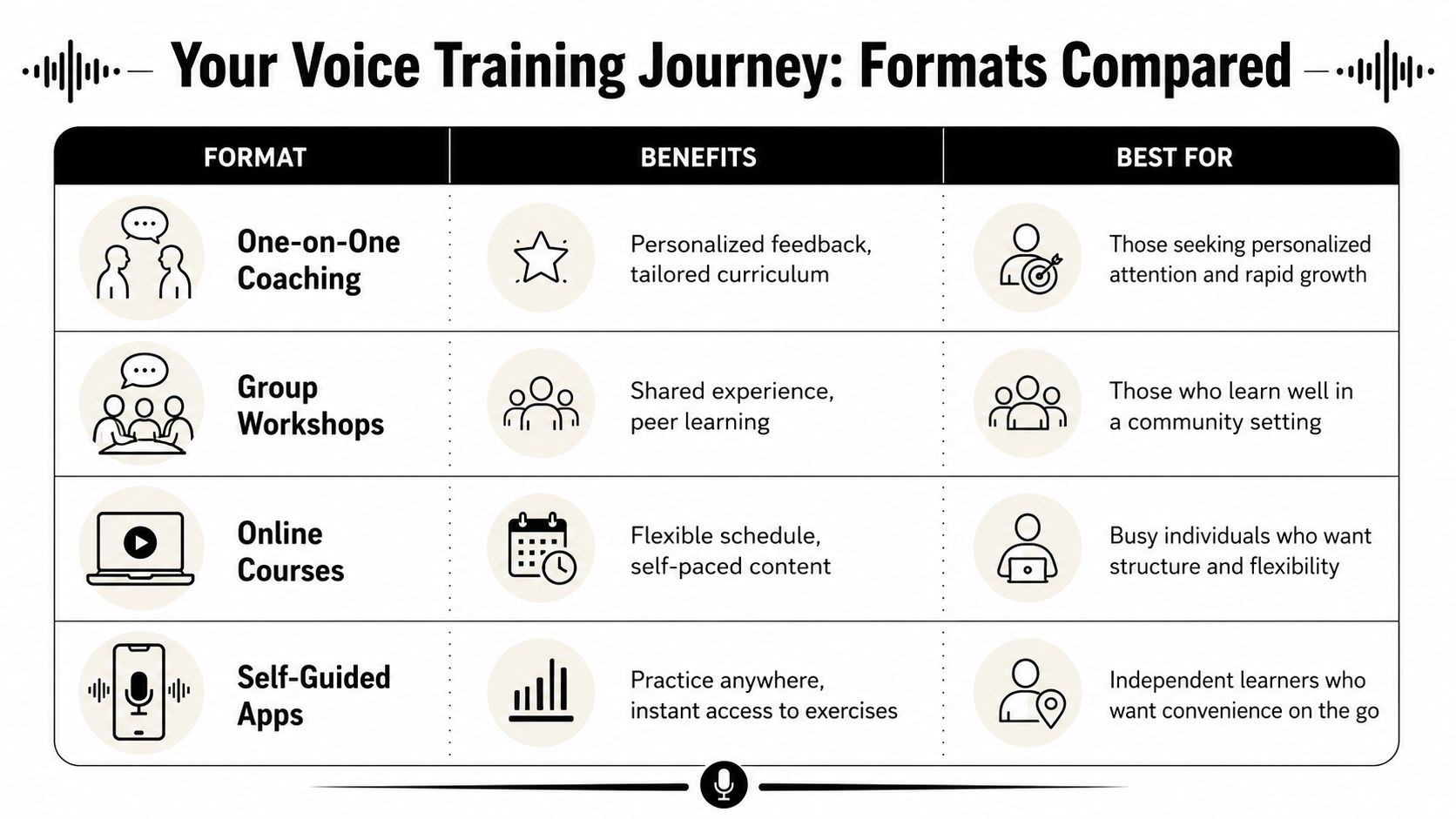
A quick comparison
| Format | Best use | Main advantage | Main limitation |
|---|---|---|---|
| One-on-one coaching | High-stakes professional goals | Tailored feedback on your exact habits | Higher cost and scheduling commitment |
| Group workshops | Confidence building and shared practice | You learn from other people's patterns too | Less individualized correction |
| Online courses | Foundation building at your own pace | Flexible and repeatable | No live adaptation when you get stuck |
| Self-guided apps | Habit maintenance and light drills | Convenient and easy to access | Shallow for executive-level nuance |
One-on-one coaching for precision
This format works best when your speaking issues are specific and expensive. Maybe your voice thins under challenge. Maybe your pacing collapses in Q&A. Maybe your pronunciation is clear in casual conversation but less reliable in investor or board settings.
One-on-one coaching gives you something generic training can't. Diagnosis. A strong coach can hear where tension begins, what triggers your speed, and which habits are hurting authority.
Workshops for momentum
Workshops are useful when people need exposure, repetition, and lower-pressure practice. They can help managers get out of their heads and start experimenting with stronger delivery.
They are less effective for entrenched habits, especially if those habits are tied to stress or language transfer patterns. If your issue shows up only when the stakes rise, group settings may not surface the underlying problem.
Courses and apps for foundations
Courses are good for understanding concepts and building a routine. Apps are good for quick reps. Both can support improvement, especially if you already know what to practice.
But if your target is executive presence, self-guided formats usually need to be supplemented. They don't tell you which habit is undermining your authority in real time. If you're comparing delivery options, this overview of online executive presence training formats can help you judge what fits your schedule and goals.
Simple Exercises to Improve Your Voice Today
You don't need a full program to start making your voice more reliable. You do need to practice the right things. Random warmups won't help much if the issue is tension, poor airflow, or rushed pacing in business conversations.
The box breath reset
Use this before a presentation or after a stressful exchange.
- Inhale gently for a count of five
- Hold for a count of five
- Exhale for a count of five
- Pause for a count of five
- Repeat several rounds
Why it works: it reduces the rushed, upper-chest breathing that often tightens the voice. You should feel your body settle, not inflate dramatically.
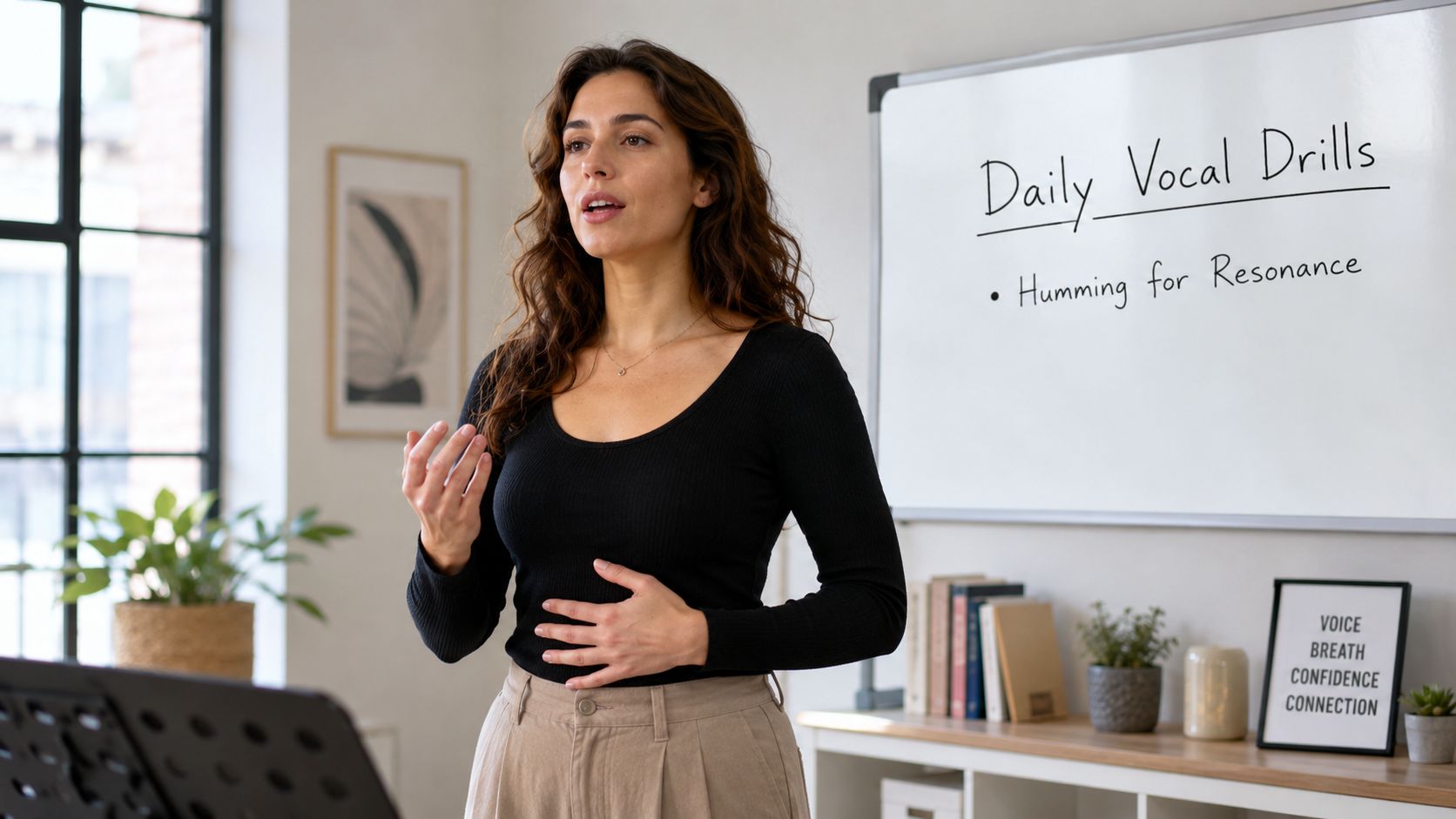
The hum for resonance
Pick a comfortable note and hum lightly for a few seconds. Then speak a short phrase immediately after, such as “Let's focus on the core issue.”
You're looking for a feeling of vibration in the face, lips, or front of the mouth. If the sound drops into the throat and feels heavy, you're pushing too much.
Useful goal: do this before calls where you need a steadier opening voice.
The pause-and-land drill
Take a sentence you use often in business. For example: “My recommendation is to delay the launch until the risk is contained.” Now insert a deliberate pause before the key phrase.
Try it like this: “My recommendation is… to delay the launch until the risk is contained.”
This teaches your body not to rush the point you most need people to remember.
Coach's note: If you feel awkward pausing, that usually means the pause is new, not wrong.
A strong library of drills can help you stay consistent. This collection of voice lesson exercises for clearer, stronger speech is useful when you want more structure in daily practice.
The micro-breath cycling reset
Virtual work changes the voice. Many professionals sound fine at the start of the day and worn down by the fourth or fifth hour of calls. A report on remote leaders and vocal strain notes that 68% report voice strain after long video conferences, and that micro-breath cycling done every 15 minutes can reduce strain by 33% according to Crystal Voice Studio's overview of vocal fatigue in remote settings.
In simple terms, the method is a short reset. Release your jaw, let the breath drop, exhale fully, then resume speaking without pushing the first word. It takes only a moment, which makes it realistic during a long Zoom day.
A quick visual walkthrough can make these mechanics easier to copy:
How to Evaluate a Voice Coach or Program
Voice training can help a lot. Bad voice training wastes time fast. The market includes singing teachers, acting instructors, speech trainers, and executive communication coaches, and they don't solve the same problems.
If your goal is executive presence, you need to evaluate a coach the way you'd evaluate any serious advisor. Look for methodology, specialization, and evidence that the process can measure progress.
What to ask before you commit
Use these questions early:
- What exactly do you assess first. A solid coach should diagnose tension, breath use, pacing, clarity, and situational speaking patterns before prescribing exercises.
- Do you specialize in business communication. Singing technique and performance coaching can be useful, but they don't automatically translate to boardrooms, stakeholder calls, or promotion interviews.
- How do you track improvement. Even when progress is partly qualitative, the method should still be structured.
- Will practice match my real speaking situations. Executive communication coaching should include actual presentations, updates, objections, and unscripted responses.
Look for measurable thinking
A useful benchmark from voice research is that effective training can improve objective vocal parameters. A Journal of Voice article on structured vocal training outcomes notes that programs can increase measures such as the Dynamic Sound Index (DSI), which gives coaches one way to validate whether a method is producing change.
That doesn't mean every executive program needs laboratory testing. It does mean the coach should care about observable change. Are your openings cleaner? Does your voice hold up longer? Are your pauses more intentional? Can listeners follow you more easily under pressure?
A strong program should feel tailored, not generic
Many professionals get stuck in programs that hand everyone the same drills. That's rarely enough. A senior engineer preparing for promotion, a founder raising capital, and a finance leader handling tense stakeholder calls may all need vocal authority, but they won't need the same interventions.
The Gravitas Method is a 12-week one-on-one executive presence coaching program for international professionals who want to communicate with more authority and influence at senior levels. The program is priced at $8,200 paid in full or $9,000 across three installments. Coached by Nikola, it covers vocal authority, strategic framing, executive body language, and high-stakes communication.
If you're comparing providers, it helps to use a sharper checklist. These seven questions to ask when choosing the right communication coach can save you from vague promises and poor fit.
Your Path to Vocal Mastery and Next Steps
Voice improvement happens in layers. First, you notice relief. Speaking feels easier. Then you notice control. You can hold a pause, finish a thought, and keep your tone steadier under pressure. After enough repetition, those changes stop feeling like techniques and start feeling like your normal executive voice.
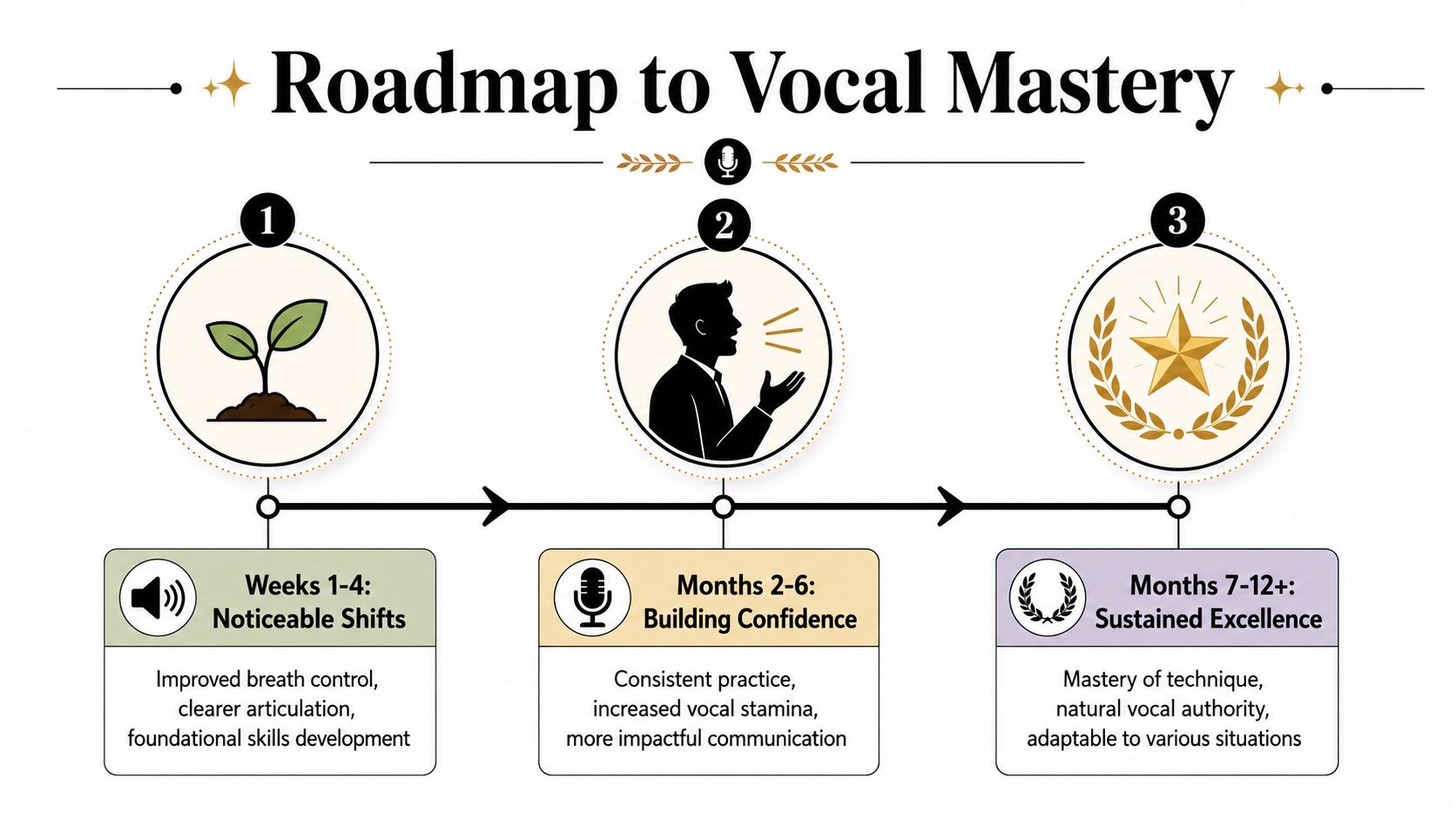
What progress usually looks like
- Early stage. You become more aware of tension, breath habits, and rushed pacing.
- Middle stage. Your delivery starts to sound more deliberate in real conversations, not just in practice.
- Longer-term stage. Authority becomes more consistent across different settings, including virtual meetings, presentations, and difficult discussions.
The key is consistency. Professional voice training works best when practice is brief, specific, and tied to the situations that matter most in your work.
Better vocal authority doesn't make you someone else. It removes the friction between what you know and how people experience you.
If your work also depends on recorded communication, brand presence, or thought leadership, this guide for podcast entrepreneurs offers a useful angle on turning voice into a business asset.
The smartest next step isn't guessing which habit is holding you back. It's getting a clear diagnosis. Most professionals don't need more generic advice. They need someone to identify the few delivery patterns that are lowering their perceived authority, then help them fix those patterns in a structured way.
If you want that kind of clarity, start with Intonetic's free Executive Communication Assessment. It's the best first step if you want to understand how your voice, pacing, framing, and delivery affect the way senior stakeholders perceive you, and what to work on next.