
Writing a Speech: Executive Secrets to Command Attention
You have a high-stakes talk coming up. The slides look polished. The agenda is clear. But the actual speech, the words you'll say when senior people are looking at you for judgment, is still a loose collection of bullets, data points, and half-finished phrases.
That's the moment when generic advice stops being useful.
Senior professionals don't need another reminder to “tell a story” or “be confident.” You need a speech that helps you sound credible under pressure, move skeptical stakeholders, and project authority without sounding rehearsed or theatrical. Writing a speech at executive level is less about performance tricks and more about decision-making. You choose what matters, what to cut, what evidence earns trust, and what language sounds strong when spoken aloud.
If you're an international professional, the pressure is often even sharper. You may already know your subject better than anyone in the room, yet still worry that your delivery will make you sound less senior than you are. Good speechwriting closes that gap. It gives your expertise a structure that other people can follow and a voice they can respect.
Beyond the Basics of Speechwriting
Most advice on writing a speech assumes the audience is friendly, the stakes are moderate, and the speaker's main job is to be engaging. Executive communication works differently. In a board update, investor presentation, leadership offsite, or major internal announcement, your speech has to do more than hold attention. It has to signal judgment.
That changes the standard approach.
Authority starts before style
A weak executive speech usually fails for one of three reasons:
- It tries to cover too much. The speaker confuses completeness with persuasion.
- It sounds written, not spoken. The sentences are technically correct but hard to say naturally.
- It hides the point. The audience has to work too hard to figure out what the speaker wants them to believe or do.
A strong speech does the opposite. It gives the audience a clear line of thought, shows restraint, and sounds like a leader speaking in real time.
If you want a useful reference point for how communication presence shapes perception, this explanation of executive presence in practice is worth reading alongside your drafting process. The speech itself is only one part of the signal you send.
Practical rule: If your audience can't summarize your message in one sentence after the meeting, the speech wasn't clear enough.
Don't start with a template
Templates can help junior presenters get moving. They often weaken senior speakers because they produce the same generic structure every time. You don't need a formula that makes your speech sound like everyone else's. You need a blueprint that fits the room, the politics, and the decision in front of you.
That's also where tools can help, if you use them correctly. For early idea capture or rough narrative testing, something like LunaBloom AI can be useful for generating alternative framings. The mistake is treating generated text as finished language. Executive speeches need human judgment, not just fluent output.
What works is sharper than often expected:
- One central message
- A small number of supporting ideas
- Evidence chosen for persuasion, not volume
- Language built for the ear
- A close that tells people what happens next
That's the difference between occupying time and commanding the room.
Foundation First with Audience Analysis and Goal Setting
A senior leader walks into a regional town hall after a difficult quarter. The slides are accurate. The facts are defensible. The speech still fails, because the audience is not asking, "Is this information correct?" They are asking, "Can I trust this person's judgment under pressure?"
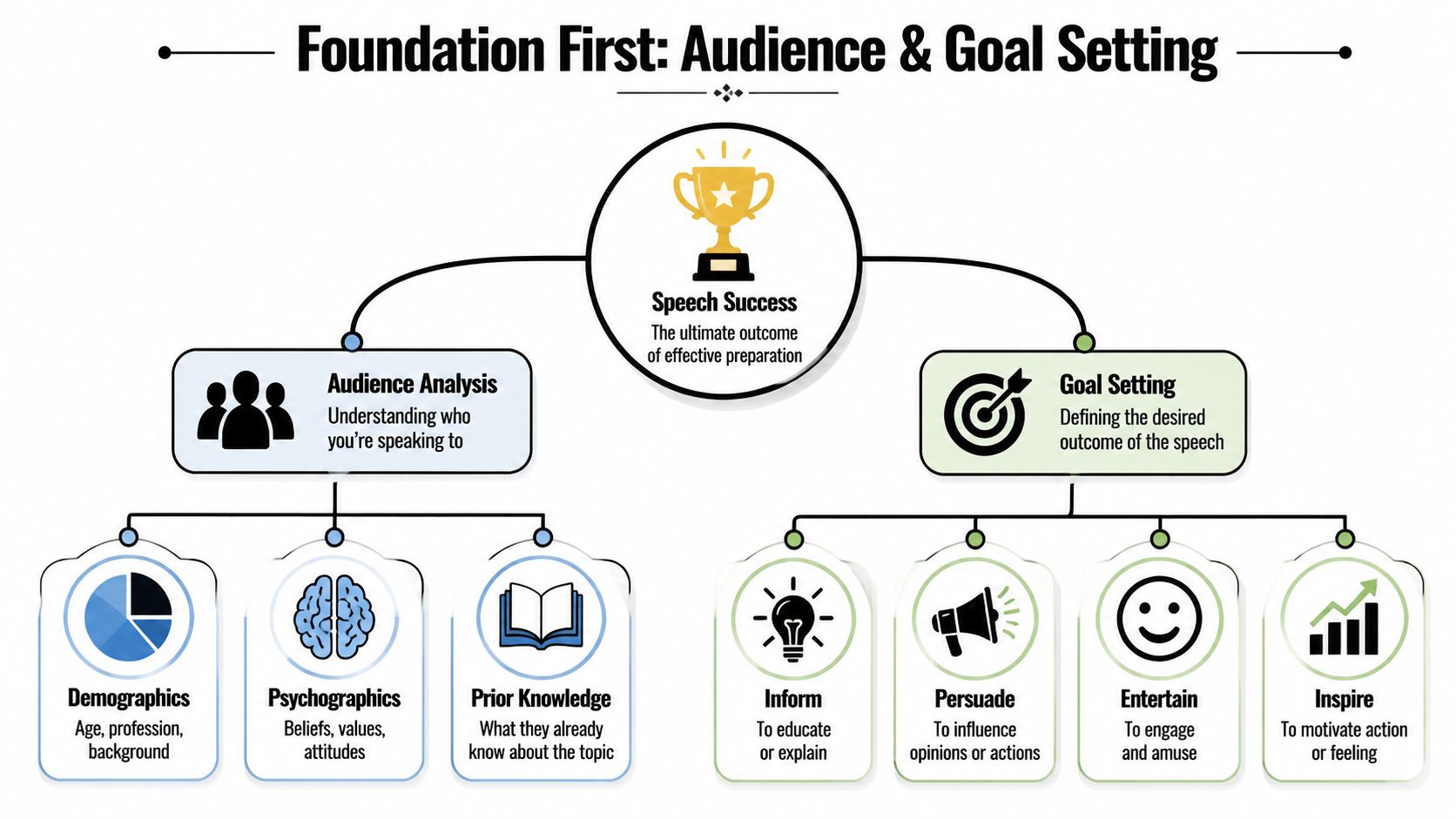
Analyze the audience by influence, not just identity
In high-stakes executive communication, audience analysis starts with power, incentives, and resistance. A room may contain peers, board members, regulators, country leaders, investors, or senior functional heads. They do not listen in the same way, and they do not need the same level of proof.
Use one practical question before drafting: who can affect the outcome of this speech, and what will convince them that you are credible?
I advise clients to sort the audience into functional groups, not job titles alone:
| Audience type | What they care about | What often loses them |
|---|---|---|
| Decision-makers | Risk, clarity, strategic consequence | Excess detail without a recommendation |
| Skeptics | Logic, evidence, consistency | Vague optimism or inflated claims |
| Influencers | Political viability, stakeholder impact, framing | Positioning that ignores internal realities |
| Allies | Momentum, language they can repeat, next steps | A message too soft to defend publicly |
That shift changes the draft immediately. You stop writing to everyone and start writing for the people who can block, shape, or carry your message after you leave the room.
In global organizations, this matters even more. Senior international professionals often face mixed audiences with different cultural expectations about directness, hierarchy, and certainty. Strong business communication in executive settings accounts for those differences without diluting the point. Senior audiences are judging more than your information. They are judging prioritization, restraint, and whether you understand the consequences of your own recommendation.
Build a one-page decision brief before you draft
A disciplined speech starts with a working brief. One page is enough if it forces clear choices.
Write down:
- Occasion: What is really happening in this room?
- Decision pressure: Are you asking for approval, defending a position, resetting expectations, or building support?
- Audience temperature: Supportive, divided, skeptical, fatigued, defensive?
- Credibility test: What proof will this audience accept?
- Risk if misunderstood: What goes wrong if people take the wrong message from this speech?
That page shapes the speech better than any clever line.
I have seen senior speakers save themselves hours of rewriting by doing this first. I have also seen experienced executives skip it because they know the business well. That is a costly mistake. Knowing the business is not the same as knowing what this audience needs to hear, in this moment, from you.
A senior speech is rarely judged only on content. People also judge whether you understood the room before you opened your mouth.
Set one objective, then protect it
A weak speech usually suffers from ambition, not effort. The speaker tries to inform, reassure, persuade, defend, and inspire in the same seven minutes. The result sounds busy and unfocused.
Choose one primary objective.
Use these questions to test it:
- After this speech, what should people believe?
- After this speech, what should people decide?
- After this speech, what should people do differently?
If you cannot answer those in one clean sentence, the objective is still too broad.
For executive audiences, the difference matters. "Explain the transformation strategy" is a topic. "Secure support for phase one despite short-term cost pressure" is an objective. "Update the board on performance" is a topic. "Restore confidence that the recovery plan is credible and controlled" is an objective.
That level of precision gives your speech force. It also helps with a trade-off senior speakers face all the time. The narrower the objective, the easier it is to persuade. The broader the objective, the easier it is to drift into commentary.
Pick the outcome first. Then write toward it.
Architecting Your Message for Maximum Impact
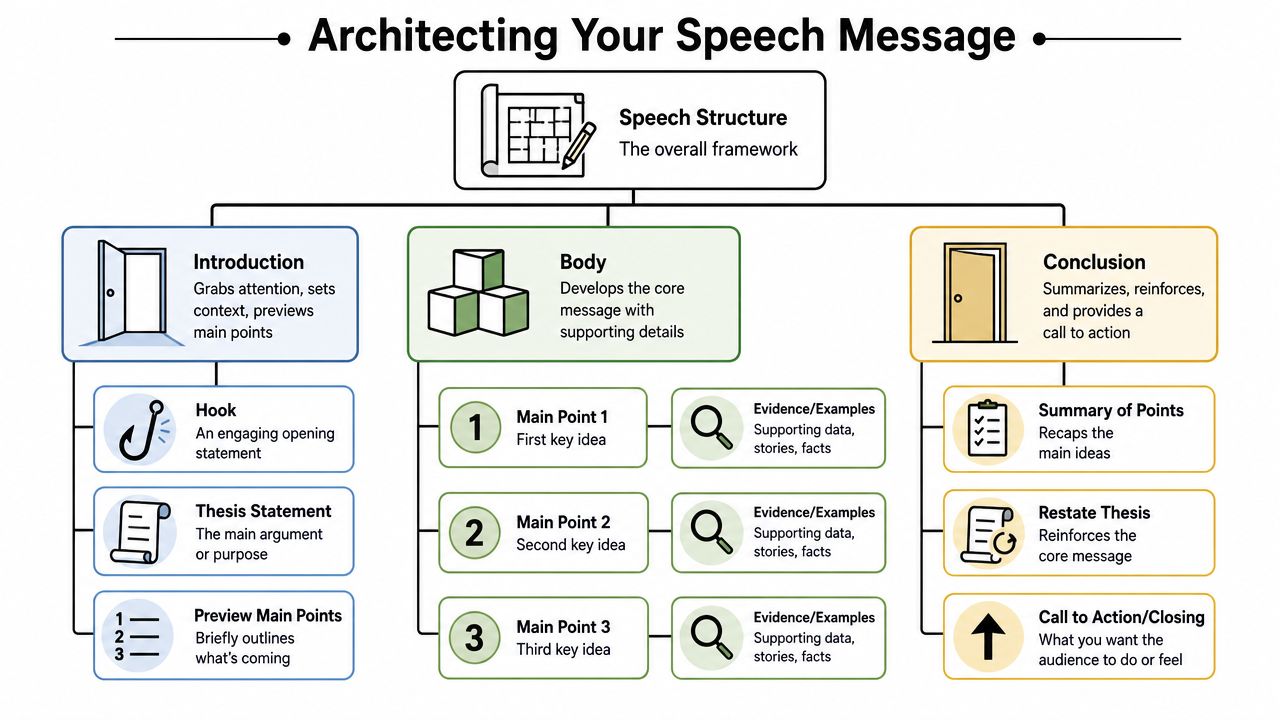
Once the objective is clear, the speech needs architecture. Not decoration. Structure is what makes authority audible.
Open with a claim worth listening to
The opening is where senior speakers often become too polite. They thank everyone, restate the event title, and spend precious time warming up. In high-stakes settings, that delays authority.
Your opening should do one of these things quickly:
- State a hard truth
- Name the strategic choice
- Surface the tension in the room
- Frame what's at stake
Here are stronger opening patterns than the usual throat-clearing:
- “We have a growth problem, but not the commonly perceived one.”
- “The decision in front of us isn't whether to invest. It's where delay becomes more expensive than action.”
- “Our results are mixed. The good news is clear. The harder news is clearer.”
- “By the end of this meeting, we need alignment on one issue. What we stop doing.”
If you need help sharpening this first impression, this guide on opening an introduction in a presentation is useful because the opening in a speech does the same strategic job. It establishes relevance and direction fast.
Build the body around a few ideas people can retain
Public-speaking guidance recommends planning around 2–3 main points and using a repeatable 4 S pattern for each section: signpost, state, support, summarize. The same guidance also gives a pacing benchmark of about 90 seconds per double-spaced page in the Amherst speech structure resource.
That matters because executive audiences don't reward density. They reward judgment.
A body built around 2–3 main points is usually enough. More than that, and your speech starts to feel like a report.
Try a structure like this:
-
Point one
Signpost the issue. State the position. Support it with relevant proof. Summarize the implication. -
Point two
Shift from diagnosis to consequence. Show what changes if the audience accepts your view. -
Point three
Land on action, priority, or decision. Give the room a clear direction.
A quick example:
| 4 S element | Executive version |
|---|---|
| Signpost | “There are two reasons the current plan won't hold.” |
| State | “The first is resourcing.” |
| Support | “The teams carrying the highest-priority work are also carrying legacy obligations.” |
| Summarize | “So the issue isn't effort. It's concentration of load.” |
That kind of structure sounds orderly without sounding scripted.
Close with consequence
Weak closings summarize passively. Strong closings create movement.
A closing should answer one of these questions:
- What decision must be made now?
- What standard should guide the next move?
- What do you want the audience to remember when debate starts after you sit down?
Good closing lines often sound like this:
- “We don't need broader ambition right now. We need narrower execution.”
- “If we want a credible turnaround, credibility begins here.”
- “The next quarter won't be defined by what we say today. It will be defined by what we choose to stop postponing.”
That's the purpose of structure in writing a speech. Not neatness. Influence.
The Language of Leadership and Persuasion
Language signals rank. Not formal rank on an org chart, but perceived rank in the room. The words you choose tell people whether you sound decisive, careful, evasive, or overextended.
Many capable professionals weaken themselves at sentence level.
Choose force over ornament
Executive authority rarely sounds elaborate. It sounds clear.
Compare these:
| Weak phrasing | Stronger phrasing |
|---|---|
| “We are looking to potentially optimize several aspects of the process.” | “We need to fix the process.” |
| “There are a number of areas where improvement opportunities exist.” | “Three areas are underperforming.” |
| “It may be beneficial for us to consider a revised approach.” | “We should change course.” |
The second version in each pair is shorter, clearer, and easier to say under pressure.
For international professionals, this matters even more. Many non-native English speakers try to sound senior by using more complex vocabulary and longer sentences. That usually backfires. Complexity can make you sound less certain, not more intelligent.
A better standard is:
- Prefer shorter sentences
- Use familiar words when they carry the meaning
- Put the main verb early
- Cut hedging unless the politics require it
Your authority doesn't come from sounding complicated. It comes from sounding clear while speaking about complicated things.
Use rhetorical devices sparingly and well
You don't need speechwriter theatrics. You do need memorable phrasing.
A few devices work especially well in executive speeches:
-
Contrast
“This is not a capacity problem. It's a priority problem.” -
Parallel structure
“We need clearer ownership, faster decisions, and tighter follow-through.” -
Rule of three
“Simple, disciplined, and visible.”
These work because they create rhythm without sounding dramatic. The listener can follow them on first hearing. That's the ultimate test.
If persuasion is part of your role, this broader view of communication as persuasion is directly relevant. The language of influence isn't about sounding impressive. It's about making the audience's next conclusion easier to reach.
Use data like a leader, not a spreadsheet
One of the fastest ways to lose a room is to dump numbers into a speech. Research on public speaking emphasizes that statistics are most persuasive when they are selective, simple, and story-driven, and speakers are often advised to use no more than three key supporting data points so the audience retains the central message, as noted in this guidance on using statistics in speeches.
That has a direct implication for executive speechwriting. Your job isn't to prove that you did all the analysis. Your job is to choose the number that clarifies the decision.
Use data in this sequence:
- State the point
- Give the number
- Explain why it matters
- Return to the implication
For example:
- Weak: “We tracked a range of operating metrics across teams, and several indicators changed materially over the period.”
- Stronger: “Customer demand didn't soften. Response speed did. That's why service quality dropped.”
If you do use a statistic, don't recite it and move on. Frame it. Compare it to expectation, prior reality, or a business consequence. A number without interpretation rarely persuades anyone senior.
Write for the mouth, not the page
Douglas Unger's guidance on spoken dialogue is right about one thing that matters greatly for speeches: spoken language doesn't behave like polished prose. It uses omission, inversion, and incomplete lines because that's how real speech carries energy.
So when you draft, ask:
- Would I say this in conversation with a board member?
- Can I breathe naturally through this sentence?
- Does this sound like me at my strongest, or like a report trying to impersonate me?
If the sentence looks elegant but feels stiff aloud, rewrite it. Spoken authority is physical. The ear decides faster than the eye.
From Draft to Delivery-Ready
You have the strategy, the numbers, and the stakes. Then the draft hits the page and suddenly the speech sounds like a committee memo. That drop in quality is common, especially for senior professionals writing under time pressure. A workable process fixes it.
Build the draft in passes, not in one sitting
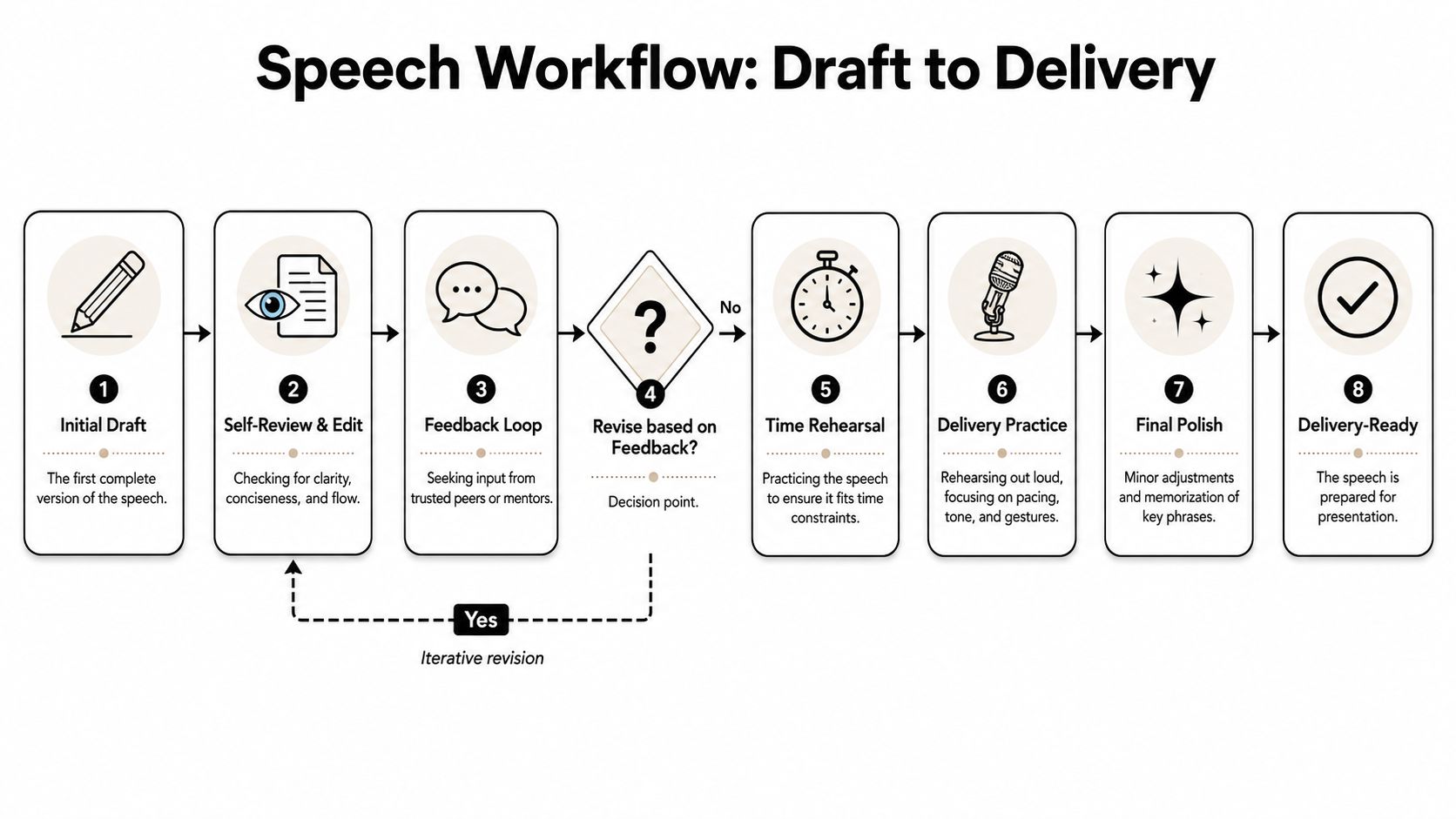
Strong executive speeches are usually rewritten several times for different reasons. One pass finds the position. Another tightens the logic. Another cuts what will weaken authority when spoken aloud.
Use a staged workflow:
- Pass one: Get the full argument down fast, including rough phrasing.
- Pass two: Check sequence. Each point should earn the next one.
- Pass three: Add proof selectively. Senior audiences do not need every supporting detail.
- Pass four: Rewrite for pressure. Shorten lines, sharpen transitions, and remove anything that sounds evasive.
- Pass five: Read it aloud and cut wherever delivery starts to drag.
Each pass has a job. Mixing them slows you down and usually produces a script that is both overworked and oddly unfinished.
I often see executives try to perfect sentences before the argument is settled. That is expensive work. Fix the structure first. Polish later.
Edit for authority under live conditions
A speech can read well and still fail in the room. Board presentations, investor updates, and cross-cultural leadership talks all expose weak phrasing fast. If a line is hard to say cleanly, it becomes hard to believe.
Read the draft aloud and test for these problems:
| Problem | What you hear | Fix |
|---|---|---|
| Sentence overload | You lose breath before the point lands | Break it into two sentences |
| Vague abstraction | It sounds formal but says little | Replace with a concrete claim |
| Fragile transition | The audience has to work out the connection | Add a clear signpost |
| Defensive wording | You sound cautious where you need conviction | State the judgment directly |
| Cultural overcorrection | The language is so polite it loses force | Keep respect, but make the decision unmistakable |
This matters even more if English is not your first language. Many international executives over-edit for correctness and under-edit for force. The audience rarely rewards that trade-off. They remember clarity, command, and whether they knew what you wanted them to do.
If you want a useful benchmark, study examples of how to engage an audience from the first minute. The point is not performance flair. It is learning how structure and phrasing hold attention before resistance sets in.
Rehearse the parts that carry the risk
Full memorization makes many senior speakers sound constrained. Minimal rehearsal creates drift, especially in high-stakes settings where one hostile question or unexpected reaction can knock you off course.
A better method is selective control:
- Lock down the opening. The first minute sets authority.
- Memorize the transitions. They keep the logic intact when pressure rises.
- Lock down the close. Final lines shape what people repeat afterward.
- Know the middle by intent. You need command of the case, not a word-for-word recital.
That approach gives you stability without making you brittle.
Audio-first formats can sharpen this skill because they punish clutter and reward cadence. That is why Podmuse's podcast planning resource can help during revision. Podcast scripting and executive speechwriting serve different purposes, but both expose where a script looks competent on screen and sounds strained out loud.
Keep AI in support mode
AI can help you sort notes, test alternate openings, or compress a long draft. It should not be making the final judgment on tone, emphasis, or executive intent.
The risk in a high-stakes speech is not only factual error. It is loss of voice. The script becomes polished, balanced, and strangely detached from your actual position. For senior leaders facing skeptical audiences, that is costly. You need language you can stand behind under scrutiny.
For professionals who want guided work across the full chain from message to delivery, Intonetic offers The Gravitas Method, a 12-week one-on-one executive presence coaching program for international professionals who want to communicate with more authority and influence at senior levels. Coached by Nikola, it covers vocal authority, strategic framing, executive body language, and high-stakes communication. The program is priced at $8,200 paid in full or $9,000 across three installments. That kind of support is useful when the issue is not just the script, but whether your delivery matches the level of your role.
Mastering Delivery in High-Stakes Contexts
Delivery is where the speech becomes credible or collapses. A well-written script can still fail if the voice is rushed, the body language is closed, or the speaker sounds as if they are asking permission to hold the floor.
A useful visual summary sits below.
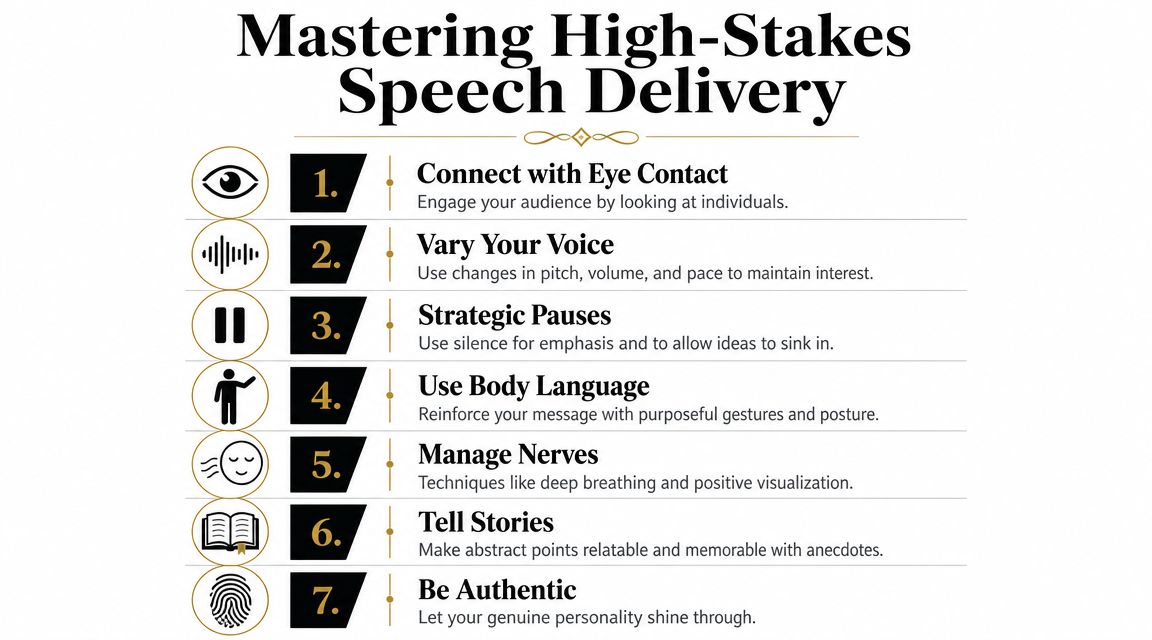
Use pace and pause as authority signals
Senior speakers often speak more slowly than anxious speakers. Not because they are performing calmness, but because they are giving their own ideas enough space to land.
Use your voice with intent:
- Slow down on key lines. Important points need room.
- Pause before a central claim. That pause tells the room to pay attention.
- Pause after a significant number or decision statement. Let people process.
- Drop your voice slightly instead of speeding up when pressure rises.
If you're presenting remotely or recording part of your talk, technical setup also affects authority. This guide for optimal lecture recordings is aimed at recorded speaking, but several principles carry over to hybrid executive communication, especially audio clarity and delivery control.
For a broader approach to keeping listeners with you in the room, this guide on how to engage the audience is especially relevant when your message is serious and you still need connection, not just correctness.
Let the body support the message
Strong executive body language is usually quieter than people expect.
Use:
- An open stance
- Gestures that underline a point instead of decorating every sentence
- Eye contact that settles, rather than flickers
- Stillness during important claims
Avoid pacing, fidgeting, over-nodding, and constant hand motion. Those behaviors leak nervous energy into the room.
This short video is worth watching before rehearsal if delivery under pressure is one of your weaker areas.
Match your delivery to the moment
The final layer of executive presence is calibration. A restructuring update, a vision speech, a board defense, and a promotion case should not sound the same. The right delivery is the one that fits the context while still sounding like you.
This is the outcome of writing a speech well. You don't become theatrical. You become easier to trust. Your argument is clearer. Your language is stronger. Your delivery carries less friction. People spend less time decoding you and more time considering your message.
If you want a sharper read on how you currently come across in high-stakes communication, start with Intonetic's free Executive Communication Assessment. It's the best first step if you want to identify the specific gaps in your speech structure, delivery, vocal authority, and executive presence before your next important presentation.