What Is Communication Audit: A Leader’s Guide
A communication audit is a structured review of how communication is sent, received, and understood, and in practice it often looks at metrics such as open rates, click-through rates, read time, survey feedback, and message reach. The importance of effective communication is frequently overlooked by leaders. One 2025 report said a single employee earning $50,000 to $100,000 loses more than 35 working days per year because of poor communication.
You may already feel this cost in a more personal way.
You prepare for an executive meeting, your analysis is solid, and your recommendation is right. You speak, people nod, and then the room moves on as if your point was optional. Later, someone else repeats a simpler version of the same idea and gets traction. Most high-performing international professionals don't need more effort at that point. They need a better diagnosis.
For senior leaders, the useful question isn't "Am I a bad communicator?" It's "What part of my communication system is failing under pressure?" That shift matters. It turns a vague confidence problem into something you can inspect, measure, and improve.
Why Your Message Is Not Landing
A senior product leader joins a cross-functional review. She knows the material better than anyone in the room. Her slides are sharp. Her recommendation is commercially sound. But when the discussion opens, two things happen. She softens her point with too much context, and she delivers the decision line too late. The room doesn't reject her idea. It doesn't feel compelled by it.
That kind of miss is common at senior levels because communication failure rarely looks dramatic. It looks like delay, dilution, polite misunderstanding, or low urgency. You leave the meeting thinking, "I said it clearly." The audience leaves thinking, "I'm not sure what she wanted us to do."
The real issue is usually systemic
Many individuals try to fix this by polishing one visible skill. They focus on presentation tips, stronger slides, or more confident body language. Those can help, but they don't identify the underlying fault line.
A communication audit does. It looks at the system behind the moment:
- Message design: Are you leading with the point, or making people work to find it?
- Channel choice: Are you sending strategic content in email when it needs discussion in a meeting?
- Audience fit: Are you speaking to how executives make decisions, or to how specialists explain details?
- Perception gap: Do you sound collaborative to yourself but uncertain to others?
Most communication problems aren't about intelligence. They're about signal loss between intention and audience perception.
This is why leaders benefit from reading miscommunication as a pattern, not a personal flaw. If people repeatedly misunderstand your level of certainty, your strategic intent, or your ask, that isn't random.
Poor communication has a measurable cost
The organizational evidence matters because it explains why this topic keeps moving up the leadership agenda. ContactMonkey's summary of Axios HQ reporting notes that in 2025, a single employee earning $50,000 to $100,000 loses more than 35 working days per year because of poor communication. At the individual level, you may not count those days directly. You feel them as repeated clarifications, slower buy-in, rework, and influence that should be stronger than it is.
If this pattern sounds familiar, it's worth learning how to avoid miscommunication at work before it starts showing up as a reputation issue rather than a workflow issue.
A personal communication audit gives you language for the problem and evidence for the fix. That matters for career growth because senior leaders are judged less by how much they know than by how clearly they move people.
What a Communication Audit Really Measures
The phrase what is communication audit is often interpreted as meaning a review of presentation style. That is too narrow. A real audit is closer to a full diagnostic than a style critique. It doesn't just check whether you sound polished. It examines whether your communication system produces the result you need.
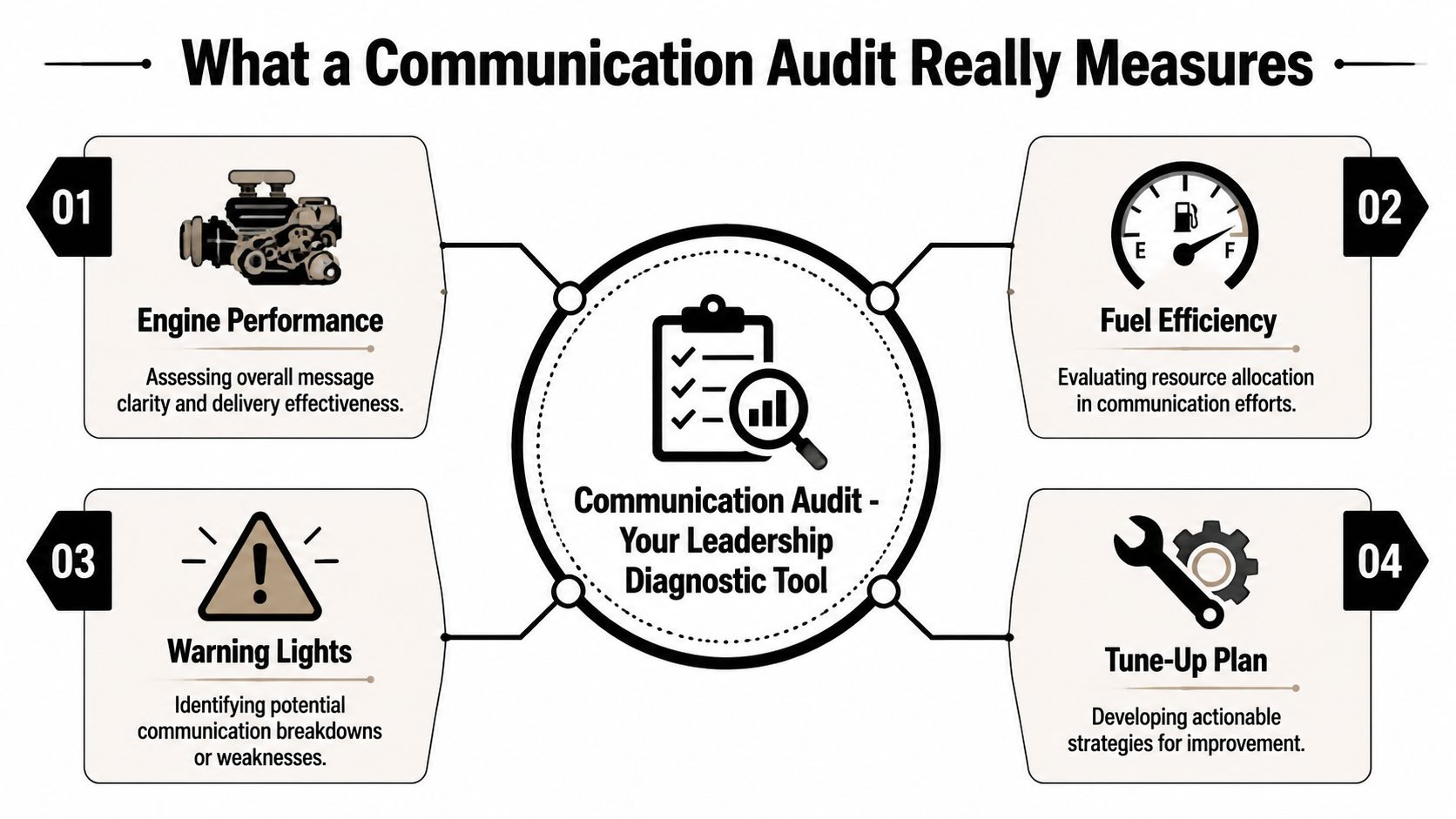
It measures three layers at once
A useful definition comes from communication practice itself. Fratzke Media describes a communication audit as a structured diagnostic that evaluates channels, messages, and audience feedback to identify where information flow is effective or breaks down. It also notes that the method is strongest when it combines content review with stakeholder feedback and channel metrics.
That same logic applies to an individual leader.
| Layer | What gets reviewed | What it reveals |
|---|---|---|
| Message | Emails, presentations, talking points, meeting contributions | Whether your ideas are clear, structured, and decision-oriented |
| Channel | Meetings, one-to-ones, written updates, stakeholder conversations | Whether you're using the right format for the message |
| Reception | Feedback, follow-up questions, engagement patterns, interpretation | Whether people understood your intent the way you meant it |
A weak communicator often focuses only on the first row. A strong audit looks at all three.
The gap between intent and impact
Many senior professionals often experience surprises. They believe the issue is wording when the issue is reception. Or they think the problem is confidence when the actual problem is sequencing. Sometimes the content is good, but the wrong channel weakens it. A carefully argued recommendation sent by email may land poorly because the stakeholders needed a verbal pre-wire before seeing it in writing.
The audit also separates recurring problems that get lumped together:
- Clarity problems such as overexplaining or burying the main point
- Delivery problems such as rushed pace, hedging, or low vocal authority
- Positioning problems such as sounding operational when you need to sound strategic
- Audience problems such as failing to adapt your message to different stakeholders
If you want a stronger lens for this, think of communication as persuasion, not just information transfer. That shift changes what you measure. You stop asking, "Did I say it?" and start asking, "Did it move the decision?"
Practical rule: If you only review what you sent, you'll miss what your audience actually received.
That is the heart of a communication audit. It is evidence-based, not mood-based. It gives leaders a way to see where their authority leaks out of the message.
From Corporate Reviews to Personal Blueprints
Most published advice on communication audits comes from the corporate side. HR teams audit internal newsletters, intranet content, leadership messages, engagement surveys, and channel use. That work matters because organizations need to know whether people are receiving and using company information.
But senior professionals need a different version of the tool.
Corporate audit versus personal audit
An organizational audit asks, "Is the communication system working across the company?" A personal audit asks, "Is my communication helping or limiting my leadership trajectory?"
The difference is practical:
| Corporate audit | Personal audit |
|---|---|
| Reviews enterprise channels | Reviews your spoken and written leadership communication |
| Looks at workforce-wide message flow | Looks at your influence in high-stakes moments |
| Focuses on internal campaigns and engagement | Focuses on authority, trust, clarity, and executive presence |
| Produces team or company recommendations | Produces a personal development blueprint |
A company may care whether employees read a town hall recap. You care whether your board update sounds strategic, whether your questions in a leadership meeting increase your seniority, and whether your tone supports your actual level of expertise.
What a personal blueprint includes
For an international professional, a personal communication audit often surfaces issues that general leadership training misses.
It can reveal that you:
- Structure ideas too cautiously when the room expects a clear recommendation first
- Use polite softeners too often and unintentionally reduce your authority
- Sound flatter or faster under pressure even when your content is strong
- Signal the wrong level of seniority through body language, pacing, or executive framing
- Translate directly from one communication culture to another without adjusting for local expectations
This is why a personal audit isn't vanity work. It's career architecture. It shows you how your current communication patterns are shaping perception, and whether those patterns match the level you're aiming for.
Many leaders find it useful to start with an executive presence assessment because it narrows the problem quickly. Instead of trying to improve everything, you identify the specific behaviors that are undermining your influence.
A personal communication audit doesn't ask whether you're good. It asks whether you're legible as a senior leader.
That is a different standard, and a more useful one.
A Leaders Guide to the Audit Process
A useful personal communication audit starts with a career problem, not a vague development goal.
A senior leader usually comes to this process with a concrete frustration. The board reads the numbers but misses the recommendation. A global stakeholder calls you "thoughtful" when you needed to sound decisive. Your ideas get accepted, but only after someone else restates them more directly. Those are auditable problems. They give you something specific to test.
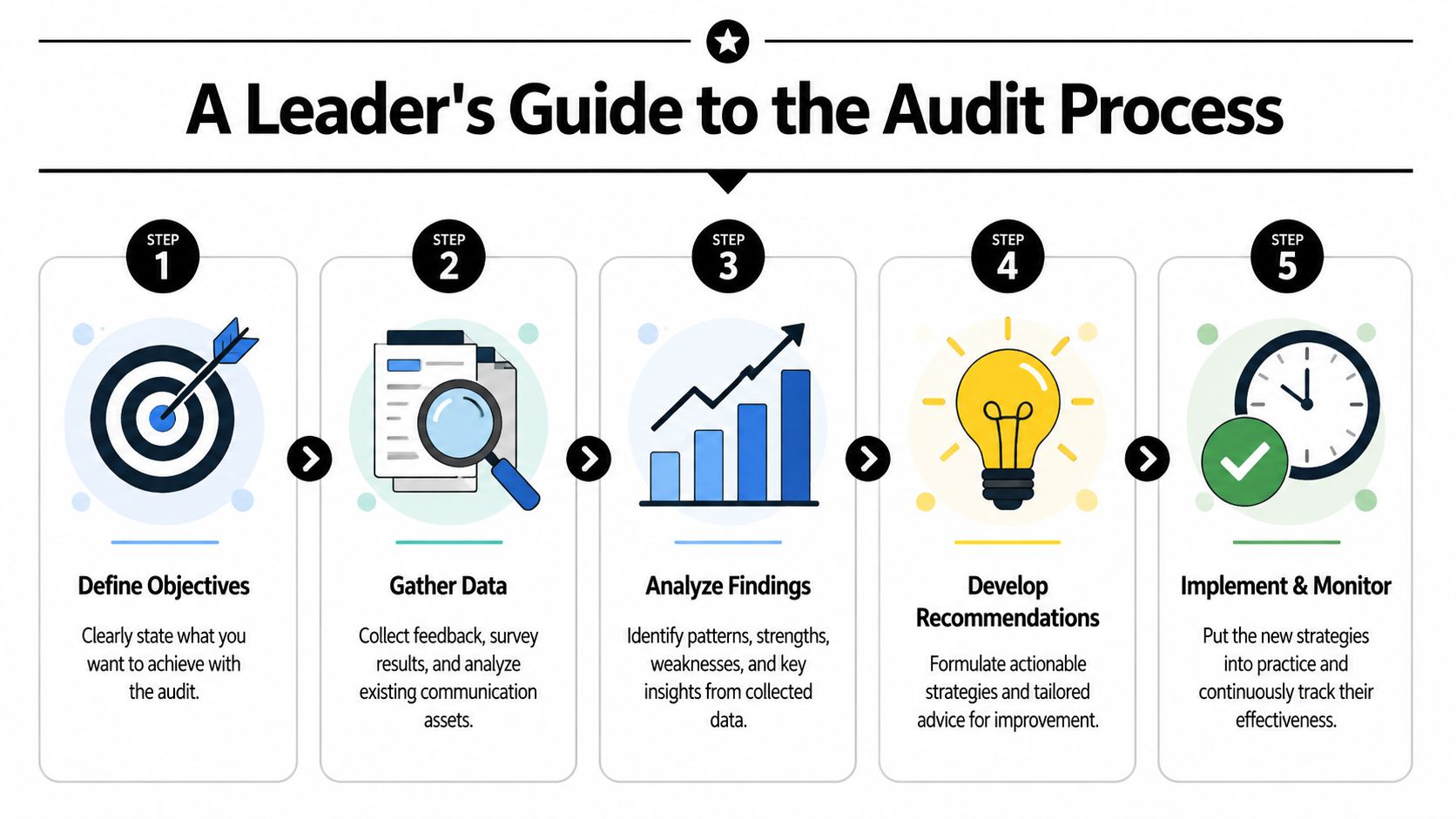
Step one starts with a narrow objective
The process becomes fuzzy fast if the goal is "improve communication." Senior professionals get better results with a target that can be observed in real situations.
Strong objectives sound like this:
- Influence decision-making meetings more effectively
- Sound more authoritative with executive stakeholders
- Reduce overexplaining in presentations
- Handle disagreement without losing composure
- Show senior-level judgment more clearly in high-stakes discussions
A narrow objective creates better evidence. It also forces an honest trade-off. If the goal is to sound more decisive, for example, you may need to give up some of the cushioning language that has helped you sound diplomatic in other contexts.
Then gather evidence from multiple sources
A personal audit should not rely on memory or one person's opinion. It works best when you review several forms of evidence and compare them across settings.
Guidance in Your Thought Partner's article on internal communication audits describes a structured review process that uses multiple inputs to establish a benchmark. For an individual leader, the equivalent is smaller in scale but similar in logic.
That usually includes:
- Communication samples. Recordings of presentations, meeting contributions, written updates, and stakeholder emails.
- Live observation. Feedback from a manager, trusted peer, or coach who can identify patterns you do not hear yourself.
- Context comparison. Review where your communication changes. Many leaders are clear in one-to-ones and less effective in group settings, or strong in writing and less controlled under pressure.
- Pattern analysis. Examine repeated behaviors such as hedging, burying the recommendation, answering too broadly, or signaling the wrong level of force for the room.
For international professionals, context matters even more. A behavior that reads as respectful in one market can read as hesitant in another. This is why I often include a check for direct versus indirect communication styles across cultures during the audit. It prevents leaders from "fixing" a habit that is only a problem in one audience or one geography.
A short visual overview can help if you're evaluating your own process:
Analysis should lead to behavior change
The audit has done its job only when it produces decisions. Senior leaders do not need another folder of observations. They need a short list of adjustments that change how they are perceived in important rooms.
Typical interventions include:
- Restructuring updates so the recommendation appears before the background
- Strengthening vocal delivery by reducing rushed pacing, trailing endings, or question-like intonation
- Adjusting body language so physical presence matches the level of authority required
- Practicing executive framing for objections, trade-offs, and high-stakes questions
- Reviewing performance again after practice to see whether the change holds under pressure
Many self-directed efforts frequently stall. Leaders can usually identify what felt off. They are much less accurate at diagnosing why it happened or which correction will work without creating a new problem. More direct language can improve authority, but overcorrection can make you sound abrupt. A tighter structure can improve clarity, but too little context can reduce trust with cross-functional peers. Good audit work accounts for those trade-offs.
Intonetic's executive communication work is one structured option in this area. The Gravitas Method is a 12-week one-on-one executive presence coaching program for international professionals who want to communicate with more authority and influence at senior levels. The program is priced at $8,200 paid in full or $9,000 across three installments. Coached by Nikola, it covers vocal authority, strategic framing, executive body language, and high-stakes communication.
The point is practical. You need diagnosis, correction, and repetition tied to the situations that affect your reputation most.
Real-World Scenarios for International Professionals
The most useful communication audits are specific enough to explain why a capable leader is being read inaccurately.
Scenario one involves authority that sounds optional
A senior product manager from India works in a US-based leadership environment. In cross-functional reviews, she aims to sound collaborative and respectful. She often uses phrases like "I think we could maybe consider" before presenting a recommendation she already knows is right.
Her peers don't hear diplomacy. They hear uncertainty.
No one says, "You lack authority." The signal shows up differently. Her ideas get revisited later. Other leaders summarize her recommendations more bluntly and gain support faster. The audit picks up a pattern across speech recordings, live meetings, and stakeholder feedback. The issue isn't expertise. It's a mismatch between her intended tone and the executive expectation for directness in that environment.
A useful correction plan might include:
- Replacing soft starts with a direct position statement
- Changing sentence endings so key points land firmly
- Reducing excess context before the recommendation
- Practicing interruption recovery so she can hold her ground without sounding combative
Scenario two involves directness that feels sharper than intended
A finance director from East Asia works with Western European stakeholders. He values efficiency and precision. His updates are brief, tightly reasoned, and stripped of unnecessary language. Yet several stakeholders experience him as abrupt in moments that require alignment, especially when tension is already present.
The audit shows that his communication is not wrong. It is incomplete for that audience. He moves to analysis before creating enough relational context. He answers the factual question but doesn't always manage the emotional temperature in the room.
Cultural nuance matters. Communication style isn't just about grammar or fluency. It includes assumptions about how much context, warmth, directness, and explicit framing a situation requires. That difference becomes especially visible in matrixed global teams. For those experiencing this challenge, it helps to understand direct versus indirect communication and how different cultures interpret both.
The audience doesn't grade your intentions. They respond to the experience of receiving your message.
In both scenarios, the audit reveals something invisible to the speaker. The first leader needs to sound more decisive without becoming artificial. The second needs to build more strategic rapport without losing precision. Generic coaching would tell both to "improve executive presence." A communication audit tells each one exactly what to change.
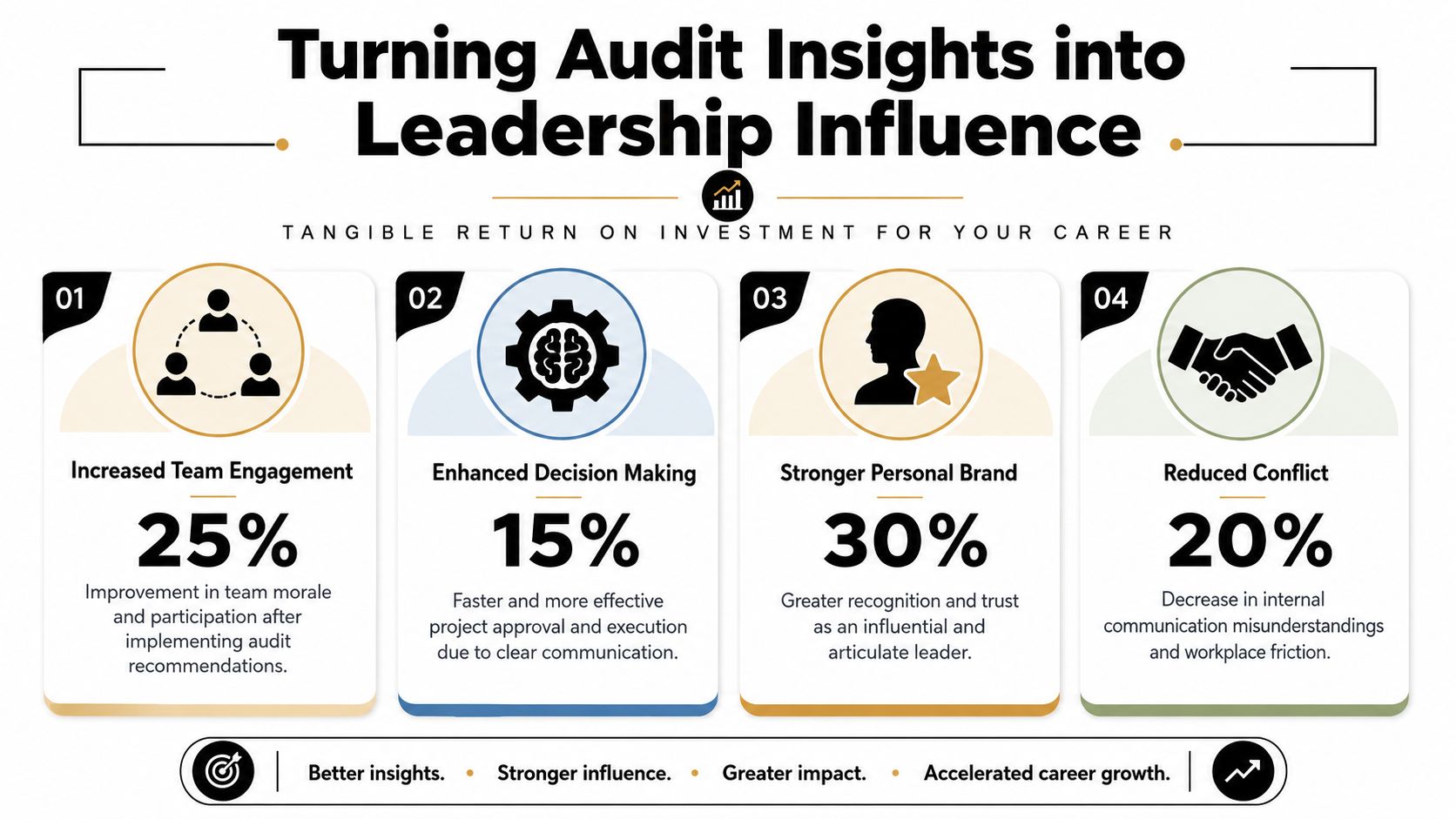
Turning Audit Insights into Leadership Influence
A communication audit is only worth doing if it changes behavior and results. Otherwise it becomes a well-worded reflection exercise.
The output should be operational
A high-quality audit doesn't stop at describing strengths and weaknesses. LeapXpert's glossary entry on communication audits notes that the point is to generate corrective actions by mapping findings to operational changes such as revised protocols, targeted training, updated messaging, and follow-up re-audits.
At the personal level, those operational changes sound like this:
| Audit finding | Leadership adjustment |
|---|---|
| You bury the main point | Start with your recommendation, then support it |
| You sound less certain under pressure | Train pacing, pausing, and vocal finish |
| Stakeholders misread your intent | Add stronger framing and explicit asks |
| Your presence drops in conflict | Rehearse objection handling and recovery language |
That is where influence starts to compound. Not because you became more charismatic overnight, but because your communication now supports your leadership role instead of undermining it.
What changes in practice
Leaders usually notice the payoff in small but important ways first.
- Fewer clarifying loops: People need less follow-up to understand your position.
- Cleaner decisions: Meetings end with clearer ownership and less ambiguity.
- Stronger executive perception: Senior stakeholders read you as more composed and more strategic.
- Better adoption of your ideas: Your recommendations move faster because they land more cleanly.
If your ambition is broader than sounding polished, and it should be, then the audit matters because it helps you increase your influence at work through repeatable communication behavior rather than personality guesswork.
Influence grows when your message becomes easier to trust, easier to act on, and harder to dismiss.
This is especially important for international professionals. You may already be operating with less margin for ambiguity. People often form quick judgments about seniority based on pacing, structure, tone, and how decisively you handle pressure. When those signals align, your expertise becomes more visible.
Your Next Step to Communicating with Authority
If you've been asking what is communication audit, the most useful answer is this. It is a strategic diagnostic for finding where your communication supports your authority and where it weakens it.
That distinction matters because many accomplished professionals don't have a knowledge problem. They have a translation problem. Their expertise, judgment, and leadership intent aren't coming through at the level they need. A communication audit makes that gap visible.

The strongest leaders don't leave this to chance. They review patterns, test corrections, and build communication the same way they build any senior capability. Deliberately.
If your message is getting diluted in executive meetings, if your tone is being misread, or if your authority drops under pressure, don't guess your way through it. Diagnose it. Once you know the pattern, you can change it.
If you're ready to stop second-guessing how you're coming across, start with Intonetic's free Executive Communication Assessment. It's the clearest first step for identifying the specific gaps affecting your authority, influence, and executive presence, and it can help you decide what to improve next.