What Are Cultural Factors: Define & Understand Impact
You're in a leadership meeting. You've done the work, your analysis is sound, and your recommendation is better than the one the room eventually accepts.
Still, your point doesn't land.
Maybe you were too direct for a group that expects alignment before open disagreement. Maybe you were too cautious in a room that reads nuance as uncertainty. Maybe you answered the question correctly, but not in the format senior stakeholders trust. When that keeps happening, many international professionals assume the problem is confidence, fluency, or politics.
Often, it's culture.
Not culture in the broad, abstract sense people throw around in diversity training. Culture as the set of expectations that shapes what sounds credible, respectful, decisive, collaborative, or senior. Once you see those signals, a lot of confusing workplace moments stop feeling random.
The Invisible Barriers to Your Influence
A common pattern shows up when a high-performing international professional moves closer to senior leadership. Their technical judgment is strong. Their work ethic is obvious. Their ideas are respected one-to-one. But in high-stakes meetings, they still get overlooked, softened, or misread.
One leader I've seen in this situation presented updates with impressive precision. Every slide was clear. Every risk was thought through. Yet executives kept responding to someone else in the room as if that person were driving the conversation. The difference wasn't expertise. It was how each person matched the room's unwritten rules around timing, authority, and disagreement.
When competence isn't the issue
In one culture, interrupting to sharpen a point can signal engagement. In another, it can look disrespectful. In one team, speaking early shows ownership. In another, speaking too early suggests you haven't listened long enough to the hierarchy or group mood.
That's why smart people can walk out of the same meeting with completely different interpretations of what just happened.
Practical rule: If your message is strong but your influence is inconsistent, don't only audit your content. Audit the cultural assumptions built into your delivery.
These barriers are easy to miss because they rarely look dramatic. They show up in smaller moments:
- Feedback style: You think you're being efficient. Others hear bluntness.
- Decision pace: You think the team is indecisive. They think you're pushing before consensus exists.
- Executive presence: You think you're being respectful. They read hesitation.
If you've felt this tension, you're not imagining it. You're likely dealing with the barriers of culture in communication and leadership, not just a personal performance issue.
Why these barriers matter more at senior levels
The higher you go, the less people evaluate you only on correctness. They evaluate judgment, trustworthiness, political awareness, and your ability to move others. Those qualities are always interpreted through a cultural lens.
That's why cultural factors matter. They don't sit outside business performance. They shape whose ideas get adopted, whose style gets rewarded, and who is seen as ready for broader authority.
Defining Cultural Factors in a Business Context
When people ask what are cultural factors, they often expect a list about nationality, etiquette, or customs. That answer is too shallow for real workplace use.
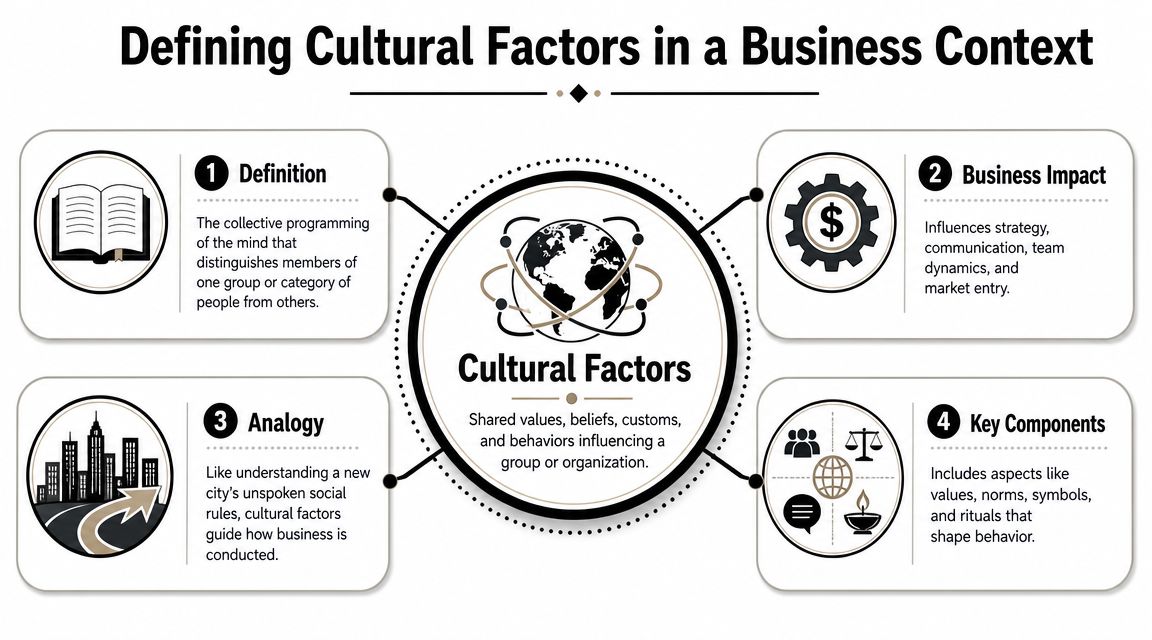
In business, cultural factors are the shared values, assumptions, behaviors, and social rules that shape how a group interprets credibility, trust, status, conflict, time, and collaboration. They operate like an invisible system in the background. That system is typically only noticed when someone violates it.
Culture is broader than heritage
A useful anchor comes from the UNESCO Framework for Cultural Statistics, published in 2009, which was designed to support international comparison through standardized definitions and classifications. UNESCO defines culture as not only art and literature, but also lifestyles, ways of living together, value systems, traditions, and beliefs in ways that can be observed and measured through behavior and practice, as described in the UNESCO framework for measuring culture.
That matters in business because it moves culture out of the vague category. It becomes something you can observe in meetings, performance reviews, negotiations, client relationships, and leadership norms.
Think of culture as an operating system
A practical analogy is this. Entering a new workplace culture is like arriving in a new city where nobody hands you the rulebook. The streets are visible. The social code isn't.
You learn by noticing patterns:
- Who speaks first
- How disagreement is signaled
- Whether brevity sounds strong or cold
- What kind of self-promotion is acceptable
- How formal authority is treated
That's why phrases like “just be yourself” often fail international professionals. If you don't understand the local operating system, authenticity alone won't protect you from misreading the room.
For professionals working across regions, high-context communication norms in business are one example of how deeply culture shapes interpretation. The same sentence can sound efficient in one context and rude or incomplete in another.
The business version of cultural factors
Here's the shortest useful way to define them at work:
| Workplace area | Cultural factor in action |
|---|---|
| Meetings | Who may challenge whom, and how |
| Feedback | Whether candor is admired or softened |
| Leadership | What authority should look and sound like |
| Collaboration | Whether group harmony outranks speed |
| Decision-making | Whether consensus or individual ownership carries more weight |
If you treat culture as background noise, you'll keep personalizing what is often a system-level mismatch. If you treat it as a measurable force, you can adapt without becoming fake.
The 6 Key Types of Cultural Factors at Work
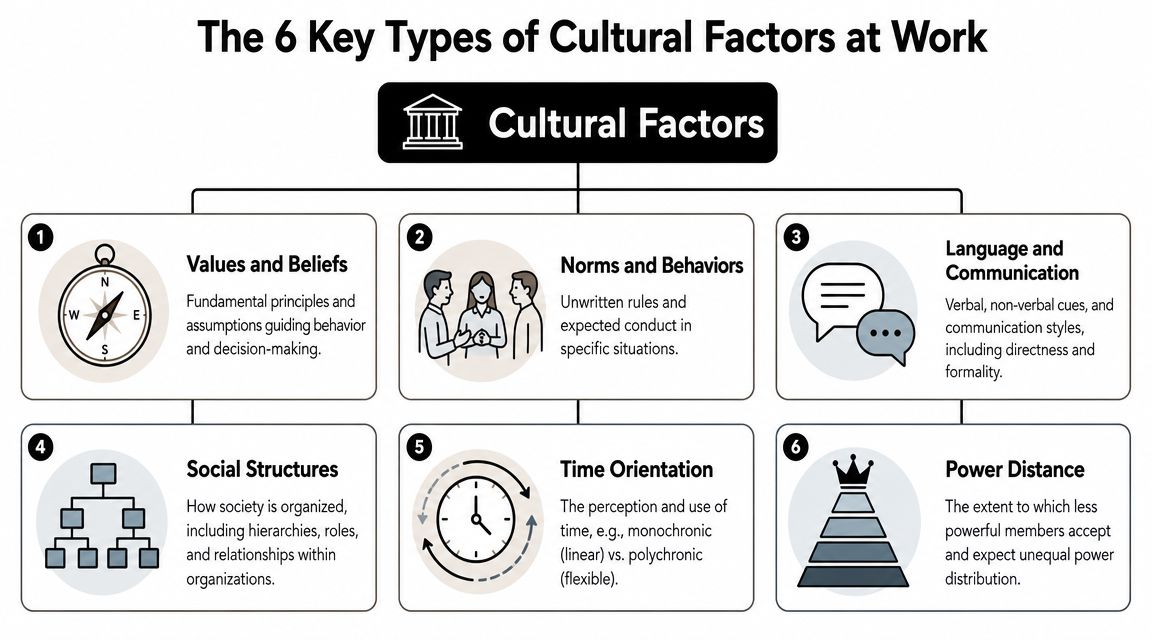
Most professionals don't need a theory-heavy model. They need a way to diagnose what's happening in the room. These six categories are useful because you can spot them in daily work.
Values and beliefs
These are the deeper assumptions about what matters. Some cultures prize harmony, restraint, and group cohesion. Others prize candor, autonomy, and visible initiative.
At work, this affects how people justify decisions. One leader may persuade by showing individual conviction. Another may persuade by showing collective support.
Norms and behaviors
Norms are the unwritten rules. They tell people what counts as appropriate conduct in specific situations.
A team may say it has an open culture, yet everyone still waits for the most senior person to speak first. Another team may claim to value alignment, but reward whoever pushes the hardest. The formal statement matters less than the repeated behavior.
Language and communication
This includes directness, formality, pacing, silence, nonverbal cues, and how much meaning is stated versus implied. It's one of the main reasons talented professionals get misread.
If this is the area causing friction, understanding direct versus indirect communication at work helps explain why a message can be accurate and still ineffective.
A quick visual can help frame the categories before you apply them:
Social structures and power distance
Some workplaces expect authority to be visible and respected. Others expect leaders to appear accessible and egalitarian. In cross-cultural decision research, power distance, environmental predictability, and long-term versus short-term orientation are treated as measurable cultural factors that influence how people solve complex problems, as discussed in this cross-cultural decision research overview.
That shows up in ordinary business moments. A flat org chart can confuse someone used to clear hierarchy. A highly deferential communication style can make someone seem less senior in a low-hierarchy environment, even when they're being appropriately respectful by their own standards.
Time orientation
Some teams treat time as linear, scheduled, and tightly managed. Others treat time more relationally, with flexibility based on context and competing priorities.
This affects deadline conversations, meeting punctuality, follow-up habits, and what “urgent” means in practice.
Individualism and collectivism
This factor shapes how people think about responsibility, conflict, and loyalty. In more individualist settings, speaking for yourself and owning your position can carry weight. In more collectivist settings, preserving social cohesion and considering group impact may carry more weight.
If you keep asking, “Why don't they just say what they mean?” you may be seeing a cultural difference, not a competence problem.
How Culture Shapes Workplace Communication
Most workplace conflict that gets labeled “style” is interpretation. Two people observe the same behavior and attach different meanings to it because culture tells them what that behavior signifies.
That's why communication breakdowns can feel personal even when they aren't.
The same message can produce different reactions
Take feedback. A manager says, “This needs to be stronger.” In one culture, that's efficient and normal. In another, it sounds abrupt and publicly diminishing. The words haven't changed. The social meaning has.
The same thing happens with silence. One person pauses to think and show care. Another hears uncertainty or lack of readiness. A fast reply can signal confidence in one setting and impulsiveness in another.
A controlled study on social-norm reactions found that participants from collectivist cultures reported greater discomfort and a stronger intention to enforce social rules after the same uncivil behavior than participants from more individualist cultures, according to this study on culture and reactions to uncivil behavior. The practical implication is straightforward. Culture changes not only opinions, but also emotional intensity and the urge to correct behavior.
Where professionals usually get trapped
In global workplaces, the most common trap is assuming your intention should override another person's interpretation. It doesn't.
If your stakeholder experiences your comment as dismissive, “I didn't mean it that way” won't repair much on its own. You need to understand what social rule may have been triggered.
Here are a few recurring flashpoints:
- Direct feedback in public: Efficient to some, face-threatening to others.
- Strong eye contact: Confident in one setting, aggressive in another.
- Frequent interruption: Energetic in some teams, disrespectful in others.
- Loose virtual etiquette: Casual in one culture, unprofessional in another.
For distributed teams, it's worth reviewing practical guidance on professional online meeting conduct, because virtual rooms often amplify these differences rather than flatten them.
Miscommunication is rarely random
A better diagnostic question is not “Who communicated badly?” It's “What rule did each person think was in force?”
Miscommunication often happens when both people are following a norm, but not the same norm.
If you want to reduce friction, study the moments where people tense up, go quiet, become overly formal, or respond with unusual caution. Those are often signs that a cultural boundary has been crossed. This is also why learning how to avoid miscommunication across cultures matters more than memorizing etiquette tips.
Connecting Cultural Awareness to Executive Presence
Many professionals think executive presence is universal. It isn't. It is always filtered through local expectations about authority, composure, warmth, confidence, and status.
What makes someone look senior in one environment can make them look rigid, loud, vague, or overly deferential in another.
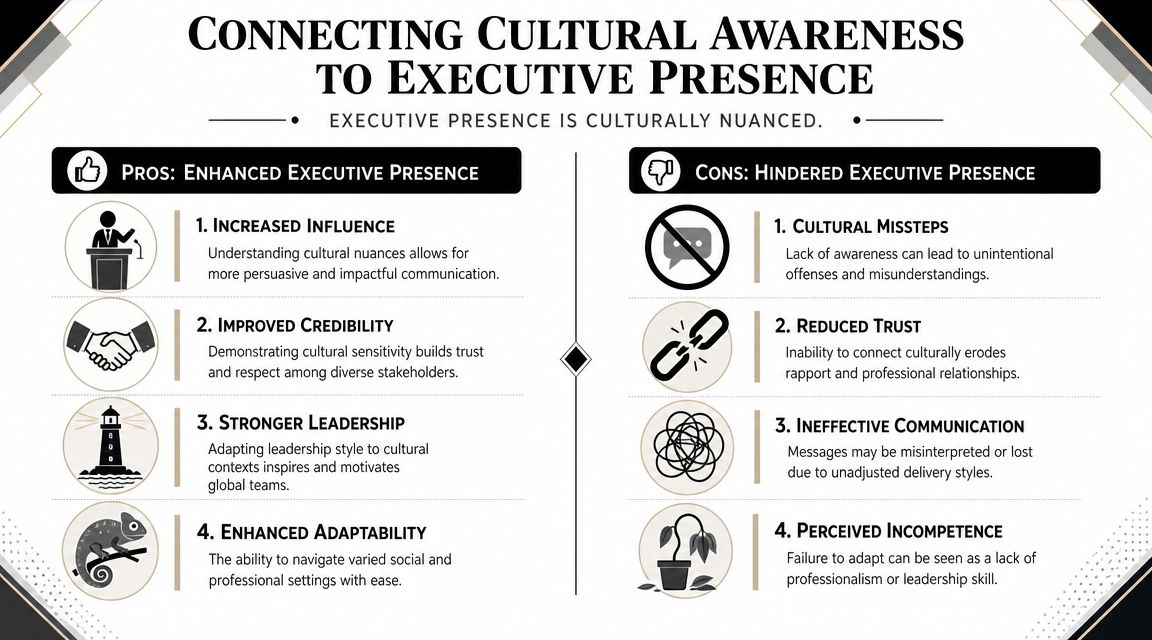
Executive presence is interpreted, not self-declared
A leader may think they are projecting humility by speaking softly and hedging claims. A board may read that as lack of conviction. Another leader may think they are signaling strength through blunt certainty. A cross-functional group may read arrogance or poor judgment.
That's why cultural awareness isn't a side skill. It shapes whether people trust your tone, follow your framing, and grant you authority.
Research on cultural competence in leadership shows it affects communication quality, trust, and perceived credibility, and the direction in 2024 is toward approaches designed for specific situations rather than one-size-fits-all models, as described in this research on cultural competence and tailored leadership approaches.
What adaptation looks like in practice
This doesn't mean becoming a different person for every room. It means adjusting the signals you send so your judgment is legible.
That often includes:
- Framing ideas differently: Lead with independent recommendation in one room, stakeholder alignment in another.
- Adjusting vocal delivery: More concise and decisive where speed is valued. More contextual where consensus matters.
- Managing body language: Stronger physical stillness in some executive settings. More visible relational warmth in others.
- Changing how you challenge: Directly in some cultures. Privately or more indirectly in others.
Professionals who want to boost your professional gravitas often focus on posture, tone, and confidence. That's useful, but incomplete if you don't also account for culture.
The real trade-off
Here's the trade-off many international professionals resist. If you adapt, you worry you'll lose authenticity. If you refuse to adapt, you may keep your internal consistency but lose external influence.
The stronger move is strategic flexibility. You keep your values. You change your expression.
Authority travels better when your expertise and your delivery match the room's expectations.
That's one reason executive presence in global leadership contexts can't be reduced to charisma. Presence is partly the skill of making your competence readable across cultural settings.
Actionable Strategies to Adapt Your Communication Style
You don't need to become a cultural anthropologist to improve your influence. You need a practical loop you can use before, during, and after important interactions.
A simple framework is Observe, Inquire, Adapt.
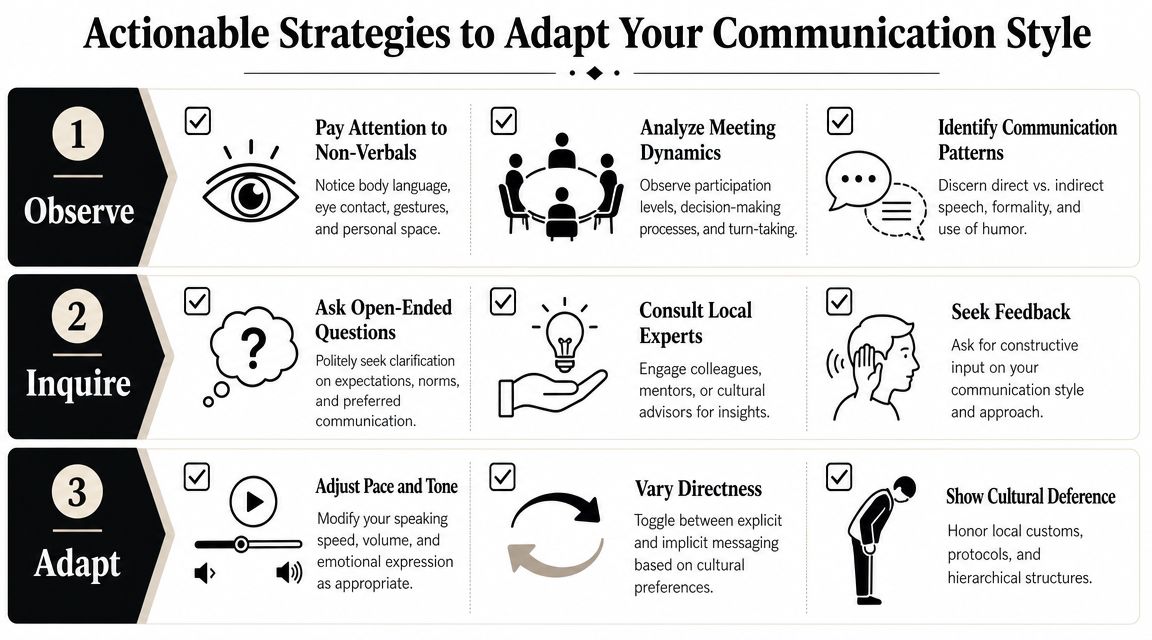
Observe
Start by looking for patterns, not stereotypes. A 2017 Pew Research study showed major differences in how people value customs and traditions across countries. For example, 66% of Greeks said customs are very important to national identity, compared with 26% of Swedes, as reported in this Pew Research study on customs and national identity. The practical lesson is that even within advanced economies, assumptions about norms can vary sharply.
Watch for signals such as:
- Meeting entry: Who opens, who summarizes, who closes.
- Pushback style: Is disagreement explicit, softened, delayed, or moved offline?
- Status behavior: Do people use titles, deference, or very informal interaction?
- Tempo: Is speed admired, or does fast movement create suspicion?
Inquire
You can ask culturally intelligent questions without sounding awkward.
Try lines like:
- “How are decisions usually socialized here before they're finalized?”
- “Would you prefer direct feedback in the meeting or after we've aligned offline?”
- “What does strong executive communication usually look like in this group?”
These questions do two things. They reduce guesswork, and they signal maturity. Senior professionals ask about operating norms because they know execution depends on them.
Adapt
Make small changes first. You don't need a full personality rewrite.
A practical adaptation table:
| If the room expects | Try this adjustment |
|---|---|
| More directness | Lead with recommendation, then evidence |
| More hierarchy | Acknowledge senior stakeholders before challenge |
| More consensus | Build support privately before public discussion |
| More formality | Reduce slang, tighten structure, slow your pace |
One option for professionals who want structured feedback is Intonetic's Executive Communication Assessment, which looks at delivery patterns that can undermine authority for international professionals and points toward targeted coaching.
The key is flexibility without stereotype. Don't assume all people from one country want the same style. Test, observe, refine.
From Awareness to Authority
Cultural factors are not abstract background details. They shape how people read confidence, credibility, respect, and leadership. If you've ever felt that your ideas were strong but your impact was inconsistent, this is often the missing layer.
The good news is that cultural awareness is learnable. You can get better at reading the room, naming the trade-offs, and adjusting your communication without losing your identity. In practice, that's what separates professionals who are merely capable from professionals who are trusted at senior levels.
For readers who want a structured way to build that skill, The Gravitas Method is a 12-week one-on-one executive presence coaching program for international professionals who want to communicate with more authority and influence at senior levels. The program is priced at $8,200 paid in full or $9,000 across three installments. Coached by Nikola, it covers vocal authority, strategic framing, executive body language, and high-stakes communication.
Authority doesn't come only from having the right answer. It comes from delivering that answer in a way the room can receive, trust, and act on.
If you want a clearer read on how your communication is landing, start with Intonetic's free Executive Communication Assessment. It's a practical first step for identifying where culture, delivery, and executive presence may be helping or limiting your influence.