
Quarterly Business Review Presentation: A Complete Guide
You're in the meeting room, the deck is open, and the room already knows the pattern. The numbers are on screen, the charts are polished, and yet no one leans in. A few executives scan their inboxes, someone asks a clarification that should've been obvious from slide 4, and by the end of the hour the team has “reviewed” the quarter without changing a single decision.
That's the problem with most quarterly business review presentation decks. They look complete, but they don't help leadership decide what happens next. A strong QBR doesn't exist to summarize activity. It exists to force a clear judgment about what matters, what changed, and what gets done in the next 90 days.
Why Most Quarterly Business Review Presentations Fail
A QBR falls apart when the presenter thinks the assignment is to report, while executives have shown up to decide. Those are different jobs. When the deck is built for one and the room expects the other, attention drops fast.
A quarterly business review is typically run every three months to review performance against goals, discuss results from the last quarter, and set priorities for the next quarter, with practical structures often landing at 12 to 18 slides built around an executive summary, KPI scorecard, financial overview, challenges, next-quarter priorities, and action items. That format only works when the presenter treats the deck as a decision tool.
The deck is not the meeting
The failure pattern is easy to recognize. Slides get crowded, the presenter reads through every chart, and executives are left to sort signal from decoration while the clock runs out. By the time the discussion reaches the issue that matters, the room has already lost focus.
Senior leaders usually do not need more information. They need fewer judgments, stated more sharply. Surface the 2 to 3 deviations that change the plan, then connect each one to an action, an owner, and the consequence of doing nothing.
Practical rule: if a slide does not change a decision, it probably does not belong in the main deck.
AI makes this worse when the deck is assembled in a hurry. The slides can look polished, but polish is not judgment. A model can format a quarterly business review presentation, but it cannot decide which tradeoff matters, which metric is only a symptom, or which issue deserves executive attention today.
Executives punish ambiguity, not complexity
Time-poor leaders accept complexity when it is tied to a real choice. What they reject is spending a meeting on background that should have been in a pre-read. A QBR earns attention when it starts with the headline and moves quickly to the decision points because it respects the room.
The presenter should come in ready to compare actuals with targets, explain what drove the quarter, and ask for decisions that matter now. That requires more than a clean slide deck. It requires a structure that helps leaders see the trade-offs quickly, which is why teams that want to craft a high-converting sales deck usually separate evidence from the decision prompt instead of blending them together. If the meeting ends with “we'll keep an eye on it,” it was not a QBR. It was a dashboard tour.
A stronger approach follows the discipline behind how to structure a presentation, where the opening frames the decision, the middle supports it, and the close makes the next step obvious.
Building a Slide Structure That Drives Decisions
A strong QBR deck is usually easier to follow than most presenters think. The mistake isn't lack of content. It's allowing content to sprawl until the audience can't tell which slide is supposed to answer which question.
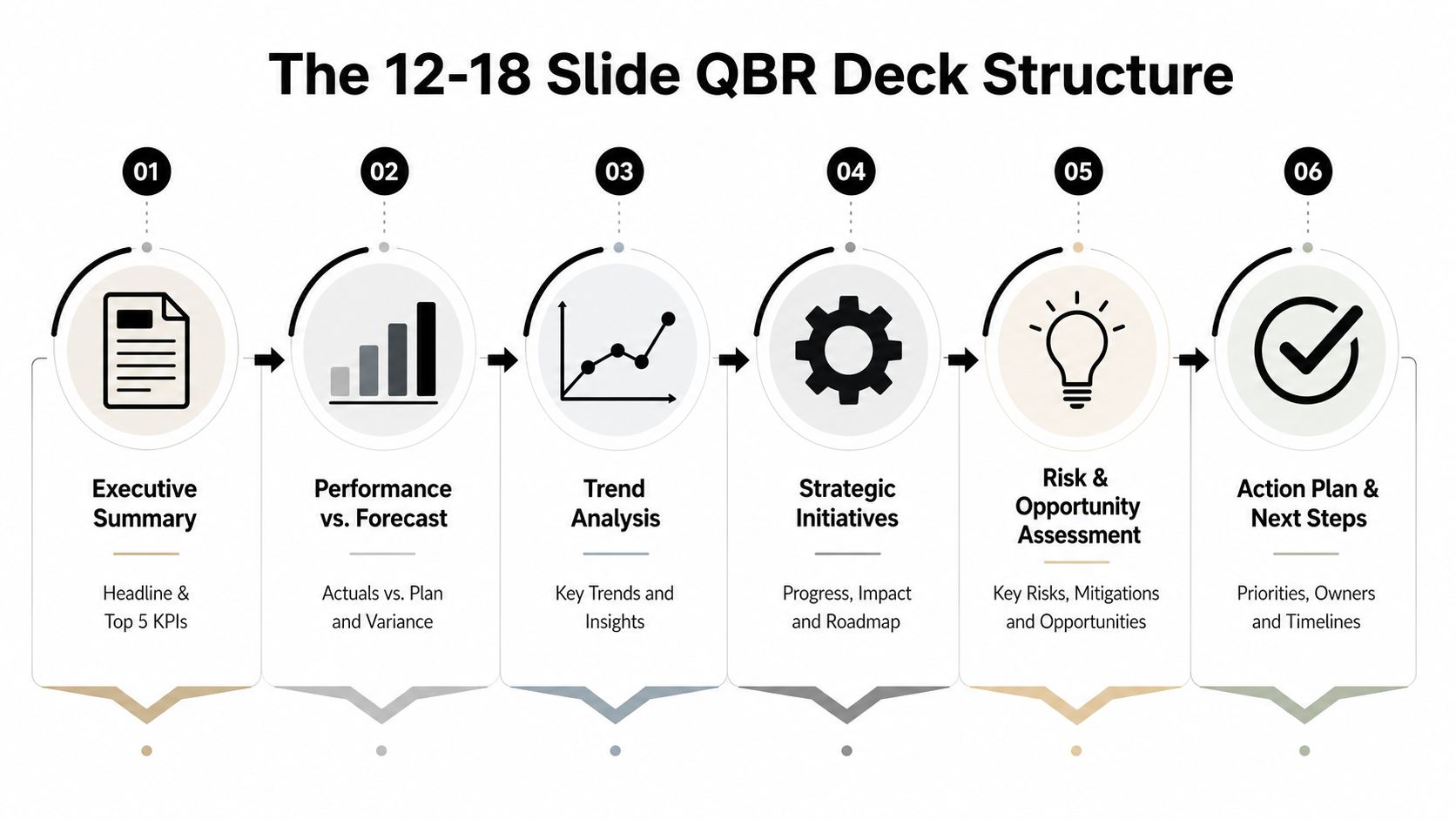
A practical structure keeps the deck in the 12 to 18 slide range, with six functional blocks that move from headline to action. SlidesMate recommends exactly that kind of flow, starting with an executive summary and top KPIs, then moving through performance, wins, challenges, priorities, and an appendix (SlidesMate). When the deck is built this way, every section earns its place.
Start with the executive summary
The opening block should take about 5 minutes to deliver and answer one question, what happened this quarter and why should leadership care. It should contain the quarter's headline and the top 5 KPIs, nothing more. If the audience can't understand the story from the first few slides, the rest of the deck is already fighting uphill.
This is also where the best way to structure a presentation matters in practice, because a QBR is not a slide dump. It's a guided decision path. The executive summary creates that path by telling the room where the truth lives before the rest of the data appears.
Separate performance, wins, and risks
The performance overview should show actual-versus-target comparisons, because executives need to see variance, not just activity. Wins and highlights belong in their own block, because they deserve recognition without crowding out the harder discussion. Challenges and risks need even more space than wins, since that's where leadership usually needs to weigh tradeoffs and authorize action.
A clean ordering works like this:
- Executive summary: headline, top KPIs, and the quarter in one sentence.
- Performance overview: actual versus target, so the room sees variance.
- Wins and highlights: proof of momentum, without turning the deck into celebration theater.
- Challenges and risks: the issues that could change the next quarter.
- Next-quarter priorities: specific initiatives, owners, and deadlines.
- Appendix: surplus detail for anyone who wants to dig deeper later.
The pre-read should go out 48 to 72 hours before the meeting. That gives senior leaders enough time to absorb the facts before the conversation starts. It also creates room for discussion, which should account for at least 30% of the meeting if the QBR is supposed to drive decisions instead of consumption.
For a good example of how to make a presentation concise and persuasive, craft a high-converting sales deck is a useful reminder that clarity beats volume every time.
Selecting and Framing the Metrics That Matter
A QBR wins credibility when the metric set is chosen with discipline. Senior leaders do not want every available number on a slide. They want the measures that show whether the business is on track, what is driving the result, and where a decision is required, especially revenue, gross margin, burn rate, runway, customer acquisition, retention, and product adoption.
The presenter's job is to frame those metrics against targets, prior periods, and the business context behind them. The strongest QBRs show each metric against target, previous quarter, and prior-year performance, then explain the driver behind any change. That keeps the room focused on interpretation instead of staring at a busy dashboard that says very little.
Use context, not isolated numbers
A metric without context invites the wrong conversation. If revenue is up, executives want to know whether that came from better acquisition, stronger retention, or one-off timing. If gross margin slipped, leadership wants the reason, not a line that says the team monitored it closely.
The QBR should make variance visible and explainable. One practical way to do that is to calculate variance as (Actual – Target) / Target * 100%, then review the result with the metric owner before the meeting. That keeps surprises out of the room and forces the presenter to understand the number before asking executives to act on it. A useful companion to that discipline is presentation on data, because the meeting only works when the numbers are already clear enough to defend.
| QBR Metric Presentation Framework | ||||
|---|---|---|---|---|
| Metric | Target | Actual | Variance | Driver |
| Revenue | compare to plan | current quarter result | explain gap or outperformance | pricing, conversion, timing |
| Product adoption | compare to goal | current usage level | explain gap or outperformance | onboarding, feature value, rollout |
| Burn rate | compare to budget | current monthly spend | explain gap or outperformance | hiring, spend timing, project mix |
The table above is the right shape for a QBR because it makes interpretation unavoidable. It also keeps the presenter from hiding behind raw output. Senior audiences do not need a decorative dashboard. They need a comparison that leads to a business decision.
Keep the metric model consistent quarter over quarter
Consistency matters more than novelty. If the metrics change every quarter, trend lines lose meaning and the conversation resets from scratch. A disciplined QBR uses the same core model over time so leadership can compare one quarter with the next and understand whether a change is real or just noise.
That is why the metric owner review matters before the live meeting. Clean data, mapped objectives, and benchmarked context reduce defensiveness and shorten the path to useful debate. If the audience can trust the numbers, they will spend more time on the implications. For a deeper lens on choosing and presenting performance measures, mastering business growth metrics is worth reading alongside your own internal KPI framework.
Crafting a Narrative That Holds Executive Attention
A QBR loses the room fast when it reads like a dump of facts. Senior leaders want the quarter interpreted, the tradeoffs named, and the decision in front of them made visible. They are not there to hear a recital of results. They are there to judge what the results mean.
The opening should do that work immediately. One sentence should frame the quarter around the central win, the central miss, or the central tradeoff, depending on what changed. If the presenter cannot state that clearly, the rest of the meeting usually turns into over-explaining, and executives stop listening for the point.

Lead with the deviations that matter
Strong presenters do not treat every datapoint as equal. They identify the 2 to 3 deviations that deserve executive attention, then move straight into why those shifts happened and what changed because of them. That keeps the meeting strategic instead of turning it into a forensic review.
The order matters. Spend more time on the forward-looking section than on the retrospective, because that is where leaders decide on investment, reallocation, and priority shifts. The retrospective should explain what happened. The forward view should answer what changes next and what the team is prepared to stop, start, or continue.
Budget misses land better when the presenter names them plainly, explains the tradeoff, and gives a recalibration plan. Defensiveness kills credibility faster than the miss itself.
Treat the financial check-in as a decision point
A strong QBR presentation should include a financial check-in that compares budgeted versus actual spend and explains why the business is over or under budget, then states the plan to recalibrate (Salesforce). That slide is about choices, not excuses.
Executives listen for judgment. If the team overspent, they want to know whether that spend bought something valuable, solved a time-sensitive problem, or needs to be corrected. If the team underspent, they want to know whether that reflects discipline or delayed execution. The narrative has to make the tradeoff visible.
Use a speech structure that keeps the room with you
A narrative only works if it is easy to follow out loud, which is why writing a speech for business leaders matters inside a QBR as much as the slide itself. Start with the point, then give the evidence, then state the implication. That structure keeps the room oriented around the decision instead of drifting into commentary.
In a hybrid or globally distributed setting, the presenter has to do more translation work. Directness, detail level, and the tolerance for silence vary across cultures and time zones. The message should be crisp enough to work in the room and clear enough to survive the pre-read, because not everyone will process the QBR the same way.
For a quick visual reference on delivery flow, the embedded video below is useful for pacing and room control.
A good quarterly business review presentation makes interpretation feel easy. It tells the story in layers, headline first, deviations second, decisions last.
Commanding the Room with Executive Presence
The deck matters, but delivery decides whether the room trusts it. A presenter can build a polished quarterly business review presentation and still lose the room if the voice is shaky, the pacing is rushed, or the answers wobble under pressure.
Executive presence isn't theatrical. Senior leaders relax when the presenter sounds settled, pauses with control, and answers hard questions without overexplaining.
Use pace as a signal of authority
Fast talking usually reads as nervousness, even when the content is strong. Slow down before the headline and before each important conclusion so the room can follow the logic and the presenter has time to think. Pauses matter after a hard number or a difficult admission, because they show the speaker is not trying to blur the point.
The best answer structure for tough questions is simple: point, reason, example. State the answer first, give the reason, then anchor it in a concrete example from the quarter. That keeps responses short enough for executives and solid enough to sound prepared.
Read the room, not just the slide
Executives signal disengagement in obvious ways. They stop writing, start checking devices, or ask questions that show they've lost the thread. At that point, the presenter needs to tighten the language, skip supporting detail, and bring the conversation back to the decision in front of the room.
International professionals often feel added pressure here, especially when presenting in a non-native language. Accent anxiety usually gets worse when the speaker tries to control every sentence. Credibility rises when the presenter focuses on structure, not perfection. Clear framing, steady volume, and direct transitions matter more than sounding native.
For practical work on physical delivery, body language for leaders is a useful reference on posture, eye contact, and room presence.
One more point deserves to be stated plainly. The Gravitas Method is a 12-week one-on-one executive presence coaching program for international professionals who want to communicate with more authority and influence at senior levels, priced at $8,200 paid in full or $9,000 across three installments, and coached by Nikola. It focuses on vocal authority, strategic framing, executive body language, and high-stakes communication, which is exactly the gap many otherwise strong QBR presenters feel when they step in front of senior leaders.
Your Pre-Meeting Rehearsal and Delivery Checklist
A QBR starts long before the meeting room fills. Senior leaders can tell within minutes whether the presenter has done the work, because the deck feels settled, the numbers line up, and the opening line sounds practiced rather than assembled on the spot. The goal is not just preparation; it is arriving ready to guide a decision, not recite a status update.
A practical sequence that holds up under pressure
-
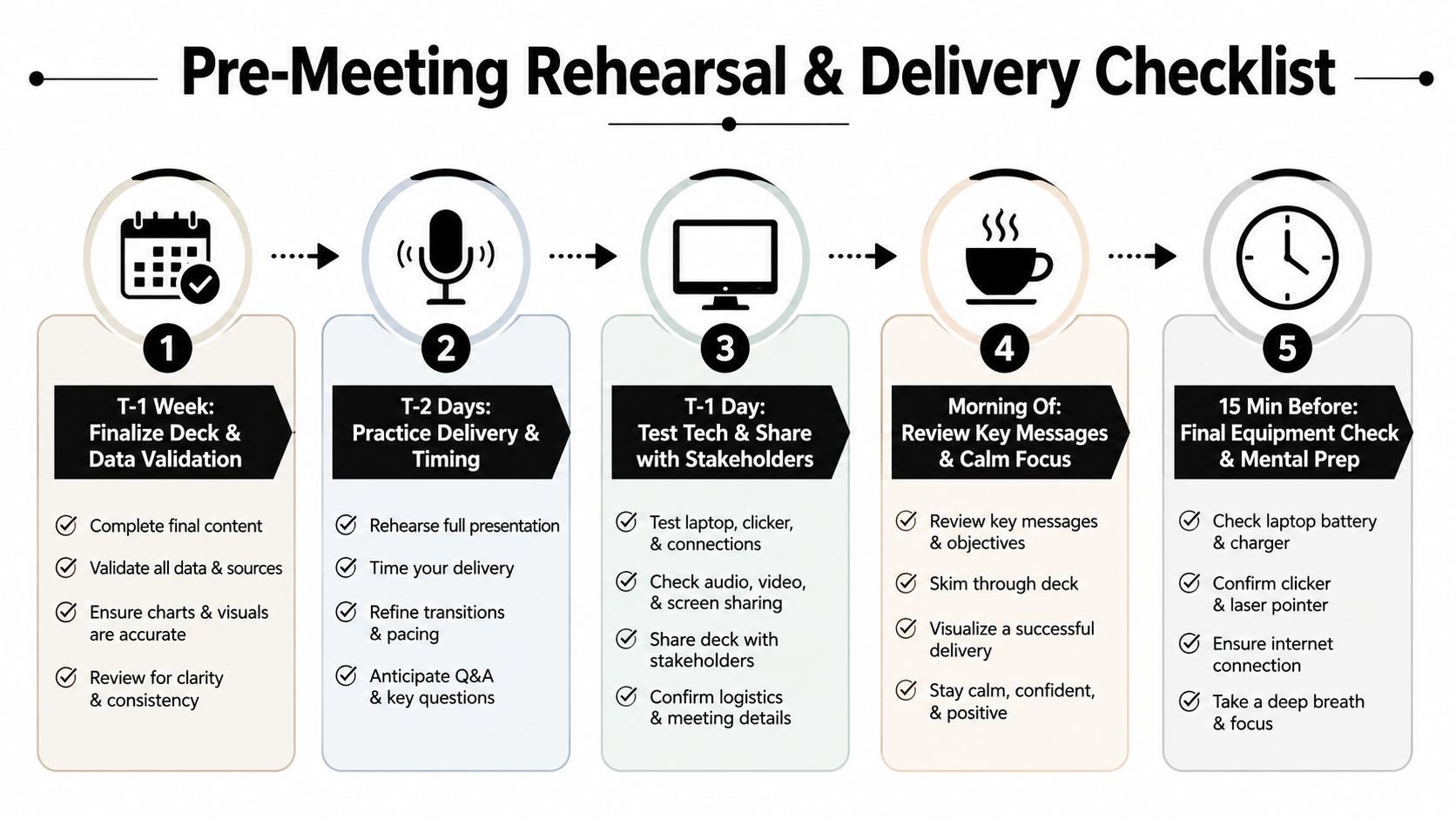
T-1 week, lock the data. Check the figures with metric owners before the meeting so there is room to settle disputes. A QBR that begins with disagreement over the numbers spends its first few minutes losing trust instead of earning it.
-
T-2 days, rehearse the headline aloud. Practice the executive summary at least three times. If the first minute feels awkward in rehearsal, it will feel worse under scrutiny. Keep the framing tight, because executives decide quickly whether the room is about strategy or slide reading.
-
T-1 day, share the pre-read and test the setup. The deck should already be in leaders' hands 48 to 72 hours early, and the meeting room or virtual platform should be checked so the technology does not pull attention away from the discussion. If nerves are getting in the way, review practical ways to calm yourself before speaking before you walk in.
-
Morning of, slow the pace. Review the key messages, then stop adding material. Extra slides will not help you think more clearly, and they rarely help executives decide faster.
-
15 minutes before, settle the body. A short breathing reset, a final equipment check, and a quick scan of the first slide are enough to get focused. At this point, confidence comes from reducing noise, not from squeezing in more preparation.
The time split also matters. A useful rhythm is 5 minutes for executive summary, 10 minutes for business impact, 10 minutes for wins and challenges, 15 minutes for insights and recommendations, 10 minutes for next-quarter priorities, and 20 to 30 minutes for discussion (EchoPitch). That structure only works if you protect the discussion time instead of letting the deck consume it.
Close with names, dates, and metrics. A QBR that ends with vague enthusiasm has not really ended at all.
The meeting itself should open with the headline in the first 60 seconds, then move straight into the evidence. Every action item should leave the room with an owner, a deadline, and a success measure. That is what turns a review into a decision session instead of a polished recap.
If you want to strengthen the way you show up in these rooms, Intonetic helps international professionals build the executive presence that makes QBRs land with more authority. Start with the free Executive Communication Assessment, then use that insight to sharpen how you frame decisions, handle questions, and command senior attention in your next quarterly business review presentation.