Promotion Interview Preparation: Master Your Next Career
You already know the company, the politics, the products, and the personalities. That's exactly why a promotion interview can feel harder than an external one. You're not walking in as an unknown quantity. You're walking in as someone the room has already decided things about.
For senior professionals, especially international leaders, that makes promotion interview preparation more complex. You're not only being assessed for capability. You're being assessed for seniority signals. Can you speak with enough clarity, weight, and judgment to be trusted at the next level? Can you show growth without sounding defensive, self-promotional, or culturally misread?
The strongest candidates prepare on two tracks at once. They build hard evidence of impact, and they sharpen the executive presence required to deliver that evidence credibly. If either part is weak, the interview panel feels it.
The Senior Promotion Interview Is a Different Game
An internal promotion interview is not a standard hiring conversation. It's a leadership readiness test inside a system that already knows your work, your habits, and your reputation. That changes the burden of proof.
Internal candidates are evaluated on “growth over tenure”, and these interviews are designed to “probe how candidates have developed”, not simply how long they've been in seat, as noted by Enboarder's guidance on internal promotion interviews. If you go in relying on loyalty, familiarity, or years of service, you'll sound dated very quickly.
What the panel is actually testing
At senior level, the interviewers are usually listening for four things:
- Evidence of development. Have your judgment, scope, and influence expanded?
- Strategic pattern recognition. Do you understand the business beyond your lane?
- Executive communication. Can you answer under pressure without rambling?
- Readiness for visibility. Will you represent the function well in tougher rooms?
That last point matters more than many people expect. Teams often promote the person who already sounds like they belong in cross-functional, high-stakes discussions. If you want a useful benchmark for that shift, study how to present to senior executives because the standard is closer to executive briefing than regular interviewing.
You are not trying to prove you've been valuable. You are trying to prove you've become promotable.
Why international professionals need a sharper strategy
International leaders often carry an extra layer of complexity. You may be judged not only on the quality of your ideas, but on how directly you frame them, how much space you take in the room, and whether your delivery matches local expectations of seniority.
That doesn't mean changing your personality. It means removing avoidable friction. If your message is strong but your delivery sounds hesitant, overly detailed, or apologetic, the panel may misread your level.
Promotion interview preparation at this level works best when you stop thinking like an applicant trying to be liked. Start thinking like a senior operator confirming that the organization can trust you with more scope.
From Accomplishments to Quantifiable Impact Stories
Most senior candidates bring a long list of responsibilities. That list rarely wins promotions. Interview panels want business evidence.
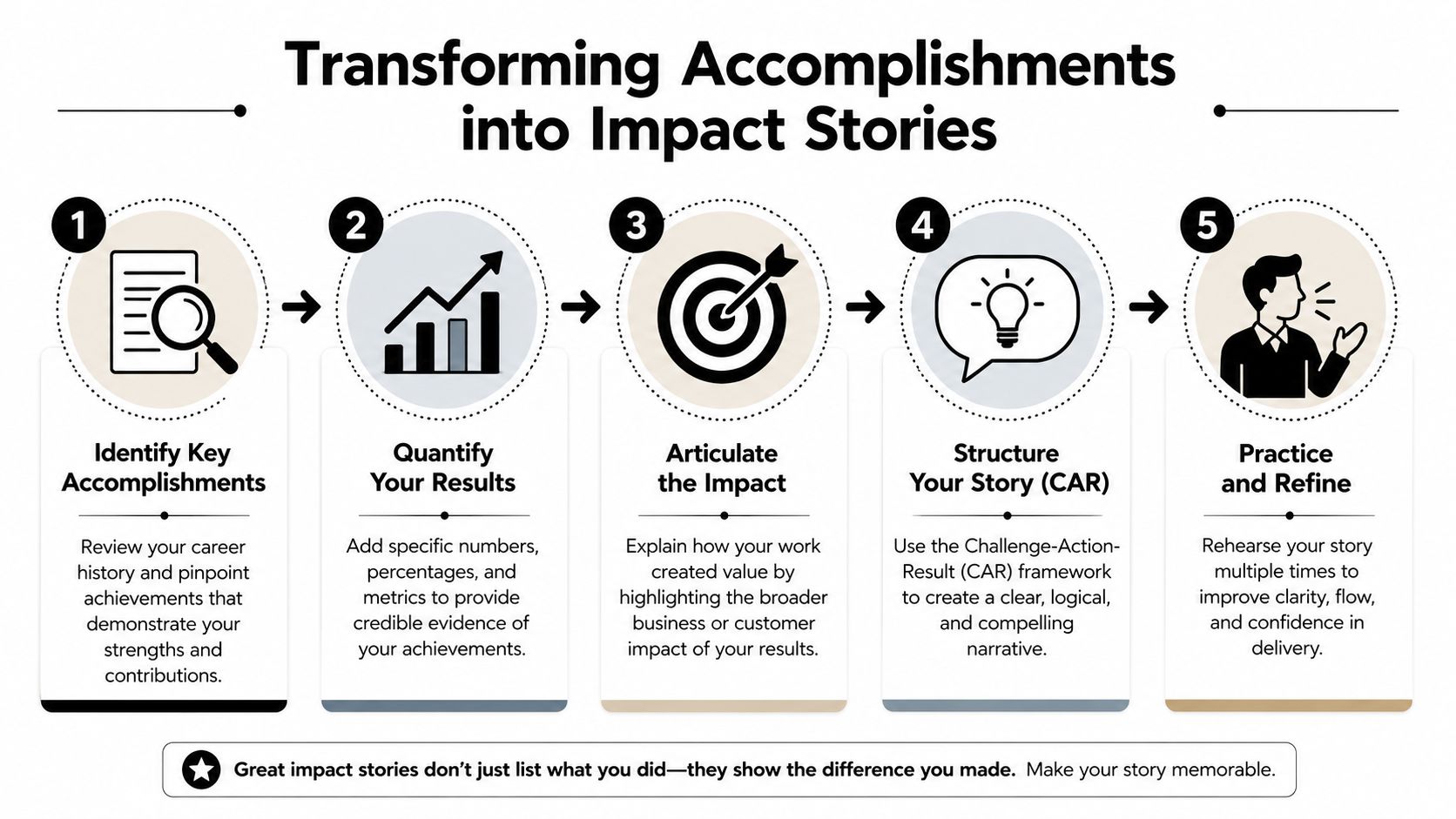
Indeed's promotion interview guidance is blunt about this: to prove you're the best fit, you must use numbers and data to quantify your achievements. Instead of saying you led a project, show that you “increased departmental efficiency by 25%” or “reduced costs by $15,000 annually.” Those examples matter because they turn effort into value.
Audit your work before you script your answers
Start with a blank document. Don't begin by writing polished interview answers. Begin by mining your actual work.
Look across the last few years and pull examples in these categories:
- Operational improvement. Process fixes, workflow redesign, delivery acceleration.
- Commercial impact. Revenue support, profitability gains, cost control.
- Leadership influence. Mentoring, stakeholder alignment, conflict navigation.
- Change under pressure. Ambiguity, crises, difficult transitions, fast learning.
For each example, ask the questions that force precision:
- What was broken, stuck, or at risk?
- What did I specifically do?
- What changed because of my actions?
- What number proves that change?
If you don't have a clean metric at first, keep digging. Look for budget changes, cycle time, error reduction, stakeholder adoption, customer outcomes, or team performance indicators.
Use STAR as architecture, not as a script
The STAR method works well in promotion interview preparation when used as structure, not as a robotic template. Your answer should sound like an executive summary, not a workshop exercise.
You can sharpen your examples further with this guide to behavioral questions using STAR.
| Component | Guiding Question | Example |
|---|---|---|
| Situation | What business context made this matter? | A critical reporting process was slowing monthly decisions across teams. |
| Task | What were you responsible for? | I was asked to stabilize the process and improve turnaround time. |
| Action | What did you actually do? | I redesigned the workflow, aligned the team, and introduced clearer checkpoints. |
| Result | What changed in measurable terms? | The process became faster, more reliable, and easier for leaders to use in decision-making. |
Strong stories do three jobs at once
A senior-level impact story shouldn't just prove competence. It should also signal judgment and scale.
A weak version sounds like this: “I led a cross-functional initiative and worked closely with stakeholders.”
A stronger version sounds like this: “I inherited a stalled initiative with competing priorities across teams, reset ownership, and created a decision rhythm that improved execution. The result was clearer coordination and a measurable operational gain.”
Practical rule: If your story only shows activity, it's incomplete. If it shows outcome and business relevance, it starts to work.
Use exactly three core stories in your preparation. Too many examples scatter your thinking. Three well-built stories can usually be adapted across leadership, conflict, delivery, influence, failure, and growth questions.
Projecting Authority Before You Speak
At senior level, the room starts evaluating you before your first answer. Your entrance, posture, facial composure, pacing, and first sentence all create a leadership impression.
According to a Center for Talent Innovation study summarized by Tandem Coach on executive presence, senior leaders assess executive presence through three pillars: gravitas at 67%, communication at 28%, and appearance at 5%. That weighting is useful because it cuts through a common mistake. Senior presence is not mostly about polish. It is mostly about how much confidence, steadiness, and authority you project.

Gravitas is visible in your timing
Gravitas shows up in delivery patterns that many candidates ignore.
If you answer too quickly, over-explain, or fill silence with verbal clutter, you lower the perceived level of your message. Strategic pauses help. Humessence's discussion of executive presence highlights the value of replacing filler words with intentional silence and slowing down enough to project composure, which you can explore in their conversation on gravitas, communication, and appearance.
For international professionals, this is especially important. If you're translating mentally, trying to sound fluent can make you rush. Rushing often reads as anxiety, not intelligence.
A few practical corrections work fast:
- Pause before the first sentence. It signals control.
- Land the answer early. State your main point first, then support it.
- Remove filler words. Silence sounds more senior than “um” or “like.”
- Finish cleanly. Don't keep talking after the answer is done.
If voice is part of your challenge, it helps to study the mechanics of using your voice with more authority.
Communication is structure under pressure
Interview panels trust leaders who make complex things easier to follow. That means your answers need hierarchy.
Use a simple verbal structure:
- headline
- rationale
- example
- implication
That pattern keeps you from wandering. It also helps when you're interrupted, because your point has already landed.
Later in your preparation, it's worth watching this short training on presence and delivery:
Appearance still matters, but not in the way most people think
Because appearance carries the smallest weighting in the executive presence data, candidates sometimes dismiss it. That's a mistake. Appearance won't create seniority on its own, but poor choices can distract from it.
For men preparing for formal internal interviews, these professional interview attire tips are a useful reference because they keep the focus where it belongs, on your judgment and presence, not your clothing.
Calm delivery beats charismatic overperformance. Senior rooms trust steadiness.
Navigating Tough Questions with Strategic Finesse
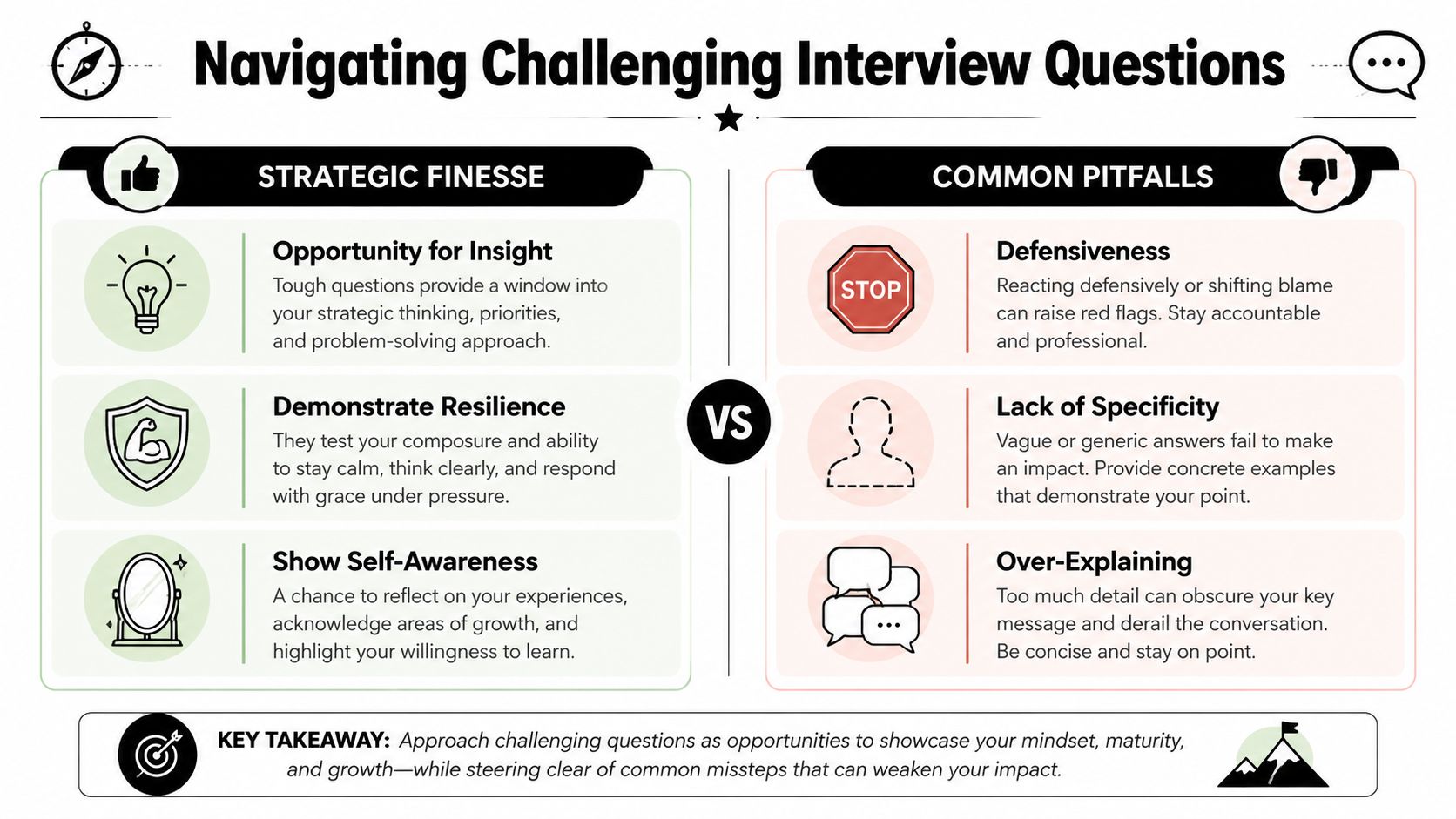
Difficult questions aren't there to punish you. They're there to reveal how you think when your status feels exposed.
That's why canned answers usually fail. They sound polished but thin. In promotion interview preparation, the goal isn't to memorize. It's to build response frameworks you can use under pressure.
The skill gap question is a leadership test
One of the most mishandled questions is some version of, “What's your biggest gap for this role?”
A strong answer doesn't deny the gap, and it doesn't dramatize it. Situational's advice on internal promotion interviews is clear: you need to identify any gaps, tie that narrative to your excitement for the opportunity, and be ready to describe learning a new skill quickly.
That creates a better structure:
- Name the gap
- Show why it doesn't block readiness
- Explain how you're already closing it
- Give an example of rapid learning
For example, if the role expands your exposure to broader financial decision-making, don't say, “I haven't done enough finance.” Say that your direct ownership has been narrower, but you've already built fluency through adjacent responsibilities and you learn quickly in live business contexts.
Failure questions are about judgment, not confession
When the panel asks about a failure, they usually want to know four things:
- Do you take ownership?
- Can you diagnose causes accurately?
- Did you change your behavior?
- Are you safer to trust now than before?
A poor answer blames context. Another poor answer performs self-awareness without any real lesson. A strong answer isolates one decision, names what was flawed, explains what changed, and stays concise.
Coach's lens: The more senior the role, the less interested they are in perfection. They want usable self-awareness.
Why should we promote you over others
This question makes many strong candidates either shrink or oversell.
The right move is neither. Anchor your answer in fit, not entitlement. State the combination of business knowledge, proven contribution, and readiness for the next scope. Keep the tone calm.
If you want realistic practice pressure, an AI interview prep tool can help you rehearse tough prompts out loud and hear where your answer starts to become vague or defensive.
For harder moments in the interview itself, this resource on thinking on your feet is especially relevant for senior professionals who know their content but lose sharpness under scrutiny.
Think Like a Strategist Not Just a Candidate
Most candidates prepare answers. Strong internal candidates prepare a point of view.
This is where promotion interview preparation moves from competent to persuasive. You stop presenting yourself as someone hoping to be chosen and start sounding like someone who already understands the business needs of the role.
Build a stakeholder map before the interview
Don't walk in with one generic message for everyone on the panel. Senior interviewers care about different things.
Create a simple map with each interviewer's role, likely priorities, current pressures, and what they need from the promoted person. The hiring manager may care about execution and team leadership. A cross-functional peer may care about collaboration and decision quality. A senior executive may care about judgment, visibility, and risk.
Once you map the room, tailor your stories accordingly.
- For the hiring manager. Emphasize operational outcomes and leadership reliability.
- For peers. Show partnership, conflict resolution, and alignment.
- For senior leaders. Speak to business trade-offs, momentum, and organizational impact.
Ask questions that prove you're already operating at the next level
One of the clearest signals of weak preparation is the generic closing question. The data cited in this interview guidance video shows that 99% of candidates ask low-value questions, while stronger candidates ask about “success in the first 90 days” or the team's biggest challenges, as discussed in this promotion interview analysis on YouTube.
That distinction matters because generic questions keep you in candidate mode. Strategic questions shift you into partner mode.
Compare these:
| Generic question | Strategic question |
|---|---|
| What does success look like in this role? | What would you want the person in this role to have solved or stabilized in the first 90 days? |
| What are the biggest challenges? | Which team challenge needs stronger ownership right now, and where could this role create the fastest leverage? |
| What are you looking for in the ideal candidate? | Which capability would make the biggest difference to the business over the next phase? |
If you're an international professional adapting to a new workplace culture, mindset work matters here too. This guide to mindsets for expats in Italy is useful because it speaks directly to how environment shapes self-positioning and confidence.
The best question in the interview is often the one that makes the panel think, “This person is already looking at the role from the inside.”
Strategic candidates talk about future impact
One trade-off shows up constantly. Candidates spend most of the interview defending their past. Panels are often deciding based on future usefulness.
Your stories should therefore end with forward relevance. Not just what you did, but why that experience prepares you to solve the problems this role now owns.
That's the shift. You are no longer summarizing your CV. You are making a business case.
Secure the Role and Set the Stage for Success
The interview doesn't end when the call ends or when you leave the room. Senior candidates use the follow-up to reinforce judgment, clarity, and momentum.
A weak follow-up says thanks and repeats enthusiasm. A strong one briefly confirms your understanding of the role's priorities and reconnects your background to those needs.
Write a follow-up like a concise business note
Your message should be short enough to read quickly and substantial enough to matter.
Use this structure:
- Thank them for the discussion.
- Reference one or two priorities you heard clearly.
- Reaffirm how your experience aligns with those priorities.
- Signal readiness to contribute early.
For example, if the panel emphasized team alignment and decision speed, your note should mention those directly. That shows listening, not template sending.
Introduce early-impact thinking
You don't need to attach a full operating plan unless the process calls for it. But you should think in that direction.
A light 30-60-90-day frame helps you answer post-interview questions with more authority:
- first phase, listen and diagnose
- second phase, align and prioritize
- third phase, execute and stabilize
That level of specificity separates ambition from readiness. It also gives you a useful base for future development conversations, especially if this opportunity doesn't convert immediately. If that happens, define sharper development goals for work while the feedback is still fresh.
The final impression is often the deciding one
In closely contested internal processes, the gap between finalists is rarely technical skill alone. It's often the degree of confidence the panel feels in your communication, judgment, and readiness for broader visibility.
That's why many high-potential professionals prepare the content but underprepare the delivery. The content gets them shortlisted. The delivery gets them trusted.
The Gravitas Method is a 12-week one-on-one executive presence coaching program for international professionals who want to communicate with more authority and influence at senior levels. The program is priced at $8,200 paid in full or $9,000 across three installments. Coached by Nikola, it covers vocal authority, strategic framing, executive body language, and high-stakes communication.
Promotion interview preparation is strongest when you treat it as leadership preparation. Build quantified proof. Refine your voice. Tighten your thinking. Ask better questions. Follow up like someone who already sees the business from the next level.
If you want a sharper read on how your communication lands in senior rooms, start with Intonetic's free Executive Communication Assessment. It's the best entry point if you want specific feedback on vocal authority, executive presence, and how convincingly you come across in high-stakes promotion conversations.