
Ace Behavioral Questions STAR: Executive Interview Prep
You have the résumé. You have the promotions. You’ve led teams, fixed messy situations, delivered under pressure, and made decisions that carried real business consequences.
Then the interview starts, and someone asks, “Tell me about a time you handled a difficult stakeholder.”
Many senior professionals answer that question badly, not because they lack substance, but because they describe experience the way insiders talk to each other. They start too wide, add too much context, hide behind “we,” and land on a result that sounds respectable but not decisive. The interviewer hears effort, but not leadership.
That’s where behavioral questions star becomes more than an interview trick. It becomes a discipline for turning experience into evidence.
Why Your Experience Isn't Enough in Behavioral Interviews
A strong background doesn’t automatically sound strong in a live interview.
Senior candidates often assume the interviewer will infer strategic thinking from title, scope, or brand names. That rarely happens. In behavioral interviews, the interviewer is listening for judgment, influence, ownership, composure, and your ability to make sense of complexity out loud.

What goes wrong for senior candidates
A director in a mock interview once answered a stakeholder conflict question by explaining the company structure, market pressure, team dependencies, and the history of the project. The answer was intelligent. It was also unfocused.
After two minutes, the interviewer still didn’t know three things:
- What the actual problem was
- What decision the candidate personally made
- Why that decision showed leadership
That’s the core problem. Your experience may be impressive, but if the listener has to work to extract the leadership signal, you lose altitude.
For international professionals, there’s often an extra layer. You may already be managing language load, accent anxiety, or the subtle pressure to sound “fluent enough” and “senior enough” at the same time. If that feels familiar, this piece on accent bias and the hidden workplace challenge for non-native speakers is worth reading.
Why behavioral questions decide seniority
Behavioral questions are where interviewers test what your CV can’t prove. A résumé shows outcomes. It doesn’t show how you think when priorities conflict, how you persuade skeptical stakeholders, or how you recover when something goes wrong.
Practical rule: If your answer makes you sound busy rather than effective, it’s not a leadership answer.
At senior level, interviewers aren’t just checking whether you’ve “done” something. They’re checking whether you can frame a situation with clarity, isolate the key decision, and explain your action without rambling or overselling.
That’s why STAR remains so useful. It gives structure to stories that would otherwise sprawl, and it helps the interviewer evaluate you on evidence instead of impression.
The shift that changes everything
The candidates who perform best don’t dump their experience onto the table and hope it speaks for itself. They package it.
They choose stories with tension. They frame the business stakes fast. They make their role explicit. They focus on action. They end with an outcome that proves judgment, not just effort.
That’s the difference between sounding like someone who participated and someone who led.
Deconstructing the STAR Framework for Executive Impact
Many learn STAR as a basic acronym. Senior professionals need to use it as a compression tool.
The STAR method suggests a common allocation of time, focusing significantly on Action while dedicating smaller portions to Situation, Task, and Result. That structure was formalized in the 1980s to improve hiring objectivity, and by the 1990s, over 70% of Fortune 500 companies had adopted behavioral interviewing because it correlated with 25-30% higher retention rates (MIT Career Advising and Professional Development).
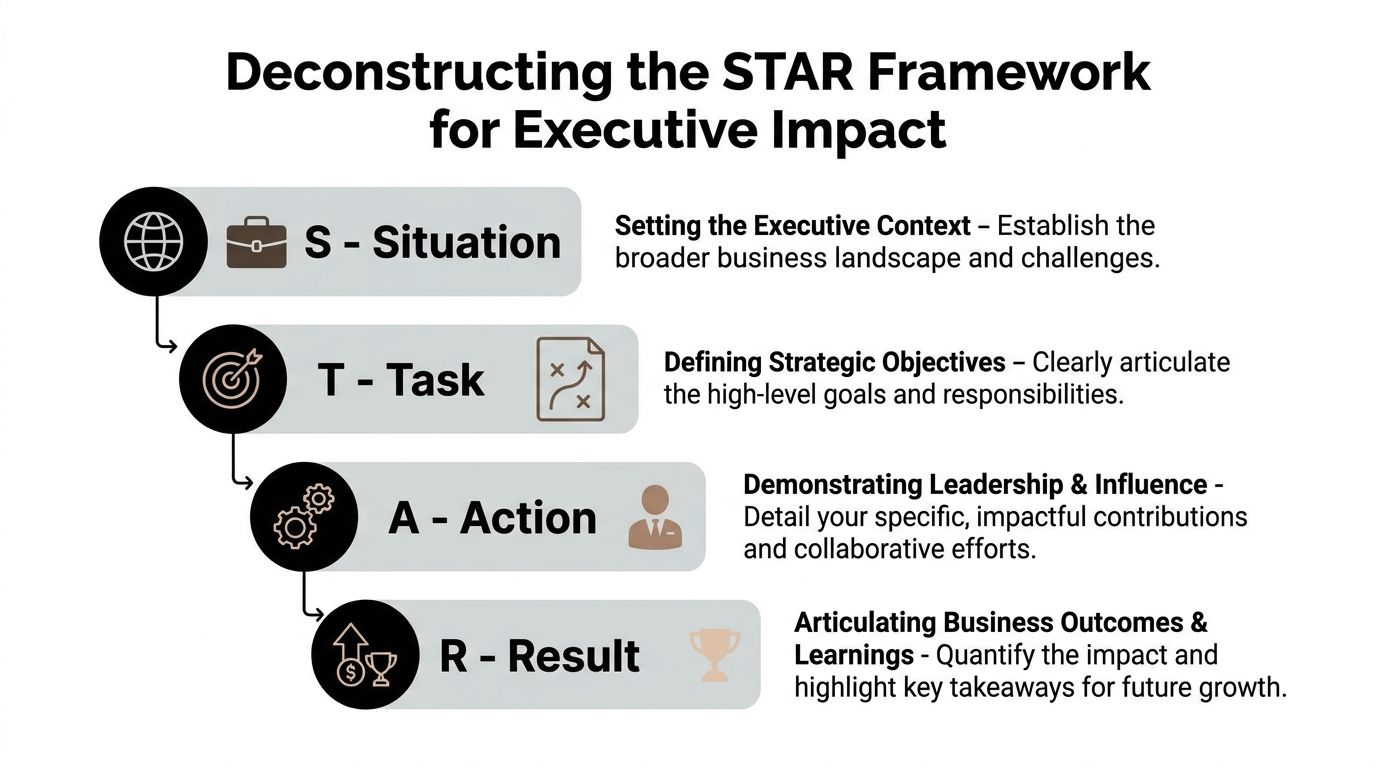
Situation should create relevance, not a documentary
A weak senior answer spends too long setting the scene.
A strong one gives only the context the interviewer needs to understand the stakes. That usually means the business environment, the pressure point, and the complication.
Compare the difference:
- Weak framing: “At the time, our organization was going through several changes, and I had recently joined a cross-functional initiative with multiple workstreams and regional considerations…”
- Strong framing: “I inherited a launch that was slipping because product, legal, and regional sales leaders were pushing different timelines.”
The second version does more with less. It’s easier to follow, and it tells the interviewer where to listen.
Task should show judgment
Many candidates treat Task as a job description. That wastes the moment.
At senior level, Task should identify the decision or responsibility that mattered. It should answer, “What, specifically, were you accountable for in that situation?”
Good task statements sound like this:
- You had to align conflicting stakeholders
- You had to stabilize trust after a mistake
- You had to make a recommendation with incomplete information
- You had to protect a long-term objective against short-term pressure
That’s what executive accountability sounds like.
Action is where you earn credibility
This is the core of the answer. If your Action section is vague, everything collapses.
Many people know they should focus on Action, but they still talk in abstractions. They say they “collaborated,” “aligned,” “supported,” or “worked with leadership.” None of that tells the interviewer how you operated.
What works is specificity.
Show sequence
Explain the steps in the order they mattered.
- Diagnose the problem
- Choose a path
- Influence the right people
- Manage risk or resistance
- Execute
That sequence reveals how you think.
Use “I” carefully and clearly
At senior level, hiding behind “we” is one of the fastest ways to weaken a story. Collaboration matters, but ownership matters more.
Say things like:
- I reframed the recommendation around risk exposure rather than preference
- I brought legal and sales into the same decision meeting instead of handling objections separately
- I paused the rollout until we had a realistic path the team could support
That language doesn’t sound self-centered. It sounds accountable.
Name the hard part
The best STAR answers include friction. If your story sounds too smooth, it won’t feel senior.
Say what made the decision difficult:
- an unpopular recommendation
- incomplete data
- resistant stakeholders
- competing deadlines
- reputational risk
- team fatigue
Interviewers trust stories that include trade-offs.
A polished answer without tension often sounds rehearsed. A credible answer shows the challenges you managed.
If you want additional frameworks to prepare for competency-based interviews, that resource is useful because it helps you match stories to the competencies being tested rather than memorizing generic examples.
Result should prove business value
A result isn’t “it went well.”
A result closes the loop. It shows what changed because of your decision. For senior candidates, the strongest results tie to business outcomes, team outcomes, stakeholder outcomes, or strategic learning.
Useful result language includes:
- The recommendation was adopted
- The rollout stabilized
- Stakeholder trust recovered
- The team avoided a poor decision
- The change became the new operating approach
If you have a verified metric, use it. If you don’t, be concrete without inventing one.
What executive-level STAR sounds like
The mature version of behavioral questions star doesn’t feel formulaic. It feels controlled.
You’re not reciting an acronym. You’re giving the interviewer a clean way to evaluate your leadership.
A practical rehearsal method is to role-play your answer aloud, then trim anything that sounds like background rather than influence. This guide on role-playing and simulation exercises to improve English accent is useful for professionals who need both language precision and delivery control under pressure.
Crafting Compelling STAR Stories for Your Industry
Generic STAR examples are one reason strong candidates sound interchangeable.
A senior product leader shouldn’t tell a story the same way a finance director would. The structure is the same, but the signals are different. Each industry rewards a different kind of judgment.
A useful reminder comes from hiring data in data-heavy fields. A 2025 Glassdoor analysis of 10,000 behavioral interviews found that 74% of rejections stemmed from unquantified results, and product managers and data scientists were 40% less likely to advance without ROI-linked stories (Northwestern Career Advancement).

Tech example
A strong tech story usually shows prioritization, cross-functional influence, and comfort with ambiguity.
Try this shape for a product or data role:
Situation
A newly launched sign-up flow was underperforming, but the broad dashboard view wasn’t isolating the issue.
Task
You needed to identify the breakdown quickly and restore performance without turning the review into blame.
Action
You pulled funnel data, segmented by browser and device, and found a Safari-specific form error. You partnered with engineering to validate the issue, helped prioritize the fix, and communicated the diagnosis in business terms so commercial stakeholders understood the urgency.
Result
The issue was resolved, $40K in lost conversions was recovered, and sign-ups rebounded within 48 hours.
That example works because it combines diagnosis, influence, and measurable impact. It also avoids one common tech mistake, which is making the answer too technical for the business audience.
Finance example
Finance leaders often undersell themselves by making stories sound procedural.
A better finance story shows risk judgment and executive communication.
Situation
You were reviewing a proposal that looked attractive on paper, but assumptions behind the model were too optimistic.
Task
You had to challenge senior enthusiasm without appearing obstructive.
Action
You rebuilt the scenario analysis around downside exposure, isolated the assumptions that carried the most risk, and reframed the conversation from “Can we fund this?” to “Under what conditions is this still a disciplined decision?” You briefed the sponsor privately before the broader meeting so the public conversation stayed productive.
Result
The recommendation changed. The leadership team adopted a more cautious path, and your credibility rose because you protected decision quality without creating unnecessary confrontation.
Notice what makes this feel senior. The story is not about spreadsheet work. It is about judgment, diplomacy, and timing.
Consulting example
Consultants often bring strong stories but tell them too abstractly.
The answer becomes much stronger when it includes a difficult recommendation and the client-management choices around it.
There’s a useful pattern in Northwestern’s tutoring example, where someone coordinated 45 tutors for 120 students weekly and proposed additional training despite initial resistance, using interviews and a budgeted proposal to improve service quality. That kind of story works because the recommendation wasn’t just operational. It required influence and evidence.
A consulting version might sound like this:
“The client expected a faster implementation than the operating model could support. I knew that agreeing would preserve goodwill in the short term and create failure later. I interviewed the people closest to the work, built a phased recommendation, and positioned it around adoption risk rather than project delay. The client didn’t love the answer immediately, but they accepted it because the logic was disciplined.”
That is the tone consultants need. Calm, commercial, and firm.
If you want extra prompts to expand your story bank, 10 Common Behavioral Interview Questions and How to Answer Them is a useful companion because it helps you map your examples to the questions most often asked.
Executive leadership example
For directors, VPs, and aspiring C-suite leaders, the story must show more than project execution. It needs to show how you moved people.
A useful template:
- Situation: A function was fragmented, trust was low, and teams were operating with different assumptions.
- Task: You had to create alignment without slowing the business.
- Action: You clarified decision rights, reset expectations with direct reports, and used a consistent message with peers so the organization stopped hearing mixed signals.
- Result: The team operated with more coherence, stakeholders escalated less reactively, and your leadership became easier to trust because your communication was stable.
How to make your own stories stronger
Don’t just ask, “What happened?”
Ask sharper questions:
- Where was the core tension
- What decision did I personally own
- Who resisted, and why
- What did I say or do that changed the outcome
- What business consequence followed
For international professionals, rehearsal matters because clarity and authority have to arrive together. If you want to sharpen how these stories sound in live conversation, this guide on accent reduction for executives is especially relevant for high-stakes interview settings.
Common STAR Method Pitfalls That Undermine Seniority
Bad STAR answers do not fail unnoticed. They create the wrong impression.
They make a senior candidate sound unfocused, low-ownership, over-rehearsed, or too junior for the role. That’s why the most useful way to improve isn’t by collecting more stories. It’s by diagnosing what weakens the stories you already have.
Predictive Index warns that rigid STAR use without customization is a major problem. 60% of generic responses fail to reveal misalignments, and vague Actions are rejected in 75% of cases. In roles like tech product management, those weak answers can contribute to 20-25% early turnover when hiring decisions go wrong (Predictive Index on rating interview responses using the STAR method).
The most common damage points
The first is over-contextualizing. Senior candidates often think more context proves sophistication. Usually it just eats the clock.
The second is diluted ownership. Too much “we” makes it impossible to see your judgment.
The third is a weak ending. If the result is vague, your story feels unfinished.
The fourth is choosing a story that’s too small. Solving a minor coordination issue may be fine for an early-career role. It won’t carry enough weight for a senior leadership interview.
Before and after
Before
“We were working on a complex initiative across multiple regions, and there were some communication challenges between teams, so we collaborated to improve alignment.”
After
“I inherited a cross-regional initiative that was slipping because each team was working from a different priority list. I brought the decision-makers into one review, forced agreement on sequencing, and reset accountability so the team stopped treating every request as urgent.”
The second answer sounds more senior because it contains a problem, a decision, and a visible intervention.
Diagnostic lens: If someone else could replace your name in the answer and it would still fit, your action isn’t specific enough.
Common STAR Mistakes and How to Fix Them
| Common Pitfall | Negative Perception | Corrective Action |
|---|---|---|
| Too much Situation | You sound long-winded and unclear | Cut the background to the pressure point, stakes, and complication |
| Task sounds like your job description | You sound generic | Name the decision, mandate, or responsibility that mattered in that moment |
| Action uses “we” throughout | You sound low-ownership | Clarify what you personally decided, initiated, or changed |
| Action is abstract | You sound managerial, not strategic | Describe the sequence of steps, trade-offs, and stakeholder moves |
| Result is vague | You sound unconvincing | State what changed in business, team, or stakeholder terms |
| Story is too simple | You sound under-leveled | Choose examples with tension, resistance, or meaningful consequences |
Don’t worship the framework
Some candidates become robotic because they treat STAR as a script format rather than a thinking format.
Interviewers don’t need to hear the acronym. They need to hear a coherent leadership story. If your answer sounds boxed in, loosen the wording while keeping the logic.
A practical rehearsal method is to record yourself answering one question three times. On the second attempt, cut half the context. On the third, make every action sentence start with a verb. That exercise quickly exposes vagueness.
For candidates who also need sharper spoken clarity, this guide on how to improve English pronunciation for job interviews can help reduce the friction between strong content and weak delivery.
Mastering Delivery to Communicate Executive Presence
At senior level, content and delivery are judged together.
You can have a well-structured answer and still sound uncertain. That happens all the time. The story is solid, but the pace is rushed, the tone drops at the wrong moments, the body language collapses, and the result lands without authority.

A landmark 1980s study by DDI found that STAR-structured responses predicted job performance with a correlation of r=0.55, which was twice that of unstructured interviews. By 2010, 85% of U.S. tech firms like Google and Amazon had integrated it into hiring processes (Management 3.0 on STAR behavioral interview questions).
That tells you why structure matters. It doesn’t tell you why one candidate with the same structure gets perceived as more senior than another. Delivery explains the gap.
What executive presence sounds like in an interview
It sounds controlled.
Not dramatic. Not inflated. Not performative.
Executive presence in a behavioral answer usually has four qualities:
- Pacing that allows ideas to land
- Tone that stays steady under pressure
- Sentence shape that is decisive rather than crowded
- Physical stillness that signals composure
Many non-native English professionals speak too fast when they want to sound capable. The result is the opposite. Speed can make a strong answer harder to follow and make ordinary language sound uncertain.
Practical delivery techniques that work
Use strategic pauses
Pause after the Situation. Pause before the Result.
Those pauses create separation between context, decision, and outcome. They also help you sound deliberate rather than rushed.
Drop your pace on action sentences
The Action section carries your leadership signal. If you race through it, the interviewer misses the point.
Slow down most on sentences that include decisions, stakeholder management, or trade-offs.
End sentences cleanly
Senior candidates often trail off at the end of important lines. That weakens authority.
Finish key statements with vocal completion. Don’t let the last word disappear.
Slow speech isn’t the goal. Controlled speech is.
Body language still matters on video
Candidates tend to underestimate how much video interviews flatten presence.
A few simple adjustments make a difference:
- Sit high enough to keep your chest open
- Keep gestures inside the camera frame
- Look at the camera when delivering the core action or result
- Avoid excessive nodding while answering
Each of those choices makes your message easier to trust.
Here’s a useful video resource to study pacing and spoken delivery in interview communication:
Rehearsal that doesn’t make you robotic
Don’t memorize full scripts. Internalize the beats.
A better method is to build a one-line prompt for each part of the story:
- Situation in one sentence
- Task in one sentence
- Three action bullets
- Result in one sentence
- One takeaway if relevant
Then practice aloud until the answer sounds natural. The goal is flexibility with structure.
The Gravitas Method is a 12-week one-on-one executive presence coaching program for international professionals who want to communicate with more authority and influence at senior levels. The program is priced at $8,200 paid in full or $9,000 across three installments. Coached by Nikola, it covers vocal authority, strategic framing, executive body language, and high-stakes communication. If you want details, the program page is here: https://intonetic.com/executive-presence-coaching/
From Preparation to Presence Your Action Plan
The strongest behavioral answers don’t sound memorized. They sound lived-in.
That only happens when structure and delivery have both been practiced enough that you can think and speak at the same time. Not perfectly. Cleanly.
What to do this week
Start with five stories, not fifteen.
Choose examples that show:
- A difficult decision
- A conflict you resolved
- A mistake you owned
- A change you influenced
- A result you can explain clearly
Then pressure-test each one.
A better preparation sequence
Use this order:
- Write the story in rough STAR form
- Cut the context until the stakes are obvious
- Underline your own actions
- Replace vague verbs with precise ones
- Practice aloud until the answer sounds conversational
If a story still feels flat, the issue is usually one of three things. The example is too small. Your action isn’t visible. Or your result doesn’t show enough business significance.
What senior candidates should listen for
When you rehearse, don’t just ask, “Did I answer the question?”
Ask these instead:
- Did I sound like the person making the decision
- Did I show trade-offs, not just activity
- Did my result prove impact
- Did my delivery match the level of the role
One final point matters a lot for international professionals. You do not need to sound like a native speaker to sound senior. You need to sound clear, grounded, and intentional. Those are trainable skills.
Behavioral questions star works best when it becomes a repeatable leadership language. Not a formula. A habit of thinking, choosing, and speaking with precision under pressure.
If you want objective feedback before your next interview, start with the free Executive Communication Assessment from Intonetic. You’ll get a clear view of where your interview delivery, structure, and executive presence may be weakening your message, and what to fix first. Book it here: https://intonetic.com/executive-presence-coaching/