
Perception and Communication: Boost Executive Authority
You're in a strategy meeting. You've done the work, your numbers are solid, and your recommendation is right. Then you notice it. Someone interrupts more easily when you speak. A senior stakeholder asks another colleague to “translate” the same point you already made. Your message lands, but your authority doesn't.
That gap is where perception and communication collide.
For many international professionals, this is the frustrating part. The issue often isn't expertise, preparation, or even English grammar. It's that people don't respond only to words. They respond to signals, assumptions, and cultural expectations they may not even notice themselves. If those signals and expectations are misaligned, a capable leader can sound less decisive, less senior, or less credible than they are.
Introduction to Perception and Communication
A boardroom rarely tells you directly what's happening. It shows you in smaller ways. Eyes drift when you start a point. Someone else speaks with the same level of certainty, and the room suddenly leans in. You may leave thinking, “I said the same thing. Why was it heard differently?”

That's not a small issue. Poor communication costs large corporations an estimated $62.4 million annually, while miscommunication alone costs U.S. businesses approximately $1.2 trillion each year. At senior levels, communication errors don't stay personal. They affect decisions, deadlines, alignment, and trust.
If you work across cultures, the challenge gets harder. A delivery style that sounds respectful in one setting may sound hesitant in another. A calm face may read as thoughtful to one audience and disengaged to another. That's why perception and communication can't be treated as separate skills.
If you want a broader foundation for how messages function inside organizations, this guide on business communication in the workplace is a useful companion. Here, I want to focus on the hidden layer underneath. The mental filters that decide how your message is received before anyone comments on the content.
The room isn't only evaluating what you mean. It's evaluating what your delivery seems to mean.
Understanding the Perception Process
People don't receive communication like a recording device. They receive it like a camera with selective focus. The camera captures some things sharply, blurs other things, and frames the scene in a particular way.
That's why two people can attend the same meeting and leave with different conclusions about the same speaker.
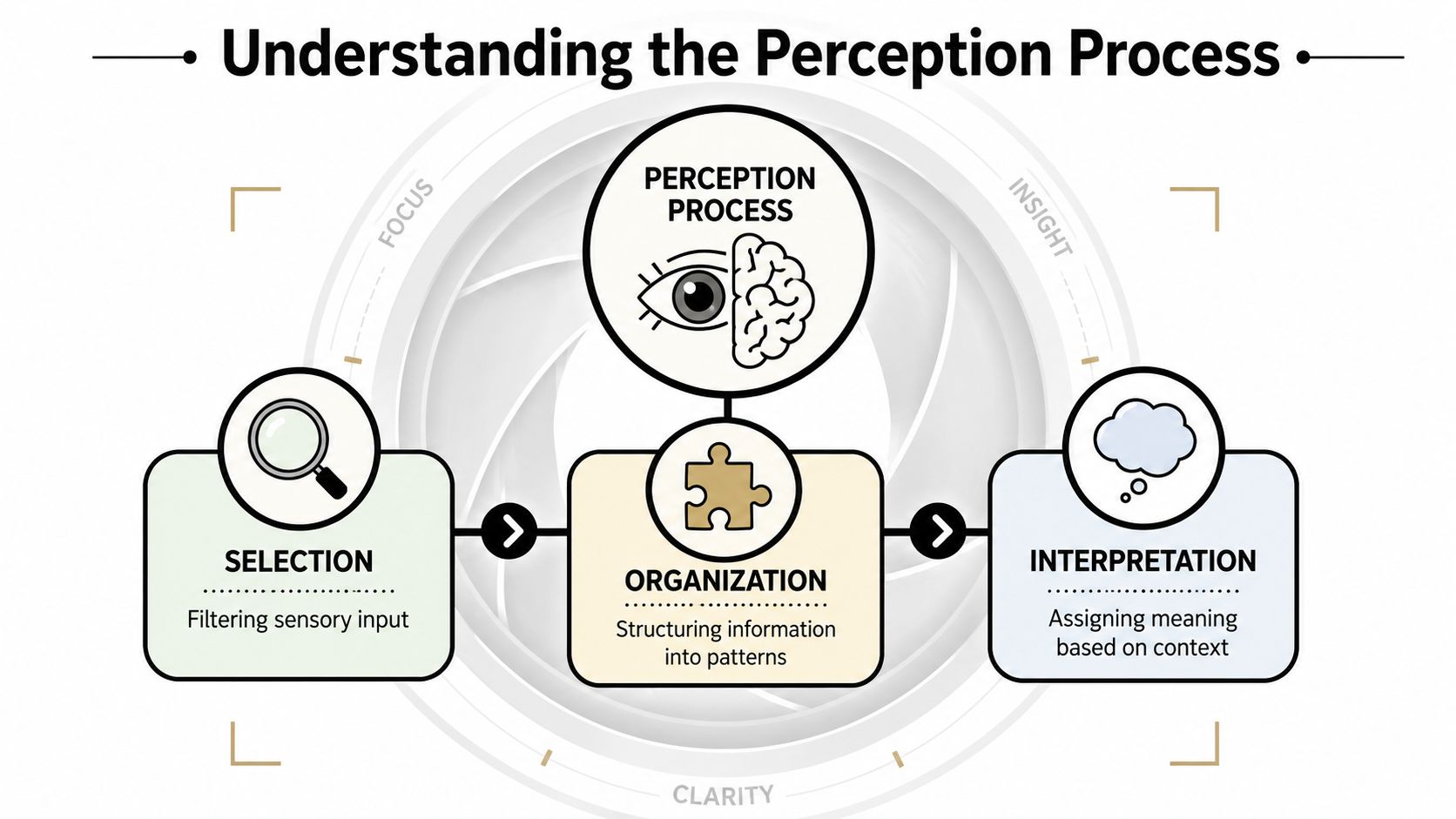
Communication research describes perception as a three-stage pipeline of selection, organization, and interpretation. That same explanation notes that this process can create distortions such as the halo effect, and that perception checking helps reduce misinterpretation by separating objective data from subjective inference.
Selection
First, people select what they notice.
No one absorbs everything. In a meeting, one executive may notice your vocal hesitation. Another may notice your slides. Another may focus on your accent because it's unfamiliar to them. Selection is never neutral. It is shaped by expectations, stress, role, and habit.
For non-native English speakers, frustration often begins in this context. You might intend your message to be judged on content, but a listener may unconsciously focus on pace, pronunciation, or facial stillness first.
A practical way to strengthen this part of communication is to improve how well you notice others before reacting. If listening under pressure is difficult, tools that help you master listening with AI methods can sharpen your awareness of tone, emphasis, and missed detail.
Organization
Then the brain organizes what it noticed.
It groups separate signals into a pattern. Fast speech plus rising intonation may become “nervous.” Brief answers plus limited eye contact may become “unprepared.” A polished suit plus confident posture may become “senior.”
This is where schemata matter. Schemata are stored mental templates. They help people move quickly, but they also lead them to sort information into familiar categories that may not fit reality.
A short example:
| Observable behavior | Possible organization |
|---|---|
| Speaker pauses before answering | Thoughtful, or uncertain |
| Speaker avoids direct disagreement | Diplomatic, or weak |
| Speaker speaks evenly with little facial change | Composed, or disengaged |
The same behavior can be organized in different ways depending on the audience.
Interpretation
Finally, people interpret the pattern.
This is the meaning-making stage. The listener decides what the pattern says about competence, confidence, trust, or intent. Once that interpretation is formed, it starts guiding future reactions. They interrupt more. They challenge more. Or they defer more.
This is why perception checking is so useful in high-stakes conversations. It slows down automatic interpretation.
Try this three-part structure in meetings:
- Describe the behavior: “I noticed the team went quiet after that proposal.”
- Offer more than one meaning: “I'm not sure if that means concern, surprise, or a need for more detail.”
- Ask for clarification: “What's your read?”
That move does two things. It reduces mind-reading, and it models executive composure.
Practical rule: Separate what you saw from what you assumed. That one habit improves perception and communication more than most people expect.
If you want to study how visible cues shape meaning moment by moment, this breakdown of facial expression and meaning helps you spot the signals people often misread.
Connecting Signals to Authority
At senior levels, authority doesn't come from information alone. It comes from how information is delivered under pressure.
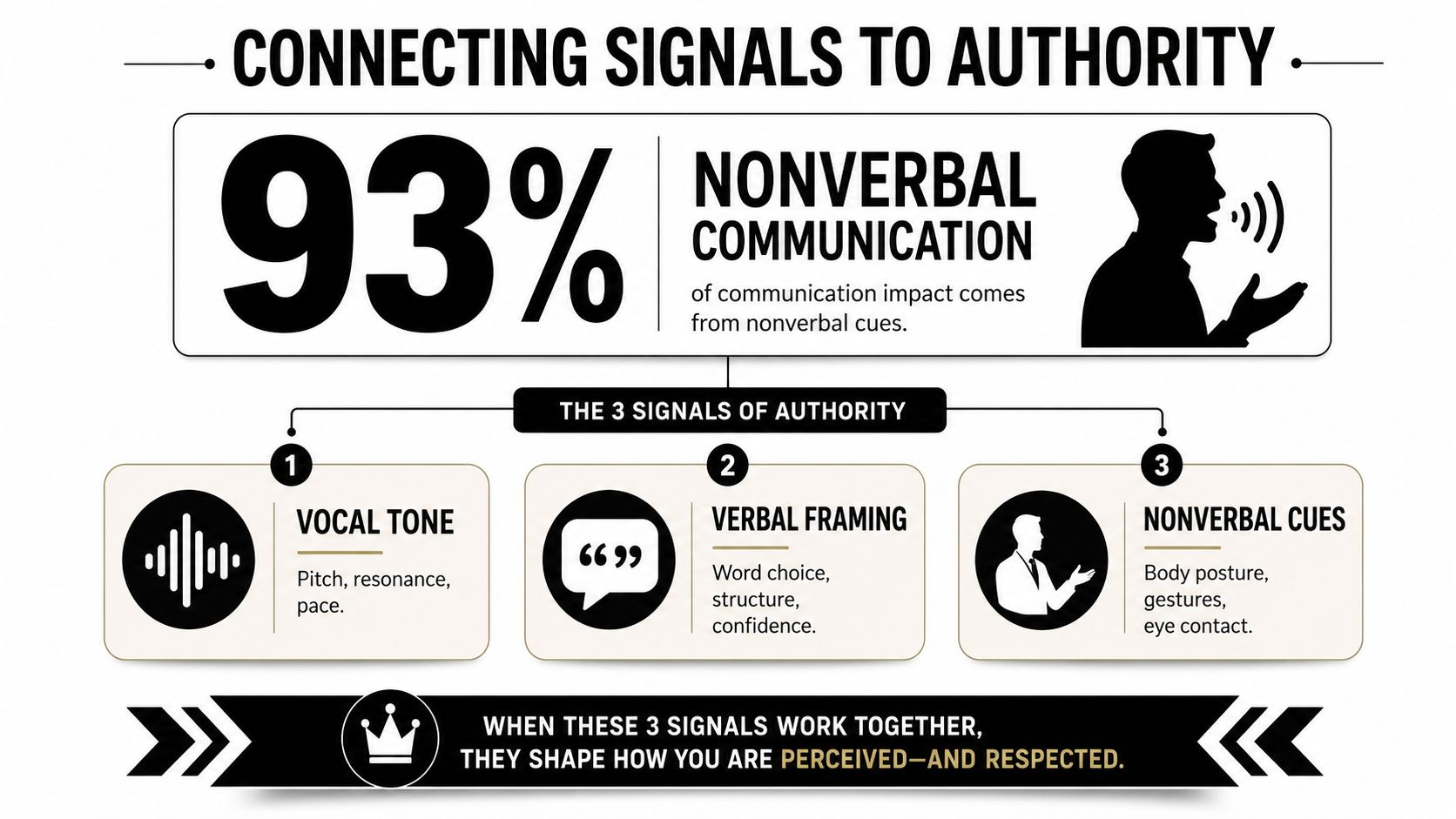
That's why one statistic keeps showing up in communication discussions. Approximately 93% of effective communication is nonverbal while spoken words account for only 7%. Whether you agree with every way that figure is applied, the leadership takeaway is clear. Delivery shapes perceived seniority.
Vocal signals people notice fast
Authority is often heard before it is understood. Training systems that focus on executive presence often break vocal authority into mechanics such as Power Pause, Pace Control, Resonance, Projection, and removing Vocal Fry.
Here's what those sound like in practice:
- Power Pause: You finish a key point, stop, and let the room process it instead of rushing to justify it.
- Pace Control: You slow down on important decisions and speed up only on background detail.
- Resonance: Your voice sounds grounded rather than thin or tight.
- Projection: Your sound reaches the room without strain.
A common mistake among non-native speakers is speaking too quickly to “prove fluency.” That usually lowers authority because speed can erase emphasis and structure.
To see these ideas in action, this short video is useful:
Verbal framing changes how confidence sounds
Words still matter. But authority depends less on advanced vocabulary and more on structure.
Compare these two openings:
- “I was thinking maybe one option could be to revisit the launch timeline.”
- “I recommend we revisit the launch timeline for two reasons.”
The second version sounds more senior because the frame is clear. It tells the audience what to do with the information.
Useful framing patterns include:
- Recommendation first: “My recommendation is…”
- Reason structure: “There are two drivers behind this.”
- Decision language: “The trade-off is speed versus risk.”
- Boundary language: “What we know, what we don't know, and what we need next.”
Body cues that either support or undercut you
Body language doesn't need to be dramatic. Small adjustments create a stronger leadership signal.
A slight forward lean can signal engagement. A stable posture can make your message feel more settled. Consistent eye contact matters too, and the communication data often cited in workplace research notes that many business professionals see eye contact as vital in business communication.
If you tend to freeze physically when speaking English under pressure, don't try to “perform confidence.” Build repeatable habits instead:
- Plant your feet before you answer.
- Lift your gaze before your first sentence.
- Keep gestures at mid-torso instead of hiding them.
- Finish the sentence cleanly instead of trailing upward.
For a fuller breakdown, this guide to body language for leaders is worth reviewing.
Strong authority signals are usually quiet. They look like control, not effort.
Measuring Blind Spots for Non-native Speakers
The hardest part of cross-cultural communication is that your blind spots are often invisible to you and obvious to everyone else.
Many communication guides treat vocal authority as universal, yet cultural perceptual frameworks vary drastically, which can cause audiences to misinterpret straightforward delivery from international professionals as lacking authority. That's why generic advice like “be more confident” rarely helps. It doesn't tell you what others perceive from your delivery.
Three blind spots to check first
Start by auditing these areas:
- Tone-read mismatch: You believe you sound neutral, but others hear flat, tense, or tentative.
- Structure-read mismatch: You think you're being careful, but others hear a lack of clear position.
- Energy-read mismatch: You believe you sound professional, but others hear low conviction.
These aren't character flaws. They're perception gaps.
A simple self-audit
Use one recent meeting recording or rehearsal clip and ask two trusted colleagues to score only what they can observe.
| Signal | What to ask |
|---|---|
| Voice | Did I sound settled, rushed, or hesitant? |
| Framing | Did my main point arrive early or late? |
| Face and posture | Did I look engaged, guarded, or unreadable? |
Ask them to describe behavior, not personality. “You looked down before each answer” is useful. “You seemed weak” is not.
If you struggle with specialized pronunciation in technical settings, tools that help improve AI dictation accuracy can reveal which terms your speech patterns make harder to catch, especially in engineering, finance, or product discussions.
A stronger version of this process is to run a formal review using a communication audit template. That gives you a repeatable way to compare your intent with how others experienced your delivery.
What to look for in cross-cultural settings
Pay attention to moments where the room changes behavior around you:
- They ask for repeated clarification on simple points.
- They respond better when a native-speaking colleague says the same thing.
- They perceive your concise answer as incomplete.
- They read politeness as uncertainty.
Those are signals. Don't treat them as random. Measure them, name them, and test adjustments.
Building Your Authority with Targeted Exercises
Authority improves faster when you train it as a set of mechanics, not a personality makeover. You don't need to become louder or more dramatic. You need to become easier to read as senior.
Strategic pauses are a defined mechanical tool that communicate thoughtfulness and control, and professionals with high gravitas use measured clarity and strategic pauses to avoid reacting impulsively. That makes pause work one of the best training tools for high-stakes communication.
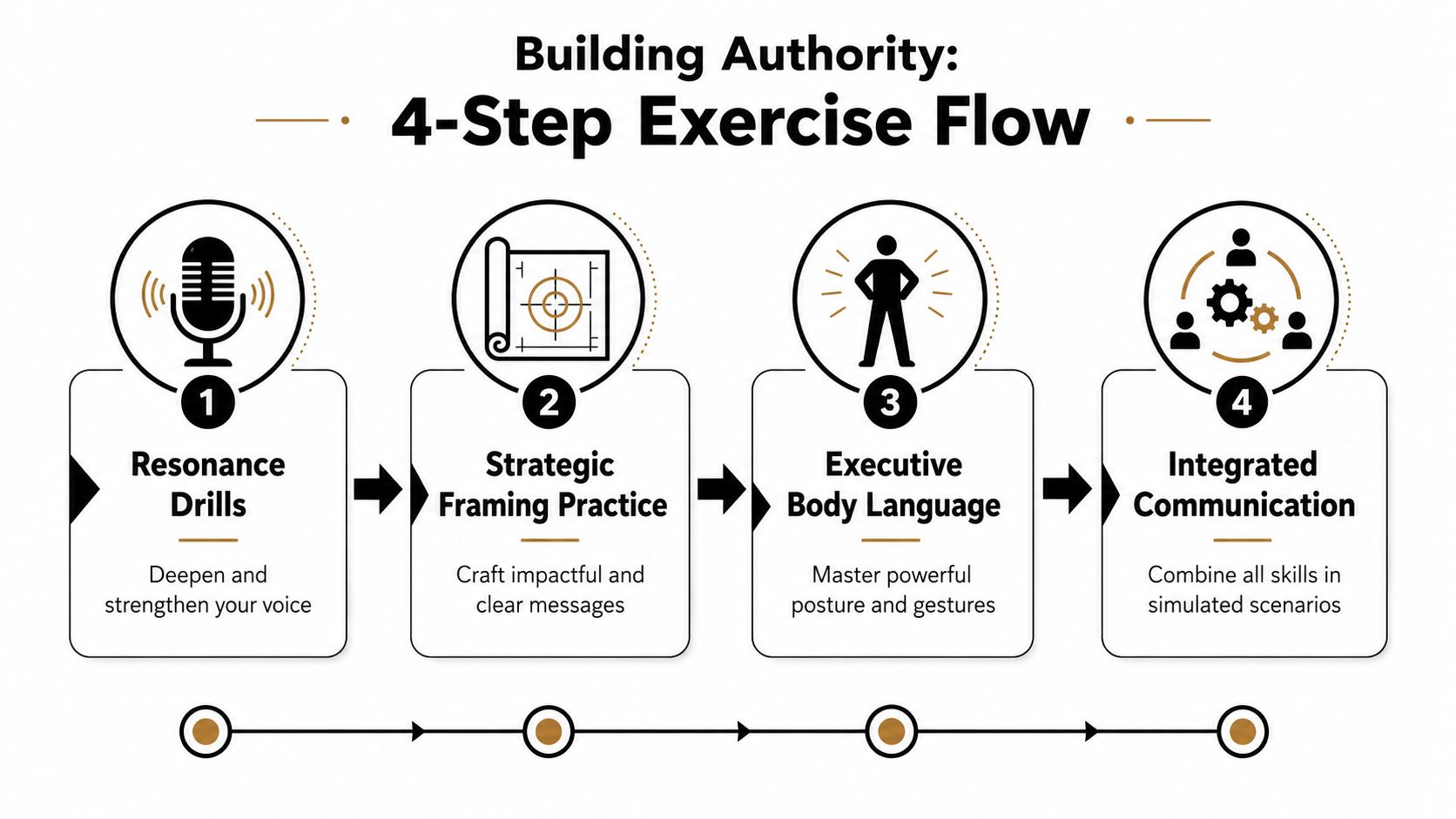
Step one with resonance drills
Start with your voice before you work on message complexity.
Read five lines from a meeting memo aloud. Keep your jaw loose, lower your shoulders, and aim for a fuller sound rather than a higher, narrower one. Then read the same five lines again, but slower.
Use this script:
“My recommendation is to delay the rollout until the team resolves the integration risk.”
Your job isn't to sound deep. Your job is to sound stable.
If your voice tires quickly, practice from a proper warm-up routine. A focused set of vocal chord exercises for speaking can help you build stamina and reduce throat tension before presentations.
Step two with strategic framing
Now train the shape of your answer.
Take one complex issue and force yourself to explain it in three lines:
- your position
- the reason
- the consequence
Example:
- “I recommend we keep the launch date.”
- “The market window matters more than the current design imperfection.”
- “The risk is support load, so we need a stronger client success plan.”
This exercise helps non-native speakers stop over-explaining before making the point.
Step three with pause control in Q and A
Many professionals lose authority at this juncture. A tough question arrives, and they answer too fast.
Practice with a partner. Ask them to challenge your proposal. Before every answer, take one measured pause. Not a dramatic pause. Just enough space to show that you're choosing your response.
Good prompts include:
- “Why should we trust this timeline?”
- “What's the weakness in your plan?”
- “Why wasn't this risk flagged earlier?”
Your target is calm sequencing, not quick defense.
If you answer immediately every time, the room may read speed as pressure. If you pause, the room often reads it as control.
Step four with integrated boardroom rehearsal
Now combine voice, framing, and body language in one short simulation.
Set up a mock executive update with these rules:
- Stand or sit as you would in an actual meeting
- Open with the recommendation first
- Use one deliberate pause after your key point
- Keep your hands visible
- End with a decision request
Record the rehearsal. Watch it once with sound off. Then watch it once with eyes closed. The first review shows your physical authority. The second shows your vocal authority.
A useful outside reference is this article on executive communication training, especially if you want more ideas for structured practice routines. One option in this area is Intonetic, which offers assessment-based coaching for non-native professionals focused on delivery, vocal authority, and executive communication habits.
A weekly reflection prompt
After each practice round, write answers to these three questions:
- What did I intend people to perceive?
- What did my delivery signal?
- What one adjustment will I repeat tomorrow?
That final question matters. Progress comes from repeating one visible change until it becomes your default.
Conclusion and Next Steps
Perception and communication shape leadership together. You can't separate the message from the filters people use to judge it. In senior environments, those filters move quickly. They read your pauses, your vocal steadiness, your structure, your face, and your level of composure.
For international professionals, the challenge is often sharper because cultural expectations distort otherwise strong communication. That's why the smartest approach isn't “sound more confident.” It's to identify the specific places where your delivery gets misread and retrain those signals deliberately.
Start with the clearest next step. Take the free Executive Communication Assessment and get a more objective view of where authority is leaking in your delivery. The Gravitas Method is a 12-week one-on-one executive presence coaching program for international professionals who want to communicate with more authority and influence at senior levels. The program is priced at $8,200 paid in full or $9,000 across three installments. Coached by Nikola, it covers vocal authority, strategic framing, executive body language, and high-stakes communication.
If you want a practical starting point, Intonetic offers a free Executive Communication Assessment at this executive presence coaching page. It's the simplest way to diagnose how your communication is being perceived before you try to fix everything at once.