Free Communication Audit Template: Boost Your Influence
You know the feeling. You've done the hard work, built real expertise, prepared your talking points, and entered the meeting ready to contribute. Then someone with less substance says virtually the same thing you were trying to say, only more crisply, and the room moves with them.
At senior levels, that gap is rarely about intelligence. It's usually about communication under pressure. Not grammar. Not polish for its own sake. Authority, structure, vocal control, and the ability to land a point so people treat it as decisive.
That's where a communication audit template becomes useful. Not the broad corporate version used to review channels across an enterprise, but a personal version designed to evaluate how you come across in high-stakes moments. If you're an international professional operating in English, this matters even more. Senior audiences often confuse familiarity of style with competence. You can't control their bias, but you can control the signals you send.
Why Your Expertise Is Not Enough
A lot of capable senior professionals face the same pattern. They know their subject cold. Their recommendations are sound. Their judgment is respected one-to-one. Yet in leadership meetings, promotion discussions, board updates, or client negotiations, their impact drops.
The issue usually shows up in small moments. They over-explain before making the point. Their voice rises at the end of sentences when challenged. They answer a good question with too much background. They physically shrink when interrupted. None of this means they lack leadership potential. It means their delivery is diluting their authority.

What a personal audit actually does
A personal communication audit is a diagnostic process. It helps you stop relying on vague impressions like “I need to sound more confident” and start identifying observable habits that either strengthen or weaken your executive presence.
If you've ever wondered what executive presence really means in practice, this is the operational version of the answer. You audit the moments where presence is either built or lost.
A communication audit isn't about becoming someone else. It's about removing the habits that make your expertise harder to trust.
The idea of auditing communication isn't new. The formal use of communication audits has roots in public-sector practice, where structured reports were used to evaluate effectiveness and define key messages. Those reports show that the template has long been designed as a repeatable management tool for strategic improvement, not just a one-off checklist, as seen in this school district communication audit report.
What senior professionals get wrong
The most common mistake is treating communication as personality. It isn't. You don't need to become louder, more extroverted, or more “native sounding.” You need to identify where your current habits are hurting clarity, confidence, and influence.
Start there. Not with self-criticism. With evidence.
Defining Your Audit Scope and Objectives
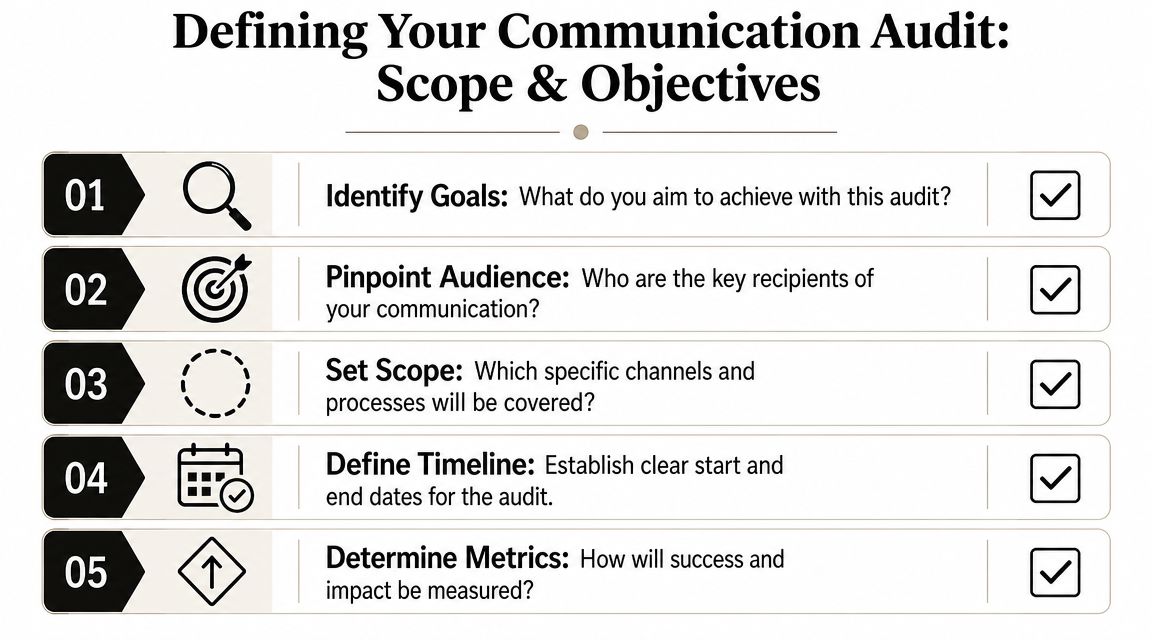
Most self-audits fail because they're too broad. “I want to communicate better” sounds reasonable, but it produces almost nothing useful. A strong communication audit template starts with boundaries.
Choose real situations, not abstract goals
Pick 2 or 3 high-stakes scenarios where your communication most affects your career. Think in concrete terms.
- Executive updates: Monthly business reviews, steering committee briefings, or leadership presentations
- Pressure moments: Q&A after a proposal, pushback in budget discussions, or cross-functional conflict
- External influence: Client calls, investor conversations, partnership meetings, or conference panels
Don't audit every context at once. Your tone in a team check-in may be completely different from your tone when challenged by a CFO. A narrow scope makes the result actionable.
An effective communication audit template starts by fixing the scope, audience segments, and KPIs before data collection. The strongest templates also combine content analysis with audience feedback, because a review is incomplete if it only measures what was sent, not what was understood or acted upon, according to this guide on internal communication audit design.
If you want a clean baseline for the broader concept, it helps to understand business communication in a leadership context, then narrow it down to your own pressure situations.
Write objectives that can be observed
Good objectives describe behavior and outcome. Bad objectives describe a mood.
Use this comparison:
| Weak objective | Strong objective |
|---|---|
| Sound more confident | Maintain a steady pace during Q&A |
| Be more executive | Lead with the recommendation before background |
| Improve speaking | Reduce filler and finish answers cleanly |
| Be better in meetings | Hold posture and eye line when interrupted |
A simple scope worksheet
Use these prompts before you review a single recording:
- Scenario: Where exactly does the communication happen?
- Audience: Who is in the room, and what level of seniority do they hold?
- Desired outcome: What do you need them to think, decide, or do?
- Risk point: Where do you usually lose control?
- Success signal: What would visibly improve if this went well?
Practical rule: If your audit scope wouldn't fit in one sentence, it's still too broad.
What works and what doesn't
What works is precision. Audit your quarterly review, not “all presentations.” Audit your response to challenge, not “confidence.” Audit your opening two minutes, not the whole day.
What doesn't work is collecting impressions without a clear objective. That's how people end up with notes like “seems nervous” or “needs stronger presence,” which sound serious but don't tell you what to change on Monday.
The Four Pillars of Executive Communication and Scoring Rubric
A useful communication audit template turns executive presence into behaviors you can score. That means no vague labels. No “charisma.” No “gravitas” without evidence. Use four pillars: Delivery, Vocal Authority, Strategic Framing, and Executive Body Language.
Effective communication audits measure quantitative indicators and combine them with qualitative feedback to identify gaps, which turns communication into something measurable and linked to action, as outlined in this guide to an internal communications audit. For a personal audit, the same logic applies. You score what you can observe, then add notes about how it landed.
If you want a benchmark before scoring yourself, a dedicated executive presence assessment can sharpen your eye.
Pillar one: Delivery
Delivery is how your message moves. It includes pacing, clarity, concision, transitions, and how cleanly you answer the question asked.
Look for signs such as:
- Pacing control: Do you speed up under pressure?
- Clarity: Do key words blur together?
- Answer discipline: Do you start with the answer, or circle around it?
- Verbal clutter: Are “maybe,” “just,” “sort of,” and filler words weakening your point?
A strong score here doesn't mean sounding theatrical. It means the listener doesn't have to work hard to follow you.
Pillar two: Vocal Authority
Many senior professionals lose influence without realizing it. Your voice signals confidence before your content has time to do its job.
Notice:
- Tone stability: Does your voice thin out when challenged?
- Ending strength: Do statements sound like statements, or like requests for approval?
- Volume consistency: Can the room hear conviction without strain?
- Pauses: Do you use silence deliberately, or rush to fill it?
When people say “You seem uncertain,” they're often reacting to vocal patterns, not your actual level of certainty.
Pillar three: Strategic Framing
Strategic framing is the executive habit of organizing ideas in the order that matters to decision-makers. Senior audiences want the point, the rationale, the implication, and the ask. They don't want a long walk to the conclusion.
Check for:
- Top-line message: Do you state the recommendation early?
- Structure: Is there a clear sequence?
- Relevance: Do you adjust detail to the audience?
- Decision orientation: Do you make it obvious what needs to happen next?
This is often the difference between sounding knowledgeable and sounding senior.
Pillar four: Executive Body Language
Body language either supports authority or leaks tension. You don't need dramatic gestures. You need physical signals that match the weight of your message.
Watch for:
- Posture: Are you grounded, or collapsing inward?
- Gesture quality: Do your hands support meaning, or distract?
- Facial composure: Do you tense up when interrupted?
- Visual steadiness: Do you maintain eye line, or look away when making an important point?
Scoring rubric
Use a simple 1 to 5 scale for each indicator.
| Score | Meaning | What it looks like |
|---|---|---|
| 1 | Needs significant work | Habit regularly undermines authority |
| 2 | Inconsistent | Works in low-stakes moments, breaks under pressure |
| 3 | Functional | Competent, but not consistently persuasive |
| 4 | Strong | Supports senior-level communication in most situations |
| 5 | Exceptional strength | Consistently reinforces authority and clarity |
Sample audit template
You can copy this into a spreadsheet, Notion, or a document.
| Pillar | Indicator | Score 1-5 | Evidence from recording | Impact on audience | Priority |
|---|---|---|---|---|---|
| Delivery | Pace during Q&A | ||||
| Delivery | Concision | ||||
| Vocal Authority | Statement endings | ||||
| Vocal Authority | Strategic pauses | ||||
| Strategic Framing | Opens with recommendation | ||||
| Strategic Framing | Clear next step | ||||
| Body Language | Posture under challenge | ||||
| Body Language | Gesture control |
Two rules make this useful. First, score only what you can observe. Second, always write evidence. “Seemed weak” is not evidence. “Voice lifted at end of answer after direct challenge” is.
How to Conduct Your Self-Audit with the Template
This process works best with video. Audio alone can help with pacing and vocal authority, but it won't show you what your body is doing when the pressure rises.
Start with one recording
Use one real communication sample from a scenario you already defined. It might be:
- a recorded presentation
- a practice run of an executive update
- a mock Q&A with a colleague
- a webinar segment
- a client meeting recording, if appropriate and permitted
Choose something recent. Don't use a heavily rehearsed clip if your real problem appears in spontaneous moments.
Review in three passes
Don't try to score everything at once. Use three separate viewings.
-
First pass for overall impact
Watch without taking many notes. Ask, “Would I trust this person at senior level if I knew nothing else about them?” -
Second pass for the rubric
Pause often. Score each indicator in the template. -
Third pass for triggers
Focus on what changes under pressure. Do you rush after interruption? Do you lose structure when challenged? Do your gestures become erratic when defending a recommendation?
Keep notes behavioral
It's easy to slip into harsh self-judgment. Avoid identity language. Write behavior, not character.
Use notes like:
- Pacing dropped after challenge
- Opened with background instead of recommendation
- Looked down before stating the main ask
- Good pause before answer, stronger authority
Don't write:
- I sounded bad
- I'm awkward
- I'm not executive enough
Your recording is not a verdict on your talent. It's raw material.
A sample filled audit snippet
Here's what a small section of a filled communication audit template might look like:
| Pillar | Indicator | Score 1-5 | Evidence from recording | Impact on audience | Priority |
|---|---|---|---|---|---|
| Delivery | Pace during Q&A | 2 | Sped up when senior stakeholder asked for cost rationale | Answer sounded rushed | High |
| Vocal Authority | Statement endings | 2 | Several answers ended with upward inflection | Reduced sense of certainty | High |
| Strategic Framing | Opens with recommendation | 4 | Clear recommendation in prepared section | Easier to follow | Medium |
| Body Language | Posture under challenge | 3 | Shoulders tightened during objection | Slight loss of composure | Medium |
Add one outside perspective
A self-audit is valuable, but self-perception has blind spots. Ask one trusted peer, manager, or mentor to review a short clip with the same rubric. Don't ask, “How did I do?” Ask narrower questions.
For example:
- Which moment made me sound most senior?
- Where did my authority weaken?
- Was my recommendation obvious early enough?
- Did my voice and body language support confidence?
You don't need a committee. One sharp observer is enough.
Analyzing Your Audit to Find Priority Actions
Scoring is the easy part. Interpretation is where the audit becomes useful.
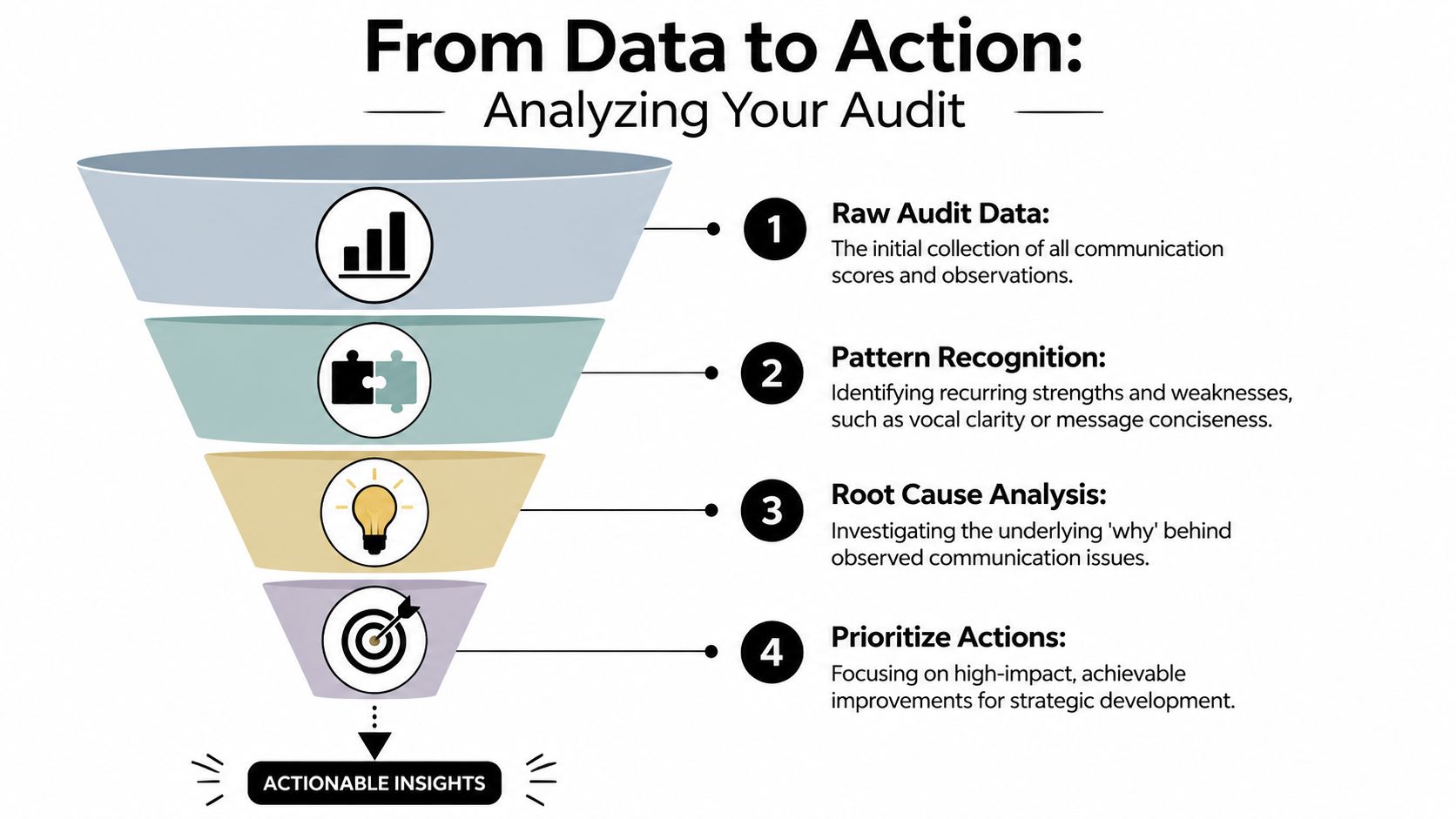
A high-performing audit includes a feedback-to-action pipeline. The recommended workflow involves collecting communication samples from the prior 6–12 months, gathering feedback, synthesizing findings, and assigning owners and milestones. A common pitfall is stopping at diagnosis without creating a phased action plan, as described in this practical guide to conducting a communications audit.
For a personal audit, you are the owner. That makes the next step unavoidable. Decide what changes first.
Later in this section, this short video adds a useful perspective on communication development under pressure:
Look for patterns, not isolated flaws
One low score doesn't matter much on its own. Patterns matter.
Ask:
- Do my weakest scores cluster in one pillar?
- Do I perform well when prepared but fall apart in Q&A?
- Does my vocal authority drop only with senior audiences?
- Is my framing strong in slides but weak in spontaneous speaking?
This is the same discipline leaders use in other performance reviews. If you were calculating webinar ROI metrics, you wouldn't stare at one number and call it strategy. You'd look for relationships between the measures, the context, and the business outcome. Your own communication deserves that same level of analysis.
Create one priority statement
Don't leave your audit with a list of twelve improvements. That scatters effort and usually changes nothing.
Write one sentence:
My primary communication goal is to [behavior] in [specific situation] so that [desired leadership outcome].
Examples:
- My primary communication goal is to maintain a steady, authoritative pace during Q&A so that senior stakeholders trust my judgment under pressure.
- My primary communication goal is to lead with the recommendation in project reviews so that executives can make decisions faster.
- My primary communication goal is to hold posture and vocal steadiness during pushback so that I'm perceived as composed and credible.
If you need a broader framework for turning that into professional growth, these development goals for work can help you translate insight into action.
When self-correction is enough and when it isn't
Some issues improve quickly with awareness. Filler words, weak openings, and poor transitions often respond well to deliberate practice.
Other issues are harder to solve alone:
- vocal habits you don't hear accurately
- body language leaks you only notice on replay
- framing problems that show up under time pressure
- a mismatch between how you feel and how senior audiences perceive you
For professionals who want structured support, The Gravitas Method is a 12-week one-on-one executive presence coaching program for international professionals who want to communicate with more authority and influence at senior levels. The program is priced at $8,200 paid in full or $9,000 across three installments. Coached by Nikola, it covers vocal authority, strategic framing, executive body language, and high-stakes communication.
The bigger point is simple. An audit only matters if it leads to practice you can sustain.
Your Tailored Follow-Up and Development Plan
A communication audit template is not a one-time exercise. It's the start of a review cycle. You identify the pattern, choose a priority, practice deliberately, then re-audit.
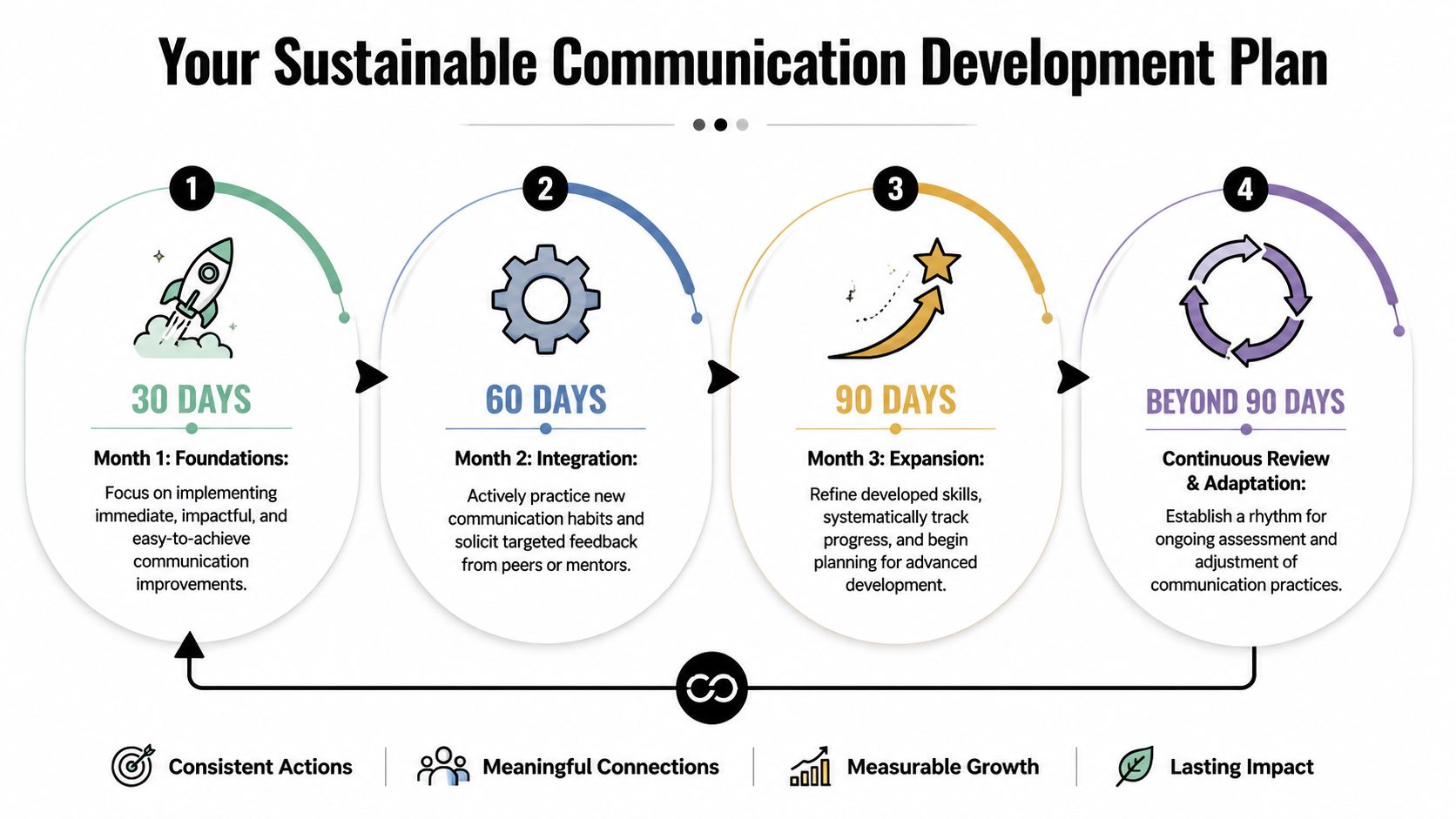
A practical 30 60 90 day rhythm
Use your priority statement to build a development plan that stays realistic.
First 30 days
Focus on awareness and one visible habit.
- Record short reps: Practice brief updates or answers and review them quickly
- Use one cue: “Recommendation first,” “slower first sentence,” or “pause before answer”
- Apply in low-stakes settings: Team meetings are the training ground
By 60 days
Move from drills into live performance.
- Use the habit in prepared presentations
- Ask for targeted feedback from one trusted observer
- Track what happens under challenge, not just in rehearsed moments
By 90 days
Test the change where it matters most.
- Bring the skill into executive meetings or client pressure moments
- Review one fresh recording using the same rubric
- Decide whether to deepen the same priority or move to the next one
Senior communication improves when practice is specific, repeated, and tied to situations that actually affect your reputation.
Keep the loop alive
If your first audit reveals weak vocal authority, stay with it long enough to change the habit. Don't jump to storytelling techniques a week later because they seem more interesting. Depth beats variety.
This is also where outside support helps. A peer can notice whether your answers sound cleaner. A mentor can tell you whether your framing is more decisive. A specialist in coaching for communication skills can help shorten the trial-and-error phase when outcomes are critical.
The professionals who rise fastest are rarely the ones with perfect natural style. They're the ones willing to measure, adjust, and repeat. That's what makes a communication audit template powerful. It replaces vague ambition with evidence, priorities, and a development path you can follow.
If you want an expert read on how your communication currently lands, start with Intonetic's free Executive Communication Assessment. It's the simplest next step if you want clearer feedback on your executive presence, authority, and influence before deciding what to work on next.