
Informative Speech How to: Plan, Structure & Deliver
You know your material. Your slides are clean. The data is solid. Then you start speaking, and the room goes flat.
Senior people glance at their laptops. Someone interrupts before you finish your point. A stakeholder asks a question you already answered two minutes earlier. That usually isn't a knowledge problem. It's a communication problem.
If you're looking for an informative speech how to guide that fits boardrooms, investor updates, technical briefings, and cross-functional leadership meetings, the standard student advice won't take you far enough. In professional settings, the job isn't just to explain. The job is to make your explanation land with enough clarity and authority that people trust your judgment.
That becomes even more important if English isn't your first language. You may already be carrying more cognitive load than everyone else in the room. You're translating in real time, monitoring tone, searching for precise vocabulary, and trying to sound senior while doing all of it. The answer isn't to sound perfect. It's to sound deliberate.
Beyond Information The Real Goal of Your Speech
A weak informative speech doesn't fail because the facts are wrong. It fails because the audience never transfers authority to the speaker.
In business, people rarely separate information from influence. If you brief a leadership team on market risk, a product launch, a technical dependency, or a hiring bottleneck, they aren't only asking, “Do I understand this?” They're also asking, “Do I trust this person's judgment?”

Executive presence changes the standard
According to a Center for Talent Innovation study of 4,000 professionals, senior leaders evaluate executive presence based on three pillars: gravitas (67%), communication (28%), and appearance (5%). Gravitas includes confidence, decisiveness, and vision, making it the most critical factor in how your authority is perceived, as summarized in this overview of Sylvia Ann Hewlett's executive presence research.
That matters because many professionals overinvest in content and underinvest in delivery. They assume that if the analysis is strong enough, the room will recognize it automatically. It won't. People experience your expertise through your voice, structure, pace, and choices under pressure.
Practical rule: In senior settings, an informative speech is never just informational. It's a test of judgment, composure, and relevance.
A technically correct presentation can still sound junior if it's overloaded, hesitant, or poorly framed. A concise presentation with fewer points can sound more senior because it shows control.
The real shift is from explaining to leading
Many smart professionals often get stuck at this point. They think authority comes from adding more detail. Often the opposite is true. Senior audiences usually trust the speaker who filters, prioritizes, and names the implication clearly.
Use that standard when you prepare. Don't ask only, “What should I include?” Ask, “What decision, belief, or level of confidence should this audience leave with?” That mindset turns a neutral data dump into a leadership act.
If you want a deeper look at why delivery and influence are inseparable, communication as persuasion is the more useful frame than the old idea that information speaks for itself.
Laying the Foundation Purpose and Audience Analysis
Most informative speeches go off track before the speaker writes the opening line. The problem starts with a vague purpose.
“I want to explain the project update” is too broad. “I want the executive team to understand the delay, trust the recovery plan, and stop treating this as a quality failure” is usable. That kind of clarity sharpens every choice after it.
Start with one controlling message
An informative speech needs a clear thesis statement, typically one to two sentences, and strong public speaking curricula recommend organizing the speech into 2-3 main sections with a logical introduction, body, and conclusion that restates the thesis and summarizes the primary points. Those same standards also emphasize thorough research and verbal source citation during delivery, as outlined by the University of Texas informative speaking guidance.
Before drafting, write three lines:
- What does this audience need to understand?
- Why does it matter now?
- What single sentence should still be remembered tomorrow?
If you can't answer those cleanly, your audience won't be able to follow you cleanly either.
Analyze the audience by knowledge, not title
A board member, CFO, engineering lead, and regional sales director may all attend the same presentation. That doesn't mean they're the same audience. They bring different assumptions, vocabularies, and thresholds for detail.
Research from Katherine Rowan highlights that a primary source of audience confusion is “unfamiliar terminology.” Effective speakers preempt this by analyzing the audience's background and avoiding jargon, or by defining a specialized term with a concrete example immediately after using it, a critical step for professionals in technical fields, as explained in this audience-centered informative speaking resource.
Here's a practical way to think about audience types:
| Audience | What they need from you | What usually goes wrong |
|---|---|---|
| Technical peers | Precision and clean logic | You over-explain basics and lose momentum |
| Skeptical stakeholders | Context, risk framing, plain language | You sound defensive or disappear into detail |
| Time-poor executives | Bottom line first, implications second | You build up too slowly and bury the point |
Adapt without diluting
If you're speaking to technical peers, use the right terminology. Just don't leave terms hanging without explanation if others are in the room.
If you're speaking to non-technical stakeholders, simplify the path, not the truth. Explain the concept in business consequences. Cost, timing, reputation, delivery risk, customer impact.
A strong speaker never makes the audience work harder than necessary to understand the point.
For international professionals, audience analysis also includes cultural expectations. Some rooms expect directness. Others expect more diplomacy before a conclusion. Some reward brevity. Others interpret brevity as lack of depth. That's why cross-cultural communication training matters when your career depends on being understood across functions and regions.
Structuring Your Speech for Executive Impact
Structure signals seniority. A disorganized talk makes people question your thinking, even when your expertise is strong.
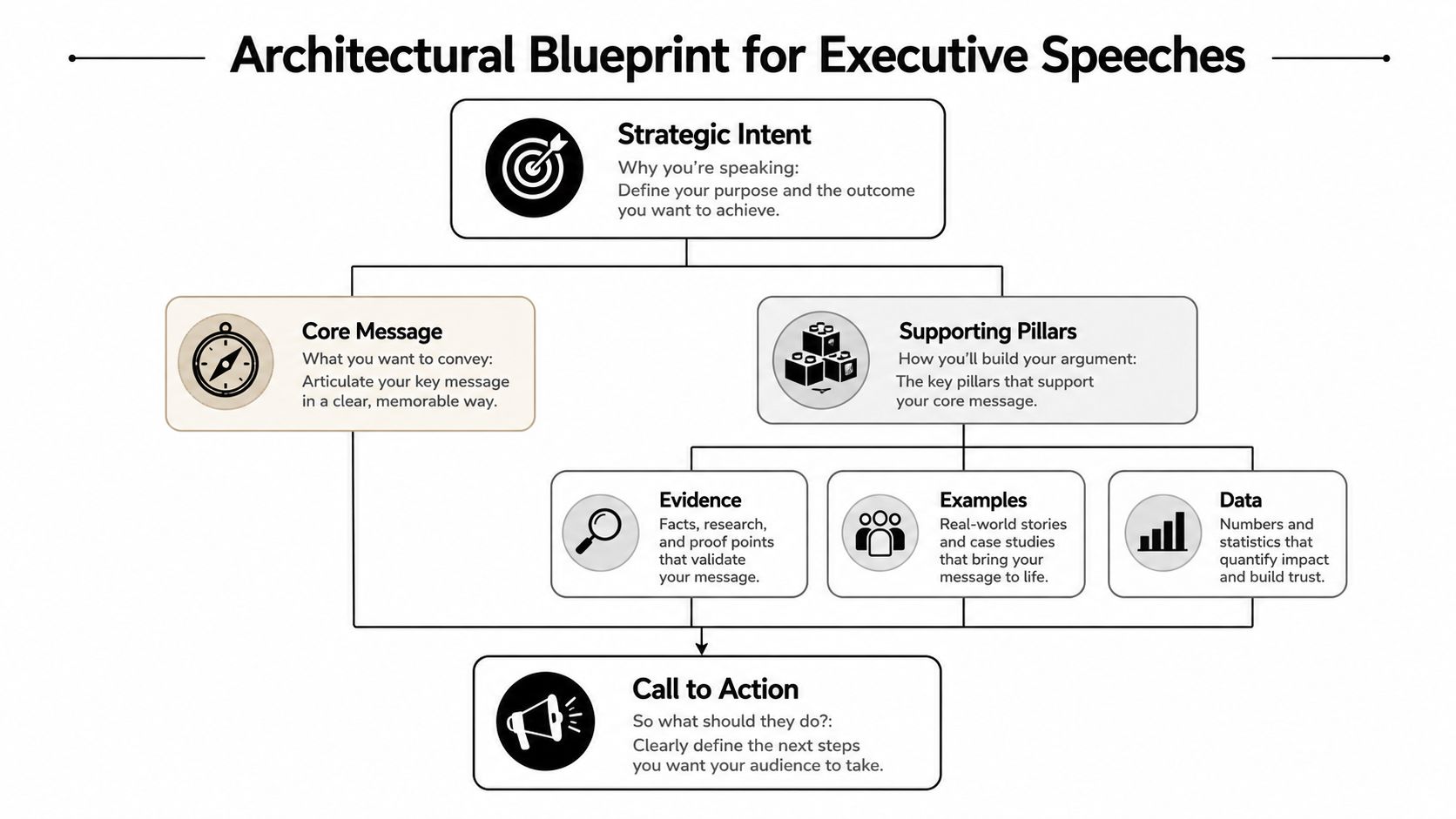
At executive level, the audience should feel a stable architecture from the first minute. They need to know what you're talking about, why it matters, and how the parts connect. If they have to build that structure themselves while you speak, you've already lost authority.
Use a three-part architecture
A reliable executive speech structure looks like this:
- Opening orientation. State the core message early. Don't make people wait for the point.
- Two or three supporting pillars. Each pillar should answer a distinct question or prove a distinct part of your thesis.
- Close with meaning. Summarize what the audience should retain and what the information means in practice.
That sounds simple because it is. Simplicity is not basic. It's disciplined.
A helpful test is whether each main point could stand as a slide title or meeting headline. If it can't, it's probably still too vague.
Apply the 30 and 70 rule
For how-to informative speeches, methodology dictates a 30/70 content ratio. No more than 30% of time should be spent on new material, while 70% must be used to repackage and reinforce that information through examples, visuals, and analogies to prevent audience cognitive overload, according to this guidance on informative speaking methodology.
That rule is especially valuable for technical and process-heavy topics. If you spend most of your time introducing concepts, the audience will nod politely and remember very little. If you reinforce those concepts through examples, comparisons, visuals, and repeated signposts, comprehension rises.
Don't treat repetition as redundancy. In executive communication, strategic repetition is what makes the message usable.
Build each point so it carries weight
A practical pattern for each main point:
- State the point in one sentence.
- Explain it in plain language.
- Support it with evidence or a concrete example.
- Name the implication.
That fourth step is the one most speakers skip. They explain the fact but not why it matters.
If you want to improve how your ideas travel from analysis to audience understanding, conveying the message is a more useful skill than merely “presenting well.”
For professionals who want more hands-on support with this level of communication, The Gravitas Method is a 12-week one-on-one executive presence coaching program for international professionals who want to communicate with more authority and influence at senior levels. The program is priced at $8,200 paid in full or $9,000 across three installments. Coached by Nikola, it covers vocal authority, strategic framing, executive body language, and high-stakes communication.
Delivering With Vocal Authority and Presence
You can lose authority with your voice before the audience has evaluated a single idea.
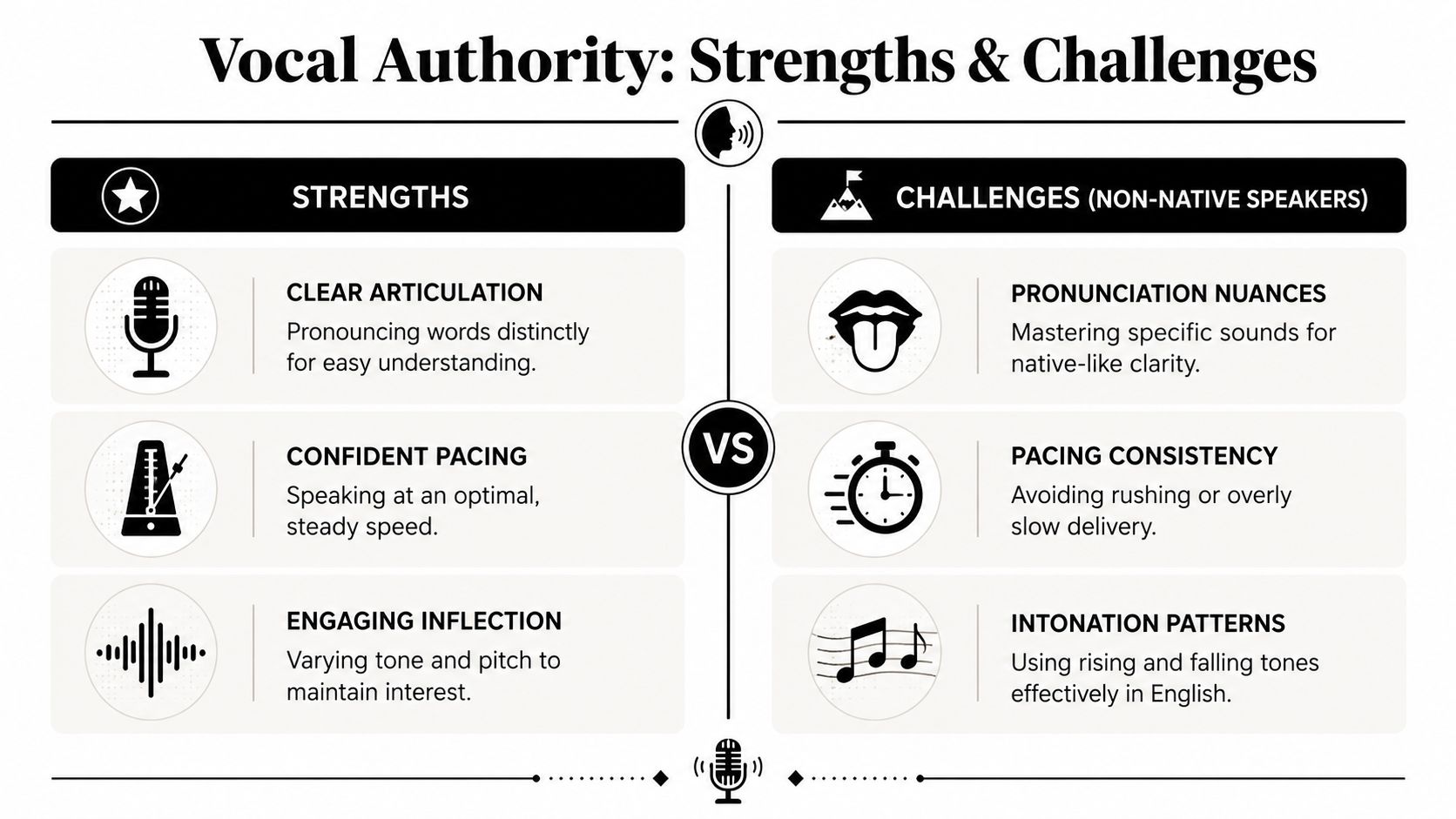
That's why delivery isn't the decorative part of an informative speech. It's the transmission system. If your pacing is rushed, your endings drop away, or every sentence begins with “um,” your content arrives weaker than it is.
Replace filler with silence
Executive coaching techniques for building gravitas mandate using strategic pauses to control conversation flow and replacing filler words with intentional silence to project confidence. Research shows this directly increases perceived authority, as discussed in IMD's executive presence guidance.
That matters even more for non-native speakers, because fillers often appear when you're searching for phrasing. The instinct is to keep noise in the air while you think. That noise weakens the sentence.
Try this instead:
- Pause before key statements so the room resets its attention.
- Pause after a key statement so people can process it.
- Stop replacing thought with sound. Silence sounds stronger than “uh” when you're choosing your next sentence.
Treat numbers differently from other language
When you use data, your delivery has to change. In informative speech construction, strong pedagogy shows that audiences judge a speaker's authority largely by the accuracy and relevance of supporting evidence, and that using credible, current, and authoritative data from sources such as academic institutions or neutral experts strengthens memorability and emotional impact. The same guidance recommends that speakers speak slower when saying numbers, pause before and after the statistic, and repeat key numbers when necessary. It also notes that comparing a statistic to an earlier point in time can make it more meaningful for listeners, as outlined in this resource on charts and statistics in speeches.
That means you shouldn't read a number at normal conversational speed and move on. Slow down. Frame it. Explain why it matters.
For example, don't say a metric and immediately jump to the next bullet. Say the metric, pause, then translate it into consequence.
If the audience can't absorb the number in real time, the number doesn't help you.
Build a voice people can follow
Non-native speakers often focus heavily on pronunciation and ignore rhythm. But audiences don't only need accurate sounds. They need a voice pattern they can track.
A few adjustments help fast:
- Lower your rush point. Most speakers speed up when they reach technical detail or feel challenged.
- Mark important words. Stress the noun or verb carrying the meaning.
- Finish sentences cleanly. Don't let the last word disappear.
- Vary intonation on purpose. Flat tone makes even strong content feel uncertain.
If anxiety is making that harder, this practical guide on help for speaking English without anxiety is useful because it addresses the emotional side of speaking, not just the mechanics.
And if vocal delivery is the bottleneck, professional voice training can help you build steadier pacing, clearer emphasis, and more composed verbal presence under pressure.
Rehearsing Strategically and Avoiding Common Pitfalls
Good rehearsal is not repetition. It's stress testing.
Many executives rehearse in the least effective way possible. They skim notes, maybe run through the opening once, and assume expertise will carry the rest. That approach works only when the stakes are low and the audience is forgiving.
Prevent overload before it starts
A dominant pitfall in how-to informative speeches is information overload. Experts recommend arranging content into 2–6 main point clusters with sub-points like “spokes in a wheel” to maintain logical flow, a method that significantly lowers the error rate of skipping steps during delivery, according to this analysis of informative speech pitfalls.
That's not just a classroom principle. It's a boardroom principle too. When speakers overload the middle of a talk, they usually create three problems at once:
- The audience loses sequence and stops tracking the logic.
- The speaker starts improvising transitions and sounds less controlled.
- Important details get skipped because the structure is too crowded to hold in memory.
Rehearse the hard parts, not the easy parts
The inclination is to practice what is already well-known. You need the opposite approach.
Use rehearsal to pressure-test:
- Your transitions between main points
- Your explanation of technical terms
- Your delivery with actual visuals or props
- Your shorter version if the room is confused or time gets cut
Whatcom's guidance also warns that practicing with visual aids only once often leads to problems when a real audience is present. That's why you should rehearse with the exact deck, clicker, screen flow, or demonstration setup you'll use live, not a simplified version.
Field note: If you can't shorten your talk cleanly on the spot, you don't know the structure well enough yet.
Build a rehearsal system you'll actually follow
If you tend to postpone preparation until the pressure becomes painful, it helps to borrow practical systems from outside communication training. I often recommend reading Boss as a Service's procrastination tips because the issue usually isn't laziness. It's avoidance, ambiguity, or a task that feels too large to start.
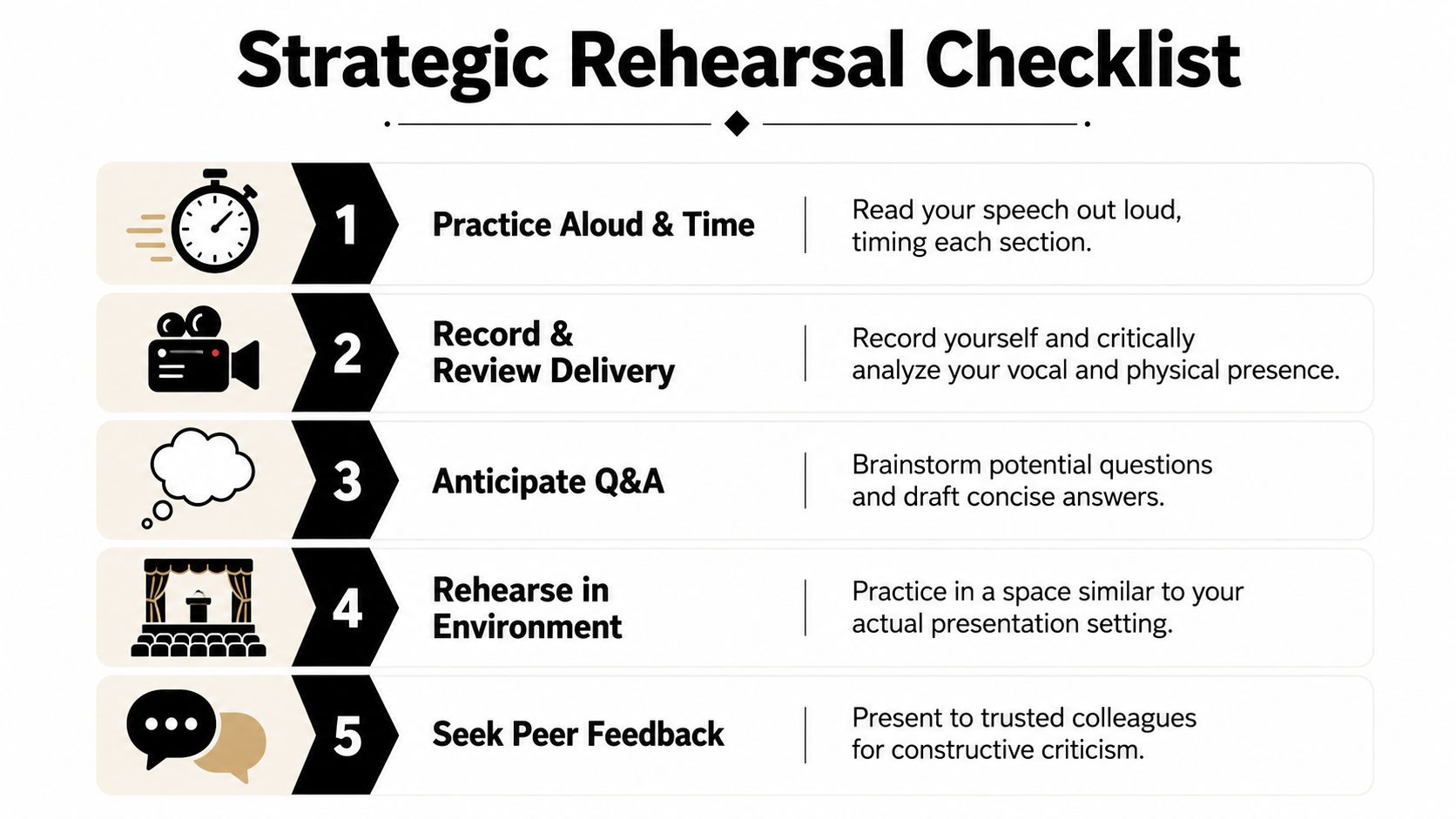
A useful rehearsal sequence is simple:
- Speak it aloud and time it.
- Record one run and review only structure.
- Record another and review only delivery.
- Cut anything the audience doesn't need.
- Practice the opening and close until they feel stable.
If nerves are interfering with practice quality, how to calm nerves before a speech can help you settle your body enough to rehearse productively instead of just repeatedly.
From Informing to Influencing Your Next Step
An informative speech becomes powerful when it does more than transfer knowledge. It creates trust in your thinking.
That's the shift senior professionals need. Not more content. Better command of purpose, audience, structure, and delivery. When those elements work together, people stop experiencing you as someone who only reports information. They start experiencing you as someone who brings clarity under pressure.
For non-native English-speaking professionals, this matters doubly. You're often judged not only on what you know, but on how effortlessly you seem to carry that knowledge in high-stakes rooms. That can feel unfair. It's still real. The answer isn't to imitate someone else's personality. It's to build a communication style that sounds deliberate, credible, and senior in your own voice.
A strong informative speech tells the audience, “I understand this subject.” A strong executive speaker also tells the audience, “You can rely on me.”
If you want to identify the specific patterns that are weakening your authority, the best next step is a targeted diagnosis rather than more generic advice.
Take the free Executive Communication Assessment from Intonetic to get a clearer view of how your delivery, vocal authority, structure, and executive presence are currently landing, and what to improve first.