
Conveys the Message: Convey the Message
You know the moment. You're in a stakeholder meeting, you've done the analysis, you understand the risks, and your recommendation is solid. Then you start speaking. Two minutes in, someone interrupts and reframes your point more clearly than you did. Another person asks a question you thought you had already answered. By the end of the meeting, your idea hasn't exactly been rejected, but it also hasn't landed.
That's the frustration behind how someone conveys the message. Senior professionals rarely struggle because they lack substance. They struggle because their thinking, structure, voice, and body language don't work together under pressure. The result is costly: good ideas sound tentative, nuanced points sound confusing, and authority gets mistaken for aggression or lost completely.
Most advice starts too late. It jumps to eye contact, posture, or “speak with confidence.” That matters, but delivery starts earlier. If your thinking is muddy, your delivery will be muddy. If your message lacks a clean frame, no amount of vocal polish will save it. The core work moves from internal clarity to external authority.
Why Your Message Fails to Land
A senior technical leader gives a project update. The content is accurate. The risks are real. The recommendation is sensible. But the update starts with too much background, the key point arrives late, and the delivery sounds cautious. People stop tracking the logic. A stronger personality in the room summarizes the issue in one sentence, and that version becomes the one everyone remembers.
That scenario happens every day. Not because smart people lack intelligence, but because they haven't built the habit of shaping the message before they speak it. They rely on expertise to carry them. In senior rooms, expertise is expected. What separates one person from another is whether their communication signals command.

What usually goes wrong
Three patterns show up repeatedly:
- The point is buried: You open with context, caveats, and process details instead of the decision or takeaway.
- The language gets defensive: You soften the message so much that it sounds like a suggestion you don't fully back.
- The delivery contradicts the content: Your words say certainty, but your pace, tone, or posture say doubt.
Good ideas often fail in rooms where weaker ideas are delivered with cleaner structure and steadier presence.
This is one reason professionals feel misunderstood. They know they're capable. They know the work is good. But others don't experience that capability in real time. If that pattern sounds familiar, it's worth tightening the fundamentals of effective communication barriers and how to break them.
Why this matters for senior credibility
People don't evaluate seniority only through content. They evaluate it through judgment, composure, and clarity under pressure. If your communication feels scattered, people assume your thinking is scattered. If your delivery feels hesitant, they question your conviction.
That can be painful, especially for international professionals who are already translating ideas, managing nuance across cultures, and trying not to sound too blunt or too passive. In those conditions, message failure often isn't about language skill alone. It's about the gap between what you know and what the room hears.
Frame Your Core Idea Before You Speak
Strong delivery starts before slides, before rehearsal, and before the meeting itself. First you need a core idea that can survive interruption, scrutiny, and time pressure. If you can't state your message in one clean sentence, you're not ready to present it.
According to Harvard Business Review, the step-by-step methodology to achieve executive presence involves the 7 Cs of Executive Presence™: Competence (domain expertise), Control (emotional composure), Confidence (without arrogance), Class (social rules), Connection (audience adaptation), Collaboration (win-win solutions), and Clarity (succinct frameworks).
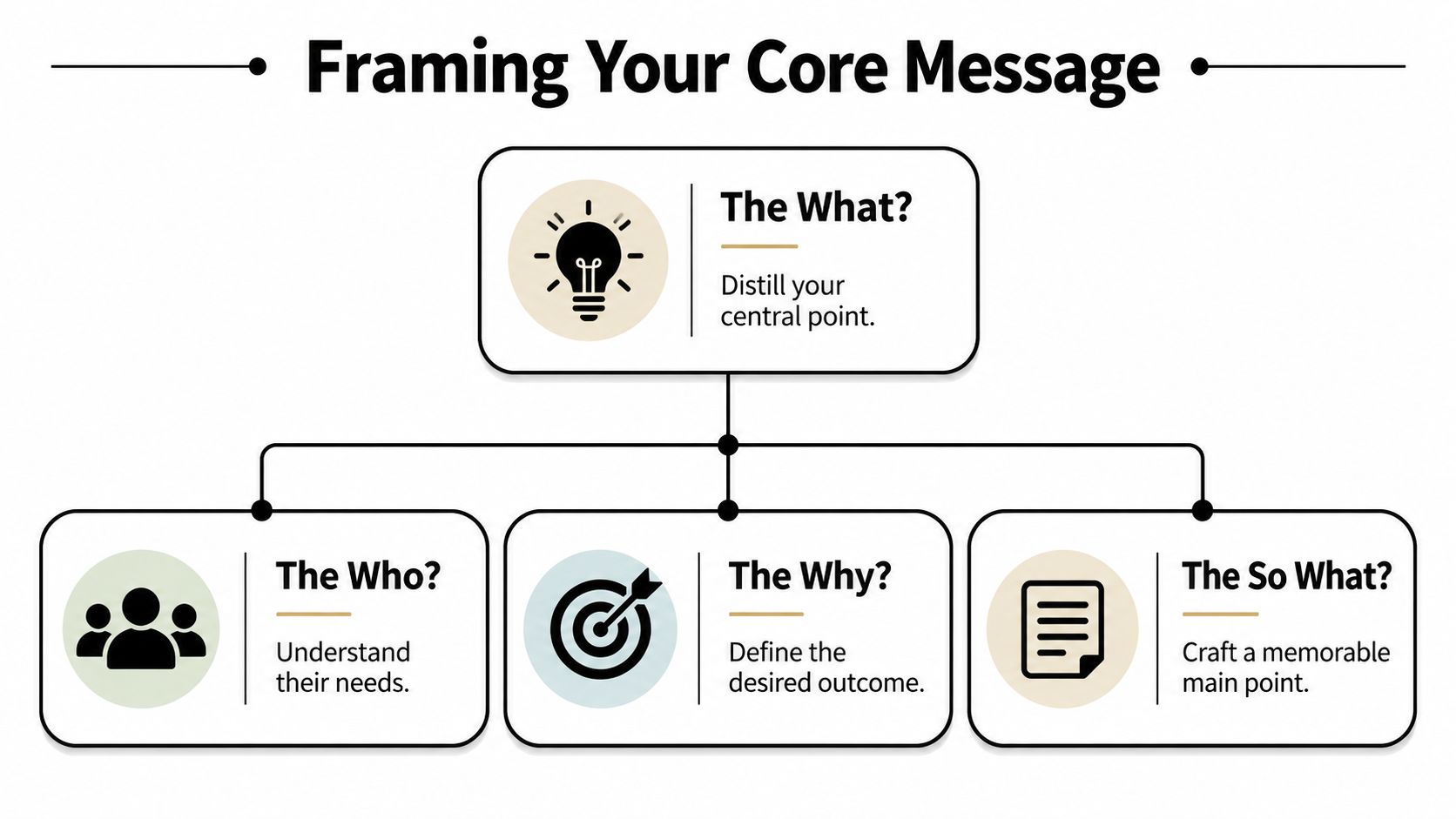
Start with four framing questions
Before you draft anything, answer these:
-
What
What is the central point? Not the topic. Not the update. The point. -
Who
Who is listening, and what do they care about most? Risk, speed, cost, adoption, reputation, political impact? -
Why
Why does this matter now? Urgency has to be explicit. -
So what
What should they think, decide, approve, or do after hearing you?
If you can answer those four questions clearly, your message has a spine.
Use the 7 Cs as a pressure test
The 7 Cs are useful because they force you to think beyond raw information.
- Competence: Have you shown that you understand the business, not just your specialty?
- Control: Can you explain the issue without sounding reactive, irritated, or flustered?
- Confidence: Are you making a recommendation, or hiding behind endless options?
- Connection: Have you translated your point into the audience's priorities?
- Clarity: Can a busy executive repeat your message after hearing it once?
The other Cs matter too, but these often make the difference between a message that sounds senior and one that sounds overworked.
Practical rule: If your audience has to work hard to find your point, they won't assign you more authority. They'll assign you less.
A framing exercise that works
Take your next presentation and write three lines only:
- The issue is
- What this means is
- My recommendation is
Then say those lines out loud. If they sound vague, abstract, or overqualified, keep tightening them. This exercise forces thought to become decision-ready language. It also helps if you're developing broader strategic communication skills for senior roles, where brevity and positioning matter as much as correctness.
What doesn't work is starting with slides. Slides reward complexity. Executive communication rewards reduction.
Structure Your Narrative for Maximum Impact
Once the core idea is clear, the next job is sequencing. Many professionals know what they want to say but lose the room because they present information in the order they discovered it, not in the order the audience can absorb it.
A simple structure works in almost every senior setting: Hook, Build, Close.
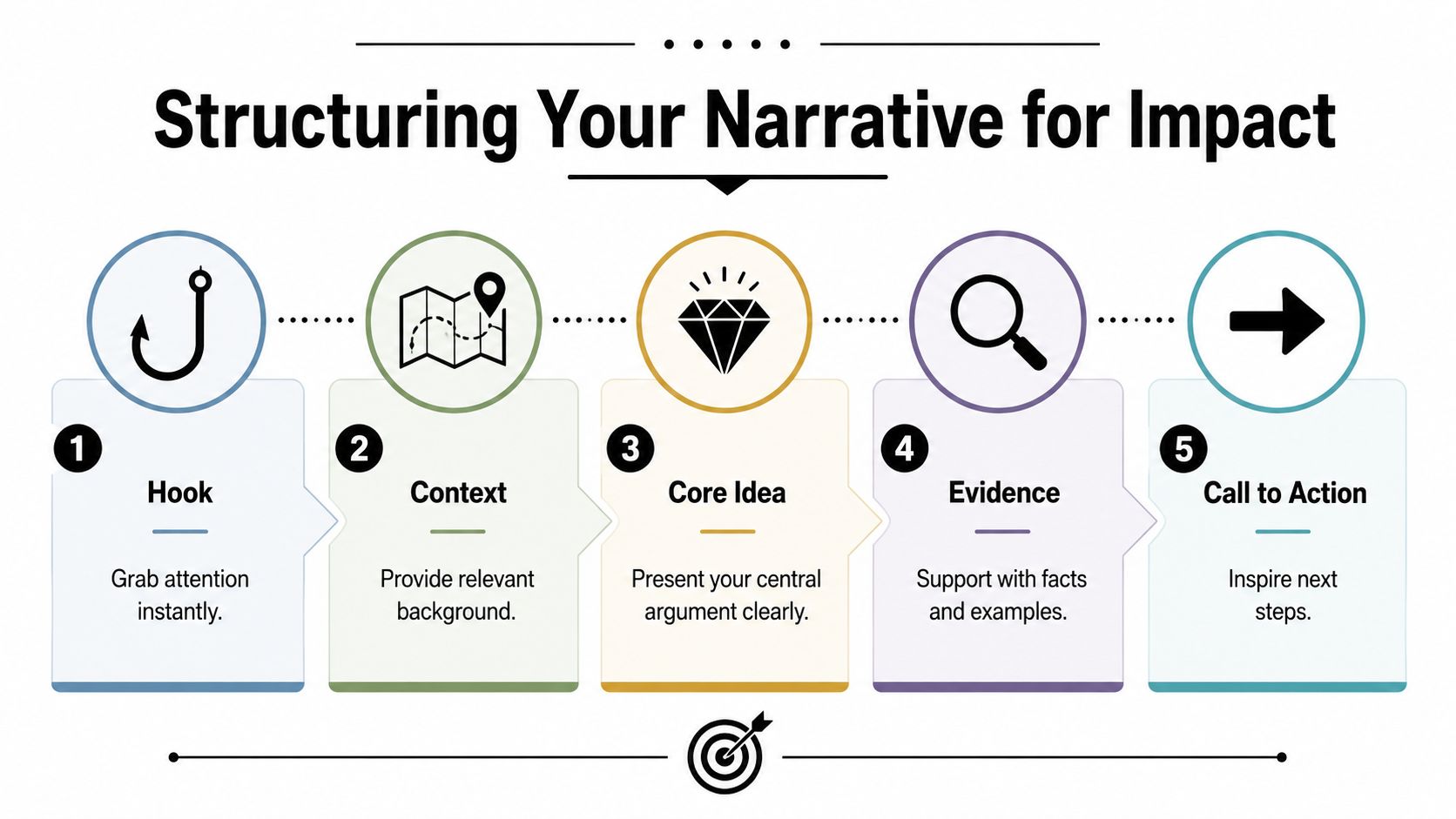
Hook
Open with the point of tension. What changed, what's at risk, or what decision is needed?
This doesn't mean being dramatic. It means being useful fast. A weak opening sounds like a recap. A strong opening creates orientation.
Build
Now support the point with only the context the audience needs. Not every fact belongs in the room. Include the evidence, trade-offs, and implications that strengthen the recommendation.
If you write often, it can help to study structure outside formal presentations. A good example is this free video script templates collection, which shows how opening, progression, and payoff shape audience attention across formats.
Close
End decisively. Restate the recommendation, define the action, and make the next step obvious.
A close fails when it drifts back into analysis. Senior listeners need closure. They need to know where you stand.
Why gravitas changes the effect
According to a study of 4,000 professionals by Sylvia Hewlett's Center for Talent Innovation, gravitas accounts for 67% of senior leaders' evaluation of executive presence, while communication accounts for 28% and appearance 5% in the Center for Talent Innovation findings summarized here.
That matters because narrative structure isn't only about comprehension. It signals judgment. When your communication is well ordered, people experience you as more composed, more decisive, and more senior.
If you need to sharpen this skill in formal settings, it helps to practice with material built specifically for writing a speech that carries authority.
Master Your Vocal Authority
A strong message can still collapse if your voice signals uncertainty. When this happens, many capable professionals lose power. They rush through key points, flatten their tone, or fill every pause because silence feels risky.
Research indicates that vocal clarity and pacing are the primary signals of authority, with strategic pauses increasing message weight by 40% in high-stakes negotiations. The same benchmark data says leaders who master strategic pauses and voice control are 2.5x more likely to be promoted to VP or C-suite roles, according to IMD's executive presence analysis.
Three drills to build vocal control
The pause drill
Read a paragraph from your own presentation. Mark a slash after each key point. At every slash, stop for a full beat.
Most professionals think they're pausing. They're not. They're merely slowing down. A real pause creates processing time and gives your words weight.
The emphasis drill
Take one sentence and speak it three ways:
- with emphasis on the business problem
- with emphasis on the decision
- with emphasis on the consequence
This teaches intentional stress. Authority doesn't come from sounding deep or loud. It comes from placing emphasis where meaning belongs.
The recording drill
Record a two-minute explanation of a current work issue. Listen once for pace, once for filler words, and once for sentence endings. If your voice trails off at the end of statements, you're leaking authority.
If your voice speeds up when the stakes rise, the room reads anxiety even when your analysis is correct.
What works and what doesn't
Here's the trade-off in plain terms:
| Approach | Effect in the room |
|---|---|
| Fast pace to sound smart | People miss your point and question your composure |
| Monotone for safety | You sound detached or underinvested |
| Short, deliberate pauses | You sound in control |
| Clean sentence endings | Your statements sound decided |
For many international professionals, vocal work also includes pronunciation, resonance, and clarity. If that's part of the challenge, focused practice such as deep voice and vocal authority exercises can help you sound steadier without forcing an artificial style.
Use Nonverbal Cues to Reinforce Your Words
People believe your body faster than they believe your script. If your words say conviction while your posture shrinks, your eyes dart away, or your hands fidget, the room trusts the nonverbal signal.
Research demonstrates that strong eye contact and purposeful hand gestures significantly enhance credibility and audience connection. In high-stakes scenarios, leaders who use strategic pauses of 2–3 seconds project control, while nervous speakers often rush and undercut perceived competence, as described in this piece on the role of communication in executive presence.

Posture and eye contact
Start with your base. Plant your feet. Let your arms rest naturally. Keep your chest open. None of this is theatrical. It prevents your body from broadcasting retreat.
Eye contact should feel direct, not fixed. In a room, complete one thought to one person, then move to another. On video, look into the camera when delivering the key line, especially your recommendation or answer.
Gestures that support authority
Useful gestures do one of three things:
- They frame a contrast: one hand for option A, the other for option B
- They mark a sequence: first, second, third
- They underline a conclusion: a contained downward gesture on the final point
What doesn't work is constant hand movement. That looks like discharge of nervous energy, not executive presence.
Here's a useful demonstration of how physical delivery affects authority in real time:
A simple correction routine
Before your next important conversation, check three things:
- Hands: Keep them visible. Hidden hands reduce connection.
- Face: Let your expression match the seriousness of the message. Neutral is better than forced enthusiasm.
- Stillness: Stop moving when you deliver the key sentence. Stillness increases perceived certainty.
If this is an area you've never trained directly, structured work on body language for leaders can help you align what the room sees with what you intend to communicate.
Turn Your Insights into Influence
Senior professionals don't need more generic advice about “confidence.” They need a repeatable process. First, clarify the thinking. Then frame the core idea. Then structure the narrative so the room can follow it. Then deliver it with a voice and body that support the message instead of weakening it.
That process matters for career outcomes, not just presentation quality. Executive presence directly accounts for 26% of a promotion-related decision, according to a survey of nearly 4,000 professionals conducted by NAEM, and Coqual independently confirmed that executive presence comprises 26% of what is required to advance a leader to the next level in the NAEM research summary.
Influence is built before the meeting
People often assume influence happens in the room. Most of it happens before the room. It happens when you decide what your message is really about, what your audience needs from you, and what impression your delivery should leave behind.
That's why professionals who are consistently overlooked often don't need more content knowledge. They need sharper communication behavior under pressure. For founders and operators who want another perspective on high-stakes communication, this founder's guide to communication is a useful companion read.
When coaching makes sense
Self-correction works up to a point. After that, blind spots get expensive. You can't always hear your own hesitation, see your own leakage in body language, or notice where your framing becomes too detailed to persuade.
One option is Intonetic. The Gravitas Method is a 12-week one-on-one executive presence coaching program for international professionals who want to communicate with more authority and influence at senior levels. The program is priced at $8,200 paid in full or $9,000 across three installments. Coached by Nikola, it covers vocal authority, strategic framing, executive body language, and high-stakes communication.
If you're capable but still getting misunderstood, the next step isn't to talk more. It's to make sure every part of your communication carries the same message: clear thinking, clear structure, and clear authority.
If you want a practical starting point, book the free Executive Communication Assessment with Intonetic. It's the simplest way to identify where your message breaks down, whether the issue is framing, vocal authority, body language, or how you handle pressure in senior conversations.