
How to Say No Professionally: Guide for Senior Leaders
You accept one more meeting, one more “quick review,” one more project that isn't really yours. None of them seems unreasonable on its own. Then your calendar fills, your strategic work slips, and the people around you start treating your availability as unlimited.
That pattern hurts more than productivity. It changes how others read your leadership. Senior professionals aren't judged only by how responsive they are. They're judged by what they protect, what they prioritize, and whether their decisions signal command or drift.
For international professionals, the stakes are even higher. If you already work across language, hierarchy, and cultural nuance, an unclear answer can easily sound like uncertainty. Learning how to say no professionally is not about becoming rigid. It's about sounding deliberate.
Why Saying Yes Can Derail Your Career
A common senior-level trap looks like generosity from the outside. You support a cross-functional initiative, join a recurring meeting “for visibility,” mentor someone informally, and agree to fix a problem because you can do it faster than anyone else. A few weeks later, your actual priorities are late, your team is waiting for decisions, and your role starts to look more operational than strategic.
That's the hidden cost of overcommitting. Every unnecessary yes trains people to bring you more work that doesn't belong at your level. It also weakens your authority because you stop looking selective.
What repeated yeses communicate
Saying yes too often doesn't just create overload. It sends signals:
- Your priorities are flexible: If everything can be added, nothing looks protected.
- Your time is available for reassignment: People assume they can keep inserting requests.
- Your role lacks clear boundaries: Others stop distinguishing between urgent, useful, and merely convenient.
For some professionals, this pattern is tied to stress rather than poor judgment. If pressure, guilt, or conflict avoidance is driving your choices, support like tailored therapy for anxiety can help you separate emotional discomfort from sound professional decision-making.
The most expensive yes is the one that pulls attention away from your highest-value work.
Senior leaders are expected to filter
At more junior levels, responsiveness often gets rewarded. At senior levels, discernment gets rewarded. People expect you to make trade-offs. They expect you to protect your team from distraction, not absorb every request personally.
This is one reason strong leaders work deliberately on building credibility as a leader. Credibility doesn't come from appearing endlessly helpful. It comes from making choices that align with outcomes.
A professional no isn't rejection. It's selection. You are deciding what deserves time, attention, and ownership. When you handle that well, people trust your yes more because they know it means something.
Reframe Your No From Conflict to Strategy
Many capable professionals know they should say no more often. They still hesitate because the internal story is wrong. They treat refusal as interpersonal risk instead of leadership behavior.
The fear usually sounds familiar. You don't want to seem difficult. You don't want to disappoint a senior stakeholder. You don't want to lose momentum by being seen as less collaborative. Those concerns are understandable, but they push people toward weak language that creates bigger problems later.

Capacity is a leadership issue
Professional refusal is increasingly treated as capacity management, not just courtesy. Workplace guidance recommends assessing your workload, declining clearly, giving a brief reason, and offering an alternative where appropriate because that protects priorities and maintains trust, as explained in Asana's guidance on how to say no professionally.
That framing matters. If you say yes when capacity isn't there, you aren't being helpful. You're delaying trade-offs until the work suffers.
Consider the difference:
- A polite but automatic yes creates hidden risk.
- A thoughtful no creates visible clarity.
- A redirected no creates clarity and momentum.
Executive presence includes refusal
People often talk about executive presence as voice, polish, or confidence in presentations. It's also the ability to make boundaries sound rational and final. If your language gets vague under pressure, people won't experience you as decisive.
That's especially relevant for professionals trying to influence without authority. Influence doesn't come from agreeing to everything. It comes from helping others see the trade-off and accept it.
Practical rule: If you can't explain why a request should displace your current priorities, don't absorb it by default.
Stop treating every request as a test of helpfulness
A request is not a command. It is a decision point.
When someone asks for your involvement, you need to evaluate three things:
- Strategic fit: Does this support your role, team goals, or core objectives?
- Real capacity: What will move, slow down, or be dropped if you accept?
- Best owner: Are you the right person, or merely the most convenient person?
When you start answering requests this way, your no becomes easier because it rests on logic, not emotion. That shift changes your tone. You stop sounding apologetic and start sounding accountable.
The Gravitas Method is a 12-week one-on-one executive presence coaching program for international professionals who want to communicate with more authority and influence at senior levels. The program is priced at $8,200 paid in full or $9,000 across three installments. Coached by Nikola, it covers vocal authority, strategic framing, executive body language, and high-stakes communication.
A Simple Framework for a Powerful No
You don't need a clever script. You need a structure you can use under pressure. The strongest refusals are short, calm, and collaborative.
A reliable method is to validate the request, surface competing priorities, and offer workable options. That approach keeps the conversation focused on trade-offs instead of personal resistance, and it's especially useful with managers or senior stakeholders, as outlined in Abbey Louie's framework for saying no in 3 steps.
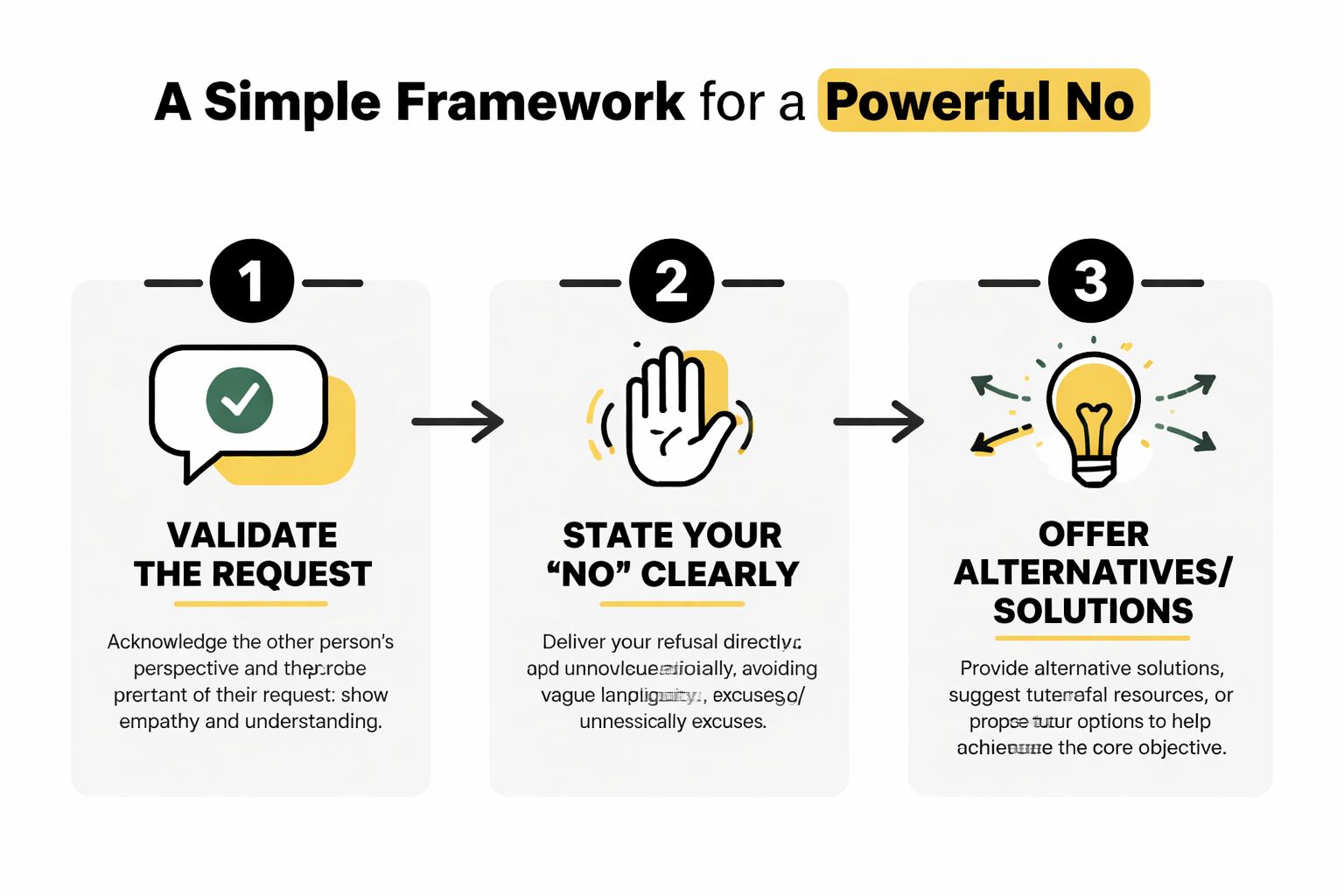
Step one: validate without surrendering
Validation shows that you heard the request and understand why it matters. It does not mean agreement.
Try language like:
- “I can see why this needs attention.”
- “Thanks for bringing me in.”
- “I understand the urgency and why you want support on it.”
This lowers defensiveness. It also helps if the other person outranks you, because you're acknowledging their concern before discussing limits.
Step two: surface the trade-off clearly
Many professionals falter. They hint. They stall. They say “maybe” when they mean no. A stronger move is to name the competing priority and let the trade-off become visible.
Examples:
- “My focus this week is closing the board deck and preparing the team for Friday's review, so I can't take this on well.”
- “I'm at capacity with the client escalation and product launch work, so I'm not able to own this right now.”
The point isn't to sound defensive. The point is to show that your refusal is based on responsible prioritization.
A useful way to strengthen this skill is to study communication as persuasion. The moment you frame the issue as a choice between priorities, the conversation becomes more strategic.
A quick walkthrough can help you hear how this sounds in practice:
Step three: offer options, not open-ended availability
If the situation allows it, propose alternatives. This keeps the refusal constructive and protects the relationship.
Use options such as:
- A later timeline: “I can look at this next Tuesday after the steering committee meeting.”
- A narrower contribution: “I can review the final draft, but I can't own the full workstream.”
- A different owner: “Priya may be closer to the operational details and could move this faster.”
- A choice between priorities: “If this needs to happen now, tell me which current commitment you want me to move.”
A powerful no doesn't block progress. It redirects it.
That's the framework. Brief acknowledgment, clear constraint, practical options. If you use it consistently, people stop pushing vague requests at you because they learn you'll respond with structured decisions.
Scripts and Email Templates for Saying No
The struggle isn't with the concept itself. The difficulty arises in the moment, when the request lands in a meeting, a chat message, or an email from someone senior. That's where prepared language helps.
The standard to aim for is simple: brief refusal, short rationale, clean ending. If your response starts stretching into a defense, it usually gets weaker.
Weak vs. strong refusals
| Scenario | Weak Phrasing (Avoid) | Strong Phrasing (Use) |
|---|---|---|
| Extra project request | “I'm not sure I have the bandwidth, but I can try.” | “My priority is the current launch work, so I can't take this project on right now.” |
| Meeting with no agenda | “I might be able to join if I finish a few things.” | “I'm going to decline this one. If there are decisions I need to weigh in on, send the agenda or key questions and I'll respond directly.” |
| Unrealistic deadline | “That might be difficult.” | “I can deliver this well by Friday. If you need it sooner, we'll need to reduce scope.” |
| Work outside your role | “Maybe I could help a little.” | “This sits outside my current scope, so I'm not the best owner. I can suggest who should handle it.” |
| Senior stakeholder request | “I'll see what I can do.” | “I can support this, but only if we pause the other priority. Which outcome would you like me to optimize for?” |
Spoken scripts for common situations
When a manager adds work late in the week
“I understand why this matters. I'm currently focused on the client issue and the Monday presentation, so I can't add this without moving one of those. Which would you like me to deprioritize?”
When a colleague wants a quick favor that will expand
“I can't take on the full task. If helpful, I can give you ten minutes to help you think it through.”
When someone invites you to a meeting you don't need to attend
“I'm going to pass on this one so I can stay focused on the priorities already in motion. If a decision comes up that needs my input, send it over and I'll respond.”
Shorter usually sounds more senior. Long explanations often sound like doubt.
Email templates you can adapt
If you want to sharpen your written tone overall, this guide for crafting business emails is useful because it helps tighten structure without sounding cold.
Declining a project politely
Subject: Re: Project support
Thanks for thinking of me. I'm focused on [priority] right now, so I'm not able to take this on and do it properly.
If helpful, I can [offer narrow support, suggest a timeline, or recommend another person].
Best,
[Name]
Pushing back on timeline
Subject: Re: Deadline for deliverable
I've reviewed what's needed. I can complete this by [realistic timeline] at the quality expected.
If it needs to move sooner, we should either reduce scope or shift another priority.
Best,
[Name]
Declining a meeting
Subject: Re: Meeting invite
Thanks for including me. I'm going to decline so I can stay focused on current priorities.
If there's a specific decision or question you want my input on, send it through and I'll respond directly.
Best,
[Name]
One editing rule for every refusal
Before sending, remove anything that sounds like one of these:
- Tentative padding: “just,” “maybe,” “hopefully,” “I'm not sure”
- Over-apology: “I'm so sorry,” “I feel terrible,” “I hate to do this”
- Unnecessary defense: long backstory, personal stress details, repeated justifications
A strong written refusal is clear, respectful, and finished. If you want examples of sharper business phrasing, review these written email examples and compare how quickly the message gets to the decision.
Deliver Your No with Executive Presence
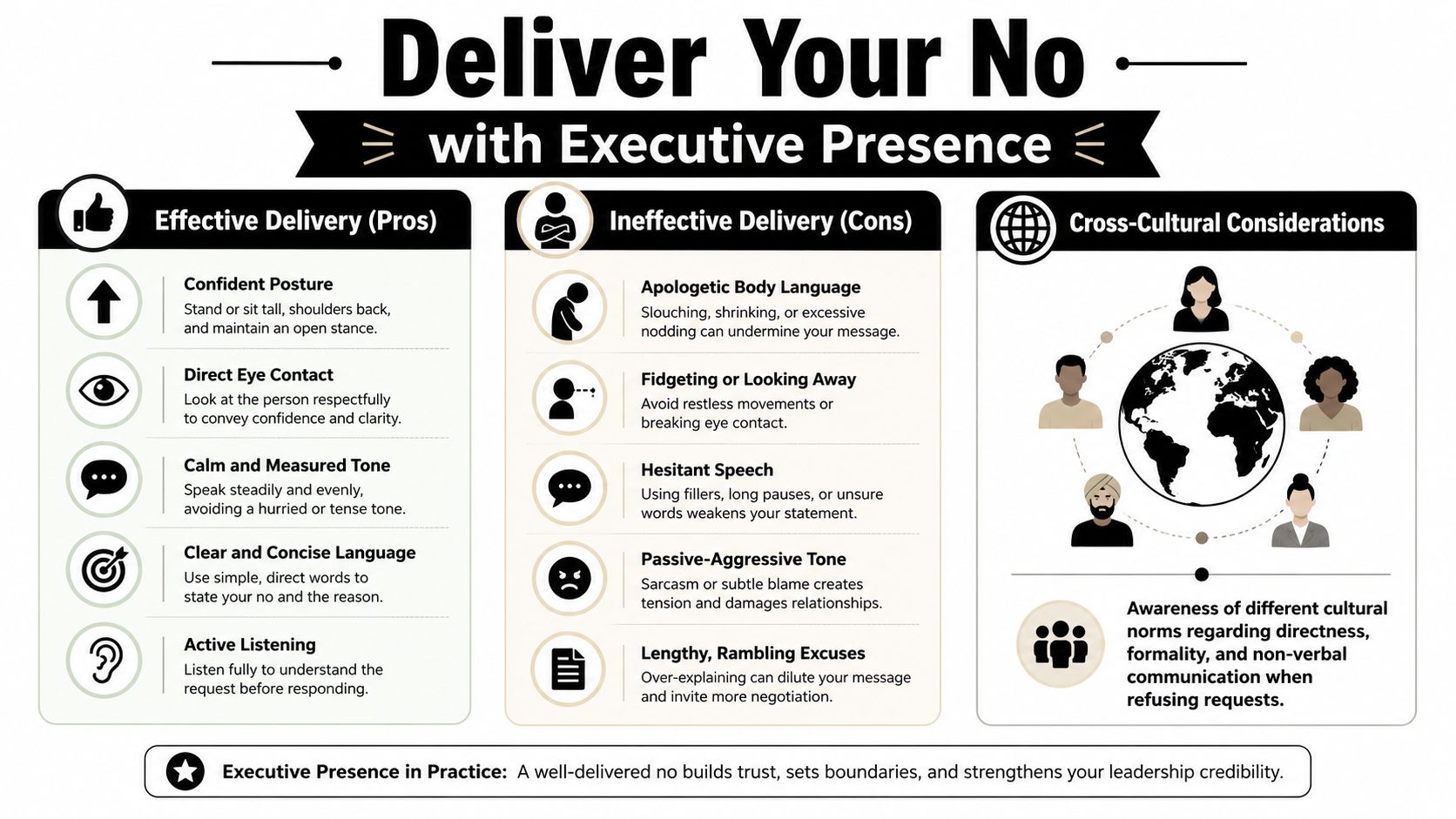
Words matter, but delivery often decides whether people accept the answer. A well-written no can still sound weak if your voice rises at the end, your posture collapses, or you keep talking after the decision is clear.
Experts on workplace communication warn that the biggest failure mode is over-explaining or using ambiguous language like “maybe”, which invites pushback. The more effective standard is a brief, direct decline with one short rationale, not a long justification, as discussed in Carey Nieuwhof's article on how to say no nicely.
What strong delivery looks like
Your delivery should match the clarity of your words.
- Posture: Sit or stand upright. Don't shrink physically while setting a boundary.
- Eye contact: Maintain steady attention without staring aggressively.
- Pace: Slow down slightly. Fast speech often sounds nervous or accommodating.
- Tone: Aim for calm and matter-of-fact, not sharp or apologetic.
- Stop point: End the sentence and pause. Don't rush in with extra explanation.
These are core parts of executive presence. People read authority through control, not volume.
Cross-cultural adjustments for international professionals
This gets more nuanced in global teams. In some environments, a direct no is respected as efficient. In others, bluntness can sound abrupt unless you add context and relational care.
The answer isn't to become vague. It's to adjust the wrapper while keeping the decision clear.
For example:
- In direct cultures: Lead with the decision quickly, then add brief reasoning.
- In more indirect cultures: Start with acknowledgment, then explain the constraint and next best option.
- With senior hierarchy: Keep the tone respectful, but make trade-offs visible rather than passively absorbing the request.
A useful parallel appears in how professionals prepare for job seekers to describe their work. The strongest communication isn't just accurate. It's shaped for the audience, context, and level of formality.
If your no requires three paragraphs of explanation, it probably doesn't sound like a real decision yet.
What weakens authority fast
Watch for these habits:
- Nervous smiling while declining
- Stacking apologies before the answer
- Offering a false maybe to soften discomfort
- Using a passive-aggressive tone instead of direct language
- Backtracking the moment someone pushes back
When your body language, tone, and wording align, the refusal lands as leadership rather than resistance.
Turn No into Your Next Leadership Opportunity
Every strong no does two things at once. It protects your time, and it tells people how to work with you.
That's why learning how to say no professionally changes more than your schedule. It sharpens your reputation. You become someone who can evaluate requests, communicate trade-offs, and stay focused on work that matters at your level.
The shift is simple, but not always easy. Stop treating no as rejection. Treat it as strategic selection. Validate the request. State the constraint. Offer the best available path forward. Then stop talking.
Used consistently, that pattern builds authority. It also creates better yeses. Your commitments carry more weight because they're no longer automatic.
If you want a sharper read on how your communication currently lands at senior levels, start with Intonetic's free Executive Communication Assessment. It's the clearest entry point for identifying where your authority, clarity, and executive presence may be getting diluted in high-stakes conversations.