How to Be Diplomatic: Master High-Stakes Settings
You're in a meeting with senior stakeholders. You've done the analysis, you know the risks, and you finally speak up. Then someone cuts across you, reframes your point more bluntly, and the room moves with them.
Many ambitious professionals often get the wrong lesson. They think they need to be tougher, louder, or more polished in a vague sense. In practice, what they need is diplomacy.
Not the ceremonial version. Not polished small talk. Not “being nice.”
In high-stakes work, diplomacy is the ability to protect the relationship while still advancing the point. It matters most when the room is tense, the hierarchy is real, and the cultural expectations are unclear. That's exactly why so much generic advice on how to be diplomatic feels useless. It usually talks about courtesy. Your problem is influence under pressure.
Why Being "Nice" Is Not Being Diplomatic
A senior product leader pushes back on a roadmap in a cross-functional review. She's right. The timeline is unrealistic, dependencies are missing, and the delivery risk is obvious. But she says it in a way that lands as resistance: “This plan doesn't make sense. We can't commit to this.”
Technically, the content is sound. Politically, it fails.
The room doesn't hear judgment. It hears friction. Now she has two problems instead of one. The bad plan is still on the table, and she has to recover her position with colleagues who feel challenged in public.
That's the mistake people make when they confuse diplomacy with softness. A diplomatic person is not passive. A diplomatic person is strategic about timing, framing, tone, and the other party's dignity.
Diplomacy is strength with control
In the workplace, diplomacy means you can do three things at once:
- State reality clearly without sounding reckless or combative
- Protect your credibility when others are emotional, rushed, or territorial
- Keep the conversation usable so the decision gets better instead of more political
That last point matters. Once a discussion turns into a status contest, the quality of thinking drops fast.
Current advice on how to be diplomatic often misses the situations professionals face. Much of the public material focuses on formal statecraft, while international professionals are dealing with volatile team dynamics, micro-aggressions, and assertive remote colleagues in real time. That gap is one reason many professionals have to act like “social anthropologists,” decoding what is said, what is avoided, and what the room really rewards in the moment, as noted in this analysis of diplomacy behind closed doors.
Being diplomatic doesn't mean reducing your opinion. It means increasing the chance that the room can hear it.
What works and what doesn't
A blunt style can feel efficient. Sometimes it even earns short-term compliance. But in senior environments, bluntness often creates hidden costs.
| Common instinct | What it signals | Diplomatic alternative |
|---|---|---|
| “That won't work.” | Dismissal | “I see a delivery risk here that we should address before we commit.” |
| “You're missing the point.” | Ego threat | “I think we may be solving a different problem. Can I test a reframing?” |
| Staying silent to avoid tension | Low ownership | Naming the issue in a calm, non-accusatory way |
If your ideas are solid but your delivery triggers resistance, the problem usually isn't intelligence. It's executive communication. That's also why building diplomatic skill overlaps with learning how to build credibility as a leader. People don't promote the clearest thinker alone. They promote the person who can move difficult conversations forward.
Cultivate the Diplomatic Mindset Before You Speak
Most communication problems start before the first sentence. They start with a bad internal frame.
If you walk into a tense conversation trying to win, defend yourself, or prove someone wrong, your language tightens. Your listening narrows. Your face gives away the fight before your words do.

Perceptiveness changes everything
The operational diplomacy framework identifies Perceptiveness as a critical technical specification. It requires you to distinguish between issues, motives, interests, and positions. Without that skill, leaders miss key drivers in the room and fail to surface the strongest ideas, which are often still unspoken, as described in the operational diplomacy framework on perceptiveness.
That distinction is practical:
- A position is what someone says they want.
- An interest is why they want it.
- A motive is the pressure behind their behavior.
- The issue is the actual decision in front of the group.
When you confuse these, you react to the loudest sentence. When you separate them, you start leading.
The pre-meeting mental checklist
Before any difficult meeting, run a short internal scan:
-
What outcome matters most
Don't aim to “handle this well.” Define your objective. Do you need a decision, alignment, a delay, or a cleaner next step? -
What does each person need
One stakeholder may need speed. Another needs political cover. A third needs proof that their team won't lose status. -
What's the visible position versus the hidden concern
“We need to move fast” may mean “I've already promised this upward.” -
Where is my own ego hooked
If you need to sound smart, be seen as right, or correct someone publicly, you're easier to provoke.
Practical rule: Enter hard conversations as an investigator, not a prosecutor.
Detach without becoming cold
A diplomatic mindset isn't emotional suppression. It's emotional regulation.
That means noticing your first interpretation, then refusing to trust it too quickly. If a colleague interrupts you, the first story in your head may be, “They don't respect me.” Sometimes that's true. Sometimes they're anxious, rushed, or trying to perform certainty in front of leadership.
Empathic listening then becomes strategic, not just kind. A strong primer on that habit is what it means to be an empathic listener. The value isn't that it makes you agreeable. The value is that it gives you cleaner data.
A better internal script
Replace these reflexes:
-
From “How do I defend my point?”
-
To “What is this person trying to protect?”
-
From “How do I stop this?”
-
To “What would move this one degree toward shared ground?”
-
From “How do I prove I'm right?”
-
To “What does the room need to hear to make a better decision?”
That shift is the foundation of how to be diplomatic under pressure. It gives your words somewhere better to come from.
Strategic Language and Phrasing Templates
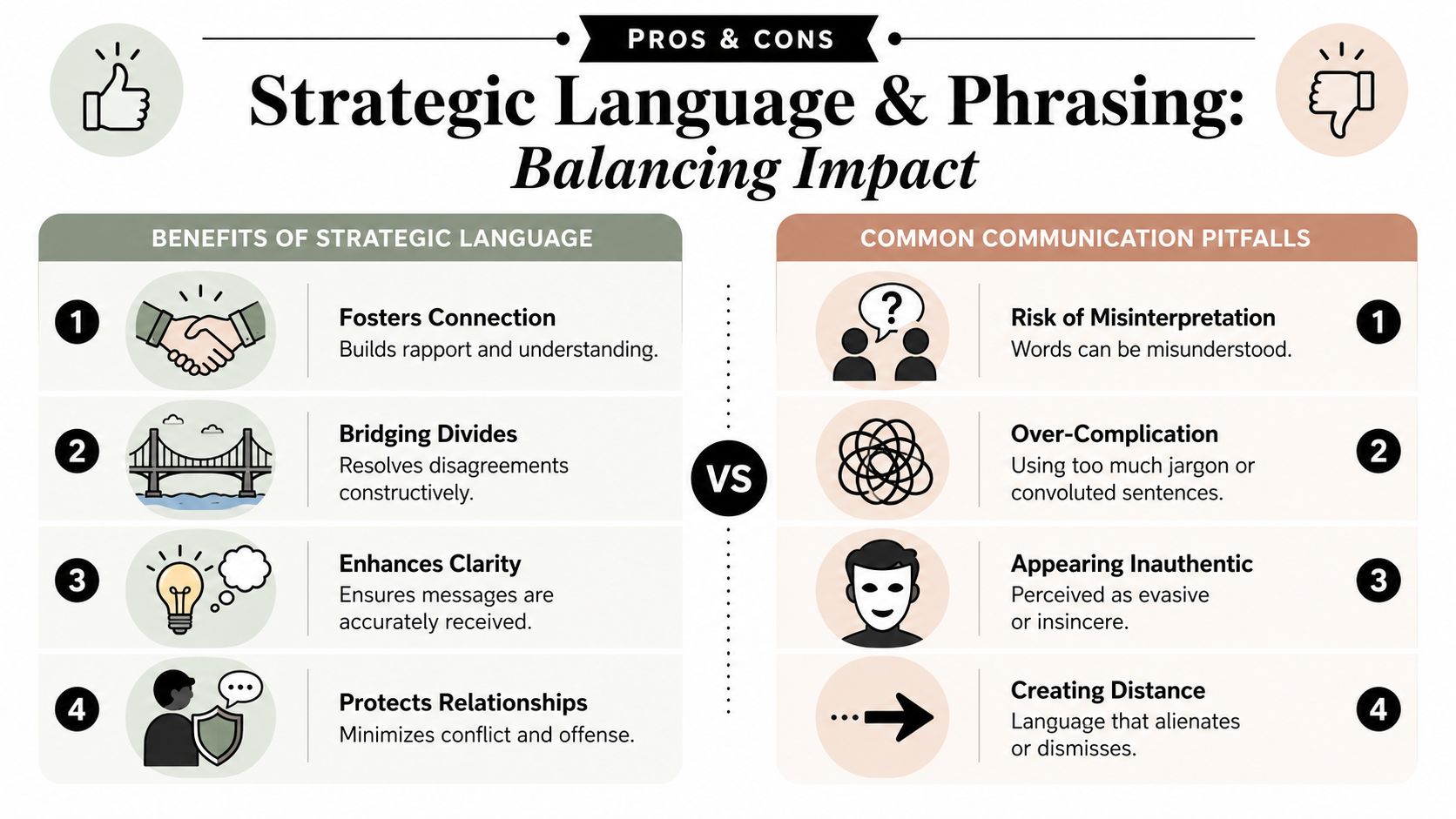
Diplomatic language is not vague language. It's precise language that lowers defensiveness and raises clarity.
The fastest way to improve is to stop leading with accusation, certainty, or conclusion. Start with inquiry, reflection, and framing. That doesn't weaken your point. It makes the other person less likely to resist it on identity grounds.
Ask before you push
One of the most common failures in diplomatic communication is not assessing intentions first. A more effective approach is to ask open questions beginning with “What,” “How,” or “Tell me about,” then periodically summarize what you've heard so the other person knows you understood them, as outlined in this guidance on asking open questions and summarizing effectively.
That gives you a simple formula:
- Open question
- Short summary
- Then your point
Example:
“What's driving the urgency on this timeline?”
“So if I'm hearing you correctly, the concern is market timing and stakeholder expectation.”
“In that case, I'd like to propose a phased commitment rather than a full launch promise.”
Phrase banks that work in real meetings
Here are better replacements for common blunt statements:
| Blunt phrase | Diplomatic alternative | Best use case |
|---|---|---|
| “That's wrong.” | “I'm seeing it differently. Can I walk you through the logic?” | Reviews, analysis disputes |
| “You need to fix this.” | “The part I'd revisit is X, because it affects Y.” | Feedback conversations |
| “This is unrealistic.” | “What assumptions would need to hold for this to be achievable?” | Planning meetings |
| “I disagree.” | “I see the trade-off differently.” | Budget or priority debates |
| “That's not my responsibility.” | “I'm happy to support, and I'll need clarity on ownership and scope.” | Boundary setting |
| “You're overcomplicating it.” | “Can we simplify the decision into two options?” | Executive updates |
Notice what these do. They keep your authority, but they remove unnecessary threat.
Three sentence structures worth memorizing
Use these repeatedly until they become natural:
-
Inquiry-led challenge
“Help me understand what would make this the preferred option over the alternative.” -
Validation without agreement
“It sounds like your main concern is execution risk. I don't see it the same way yet, but that concern makes sense.” -
Reframing toward decision quality
“Rather than deciding who owns the problem, I think we should define what a workable outcome looks like.”
Good diplomatic language sounds like a real person under control. If your wording starts sounding polished but unnatural, study rhythm as much as vocabulary. This guide to natural AI prose is useful because it shows why stiff wording often loses credibility, even when the sentence is technically correct.
Use writing as training
Email is one of the best places to practice diplomacy because it forces structure. Before sending a difficult message, check for three things:
- Intent clarity. Does the reader know what you want?
- Emotional leakage. Have irritation or blame slipped into the phrasing?
- Decision path. Is there a clear next step?
If you want a practical model, study a strong written email example and notice how calm wording can still hold a firm line.
Projecting Authority with Non-Verbal Diplomacy
A diplomatic message delivered with rushed speech, apologetic posture, or unstable eye contact loses force before the content has a chance to land.
Senior leaders don't only evaluate your ideas. They evaluate whether your presence makes those ideas safe to trust. According to Sylvia Hewlett's research, executive presence is assessed through three pillars: gravitas at 67%, communication at 28%, and appearance at 5%, with gravitas carrying the most weight and including confidence, decisiveness, integrity, and emotional intelligence, as summarized in this breakdown of Hewlett's framework.

Your voice carries your authority
Professionals often focus on word choice and ignore delivery. That's a mistake.
A strong diplomatic voice usually has these qualities:
- Measured pace rather than speed driven by nerves
- Clear endings on sentences instead of trailing off
- Strategic pauses before key points
- Stable volume that doesn't collapse under challenge
When you rush, you sound less certain than you are. When you over-explain, you signal that you expect resistance. A pause, used well, does the opposite. It tells the room you're in control of your thinking.
Body language that helps instead of harms
Your body should support the message, not contradict it.
Consider the difference between these two versions of the same point:
- Shoulders tight, chin down, quick speech, eyes moving. “I just think maybe we should reconsider the launch date.”
- Upright posture, stillness, slower pace, direct eye contact. “I recommend we reconsider the launch date because the dependency risk hasn't been resolved.”
Same idea. Different authority.
For a practical overview of this skill set, review these principles on body language for leaders. The strongest leaders don't perform confidence theatrically. They remove the small non-verbal habits that make them look unsure.
“Calm is persuasive when other people are forcing the pace.”
What to change this week
A few adjustments create immediate improvement:
-
Cut filler openings
Stop starting with “Just,” “Maybe,” “I'm not sure, but,” or “Sorry.” These phrases often weaken accurate points. -
Land one sentence at a time
Say less, then stop. Senior presence often sounds lighter, not denser. -
Hold still when challenged
Don't smile reflexively. Don't look down at your notes too quickly. Let the question sit for a beat.
A quick visual example can help when you're training this skill in real time:
Virtual diplomacy still counts
Remote settings magnify non-verbal mistakes. If your camera is too low, your face looks withdrawn. If you look at your own tile instead of the lens, you seem less direct. If your audio is thin or rushed, your authority drops.
Diplomacy in virtual meetings depends on the same principle as in-person presence. Your delivery has to make your message easier to accept. Not because you are diluting it, but because you are reducing friction around it.
Handling Pushback and De-escalating Conflict
The test of diplomacy isn't a pleasant meeting. It's the moment someone challenges you sharply, dismisses your point, or tries to corner you in front of others.
Most professionals fail here in one of two ways. They either become aggressive and lose strategic control, or they retreat and lose position. Diplomatic skill sits in the middle. You stay calm, keep the issue visible, and refuse the bait.
Use a response sequence, not a reaction
When tension rises, use this order:
-
Regulate yourself first
Breathe once. Slow your next sentence. If your body escalates, your language will follow. -
Name the concern, not the attack
If someone says, “This is going nowhere because your team keeps blocking progress,” don't answer the accusation first. Surface the underlying issue. “It sounds like the concern is delay and decision speed.” -
Move to facts and shared interests
“We both want a path that the teams can execute.” -
Propose a cleaner process
“Let's separate the timeline question from the ownership question so we can solve them in the right order.”
This is what many companies fail to teach. Empirical analysis found that fewer than 10% of global companies systematically train managers in diplomacy and international relations, leaving a major capability gap in how leaders handle risk, ambiguity, and non-commercial pressure, as discussed in the Academy of Management article on business diplomacy.
Phrases that de-escalate without surrendering
Try these in live conflict:
-
When interrupted
“Let me finish the thought, then I'm happy to come to that.” -
When someone gets personal
“I'd prefer to keep this focused on the decision rather than on intent.” -
When the room gets heated
“We may be combining several issues. Can we isolate the main point first?” -
When you need time
“I want to answer carefully rather than quickly. Give me a moment.”
Don't mirror the temperature of the room. Reset it.
A scenario that shows the difference
Suppose a director says, “Your concerns are theoretical. We need action, not analysis.”
A weak response is submissive: “Okay, maybe I'm overthinking it.”
A combative response is: “That's unfair and inaccurate.”
The diplomatic response is stronger than both:
“I'm aligned on action. My concern is that if we skip this dependency check, we create execution risk later. If speed is the priority, I'd suggest a narrowed scope we can commit to confidently.”
That answer does four things at once. It absorbs pressure, protects your expertise, aligns with business urgency, and redirects the conversation toward a workable option.
If this is an area you want to sharpen deliberately, how to disagree respectfully is a useful companion skill because disagreement is often where diplomacy either becomes visible or falls apart.
One structured option for professionals who want focused support is this: The Gravitas Method is a 12-week one-on-one executive presence coaching program for international professionals who want to communicate with more authority and influence at senior levels. The program is priced at $8,200 paid in full or $9,000 across three installments. Coached by Nikola, it covers vocal authority, strategic framing, executive body language, and high-stakes communication.
Your Diplomatic Toolkit and Next Steps
The need isn't for more advice on manners. It's for repeatable habits for high-pressure moments.
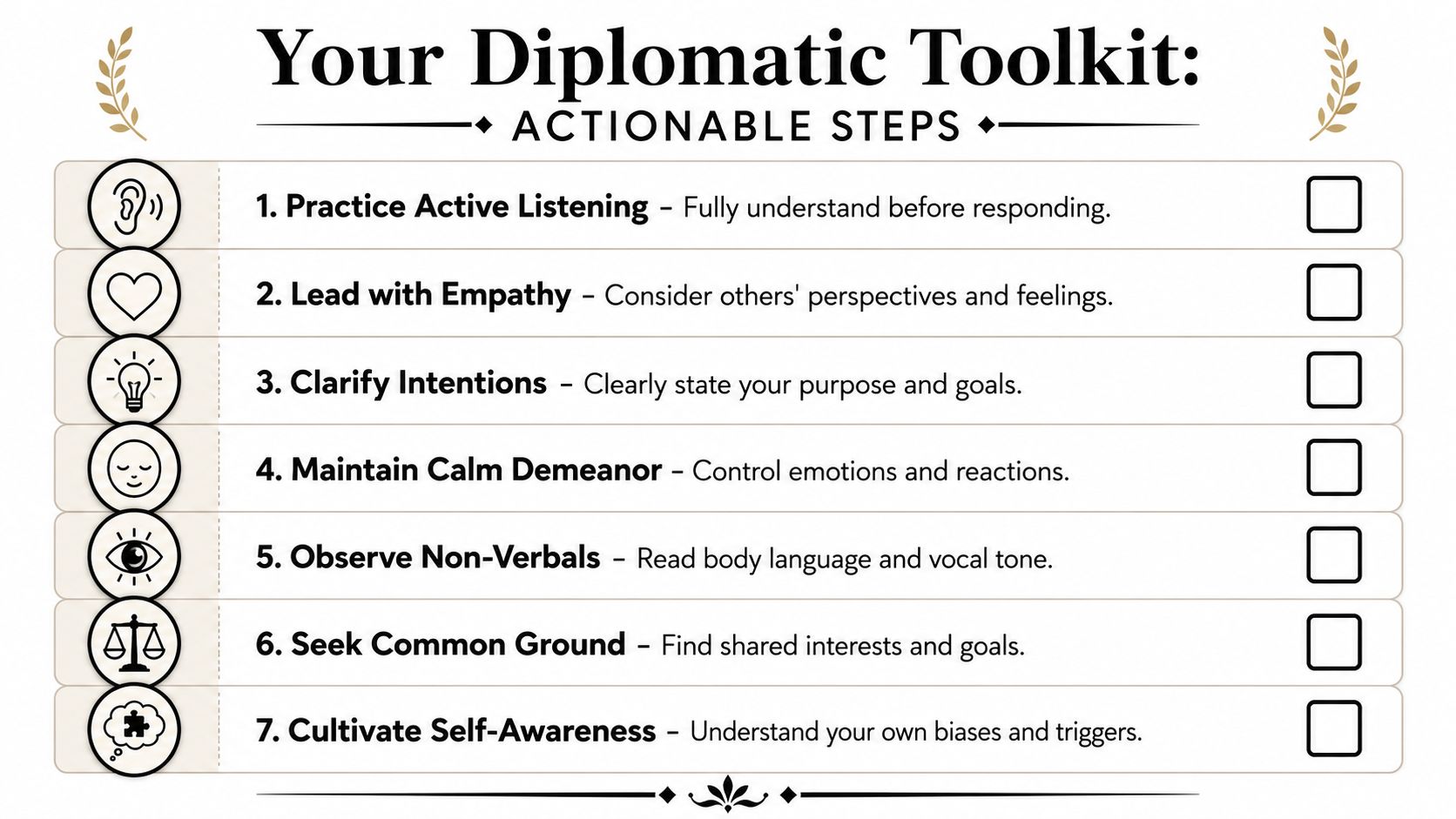
That's the practical answer to how to be diplomatic. Build a toolkit you can use when the stakes are real, your status is being tested, and the room won't slow down for you.
The daily toolkit
Use this as a working checklist:
-
Listen for interests, not just words
Ask yourself what pressure, fear, or priority sits beneath the sentence you heard. -
Open with questions
Modern diplomacy requires leaders to ask questions that reveal the other party's goals and interests, helping uncover bargaining material that isn't visible on the surface, as explained in this discussion of new skills for diplomacy in the 21st century. -
Summarize before you argue
A short paraphrase lowers resistance and buys you accuracy. -
Slow the first response
The first reaction is often ego. The second response is usually judgment. -
Use fewer words
Concision often reads as seniority. Over-explaining often reads as uncertainty.
Practice in low-stakes situations first
Don't wait for the board meeting. Train the skill in smaller moments.
Try this for five workdays:
| Day | Practice |
|---|---|
| Monday | Replace one blunt statement with an open question |
| Tuesday | Summarize a colleague's point before giving your own |
| Wednesday | Remove filler words from one meeting contribution |
| Thursday | Hold a two-second pause before answering a challenge |
| Friday | Review one interaction and identify the other person's likely interests |
This is how diplomatic communication becomes part of your default behavior. Not through theory, but through repetition.
What ambitious professionals often miss
The professionals who rise fastest are not always the most brilliant in the room. Often, they are the ones who can absorb tension without becoming smaller or sharper. They can challenge without humiliating. They can stay clear without sounding rigid.
That combination is learnable.
If you're serious about growing into senior leadership, treat diplomacy like any other executive skill. Diagnose the weak points. Practice under pressure. Refine the parts that are costing you authority without your noticing.
If you want a clear read on how your communication currently lands, start with Intonetic's free Executive Communication Assessment. It's the best entry point if you want specific feedback on your vocal authority, strategic framing, body language, and performance in high-stakes conversations.