
Boost Your Career: Executive Presence Skills 2026
You leave a meeting thinking, “I said the same thing everyone agreed with ten minutes later. Why didn't it land when I said it?”
That's the moment many high-performing professionals run into the actual problem. Their expertise is strong. Their analysis is solid. Their work is respected. But in senior rooms, expertise alone doesn't carry the message. Delivery does.
This is especially frustrating for international professionals. You may already be doing the hard part: building the insight, solving the problem, preparing thoroughly. Yet feedback still comes back vague. “Be more confident.” “Sound more strategic.” “Have more presence.” That kind of feedback feels personal, but it usually points to something far more practical.
What Is Executive Presence and Why It Matters Now
You present a strong recommendation in a meeting. The idea is solid. Ten minutes later, someone else makes a shorter version of the same point, and the room responds as if they heard it for the first time.
That gap is often executive presence.
Executive presence is not a personality trait or a polished image. It is a set of observable executive presence skills that shape how other people judge your judgment, credibility, and readiness to operate at a higher level. For international professionals, that distinction matters. The problem is often not intelligence or capability. It is that the signals other people rely on are not coming through clearly enough.

In senior settings, people are making fast judgments about questions like these:
- Can this person stay steady under pressure?
- Do they communicate in a way others can follow?
- Do they sound ready to represent the team or function?
- Can they frame a message so people know what matters and what to do next?
Those judgments may not be fair. They still affect who gets trusted, included, and promoted.
That is why I treat executive presence as a practical skill set, not a vague label. You can improve vocal pacing, message framing, brevity, response control, and visual composure. You can assess where your signal breaks down. You can practice the specific behaviors that change how your expertise is received. The work is concrete, especially if you approach communication as persuasion rather than self-expression alone.
Why it matters more now
Work is more visible and more compressed than it used to be. Senior professionals are evaluated in live meetings, on video calls, in written updates, and in quick cross-functional exchanges where there is little time to recover from a muddled point.
A strong contribution now has to travel across formats.
If your message is clear in a prepared presentation but weak in a Q&A, people notice. If you sound credible in a one-on-one conversation but hesitant in a group setting, people notice that too. If your ideas are strong but your updates are too detailed, too cautious, or too hard to follow, your judgment may be underestimated.
This is one reason communication as persuasion in professional settings matters so much to executive presence. Senior leaders are not only judged on what they know. They are judged on whether they can help other people decide, align, and act.
What executive presence is, and what it is not
Executive presence is not about becoming louder or copying someone else's style. It is the ability to send consistent signals of clarity, steadiness, and sound judgment.
That usually shows up in visible behaviors:
- speaking at a pace people can absorb
- leading with the main point
- holding eye contact without strain
- answering challenge without becoming defensive
- staying concise when the stakes rise
- sounding grounded rather than rushed
These are trainable behaviors. They also involve trade-offs. A very detailed style can signal thoroughness, but in senior rooms it can also weaken perceived judgment if the key point comes too late. A highly polished delivery can sound confident, but if it feels scripted, trust drops. Strong executive presence is rarely about doing more. It is about removing the habits that blur your authority and strengthening the ones that make your thinking easy to trust.
The Three Pillars of Executive Presence
Executive presence has been codified in leadership literature as a distinct capability built from gravitas, communication, and appearance, as explained in this overview of what executive presence is. That framework is useful because it turns a fuzzy topic into something you can diagnose.
Gravitas
Gravitas is what people feel from you when pressure rises.
It shows up in your steadiness, judgment, pacing, and ability to stay composed when challenged. People with gravitas don't rush to fill silence, overexplain, or become defensive the moment someone pushes back. They look as if they can carry weight.
For international professionals, gravitas often gets confused with accent, fluency, or personality style. That's a mistake. Gravitas comes through much more reliably in how you hold your point, how you respond under scrutiny, and whether you sound grounded rather than hurried.
Communication
Communication is often an underestimated pillar. It's not only about speaking well. It's about helping other people understand what matters, why it matters, and what should happen next.
Strong communication includes:
- Message structure: leading with the point instead of circling around it
- Audience judgment: framing the same issue differently for engineers, finance leaders, or executives
- Conciseness: giving enough context without burying the recommendation
- Persuasion: making your idea relevant to the other person's priorities
If you want a deeper look at how strategic framing changes outcomes, communication as persuasion is the right lens.
A useful distinction: many smart professionals inform well but persuade poorly. Senior leaders need both.
A short explanation helps here:
Appearance
Appearance sounds old-fashioned until you define it correctly.
This pillar isn't just clothing. It includes your visual polish, your on-camera setup, whether your nonverbal presentation supports your authority, and whether your written style sounds senior. In hybrid work, appearance includes how you show up in every channel where people form quick judgments.
| Pillar | What people notice | What weakens it |
|---|---|---|
| Gravitas | Calm under pressure, steadiness, confidence | Defensiveness, rushing, visible tension |
| Communication | Clarity, structure, relevance | Rambling, jargon, unclear ask |
| Appearance | Professional polish, consistency, presence across channels | Distracting visuals, messy delivery, casual inconsistency |
Most professionals don't have a presence problem across all three pillars. They usually have one dominant gap that contaminates the rest.
How to Develop Gravitas and Project Credibility
Gravitas is the pillar people talk about most and teach least well. Telling someone to “be more confident” doesn't help. Confidence becomes believable when it shows up in specific behaviors.
One of the clearest examples is pace. Authoritative leaders are advised to speak 10-15% slower than their natural rate, eliminate filler words, and insert strategic pauses after key points, according to this guide on executive presence delivery techniques. Those are trainable behaviors, not personality traits.
Start with vocal authority
If you speak too quickly, your audience has to work harder to process your ideas. Under pressure, that often reads as nervousness, even when you know the material cold.
Use this sequence instead:
- Lower your launch speed. Start your first sentence more slowly than feels natural.
- Finish the sentence completely. Don't fade out at the end.
- Pause after the point. Let the room absorb it.
- Continue only when needed. Don't add extra words to protect yourself from silence.
A rushed speaker sounds like they're seeking approval. A measured speaker sounds like they expect to be heard.
Remove the habits that leak uncertainty
Most credibility losses come from small leaks, not major failures.
Watch for these patterns:
- Filler words: “um,” “you know,” “kind of,” “I think” when you already know your point
- Verbal backtracking: starting a sentence, abandoning it, then restarting
- Premature softening: “This may be a silly idea, but…”
- Overqualification: adding too much context before the recommendation
These habits are common among capable professionals who are trying to sound careful. The trade-off is real. Precision matters. But too much cushioning weakens authority.
If your role requires influence without formal authority, mastering influence as a product manager offers a practical view of how calm, clear communication shapes decisions across functions.
Train gravitas like a performance skill
Gravitas improves faster when you practice with constraints.
Try this simple routine:
- Record one minute: explain a business recommendation out loud
- Review with sound first: check pace, filler words, and endings
- Review with video next: check whether your face, posture, and gestures match the message
- Repeat with one improvement goal: don't fix everything at once
For professionals who need a sharper framework for trust and delivery, this article on how to build credibility as a leader is a useful next step.
The mistake to avoid is practicing content without practicing delivery. In senior settings, people evaluate both at the same time.
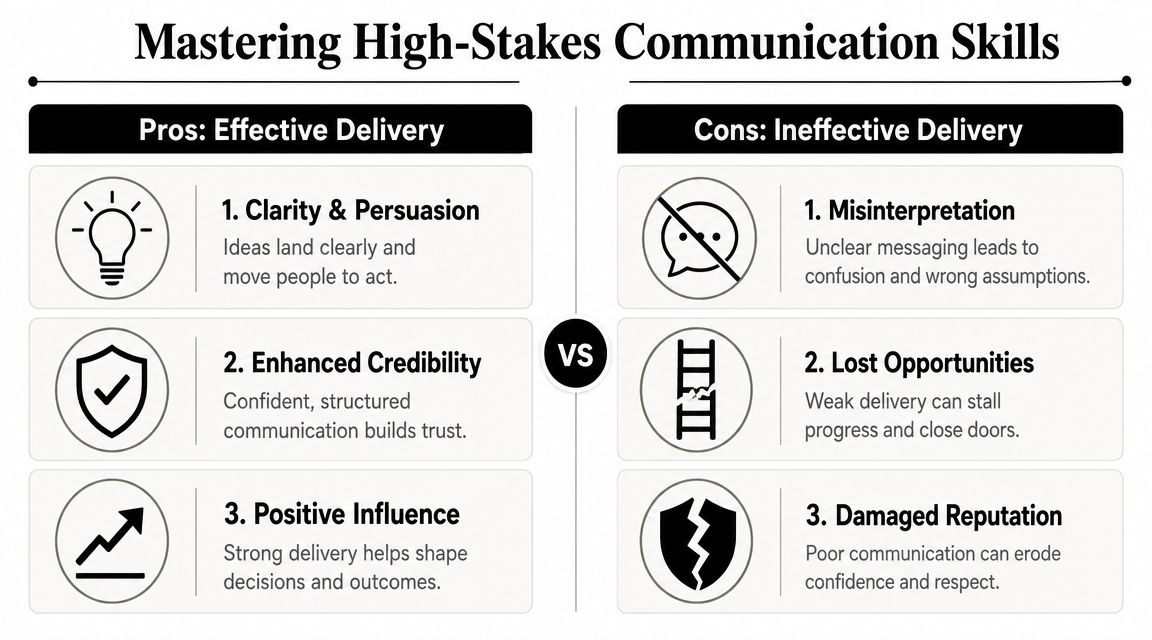
Mastering High-Stakes Communication Skills
High-stakes communication is where executive presence becomes visible. Presenting to leadership, handling a tough Q&A, giving an off-the-cuff update, defending a recommendation in a tense meeting. These moments expose whether your message, body language, and composure work together.
Frame for the audience, not for yourself
Many professionals explain ideas in the order they discovered them. That's logical to the speaker, but inefficient for the audience.
Executives usually want this order instead:
- What's happening
- Why it matters
- What you recommend
- What decision or support you need
That's strategic framing. It doesn't simplify the substance. It prioritizes it.
If you're speaking to senior leadership, start with business consequence, not process detail. If you're speaking to technical peers, start with trade-offs and constraints. Same issue, different frame.
Use nonverbal signals deliberately
Executive presence is strongly shaped by non-verbal signaling. Body language, eye contact, vocal variety, and conciseness materially affect perceived credibility, while distracting micro-behaviors reduce it, as described in this Vistage discussion of executive presence coaching.
That means small behaviors matter more than people think.
A short comparison makes this clear:
| Effective delivery | Ineffective delivery |
|---|---|
| Steady eye contact | Looking away during key points |
| Natural gestures | Fidgeting, pen-clicking, phone-checking |
| Short, complete answers | Long, winding responses |
| Upright posture | Collapsed or restless posture |
| Controlled pace | Fast, breathless speech |
The room reads your body before it fully processes your argument.
Build one integrated skill set
Strong communicators don't separate verbal and nonverbal performance. They align them. The recommendation sounds clear because the structure is clear. The answer feels credible because the speaker doesn't rush. The message lands because the delivery supports it.
One structured option for developing that combination is The Gravitas Method, a 12-week one-on-one executive presence coaching program for international professionals who want to communicate with more authority and influence at senior levels. The program is priced at $8,200 paid in full or $9,000 across three installments. Coached by Nikola, it covers vocal authority, strategic framing, executive body language, and high-stakes communication.
If senior rooms still feel harder than they should, learn how to talk to senior leadership in a way that matches what decision-makers listen for.
Executive Presence Examples in Tech Finance and Consulting
Executive presence doesn't look identical across industries. The underlying skills are similar, but the visible form changes with the environment.
Tech
A product manager presents a roadmap update after a delay. A weaker version sounds apologetic, overloaded with detail, and defensive about trade-offs.
A stronger version sounds different. The PM states the decision clearly, names the impact on users and business priorities, explains the trade-off without hiding from it, and answers pushback without becoming tense. In tech, presence often means translating complexity without losing authority.
Finance
An analyst presents a risk view to senior stakeholders during an uncertain quarter. The room doesn't need drama. It needs steadiness.
Executive presence here shows up in disciplined language, clean summaries, and emotional control. The analyst doesn't speculate casually or bury the headline in caveats. They distinguish what is known, what remains uncertain, and what action makes sense now. In finance, composure often carries as much weight as insight.
In high-trust industries, presence often sounds less expressive and more precise.
Consulting
A consultant faces a skeptical client who challenges the recommendation halfway through a presentation. Many people in this scenario either become rigid or too eager to please.
The stronger consultant acknowledges the concern, reframes the issue around the client's stated priorities, and returns to the structure of the recommendation. They don't fight for control of the room. They regain it by clarifying the decision path. In consulting, executive presence often means holding authority without sounding territorial.
What these examples have in common
The surface style differs, but the pattern doesn't.
- They lead with relevance: each speaker ties the message to what the audience cares about
- They stay composed under interruption: they don't collapse when challenged
- They sound organized: listeners can follow the logic quickly
- They protect signal quality: they avoid rambling, hedging, and reactive language
That's why executive presence skills aren't cosmetic. They shape whether expertise turns into influence in the settings that matter most.
How to Assess Your Executive Presence Gaps
You leave a meeting knowing your analysis was solid, but the decision goes to someone whose point sounded clearer, steadier, and easier to act on. That is the moment to stop asking for a vague boost in presence and start diagnosing specific behaviors.
For many capable professionals, especially international professionals, the problem is not competence. It is signal clarity. Colleagues are reacting to observable cues such as pacing, message order, vocal confidence, and how quickly you connect your point to the business decision.
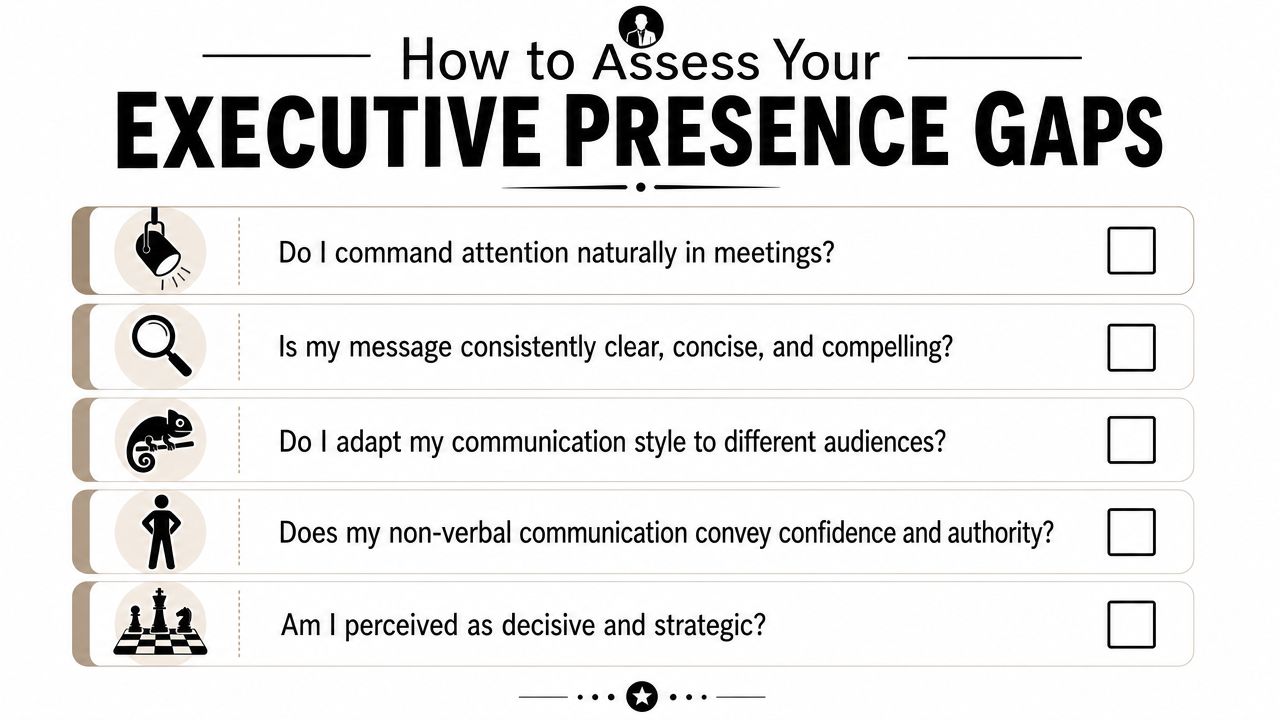
A practical self-check
Assess yourself based on behavior other people can see and hear, not on what you meant to convey.
- In meetings: Do people track your point within the first 15 seconds, or do you need too much runway before they engage?
- Under pressure: Does your voice speed up, drop in volume, or lose structure when someone challenges you?
- In presentations: Do you state the recommendation first, then support it, or do you spend too long building context?
- In Q&A: Do you answer the question directly, then expand, or do you over-explain before you commit?
- In writing: Do your updates help senior stakeholders see the headline, risk, and next step quickly?
- On video: Do your posture, facial expression, and vocal energy reinforce authority, or dilute it?
A useful rule: if you cannot point to the behavior, you cannot improve it consistently.
Diagnose the likely gap
I usually see three categories. They overlap, but one is often doing the most damage.
| Primary gap | What it sounds or looks like | Most likely fix |
|---|---|---|
| Authority gap | You sound hesitant, rushed, or overly deferential | Practice slower pacing, cleaner sentence endings, deliberate pauses, and firmer wording |
| Context gap | Your ideas are strong but the audience does not see why they matter yet | Improve message framing, prioritization, and executive summary structure |
| Expression gap | Your content is sound but delivery weakens confidence in it | Improve eye contact, posture, gesture discipline, and written polish |
International professionals often get misread in all three areas. A speaker may be highly competent but use indirect phrasing to sound respectful, add too much background to avoid seeming abrupt, or flatten vocal emphasis in a second language. None of that means the person lacks leadership potential. It means the delivery pattern needs adjustment for the audience and setting.
What to do after the self-check
Choose the pattern that shows up most often in feedback, recordings, and high-stakes interactions. Work on one gap first. Trying to fix everything at once usually produces self-conscious delivery rather than stronger presence.
If your feedback is broad or inconsistent, use a more structured executive presence assessment framework to pinpoint whether the issue is authority, context, or expression. Clear diagnosis saves time. It also gives you a practice plan you can apply in meetings, presentations, and written communication.
When to Seek Personalized Executive Presence Coaching
You leave a leadership meeting knowing your recommendation was sound. A colleague repeats the same point ten minutes later, and the room treats it as the decisive takeaway. That is usually the point where self-study stops being enough.
Books, recordings, and practice drills can clean up visible habits. They are less effective when the underlying problem is pattern recognition. Many professionals cannot hear their own hesitation, see where they over-explain, or tell which parts of their delivery read as less senior in a specific culture or business setting.
That challenge shows up often with international professionals. Respectful phrasing can sound tentative. A detailed explanation can bury the headline. A neutral vocal pattern in a second language can flatten conviction. The issue is rarely capability. The issue is that other people are reading signals you did not intend to send.
Signs you've outgrown self-study
Personalized coaching makes sense when one or more of these patterns keeps showing up:
- Your results are strong, but advancement has slowed: decision-makers value your work, yet still hesitate to picture you at the next level
- Feedback keeps pointing to presence, polish, or seniority: the comments are consistent, but no one can tell you which behavior is creating the impression
- You are entering a higher-stakes context: executive interviews, board presentations, investor conversations, reorg announcements, or larger client-facing responsibilities
- Your self-corrections are making you sound less natural: you are trying to fix everything at once, and your delivery now feels controlled rather than clear
- You need adaptation, not generic advice: your role, industry, and cultural context require specific adjustments in pacing, framing, and authority signals
Good coaching speeds up diagnosis. It identifies the few observable behaviors that are distorting how your message lands, then gives you a practice method you can use in real meetings.
If you want that kind of targeted diagnosis, start with Intonetic's executive presence coaching and assessment process. It helps you pinpoint whether the gap is in vocal authority, strategic framing, nonverbal discipline, or high-stakes communication, so you can work on the right behavior instead of guessing.