Definition of Gravitas and How to Develop It
Gravitas is the quality of composure, credibility, clarity, and confidence that makes others treat a speaker's words as weighty and trustworthy. It isn't just sounding serious. It's the visible mix of calm, precision, and authority that makes people lean in, trust your judgment, and take your message seriously.
You've probably seen it in a meeting already. Two people can have the same title, the same preparation, and the same slide deck, yet one fills the room while the other seems to disappear into it. The difference is often not expertise, it's gravitas, and that's why it matters so much in leadership, interviews, negotiations, and any conversation where your presence is part of the message.
The Moment Gravitas Becomes Obvious
A senior manager once watches two equally qualified colleagues present the same project update. Both know the numbers. Both understand the risks. One speaks in a steady rhythm, pauses before key points, and frames the situation with calm certainty. The other rushes, fills every gap with extra explanation, and sounds like he's asking permission to believe his own idea.
The room notices the difference immediately. No one says, “This is a gravitas problem,” but that's exactly what it is. The first speaker seems trustworthy because the audience can feel structure and control. The second speaker may be smart, but the delivery makes the message feel less settled.
That's the central challenge for many professionals in English-language business settings. Technical skill gets you into the conversation, but it doesn't always make people treat your words as authoritative. Gravitas is the layer that changes how your message lands, especially when people are scanning for composure.
A helpful companion if you're already working on this skill is this practical speaking confidence guide, because confidence and gravitas often show up together, even though they're not identical.
The good news is that gravitas isn't a mystery trait reserved for a lucky few. It's easier to understand once you can see what it looks like, hear what it sounds like, and notice what cultures sometimes interpret differently. That's where the definition becomes useful, not just academic.
What the Definition of Gravitas Really Means
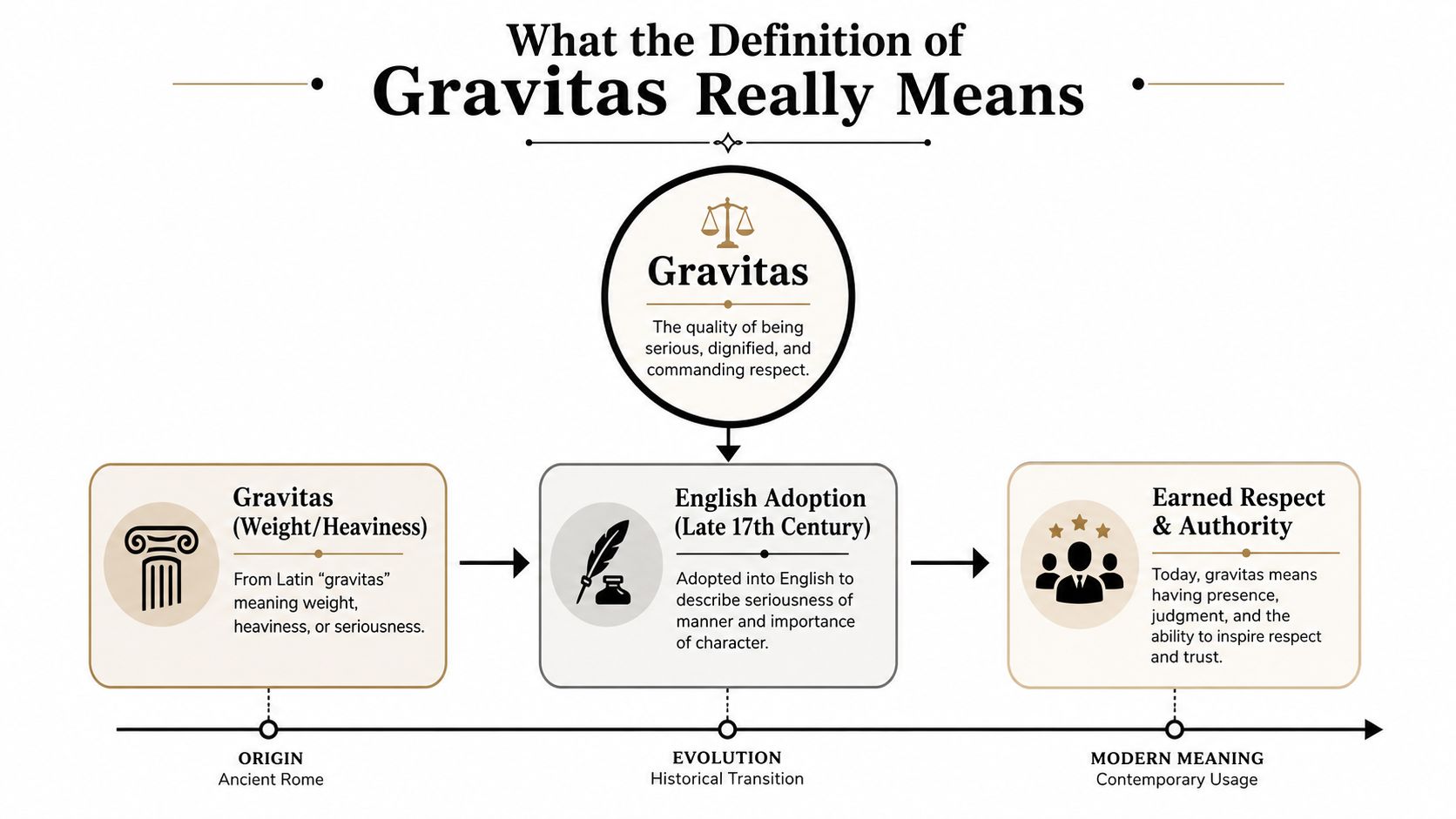
The word gravitas comes from Latin gravitas, meaning weight or heaviness. English borrowed it in the late 1800s to describe a person's dignity, presence, influence, or seriousness, not physical weight. That metaphor matters, because the modern sense of gravitas still rests on the idea that some people and some messages carry more social “weight” than others.
The dictionary thread stays remarkably consistent
Merriam-Webster defines gravitas as “high seriousness” (Merriam-Webster). Cambridge describes it as “seriousness and importance of manner, causing feelings of respect and trust in others” (Cambridge). Longman says it is a seriousness of manner that people respect, and Collins adds that someone with gravitas seems serious and intelligent (Longman).
Oxford Learner's Dictionaries identifies gravitas as the quality of being serious and traces it to Latin gravis, meaning “serious” (Oxford Learner's Dictionaries). Vocabulary.com also notes the root sense of weight or heaviness and the later figurative meaning of seriousness and dignity (Vocabulary.com).
A plain-English working definition
The cleanest working definition is this. Gravitas is the quality of composure, credibility, clarity, and confidence that makes others treat a speaker's words as weighty and trustworthy. That's more useful than calling it “seriousness,” because mere seriousness can look stiff, distant, or even awkward. Gravitas is seriousness that earns respect.
That distinction is where many people get confused. A quiet person isn't automatically someone with gravitas. Cambridge's definition helps here, because it links gravitas to importance of manner and to the respect and trust it creates in other people. In other words, the issue isn't whether you speak softly or loudly. It's whether your manner makes the room believe your judgment has substance.
If you want the broader executive context, this internal guide on what executive presence means fits neatly with gravitas, because gravitas is one of the most visible parts of it.
The Four Signals That Make Gravitas Visible
Gravitas becomes easier to recognize when you stop treating it as a vague aura and start looking at the behaviors people notice. In business settings, those signals usually cluster around four areas, composure under pressure, vocal authority, strategic framing, and executive body language. Together, they tell the listener whether to relax, doubt, or trust.
Composure under pressure
This is the first thing people feel in a tense moment. A composed speaker doesn't speed up to escape discomfort, and they don't over-explain just because the room is quiet. The audience reads that steadiness as self-control, which often becomes a proxy for judgment.
Vocal authority
Vocal authority is not about sounding theatrical. It's about speaking with a steady pace, enough pause to show control, and a tone that doesn't wobble at the end of each sentence. When a voice sounds rushed or tentative, listeners often assume the speaker is less certain than they really are.
Strategic framing
Strategic framing means you lead the listener to the point instead of circling it. A person with gravitas often names the conclusion first, then supplies the logic. That structure tells the room, “I have organized this thinking already,” which reduces friction for everyone else.
Executive body language
Body language matters because people read your physical presence before they finish processing your words. Open posture, stillness, and grounded movement all signal that you're settled enough to handle attention. By contrast, fidgeting, collapsing into the chair, or shrinking physically can make even a strong idea feel smaller.
If you want a deeper look at voice mechanics, this executive communications coaching resource is useful context because vocal delivery is one of the clearest channels through which gravitas shows up.
Practical rule: people rarely describe gravitas directly, they describe what it made them feel. Calm. Certain. Able to trust the person in front of them.
The common thread is that gravitas is observable. It doesn't live in personality alone. It lives in cues the listener can detect within seconds.
Gravitas in Action and What Gravitas Sounds Like Instead
The fastest way to understand gravitas is to hear the difference between a message that slips away and one that holds its shape. The words can be almost identical. What changes is pacing, framing, and the sense that the speaker is in command of the moment.
A quick note before the examples. The same idea can sound very different depending on how it's delivered. That's why strong professionals sometimes still sound uncertain, not because they lack knowledge, but because pressure changes how they speak.
| Situation | Undermines Gravitas | Builds Gravitas |
|---|---|---|
| Project update in a leadership meeting | “Um, I just wanted to give you a quick update. There are a few things happening, and I'm not sure which one matters most.” | “The update is simple. We're on track for the launch, the main risk is vendor timing, and I'll explain the decision we need today.” |
| Stakeholder negotiation | “I think we might be able to move a little, but I'd have to check with the team.” | “We can adjust the timeline, but only if scope stays fixed. If scope changes, the date moves too.” |
| Executive Q&A | “That's a good question. I guess what I'd say is that there are several factors.” | “The main factor is resourcing. The secondary factor is sequencing. I'll walk you through both.” |
The pattern is consistent. The weaker version diffuses attention. The stronger version organizes it. That's why professional voice training often focuses on more than pronunciation, because the listener is responding to authority cues, not just language accuracy.
What changes between the two versions
In the weaker examples, the speaker sounds as though they are discovering the idea in real time. In the stronger examples, the speaker sounds as though they have already done the thinking. That difference matters because audiences often equate internal order with external credibility.
A few practical contrasts stand out.
- Pacing: rushed delivery often reads as uncertainty, while a measured pace suggests control.
- Framing: burying the point forces listeners to work harder, while leading with the conclusion lowers effort.
- Presence: scattered body language makes the message feel less settled, while stillness makes it easier to trust.
For writers and speakers, this is the hidden tension. You can be technically brilliant and still sound unsteady if your delivery leaks pressure. Gravitas closes that gap by making your thinking visible before your audience has time to doubt it.
For a related resource on the language layer, this tier 2 words guide can help you choose words that sound precise without becoming inflated.
How Culture Shapes Gravitas for International Professionals
Gravitas does not land the same way in every business culture. A behavior that reads as confident in one setting can look blunt, evasive, or overly formal in another. International professionals feel this tension sharply because they're often being judged not only on content, but on whether their style matches local expectations.
Directness and context are not the same thing
In more direct business environments, people often expect the point to come early and clearly. In higher-context settings, a slower approach can signal care, respect, and awareness of the group. Neither style is automatically better, but each changes how gravitas is perceived.
Eye contact and silence travel differently
Eye contact can signal confidence in one room and feel intense in another. Silence can communicate thoughtfulness in one culture and hesitation in another. The useful skill is not copying a single global standard, it's reading the room and adjusting without losing your center.
That means gravitas in international settings is less about performing a universal style and more about being deliberate. If you are too fast, too blunt, or too self-effacing, people may miss your authority. If you are too elaborate or too restrained for the room, they may miss your point.
A practical example helps. In a leadership call with US-based stakeholders, a concise recommendation up front often lands well. In a cross-border negotiation, the same directness may need a softer lead-in, a brief pause, and a more explicit explanation of how you reached the conclusion. The message stays strong, but the delivery adapts.
Gravitas travels best when the speaker stays calm, clear, and observant, then adjusts the outer signal without losing the inner authority.
Quick Exercises to Start Building Gravitas This Week
You do not build gravitas by thinking about it longer. You build it by rehearsing a few visible behaviors until they feel more natural under pressure. Keep the practice small enough that you'll do it.
1. Use a two-breath pause
Before answering a question, take two silent breaths. That gives your nervous system a beat to settle, and it stops you from rushing into filler words. Success looks simple, you answer more slowly without sounding hesitant.
2. Frame every answer in three sentences
Start with the conclusion, add the reason, then end with the implication or next step. This takes about a minute once you've practiced it, and it helps you sound organized instead of scattered. If someone can summarize your point back to you easily, you framed it well.
3. Reset posture before high-stakes moments
Sit tall, plant both feet flat, and take one slow exhale before a meeting or call. This takes less than a minute, and the goal is not perfect posture, it's a stable physical signal. If your shoulders stop creeping up toward your ears, you're already improving.
4. Open meetings with one decisive line
Before you speak, decide the first sentence out loud in your head. Then say it cleanly, without apologizing or over-explaining. A strong opening line tells the room that you know why you're there.
For more structured drills, the voice lesson exercises page is a practical companion because repetition matters more than insight alone.
Mindset shift: gravitas is not sounding bigger than you are. It's sounding as clear, calm, and organized as your real judgment deserves.
A 12-Week Roadmap for Developing Real Gravitas
A useful development plan has to do more than inspire you. It has to change how you sound, move, and structure your message under pressure. Four weeks per signal gives enough time to notice the habit, practice the replacement, and make the new behavior less fragile when the stakes rise.
A simple progression that holds together
Weeks one through three focus on vocal authority. Weeks four through six focus on strategic framing. Weeks seven through nine focus on executive body language. Weeks ten through twelve focus on high-stakes communication, when all the pieces have to work together at once. That sequence matters because it builds from the easiest-to-observe signals into the most demanding situations.
If you want outside structure, training from Professional Careers Training can be a useful supplement, especially if you're already strengthening broader leadership behaviors alongside communication.
The reason this order works is simple. Vocal control changes quickly, framing is easier to rehearse in writing and speech, body language becomes more automatic with repetition, and high-stakes delivery tests whether the earlier habits hold under real pressure. If you skip straight to the hardest moments, you often end up rehearsing the same stress response.
For professionals who want a more guided route, The Gravitas Method is a 12-week one-on-one executive presence coaching program for international professionals who want to communicate with more authority and influence at senior levels. It is coached by Nikola, and it covers vocal authority, strategic framing, executive body language, and high-stakes communication. The program is priced at $8,200 paid in full or $9,000 across three installments.
That structure makes sense for senior professionals because gravitas is not one isolated habit. It's a coordinated pattern of speech, composure, and presence. If you want to start with a lighter entry point, the free Executive Communication Assessment is the natural first step, and it leads directly into the right development path. For a parallel practice track, the business English speaking practice resource can also support the language side of the work.
If you want to sound more authoritative in meetings, interviews, and senior-level conversations, start with the free Executive Communication Assessment. Intonetic helps international professionals build the speaking habits, vocal authority, and executive presence that make their ideas carry more weight. Visit Intonetic to take the next step and see where your gravitas is already strong, and where it needs sharpening.