
Cross Cultural Understanding of Consumer Behaviour
You're launching the same campaign in London, Chicago, Mumbai, and Tehran, and the numbers look fine in the dashboard. Then the results split. The message that feels crisp and persuasive in one market lands as pushy, vague, or risky in another, and the problem usually isn't the creative polish. It's the cross cultural understanding of consumer behaviour underneath it.
That gap shows up everywhere. A brand can win on product features and still lose because buyers in one market want reassurance before action, while buyers in another want proof of status, fit, or social alignment. Consumer behavior is rarely universal, and the research is clear that culture shapes not just the final choice, but the path people take to get there, from attention and trust to risk and purchase.
Why Global Campaigns Fail Without Cultural Context
A global launch can look flawless in the board deck and still fall flat in the market. The usual failure mode is simple, the team assumes that a message that worked in one country will trigger the same response everywhere, then treats the weak market as a media-buying problem instead of a cultural one. The fix starts with a more honest diagnosis, because consumer behavior is culture-bound, not culture-neutral, as a 2011 review in the Journal of International Consumer Marketing makes clear link.
The breakdown often begins before the ad even runs. A team may localize language, currency, and visuals, yet still miss the cultural logic that governs attention, trust, emotion, and decision making. That is why workplace misalignment is such a useful analogy, and it's worth reading a practical guide on miscommunication in the workplace if you want to see how the same pattern appears inside organizations.
The same message, different interpretation
A premium offer can read as reassuring in one market and exaggerated in another. A direct call to action can signal confidence to one audience and pressure to another. That's not a creative flaw, it's a context mismatch.
Cross-cultural consumer research shows that core frameworks still help explain those differences. Hofstede, Hall, Schwartz, and GLOBE remain useful because they help marketers ask the right question, not “What do people buy?” but “What cultural lens are they using when they evaluate the offer?” An efficient local campaign is often the one that understands what buyers are trying to avoid, not just what they are trying to get.
Practical rule: if a campaign succeeds on one market's logic, don't assume the same persuasive route will work elsewhere. Check whether the issue is trust, risk, status, or social fit before you change the creative.
A common mistake is to blame underperformance on the audience being “harder to reach.” In reality, the market may be evaluating the message through a different cultural filter. That is why a single global playbook can look elegant and still waste spend.
Core Cultural Frameworks That Explain Buying Behavior
Culture acts as a filter on perception. It changes what people notice first, what they treat as credible, and which trade-off feels acceptable. That is why two shoppers can open the same page and leave with opposite impressions, even when the product and the copy are unchanged.
The most useful models are not rival theories, they are different angles on the same decision. A clear overview of what cultural factors are helps ground that idea, while a broader cross-cultural consumer behaviour text shows how values such as individualism, indulgence, and uncertainty avoidance shape what consumers seek, evaluate, and buy link.
Hofstede, Hall, Schwartz, and GLOBE as practical lenses
Hofstede's dimensions help when you want to anticipate responses to hierarchy, group identity, and ambiguity. Hall's high-context and low-context communication model clarifies whether buyers expect messages to be explicit or to draw meaning from surrounding cues. Schwartz's values theory is useful when you want to understand what a market treats as desirable, while GLOBE connects cultural patterns to leadership, trust, and social expectations.
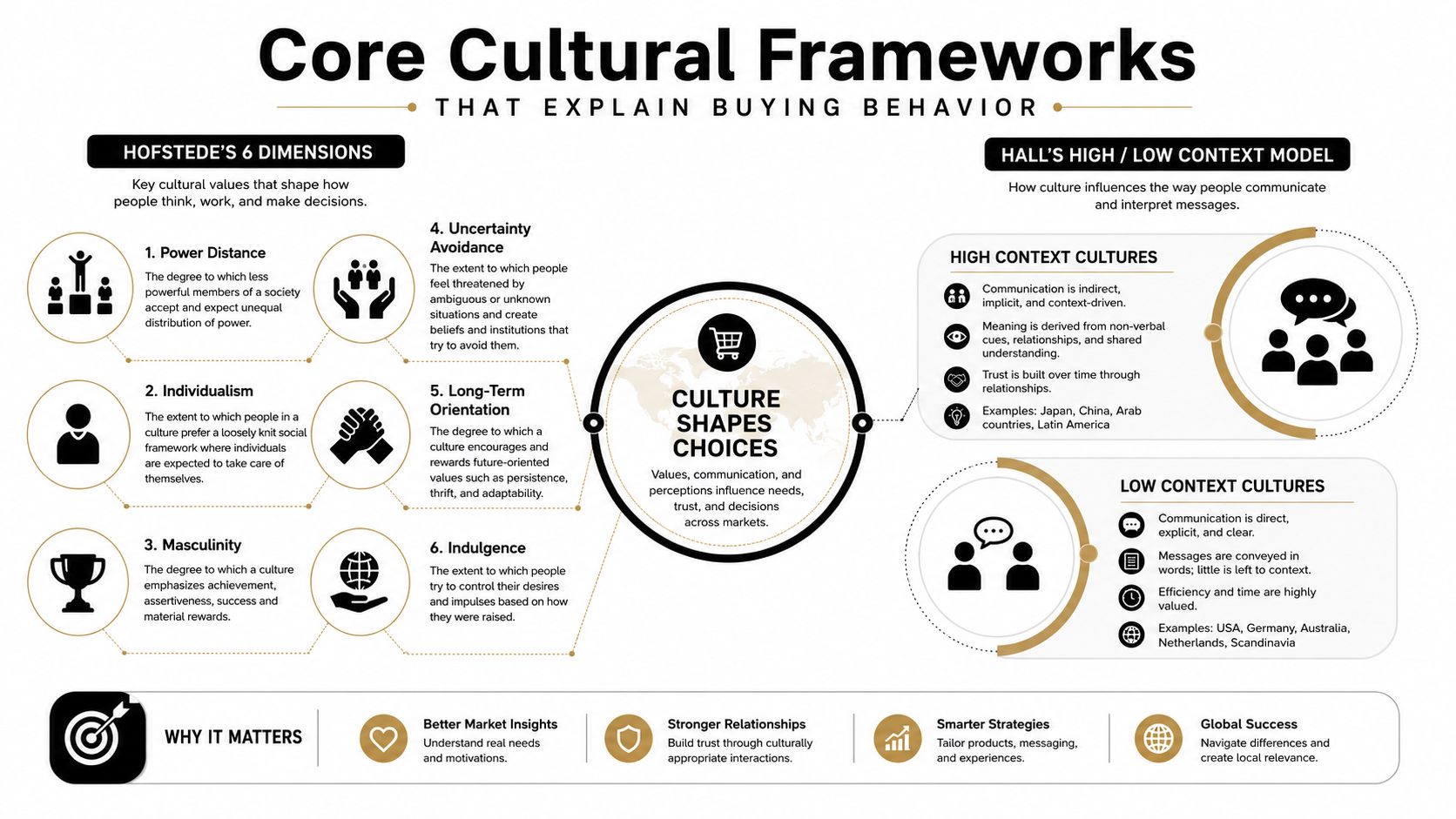
The practical reading is straightforward. Individualism versus collectivism changes whether brand loyalty grows from personal fit or group belonging. Uncertainty avoidance changes how much risk people accept in online purchase decisions. Power distance changes whether status cues and prestige signals matter, which is why some categories emphasize authority and hierarchy while others emphasize accessibility.
Language and culture also travel together. A useful example is seanfhocail for language learners, where meaning depends on context, not literal wording alone. Marketing works the same way. The words matter, but the cultural frame around them shapes how those words land.
A quick diagnostic for marketers
Before you standardize a campaign, ask three questions. What does this market trust? What does it fear? What social signal does the category carry here? Those answers usually explain more than a generic “local preference” label.
Culture does more than color perception. It changes the structure of the decision itself, including whether people are filtering for trust, risk, status, or social fit. That is why a brand can feel clear in one place and confusing in another, even when the translation is accurate.
Research Evidence Showing Culture as a Causal Filter
A useful way to test intuition is to compare groups that differ culturally and see whether the same buying variables move in the same direction. In a cross-cultural psychological study comparing consumers in the Anglo cluster, meaning the UK and US, with consumers in Southern Asia, meaning India and Iran, the Anglo group scored higher on customer perception, brand commitment or loyalty, and buying behaviour. The study reported mean scores of 4.2 vs. 3.8 for customer perception, 4.1 vs. 3.7 for brand loyalty, and 4.3 vs. 3.6 for buying behaviour, with ANOVA p-values of 0.000 for all three variables study.
Those results matter because they show culture affecting more than response size. They show culture shaping evaluation itself. In plain terms, the same offer is not merely getting a different score, it is being processed through a different set of expectations about what makes a brand credible, compelling, or worth choosing.
Why survey comparisons can mislead
A major review of 85 peer-reviewed publications found recurring cultural effects on information structure, attitudes, and choice criteria, and it also noted that cross-cultural studies often detect differences in the measurement structure itself review. That is a serious warning for global teams, because it means the same survey item can behave differently across markets even when the wording is identical.
So when a brand compares “trust scores” across countries, it may be comparing different underlying constructs. One market might interpret trust as institutional reliability, another as peer endorsement, and another as low personal risk. If the measurement doesn't hold, the comparison looks neat but the conclusion is unstable.
Simple takeaway: if you haven't tested measurement invariance, don't assume the numbers mean the same thing in every country.
That's why local market models for self-concept, social influence, and risk perception are safer than one global segmentation model. The evidence doesn't say global analysis is useless, it says the comparison has to be built carefully. A standardized dashboard is only useful when the constructs underneath it behave consistently.
The deeper lesson is that culture acts like a causal filter. It changes what people notice, how they interpret it, and whether they feel ready to move.
How Cultural Dimensions Shift the Purchase Mechanism
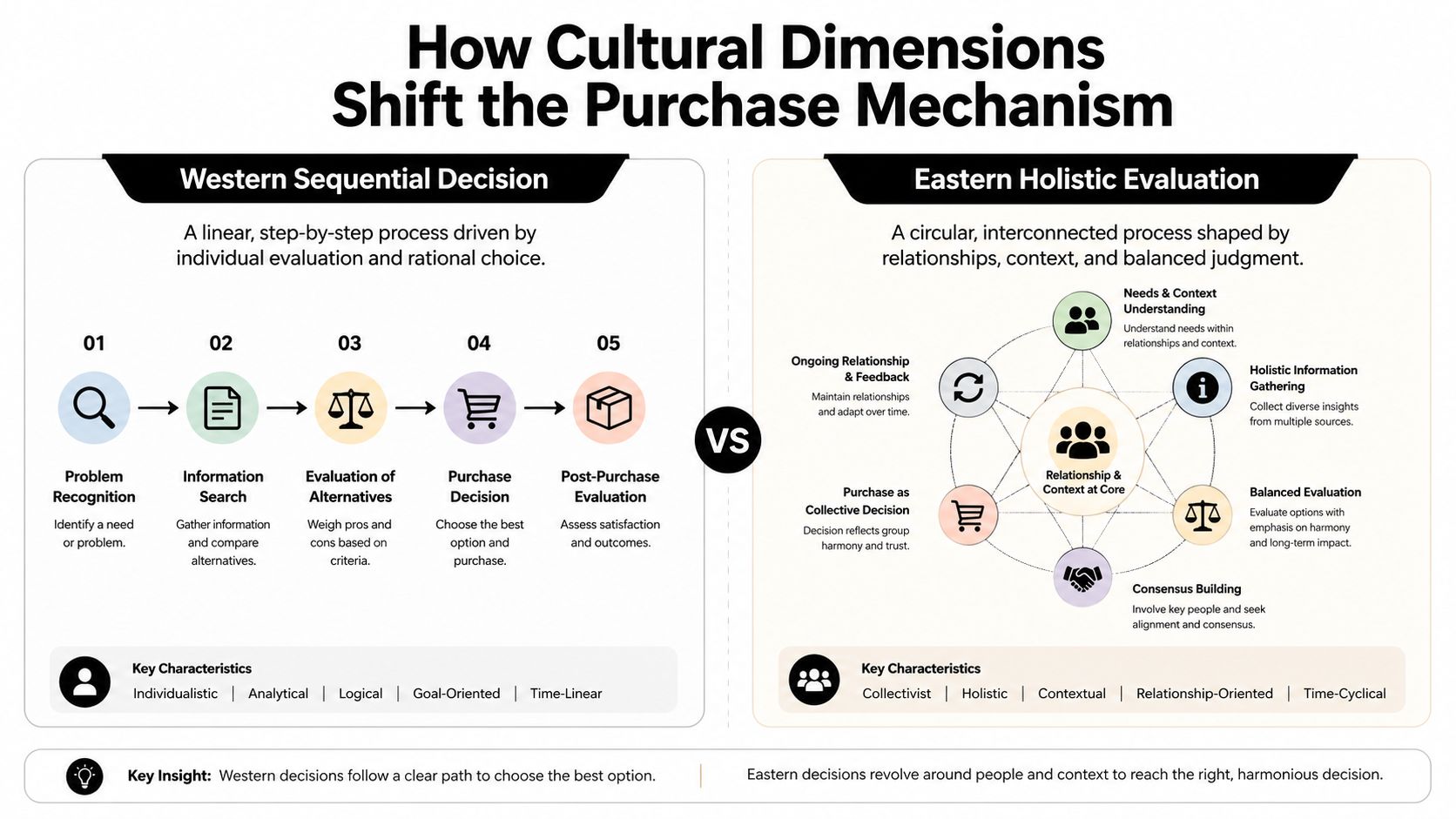
A marketing team can localize the headline and still miss the point entirely. Culture does not only change what people buy, it changes how they decide. In a PMC/NIH study on online purchase behavior, European consumers' cultural dimension was more strongly associated with trust, with β = +0.34 and p < 0.01, while the Asian cultural dimension was more strongly associated with perceived risk, with β = +0.35 and p < 0.01. Both variables influenced online purchase intention and behavior study.
That distinction changes the marketing job. In a trust-driven market, buyers need to feel that the seller is legitimate, stable, and accountable. In a risk-sensitive market, they need fewer doubts first, fewer surprises, and fewer moments that make them hesitate.
Trust-driven and risk-sensitive paths
Trust-driven markets respond well to credibility cues. Security signaling, institutional legitimacy, recognizable payment flows, and visible proof of competence carry weight because they reduce uncertainty without over-explaining it. Risk-sensitive markets usually need a more friction-reducing experience, which means simpler checkout, stronger social proof, and clearer post-purchase assurances.
The decision pathway itself is shaped by cultural values such as individualism, indulgence, and uncertainty avoidance. A cross-cultural consumer behavior text makes that clear, and a separate discussion of direct vs. indirect communication helps explain why the same promise can feel persuasive in one market and blunt in another text. Language localization alone is not enough. You can translate the copy and still leave the persuasive mechanism untouched.
The same logic applies outside e-commerce. A board presentation to a risk-averse stakeholder group often needs more evidence of due process and downside management. A growth pitch to a trust-heavy environment may need tighter framing around legitimacy and fit. The channel changes, but the mechanism is the same.
“Localize the proof, not just the prose.”
The practical signal is straightforward. If a market is trust-led, show who stands behind the offer. If it is risk-led, show what happens if the buyer is wrong. That may sound small, but it often determines whether the buyer proceeds or exits.
Beyond National Stereotypes to Nuanced Segmentation
Treating culture as a country flag is convenient, but it is often too blunt to guide a purchase strategy. A 2014 review pointed out that topics like advertising, segmentation, and product-variety management remain undervalued in cross-cultural research, and it also noted contradictions in terminology and the lack of a unified definition of cross-cultural variation in consumer behavior. That gap is where many marketing teams lose precision, because they want a clean country-level answer to a question that is usually more layered than that.
The better question is, “Which cultural frame is active in this purchase?” That distinction matters for bicultural consumers, digitally hybrid consumers, and people who shift between local and global identities depending on the situation. A shopper may use one frame while comparing prices on a phone and another while choosing a gift for family, even if the market is the same.
Why the same person can behave differently
A review from the University of Illinois notes that culture affects attention, information processing, culturally matched advertising, and consumer behavior among bicultural consumers. The practical lesson is simple, identity does not sit still at the passport level. A person can respond to one message through a local frame and another through a globally exposed frame, much like a skilled operator who uses different settings for different tasks.
The horizontal and vertical individualism and collectivism literature adds another layer. It shows that vertical individualists connect power with status and prestige, while horizontal collectivists connect power with helping others study. Two buyers from the same country can still look for very different cues in the same category, because the signal they trust is not always the same as the signal they admire.
That matters for segmentation more than many teams admit. Age, income, and category behavior still matter, but culture can outweigh them when the product carries identity, trust, or social meaning. A premium watch, a financial app, or a family-oriented service can all trigger different decision routes depending on whether the buyer is thinking about belonging, competence, or personal standing.
A practical way to work with this is to segment by context, not just by census data. Ask whether the buyer is acting in a family frame, a status frame, a professional frame, a global frame, or a digital-native frame that blends several at once. In India, for example, working with local expectations around status, hierarchy, and social proof can help separate a broad “Indian consumer” label into more useful clusters. A small team of context-switching professionals may want formal cues at work, but relaxed, experiment-friendly cues on a private shopping app. That approach is less tidy than a national stereotype, yet it gives marketers a clearer read on what moves the decision.
Actionable Communication Strategies for International Professionals
The same cultural reading that improves campaigns also improves how you speak in rooms full of senior stakeholders. If you want your message to travel across markets, it has to survive translation at the level of framing, not just language. That means tightening your point, choosing the right proof, and matching the social logic of the audience.
The most reliable starting point is the one used in etiquette tips for Hong Kong professionals, where small differences in formality, timing, and deference can change how competence is perceived. The same principle applies in executive settings, the audience is reading both the content and the manner.
Four moves that work across cultures
- Adapt message framing: present the benefit in collective terms when the audience is group-oriented, and in individual terms when personal gain matters more.
- Choose social proof deliberately: use peer validation where buyers want belonging, and institutional validation where they want legitimacy.
- Localize the value proposition: don't just translate features, translate the reason the category matters in that market.
- Test with cultural proxies: use a few trusted local readers or stakeholders to check whether the message feels confident, respectful, and believable before launch.
These moves help in marketing, but they're just as useful in executive communication. In a boardroom, the wrong frame can make a smart point sound thin. In a negotiation, the wrong proof can make a strong offer feel uncertain.
Cross-cultural competence becomes real when it changes how you structure ideas under pressure. A clear opening, a credible rationale, and a calm close often matter more than the sheer volume of detail. That's especially true when the room includes people who read hierarchy, face, and certainty differently.
A practical way to sharpen this skill is to work through a real communication audit, then rehearse the same idea in multiple cultural frames until the friction disappears. That's the level where authority starts to feel portable.
Building Your Cross-Cultural Executive Presence
Cross-cultural understanding only becomes valuable when it changes how you're perceived in the room. That's why executive presence matters, it turns cultural insight into visible authority, especially in high-stakes conversations where tone, structure, and body language carry as much weight as the content. A useful primer on what executive presence is helps clarify why this skill sits at the center of senior influence.
For international professionals, the next step is usually not more theory. It's cleaner framing, stronger vocal authority, sharper body language, and the ability to stay composed under pressure. The Gravitas Method is a 12-week one-on-one executive presence coaching program for international professionals who want to communicate with more authority and influence at senior levels. It's priced at $8,200 paid in full or $9,000 across three installments, coached by Nikola, and it covers vocal authority, strategic framing, executive body language, and high-stakes communication.
What matters most is fit. If you already know the frameworks, the key now comes from making your delivery match the room you're in, whether that's a board meeting, an investor conversation, or a cross-border leadership discussion.
If you're ready to turn cultural insight into stronger executive communication, visit Intonetic and start with the free Executive Communication Assessment. It's the best entry point for seeing how your current delivery lands across cultures, and where your authority can become clearer, steadier, and more persuasive.