
Working With Indian Culture a Guide for Leaders
If you’re a global executive getting ready to work with teams in India, you've probably realized it's not just about aligning on project goals and timelines. It's about navigating a rich and complex professional culture that often operates on a different set of unwritten rules. Get it right, and you’ll build some of the most loyal and effective partnerships of your career. Get it wrong, and you’ll face confusion, delays, and a frustrating lack of progress.
I've seen this play out time and time again with my clients. The key to success isn't just about what you do, but how you do it. It all comes down to understanding the foundational pillars that drive the Indian workplace: hierarchy, relationships, and a more indirect style of communication.
Let’s break down what this actually looks like in practice.
Decoding the Indian Workplace for Global Executives
Before we dive into specific strategies, it helps to have a mental map of how these cultural elements connect. Think of them not as separate challenges, but as three interlocking gears that define the professional landscape in India.
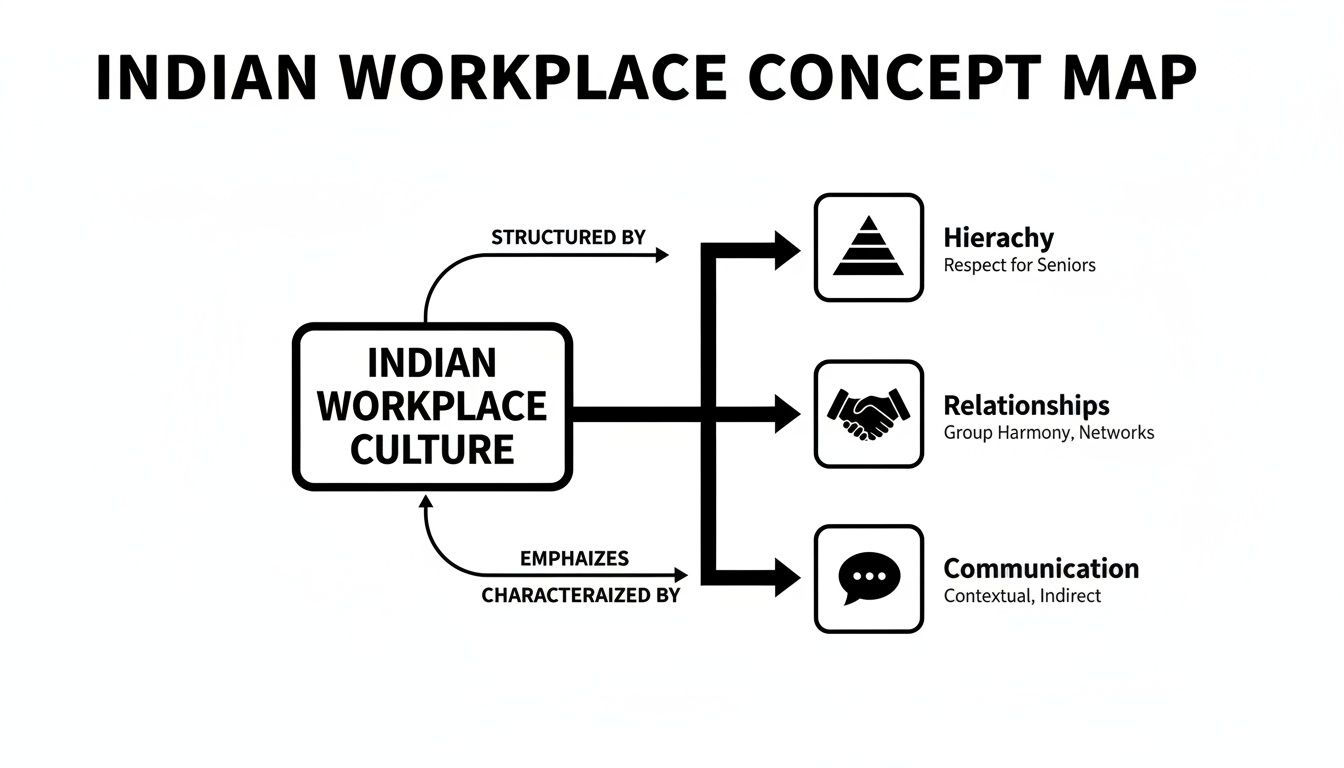
As you can see, the way people communicate is shaped by their respect for hierarchy, and both of these are influenced by the importance placed on personal relationships. Understanding this interplay is your first step toward effective leadership.
A Culture of Rich Diversity
One of the first things that strikes executives working with India is its incredible diversity. This isn't just a footnote; it’s a central feature that shapes everything. With dozens of languages and vast regional differences, a one-size-fits-all approach is doomed from the start.
This diversity creates a professional environment where seniority and experience are deeply respected, and decisions often flow from the top down. While this can be a huge advantage for efficiency in fast-paced sectors like tech and finance, it means that as a leader, you need to project a certain gravitas to earn that respect. Your title alone isn't always enough.
As more companies tap into India’s massive talent pool—a trend highlighted on platforms like Workforce.com—your ability to adapt becomes your most valuable asset.
The most meaningful breakthroughs often happen when we build on each other’s ideas together. Adapting your leadership style to foster this collaborative energy within India's unique cultural context is a powerful skill.
Core Pillars of the Workplace
To really get traction, you need to move beyond surface-level observations and understand what's happening underneath.
Here's a quick summary of the core concepts you'll encounter when working with Indian teams, and the executive actions required to navigate them effectively.
Key Cultural Pillars in the Indian Workplace
| Cultural Pillar | Common Observation | Recommended Executive Action |
|---|---|---|
| Respect for Hierarchy | Junior team members may seem hesitant to speak up or challenge a senior leader’s opinion directly. Deference is a sign of respect, not a lack of ideas. | Acknowledge seniority, but create structured, safe opportunities for junior staff to contribute ideas without feeling they are overstepping. Directly solicit their input. |
| Relationship-Driven Business | You might notice that initial meetings focus more on personal conversation than on the agenda. Building rapport is seen as a prerequisite for business. | Invest time in small talk and getting to know your colleagues as people. Don't rush straight to the business at hand. This is the work. |
| Indirect Communication | A "yes" might mean "I hear you and will look into it," not necessarily "I agree and will do it." Direct confrontation is often avoided to maintain harmony. | Learn to read between the lines. Ask clarifying questions like, "What do you see as the next steps?" or "What potential challenges should we prepare for?" |
Mastering these pillars takes practice, but just being aware of them puts you miles ahead. The nuance in communication, for instance, is a critical skill. Sometimes, what seems like a simple language issue is actually a cultural one. In other cases, you might encounter real communication barriers, and it helps to understand how to navigate those, too. For a deeper dive into this specific challenge, it's worth learning about how to identify accent bias, a related hurdle in any global team.
If you've spent any time working with teams in India, you’ve probably had this experience: you ask for a commitment, get what sounds like a firm "yes," and then… things don't go according to plan. What you're running into isn't a lack of commitment; it's a completely different communication style, one where harmony and relationships often take priority over direct, blunt answers.
When your Indian colleagues communicate, what you hear is often just the beginning of the conversation. Reading between the lines isn't just a "nice-to-have" soft skill—it's absolutely critical.

This can be a major adjustment if you're used to direct feedback cultures. A simple "yes" might not be the confirmation you think it is. It could just as easily mean "I've heard you," "I'm willing to look into it," or, most commonly, "I don't want to create conflict by saying no right now."
To succeed, you have to change how you ask questions and interpret the answers. Forget trying to get a simple "yes" or "no." You need to dig for specifics, but in a way that feels collaborative, not like an interrogation.
Decoding the “Yes”
The most frequent point of cross-cultural confusion comes down to that one, three-letter word. To get real clarity without making your counterpart uncomfortable, you need to reframe your questions from closed to open-ended.
- Instead of asking: "Can this be done by Friday?"
- Try asking this: "What would it take for us to get this done by Friday? What potential roadblocks should we anticipate?"
See the difference? The second question invites a real discussion about resources, dependencies, and potential hurdles. You’ve just shifted the dynamic from a high-pressure binary choice to a shared problem-solving session, which is infinitely more productive.
A key takeaway for any leader is that in India, a 'yes' is often the beginning of a negotiation, not the end of one. Your role is to guide that negotiation toward a clear, mutually understood outcome.
The Power of Personal Connection
In many Western business settings, asking about someone's family or personal life can feel a bit nosy. But when working with Indian colleagues, it’s an essential part of building trust. Asking about someone’s family isn’t just small talk; it's a genuine signal that you see them as a whole person, not just a task-doer.
This relationship-first approach is a cornerstone of doing business in India. In fact, a recent survey found that the Indian workforce has one of the highest senses of belonging globally, driven by these strong personal bonds. This habit of saying 'yes' to be polite is rooted in these collectivist values, where personal rapport forms the bedrock for professional collaboration.
This can be tricky, especially in fast-paced sectors like tech and finance. You’ll often find colleagues are direct with peers but much more indirect with superiors. While the high level of English fluency among professionals provides a great foundation, adapting to these nuances is what builds real trust.
These small, personal conversations build the social capital you’ll need to draw on later when you have to navigate disagreements or push through a tough project. And especially on video calls, how you show up visually matters. If you’re looking to boost your on-screen presence, our guide on how to speak English more clearly on video calls has some great tips.
When you invest time in these relationships, you create a foundation of trust that makes the more direct, down-to-business conversations much more effective down the road.
Leading Effectively Within a Hierarchical Structure

If you’re coming from a flatter organizational culture, the concept of hierarchy in India can feel intimidating. I’ve seen many Western leaders misinterpret it as a rigid barrier. The trick is to see it not as a wall, but as a roadmap for how respect is shown and decisions are made.
Deference to seniority is a cornerstone of professional life in India. It’s not about being subservient; it’s a deeply ingrained sign of respect. As a leader, your challenge isn't to flatten this structure, but to work within it—showing you respect the established order while confidently carving out your own authority.
This doesn't mean you need to become some stiff, formal figure. It’s actually much simpler. Small gestures, like addressing senior colleagues with formal titles ("Mr. Kumar," "Ms. Rao") until they invite you to use their first name, can make a huge difference. Letting a senior stakeholder speak first in a meeting is another simple but powerful signal. These acts show you get it, building the goodwill you need for your own leadership to be embraced.
Framing Ideas for Top-Down Approval
In my experience, one of the biggest adjustments for leaders is realizing that great ideas rarely succeed just by bubbling up from the bottom. They almost always need a senior sponsor to gain any real traction. Your job is to be that sponsor and, just as importantly, to frame your team’s proposals in a way that resonates with those at the top.
When you're pitching a new initiative, your first thought should be: How does this connect to what senior leadership already wants? Instead of presenting it as a brilliant, standalone concept, tie it directly to their stated business objectives.
- This approach often falls flat: "I have a new marketing idea that I’m sure will work."
- This one gets traction: "I know expanding our market share is our top goal for Q3. With that in mind, the team and I put together a proposal that I believe directly supports that objective. I'd love to get your thoughts on it."
See the difference? The second one isn't just your idea; it's a solution to their problem. It positions you as a strategic ally, not a disruptive force, making it far easier for them to get behind your proposal.
The most impactful leaders in a hierarchical culture don't just push their ideas through; they skillfully align their vision with that of existing leadership, creating a shared path forward.
Empowering Your Team Without Causing Friction
Delegation can be a delicate dance. You want to empower your team members, but you can’t do it in a way that makes them look like they’re overstepping their roles or, worse, disrespecting the local chain of command. The secret is to grant authority clearly and, most importantly, publicly.
When you assign a project, don't just tell the person in a private chat. Announce it. State their responsibility and your backing in front of their peers. This gives them the official cover they need to do their job effectively without creating unspoken tension.
For instance, you might say in a team huddle, "For Project Phoenix, I've asked Priya to take the lead on the research phase. She has my full support and will be coordinating the next steps, so please give her everything she needs." That public endorsement is everything. It empowers Priya while reinforcing the structure everyone understands.
This kind of high-stakes communication—knowing what to say, how to say it, and who to say it in front of—is the essence of executive presence. It's a skill that requires real finesse. For leaders looking to sharpen their ability to navigate these complex dynamics, getting a professional evaluation like a complimentary Executive Communication Assessment can provide a clear and targeted roadmap for growth.
Building Relationships to Drive Business Results
If there’s one mistake I see international leaders make when working with Indian teams, it’s getting the business-relationship dynamic completely backward. In many Western cultures, strong relationships are a nice side effect of getting the job done. In India, it's the other way around.
Strong relationships are the foundation you have to build before any real work can get done. Forgetting this is the fastest way I've seen a promising project grind to a halt.
Think of it this way: business in India runs on a collectivist mindset. This means trust, personal connection, and group harmony aren't just "soft skills"—they are core business assets. That quick chat about a colleague’s family or a team lunch isn't a distraction from the work. It is the work. To drive projects forward, you need to be seen as part of the group, not just an outsider managing it.
The Collectivist Mindset in Action
This relationship-first approach is supercharged by India's incredibly dynamic and youthful workforce. With 66% of its population under 35, India has the largest youth demographic in the world, and they bring a powerful, team-first ethos to the table.
This generation is adaptable, comfortable with ambiguity, and thrives on collaboration, which is fantastic for scaling global teams. But they respond best to leaders who take the time to build genuine personal rapport.
Of course, building relationships goes beyond your immediate team. A truly effective approach means applying the principles of professional stakeholder engagement. You want to build allies not just with your direct reports, but with everyone who has a stake in your project's success.
Navigating Time and Deadlines with Finesse
A common friction point I hear about from my clients is the concept of 'Indian Stretchable Time' (IST). While it often starts as a joke about a more fluid approach to punctuality, it can cause real anxiety around business deadlines.
The secret isn’t to be more rigid, but to manage expectations with a blend of firmness and flexibility.
Here’s how I coach leaders to set their projects up for success:
- Always explain the ‘Why’ behind the deadline. Don't just state a date. Frame it in terms of the team's collective success. "For us to hit our shared launch target, we all need to have our parts wrapped up by Friday."
- Build in buffers. This is non-negotiable. When you map out your project timeline, add a small cushion to your key milestones. This gives you breathing room for the unexpected without derailing everything.
- Use frequent, informal check-ins. Don't save it all for the formal weekly review. A quick, friendly message like, "Hi Rohan, just checking in on the report. Are you running into any roadblocks I can help with?" is far more effective.
The goal isn't to force a rigid, Western-style adherence to timelines. It's to create a shared understanding of urgency and a collaborative spirit of accountability that respects cultural norms.
When you invest in relationships first, you earn the trust required to have candid conversations about deadlines later. That personal connection ensures your requests feel like a collaborative effort, not a top-down command. It’s this blend of personal rapport and clear communication that ultimately drives business results. And for professionals who want to master that clarity, you might find our guide on how to improve your English accent without losing your culture useful.
Practical Scripts for High-Stakes Interactions

Knowing the theory is one thing. But when you’re in a high-stakes meeting and the pressure is on, it all comes down to the words you choose. The real test of your cultural fluency isn't just what you know, but how you apply it in those critical moments.
Having a few proven scripts in your back pocket can give you the framework to navigate these situations with confidence and cultural finesse. Let's move past the concepts and look at exactly what to say.
Scenario 1: Managing an Unexpected Project Delay
Imagine your project lead, Anika, tells you a key deliverable is going to be late. Your first instinct might be to demand an explanation, but a direct, confrontational response can easily damage the relationship you've worked so hard to build.
-
What to avoid: "Anika, you committed to this deadline. Why is it late, and what went wrong?" This immediately sounds accusatory. It puts her on the defensive and is likely to shut down the open, honest conversation you need to have.
-
A better approach: "Thank you for the update, Anika. Let's look at this together. Can you walk me through the current challenges? What resources would help us get back on track?" See the difference? This language instantly makes it a shared team challenge, not an individual failure.
Scenario 2: Gracefully Declining a Request
Your team proposes a well-intentioned idea that simply doesn't align with the strategic direction. In a culture where hierarchy is respected and ideas are presented with care, a flat "no" can be seen as dismissive and cause a loss of face for the person who suggested it.
-
What to avoid: "No, we can't do that. It's not in the budget and it's off-strategy." While true, the bluntness can feel disrespectful and shut down future creativity.
-
A better approach: "I appreciate the thought you've put into this. It's an interesting idea. For our current objectives, we need to focus our resources on X and Y. Could we explore how we might adapt this concept for a future phase?" This approach validates their effort, gives a solid business reason, and keeps the door open—all while preserving harmony.
The most effective communicators in India don't just deliver a message; they manage the emotional and relational impact of their words. It's about ensuring everyone involved feels respected, even during disagreement.
Scenario 3: Following Up Without Seeming Aggressive
You're waiting on a decision from a senior stakeholder, and the delay is holding up your timeline. Constant, direct follow-ups can come across as impatient and disrespectful of their authority.
-
What to avoid: "Hi Mr. Sharma, I'm still waiting for your approval on the proposal. I need it by EOD." This feels like a demand, which is almost always inappropriate when addressing a senior colleague. It creates unnecessary pressure.
-
A better approach: "Good morning, Mr. Sharma. I'm just checking in on the proposal we discussed last week. Is there any additional information I can provide to help with your review?" This phrasing is respectful and positions you as helpful, not demanding. It’s a polite nudge that gets the job done without ruffling any feathers.
Getting these conversational nuances right is a huge part of executive presence, especially when working across cultures. For leaders who want to take their verbal delivery to the next level, it's also worth exploring resources on how to improve English pronunciation for business professionals, as clarity and impact go hand-in-hand.
Think of these scripts as a starting point. They'll help you handle any critical conversation with strategic composure.
Your Path to Executive Influence in India
So, how do you pull all this together? Ultimately, succeeding with your Indian colleagues and stakeholders comes down to three things: tweaking your communication style, respecting the hierarchy, and genuinely investing in relationships. This is what separates the managers who struggle from the leaders who earn respect.
The real goal is to shift from being an outsider who gives directions to becoming an insider who builds consensus. That takes a conscious effort. It means seeing a team lunch not as a break, but as a crucial part of your project's success. It means learning to frame your requests in a way that aligns with the priorities of senior leaders, showing you're a partner, not just a manager.
Your Quick-Reference Action Plan
Before your next meeting or trip to India, run through this list. These are the practical dos and don'ts I've seen make an immediate difference in how my clients are perceived.
Key Dos:
- Invest in relationships first. Always spend a few minutes on personal conversation before getting down to business. It matters.
- Show deference to seniority. Acknowledge titles and let the most senior person in the room guide the conversation, at least initially.
- Ask open-ended questions. Instead of a simple "Can we do this?", try "What will it take to get this done?" It opens the door for a real discussion.
Key Don'ts:
- Never mistake a polite "yes" for a firm commitment. Always follow up to clarify next steps, timelines, and any potential hurdles.
- Avoid being overly direct or confrontational. If you disagree, frame your point as a collaborative question, like "Have we considered this alternative approach?"
- Don't rush the small talk. Skipping the rapport-building phase is often seen as rude and can seriously undermine the trust you're trying to build.
A big part of building influence is, of course, building your network. Knowing how to get more connections on LinkedIn is a practical skill that can give you a major advantage. These connections aren't just numbers; they are potential allies and sources of insight for your initiatives.
Elevating Your Executive Impact
For international professionals who are serious about making a real impact, applying these principles is just the beginning. The next step is cultivating an executive presence that commands respect no matter where you are in the world. This involves mastering the nuances of vocal authority, strategic framing, and confident body language.
True influence isn’t just about what you say; it’s about how you make people feel. In India, making your colleagues feel respected and heard is the most direct path to achieving your business objectives.
The Gravitas Method is a 12-week one-on-one executive presence coaching program for international professionals who want to communicate with more authority and influence at senior levels. The program is priced at $8,200 paid in full or $9,000 across three installments. Coached by Nikola, it covers vocal authority, strategic framing, executive body language, and high-stakes communication.
If you’re ready to take that next step, the best place to start is by getting a clear picture of your current strengths and weaknesses. I invite you to book a complimentary Executive Communication Assessment to pinpoint the specific gaps in your executive presence and create a targeted plan for senior-level impact.
Frequently Asked Questions About Indian Business Culture
When you're new to working with teams in India, a few common questions always come up. I've heard them from countless clients over the years. Let's tackle them head-on so you can navigate your daily interactions with a lot more confidence.
How Should I Address Colleagues in India?
One of the first things people ask is how to address their Indian colleagues. It's a great question, and getting it right from the start really helps set a respectful tone.
When you're first introduced, stick to formal titles like 'Mr.' or 'Ms.' followed by their last name. This is especially true when speaking with anyone senior to you. As you work together and build more of a personal connection, they’ll almost always invite you to use their first name. Let them lead that shift.
You'll also hear 'Sir' or 'Ma'am' used frequently. Don't be surprised by it—it’s a very common and genuine sign of respect for seniority. Using it yourself when addressing a senior stakeholder is a safe, appreciated default that shows you understand the cultural context.
Is Gift-Giving Common in a Business Context?
Gift-giving can be a wonderful gesture, but it’s something you need to approach with a bit of cultural savvy. It’s most common around major festivals like Diwali or to mark a big project success.
The key is to keep it thoughtful, not extravagant. A gift that's too expensive can create awkwardness or be misinterpreted. I always advise my clients to consider simple, meaningful options:
- Something small that represents your home country or city is always a great choice.
- High-quality company merchandise, like a nice pen or notebook.
- Sweets or gourmet food items are very popular, particularly during festival times.
And a crucial piece of etiquette: always present and receive any gift with your right hand, or with both hands. Never just the left hand.
How Do I Interpret a Head Wobble?
Ah, the famous Indian head wobble. It’s probably the most discussed—and most misunderstood—non-verbal cue. For newcomers, it can be really confusing, but it's almost always a positive or neutral gesture.
The wobble is a multi-tool of communication. Depending on the situation and what the person's face is doing, it can mean "yes," "I'm following what you're saying," "got it," or just a general acknowledgment that they are listening intently. It very rarely, if ever, means 'no.'
The best way to decipher it? Pay attention to the context of the conversation. If you've asked a question and get a wobble with a smile, it’s likely a "yes." If you're explaining something complex and get a wobble, it’s probably an "I understand, keep going."
At Intonetic, we find that mastering these cultural nuances is the first step toward effective leadership. The next is communicating with an authority that inspires confidence and drives action. If you're ready to close the gap between your expertise and your executive presence, we invite you to book a complimentary Executive Communication Assessment to create a targeted plan for senior-level impact.