
Composure Under Pressure: A Senior Leader’s Guide
You're in the room, the deck is up, and someone senior has just asked the one question that changes the temperature of everything. Maybe it's a CFO pushing on margin, a client challenging delivery, or a board member asking why a decision took so long. In that instant, composure under pressure isn't about looking serene, it's about keeping your thinking intact long enough to answer well.
That distinction matters more than most executive presence advice admits. Senior professionals aren't judged only on what they know, they're judged on how they behave when the stakes rise, the room gets sharper, and the margin for sloppy thinking disappears. Composure is the ability to keep cognitive clarity, visible control, and message structure working together under load.
What Composure Under Pressure Actually Looks Like
A tense moment rarely announces itself politely. It shows up as a direct challenge in a meeting, a sudden interruption in a client call, or a question that seems simple until you realize everyone in the room is watching how you handle it.
That's why composure under pressure is better understood as a trainable response skill than as a personality trait. Some people are naturally quieter. That doesn't make them composed. Real composure combines three things at once, clear thinking, controlled delivery, and structured messaging. If one of those drops out, people feel it fast.
The visible and invisible parts of authority
Senior leaders often assume composure is mostly internal. It isn't. Others read your face, your voice, your pacing, and the shape of your answer before they fully process your content. The leader who can pause, frame the issue cleanly, and answer without rushing looks more authoritative because the brain around them has fewer signals of panic to interpret.
That's why this topic belongs in leadership development, not just stress management. The mentalhealth.org.uk stress data shows just how normal high strain has become, with 74% of people saying they had felt so stressed in the past year they were overwhelmed or unable to cope, and younger adults reporting especially high pressure to succeed (Mental Health Foundation stress statistics). In other words, many professionals are already operating near their limit before a difficult conversation even begins.
Practical rule: if your body looks rushed, your message will sound less credible, even when your answer is right.
For a more complete definition of the wider leadership signal behind this, see what executive presence actually means. Composure sits inside that larger picture, but it shows up most clearly in high-pressure moments.
What to build, not what to hope for
If you want to improve this reliably, train the layers separately. Work on breath first, then voice, then body language, then message structure, then rehearsal. That order matters because pressure hits each layer differently, and good intentions don't hold if your nervous system is already ahead of you.
The goal isn't to become emotionless. The goal is to stay usable under pressure, so the room still experiences you as clear, steady, and ready to lead.
How Pressure Hijacks Your Thinking
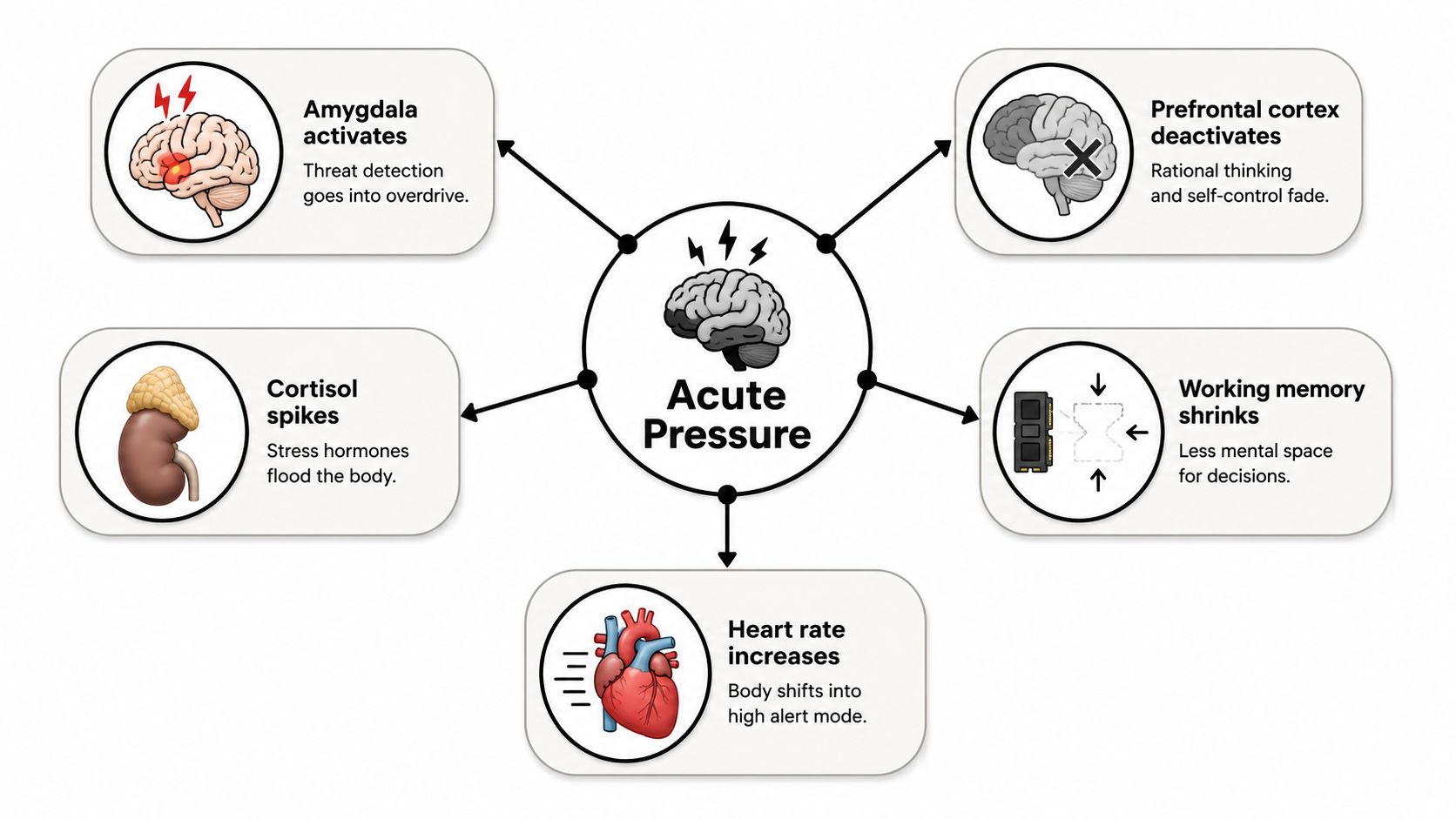
A hard question can change the room in seconds. A leader who sounded sharp a minute ago may suddenly sound clipped, vague, or defensive, not because the answer disappeared, but because pressure started taking up mental space that should have gone to judgment.
Why skilled people still choke
The problem is usually choking, which means performance gets worse under pressure even though the skill is already there. That distinction matters. If you treat it like a knowledge gap, you will train the wrong fix.
A systematic review found that interventions using realistic pressure simulations produced the most consistent performance gains versus control conditions, and stress inoculation is typically built in three steps, education and cognitive preparation, skill acquisition and rehearsal, then application under escalating pressure (systematic review). That pattern points to the task, teach people what stress does, rehearse a response, then test it in conditions that resemble the actual event.
The cognitive load problem most guides skip
Composure is best understood as cognitive bandwidth management. Pressure narrows attention, increases reflexive responses, and pushes people to react before they have fully reappraised what is happening. The visible sign may be tension, but the cost is thinner thinking.
Real-world pressure regulation research found that the control condition showed the choking effect, while reappraisal and especially distraction helped participants cope under pressure instead of choking (PubMed study). For a leader, that means the answer is not always “calm down.” Sometimes the better move is to shift the frame, then shift attention.
Why multilingual professionals feel this faster
International professionals carry one more layer. Speaking in a second language adds cognitive load, which compresses working memory right when pressure is already crowding it. A method that sounds clean in theory can fail if it assumes extra mental room that is not there.
That is why the usual advice about breathing and staying calm often disappoints in live settings. Calm-looking body language does not guarantee clear thought, especially in conflict, ambiguity, or rapid-fire executive Q&A. For more on how pressure affects leadership cognition, see the psychology of leadership at Intonetic and the broader discussion on psychology of leadership and pressure. Composure has to hold up under cognitive load, and in multilingual rooms it also has to hold up across language and cultural expectations.
Resetting Your Body in the Moment
When pressure spikes, you don't always get the luxury of a long reset. You need something discreet, fast, and reliable enough to use while someone else is still talking. The best real-time tool here is the physiological sigh.
The fastest short reset to use before you answer
The mechanics are simple. Inhale through the nose, take a second shorter inhale, then make a long, slow exhale through the mouth until the lungs feel empty. That pattern is described as the fastest known voluntary method for reducing acute stress in real time, and it works because the long exhale helps downshift the arousal that makes your thinking feel crowded (scienceinsights.org).
You can use it in a meeting without announcing it. One cycle before you answer is often enough to create enough space to think. If you need more, take a second cycle while looking at your notes or while the other person is finishing their point.
Small resets that no one notices
There are other resets that work well when you can't visibly pause for long.
- Shoulder drop: lift both shoulders slightly, then release them fully on the exhale. It breaks the freeze pattern that makes people look tight.
- Hand-temperature anchoring: press fingertips together or rest a hand lightly on the table and notice the sensation. It pulls attention back into the body.
- Discreet foot pressure: press both feet into the floor for a few seconds. That grounding cue is useful when you're seated and need stability without drama.
For a simple breathing-focused reset you can pair with this, see how to calm nerves before a speech. In practice, the exhale-down pattern is more useful than trying to meditate in the middle of a hard conversation because it's short enough to survive the moment.
If you can't breathe deeply, don't force depth. Slow the exhale, relax the shoulders, and buy back a little cognitive room.
That's the key point. You're not trying to become perfectly calm. You're trying to stop the body from talking your brain into a bad decision.
Voice and Body Language That Project Calm
A lot of leaders think composure is invisible until they hear themselves on a recording. Then the signs show up immediately, faster pace, tighter tone, a slightly rising finish to sentences, and a face that looks more concentrated than confident. In the Canadian office-worker survey, the hardest cues to control were facial expressions at 36% and tone of voice at 35% (Canadian office workers survey).
What to adjust first
You don't need to reinvent your personality. You need to manage the cues that move perception the fastest.
- Slow your pace a little: aim for roughly 15% slower than your default, but keep it conversational. If you slow down too much, you'll sound staged.
- Drop the pitch at the end of statements: a falling finish removes the question mark that makes an answer sound uncertain.
- Hold a steady gaze, not a stare: look at one person long enough to finish the thought, then move on naturally.
- Anchor your posture: feet planted, shoulders open, chest not puffed. The goal is grounded authority, not performance aggression.
Those adjustments matter because visible composure shapes how others judge judgment itself. In senior rooms, people don't separate body language from competence nearly as neatly as presenters like to think.
A quick pre-meeting check
Before you go into the room, run this private scan in the elevator or hallway:
- Face: unclench the jaw and soften the brow.
- Voice: take one long exhale and start the first sentence lower than you feel you need to.
- Posture: feel both feet and let the shoulders settle.
- Pace: decide in advance not to rush the first answer.
For leaders who want a structured body-language lens, body language for leaders is a useful reference point. International professionals often need one extra correction here, since faster cadence or rising intonation can make calm answers sound less final than they are. The fix isn't to imitate someone else's speech. It's to make your natural style land with more steadiness.
Structuring Your Message When Stakes Rise
A tense room changes the job of speaking. Your first task is not eloquence, it is bandwidth management. Under pressure, people lose track of their point, start filling silence, or answer the question they wish they had been asked. A clear structure keeps that from happening.
A short protocol that protects performance
Use the same sequence every time. Pause, reappraise the stakes, then use an attention-shifting cue. That order helps keep the threat response from taking over the conversation, which is the practical lesson from the choking research discussed earlier. The aim is not to sound detached. The aim is to stay useful while your body is still reacting.
Then answer in chunks.
- Lead with the conclusion. Put the point first so the room does not have to hunt for it.
- Name the constraint. State what is limiting the decision, timeline, or option set.
- Give the next action. Say what happens now, who owns it, and what the room should expect.
- Stop. Do not keep talking just to soothe your own nerves.
If you want a fuller presentation framework that supports this discipline, a guide to structuring presentations under pressure is a useful complement. The same logic applies in a boardroom, only compressed into a few sentences.
A simple way to answer in a second language
For international professionals, the worst move is trying to sound fully fluent while pressure is peaking. That usually produces rushed phrasing, filler, and lost structure. Short bridging phrases buy thinking time without signaling panic, which matters even more in multilingual rooms where listeners are already working a little harder to follow nuance.
Useful options include, “The short answer is…”, “What matters here is…”, and “The constraint is…”. Those phrases create a small buffer while keeping authority intact. If you are answering in English as a second language, that buffer is often the difference between a clean response and a scrambled one.
Practical rule: do not spend your mental energy sounding perfect. Spend it on making the answer easy to follow.
A tense stakeholder question can still be handled in under 30 seconds. Start with, “The short answer is we're not ready to commit to the earlier date.” Then continue, “The constraint is vendor dependency, so the safer move is to confirm the revised timeline after today's review.” That answer is short, clear, and defensible, which is exactly what composure under pressure should look like.
Cross-cultural pressure changes the details, not the need for structure. In some settings, a direct answer reads as strong. In others, it can feel abrupt unless you give a brief frame first. The message does not need to become longer. It needs to become easier to process for the people in the room.
Rehearsing Pressure Before It Happens
Composure gets much easier when the situation feels familiar. That's the logic behind stress inoculation. You don't wait for a crisis to find out whether your reset works, you rehearse it until the response is available on command.
Build it in the order that works
The three-step method from the review is worth treating as a practical sequence, not a theory.
- Education and cognitive preparation. Learn how your stress response shows up. Decide which cue is most likely to betray you, speed, pitch, facial tension, or rambling.
- Skill acquisition and rehearsal. Practice the physiological sigh, a slower first sentence, and the short answer frame in low-stakes settings.
- Application under escalating pressure. Test the same skills in harder simulations, then repeat them until the response holds.
For a related example of pressure training outside executive communication, mental training for athletes shows how deliberate mental rehearsal is used in another high-stakes performance context. The principle transfers well, because performance under observation is still performance under observation.
A two-week rehearsal cadence
Start simple. Map your three most common high-stakes moments, then identify the two cues you lose first in each one. One event may make you talk too fast, another may tighten your face, and a third may push you into overexplaining.
A workable two-week pattern looks like this:
- Days 1 to 3: rehearse the reset techniques alone, out loud, with no pressure.
- Days 4 to 6: record a mock answer to a hard question, then listen for pace and sentence endings.
- Days 7 to 10: run a live simulation with a colleague who interrupts you.
- Days 11 to 14: add stakes, a shorter timer, a stricter question, or a more formal setting.
The point is not to eliminate discomfort. It's to make discomfort less disruptive. That's how pressure stops feeling novel and starts feeling manageable.
Build your first rehearsal week
Choose one real situation, such as a board challenge, investor update, or client escalation. Write the first sentence, the constraint, and the next action in advance. Then rehearse the reset and the answer together until they feel like one behavior instead of three separate ones.
If you do this consistently, you stop improvising your composure. You arrive with it.
Daily Practice Drills and Where to Go Next
The reason these drills matter is simple. The stress environment is already intense, and it's not limited to senior leaders. A major 2024 UK survey found that 74% of people said they had felt so stressed in the past year that they were overwhelmed or unable to cope, and pressure to succeed was especially high among younger adults, including 60% of 18 to 24-year-olds, compared with lower figures in older groups (Mental Health Foundation stress statistics). That's the context composure has to survive.
What to do every day
Keep it short and repeatable.
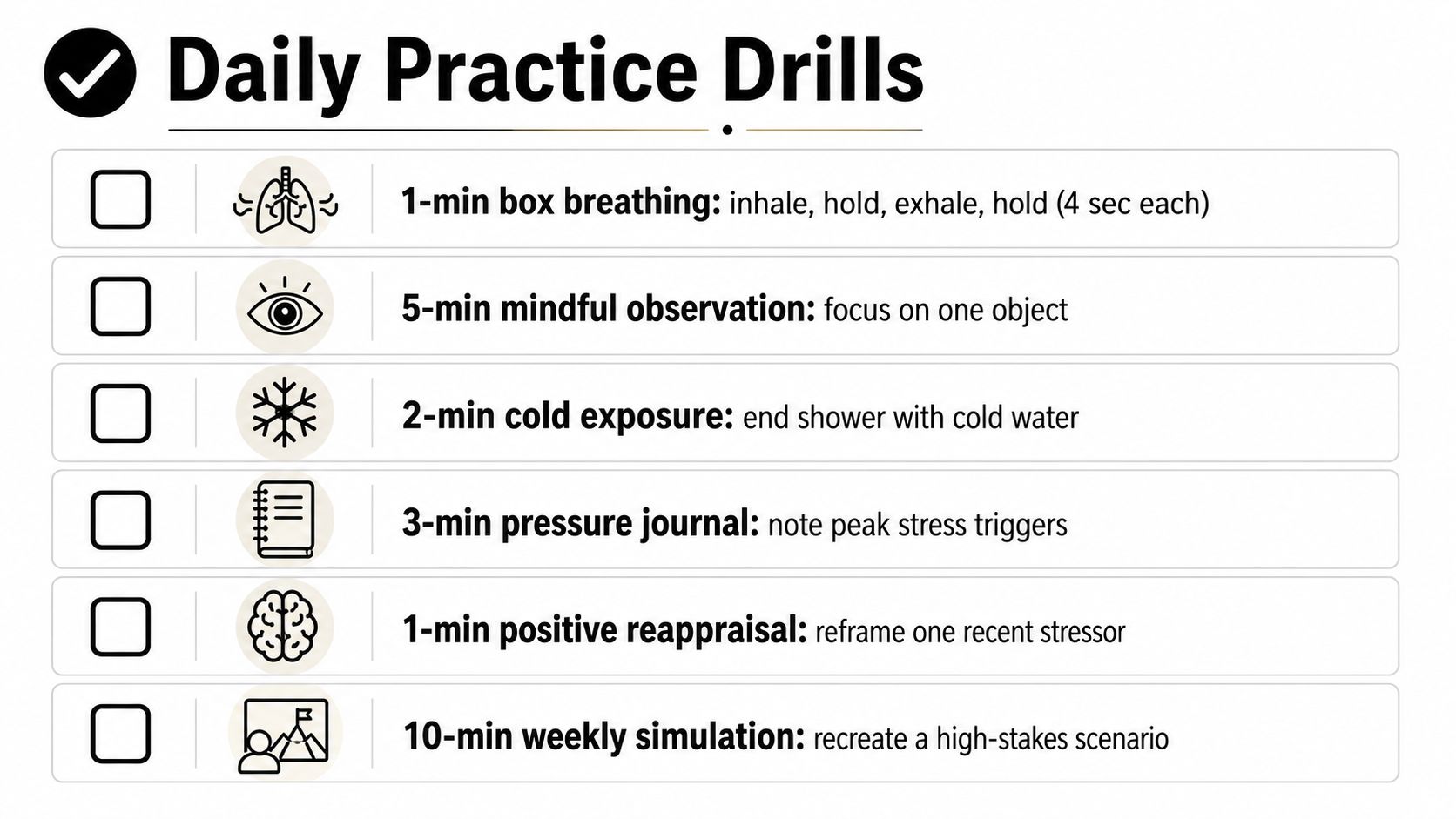
- 1 minute of box breathing: use a steady inhale, hold, exhale, hold rhythm when you're not in crisis.
- 3 minutes of pressure journaling: note what triggered the spike and what you did first.
- 1 minute of positive reappraisal: rewrite one recent stressor as a solvable challenge.
- 5 minutes of mindful observation: focus on one object to train attention control.
What to do once a week
Spend 10 minutes running a pressure simulation. Recreate a hard question, a delayed response, or a disagreement with a colleague, then use the reset and message structure you've practiced. For a practical way to document the leadership shift these situations create, how StoryCV helps prove leadership is a useful reference when you want to turn composure into evidence of senior capability.
Where the assessment fits
If you're serious about improving this, start with the diagnostic before you start guessing. The free Executive Communication Assessment gives you a clean baseline for where your composure breaks down, and it's the right entry point before committing to longer development. The Gravitas Method is a 12-week one-on-one executive presence coaching program for international professionals who want to communicate with more authority and influence at senior levels. It's priced at $8,200 paid in full or $9,000 across three installments, coached by Nikola, and it covers vocal authority, strategic framing, executive body language, and high-stakes communication.
If you want a sharper read on how you come across in difficult rooms, start with Intonetic and book the free Executive Communication Assessment. It's the fastest way to see where pressure is narrowing your bandwidth and what to fix first. From there, you can decide whether deeper coaching is the right next move.