
Building Strategic Alliances: Master High-Value Partnerships
A lot of alliances look strong in the announcement deck and weak in the operating model.
You may be in that position now. A cross-border partner looks promising. The commercial logic is easy to explain. One side brings market access, the other brings product depth, delivery capability, data, or credibility. Senior leaders shake hands, legal starts drafting, and everyone assumes momentum will take care of itself.
It usually doesn't.
Building strategic alliances is less about finding a company you like and more about managing a sequence of high-stakes decisions. The hard part isn't the press release. It's getting two organizations, often with different power, pace, incentives, and communication norms, to keep making aligned decisions after the initial excitement fades. For international leaders in tech, finance, and consulting, that challenge gets sharper. Language nuance matters. Executive presence matters. Trust signals matter. A lot.
Beyond the Handshake Why Most Alliances Disappoint
A familiar pattern shows up in failed partnerships. The first meetings are energetic. Both sides talk about synergy, scale, and shared opportunity. Then the practical friction starts. One partner expects fast experimentation. The other wants layered approvals. One team treats the alliance as a strategic priority. The other treats it as an optional channel motion. Nobody names the mismatch early, so it hardens into delay, resentment, and quiet underperformance.
That's one reason alliance disappointment isn't usually caused by a bad idea alone. It's caused by weak translation between strategy and execution.
The timing makes this more important, not less. Salesforce reports that 89% of sales professionals say partner selling is increasingly important for hitting revenue targets in its guidance on strategic alliances and partner selling. Partnerships now sit closer to core growth than many leadership teams admit. If your company relies on its ecosystem for strategic advantage, poor alliance discipline becomes a revenue problem.
What goes wrong in practice
Three breakdowns appear repeatedly:
- The alliance starts as a slogan: Leaders agree on ambition, but they never define what each side will contribute, protect, or own.
- The wrong people carry the relationship: Senior sponsors bless the deal, then disappear. Mid-level operators are left to resolve conflicts they don't have authority to settle.
- Communication gets mistaken for politeness: Teams avoid difficult conversations because they want to preserve goodwill. That usually creates more damage later.
Practical rule: If a partnership cannot survive an uncomfortable early conversation, it won't survive operational reality.
For many senior professionals, especially those working internationally, the challenge is compounded by status differences. A larger partner may dominate the room without saying anything explicit. A more fluent native-English executive may sound more certain even when the substance is weaker. If you've had to influence without authority in senior environments, you already know that control often follows communication, not just org charts.
What strong alliances do differently
Effective alliances are built like repeatable business systems. They have a rationale, a screening process, a communication protocol, a governance rhythm, and boundaries. They don't rely on goodwill alone.
That's the shift that matters. Stop asking, “Is this a good partner?” Start asking, “Can these two organizations make decisions together under pressure, over time, with enough trust and enough structure to create value?”
The Alliance Blueprint Start with Internal Strategy
Most alliance problems begin before the first external meeting. They start inside your own company, when leaders pursue a partner before they've defined the gap the partner is meant to close.
An alliance should extend strategy, not compensate for the absence of one. If your team can't explain why this partnership matters in plain commercial and operational terms, you're not ready to approach the market.
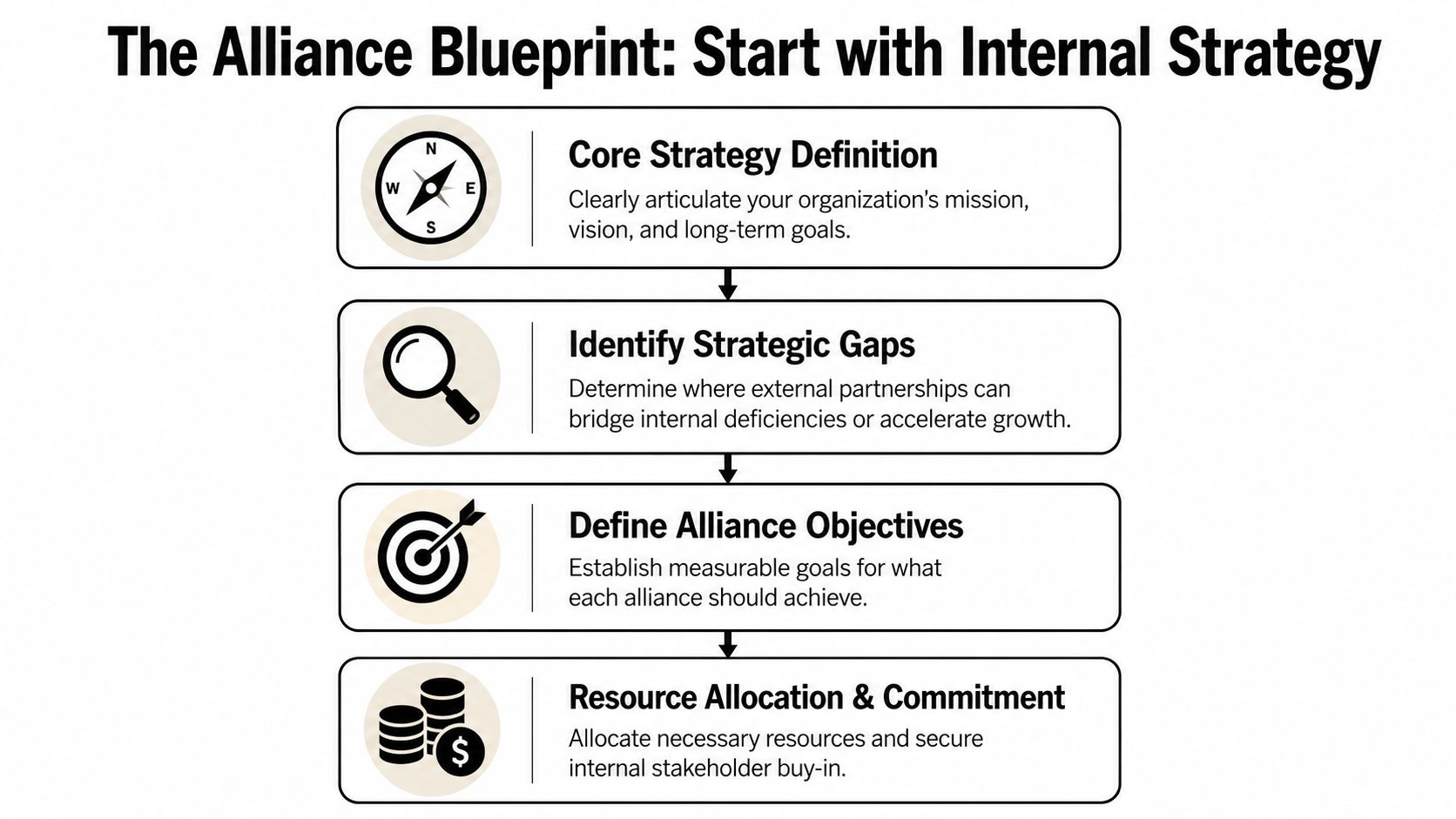
Define the gap before you define the partner
Start with what your business needs but can't efficiently build alone. In practice, that usually falls into one of a few categories: distribution, product capability, market credibility, implementation capacity, or geographic access.
Ask your leadership team direct questions:
- What strategic gap are we trying to close? Be specific. “Growth” isn't a gap. “Enterprise access in a region where we lack trusted distribution” is.
- What must remain internal? Some capabilities should never be diluted through a partner model.
- What would make this alliance worth the management burden? Alliances consume leadership time. Treat that as a real cost.
- What aspects cannot be compromised? Brand control, customer ownership, data boundaries, pricing authority, and service standards need internal agreement early.
Build internal commitment before external outreach
A weak internal mandate creates a weak external position. If your own executives are only casually supportive, the other side will feel it.
That's why formal alliance capability matters. Wharton's guidance on successful alliances notes that firms with a dedicated alliance function and a repeatable management process achieve more consistent success than companies that treat each partnership as a one-off transaction. That finding matches what experienced operators already know. Ad hoc partnerships drift because nobody owns the system around them.
A simple internal blueprint looks like this:
| Internal question | What a strong answer sounds like |
|---|---|
| Why this alliance? | “It gives us access to a segment or capability we can't reach quickly alone.” |
| Why now? | “The timing aligns with a market move, product launch, or expansion priority.” |
| Who owns it? | “One executive sponsor and one operational lead are accountable.” |
| What are we protecting? | “We've set boundaries on data, decision rights, and customer experience.” |
Get the internal narrative tight enough that a senior leader can explain it in two minutes without slides.
Prepare for executive-level scrutiny
If you can't speak to risk, trade-offs, and execution pressure, your alliance proposal will sound naïve to senior stakeholders. At this point, communication quality starts to shape strategic outcomes. Leaders who need to talk to senior leadership with clarity and authority do better when they frame the alliance as a portfolio decision, not a hopeful partnership story.
Internal clarity provides you with an advantage later. It helps you reject attractive but distracting offers. It also makes negotiation cleaner, because you know what you need, what you can trade, and what you won't give away.
Pinpointing and Vetting the Right Partners
Once your internal strategy is clear, partner evaluation gets sharper. You're no longer asking who looks impressive in the market. You're asking who can create value with you without generating unmanageable friction.
That distinction matters because alliances rarely fail on logo appeal. They fail on compatibility.
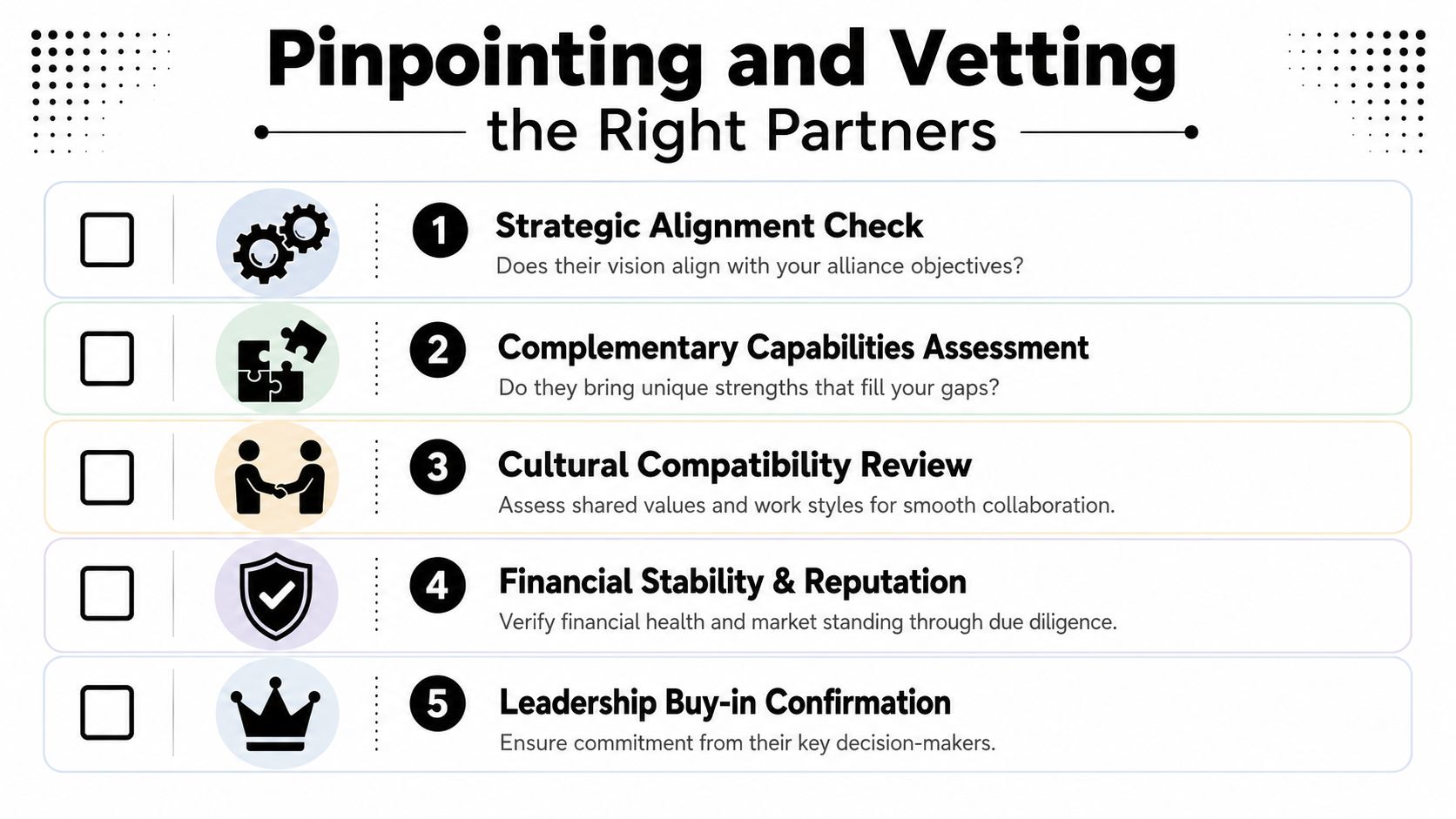
Use a scorecard instead of intuition
A useful way to vet candidates is to score them across five dimensions: strategic fit, operational complementarity, cultural fit, financial expectations, and leadership chemistry. That isn't just common sense. A 2025 analysis of partnership compatibility metrics reported correlations with alliance success of 0.73 for strategic alignment, 0.68 for operational complementarity, 0.65 for cultural fit, 0.59 for financial expectations, and 0.56 for leadership chemistry.
The practical lesson is simple. Non-financial factors aren't soft extras. They're part of the decision core.
What to test before negotiation begins
Many teams over-focus on capability and under-test operating behavior. Don't just ask what the partner has. Ask how they work.
A serious vetting conversation should examine:
- Decision speed: How many approvals does a routine commercial decision require?
- Escalation style: Do they surface problems early or hide them until senior leaders intervene?
- Risk tolerance: Are they willing to pilot, or do they expect certainty before motion?
- Communication norms: Do they value direct disagreement, careful consensus, or relationship-first signaling?
- Executive access: Will you have access to sponsors, or only to channel managers and intermediaries?
For alliance leaders in global roles, cultural due diligence is often the missing layer. A partner may be commercially attractive and still be impossible to execute with if the organization punishes candor, avoids ownership, or treats deadlines as symbolic.
The right partner doesn't just fill your gaps. They reduce the friction of creating value together.
Watch for buying behavior, not just branding
Early market signals often reveal more than polished partnership decks. How a company responds to exploratory outreach, how quickly they involve the right people, and how they discuss mutual gain versus one-sided extraction all tell you something real.
That's where adjacent commercial tools can help. If your team wants a better read on intent and timing before investing heavily in outreach, Reachly's B2B guide for lead generation is useful because it sharpens how you interpret engagement signals, stakeholder interest, and readiness patterns in complex business development cycles.
Red flags that deserve immediate attention
Use this short filter in leadership discussions:
- Hidden agenda risk: They say “strategic partnership” but behave like they want cheap distribution, product access, or market intelligence.
- Capability inflation: Their sales team promises integration, delivery, or executive support that operations can't sustain.
- Culture mismatch: Meetings feel smooth because nobody disagrees openly, yet decisions never land.
- Power asymmetry denial: One side clearly has more power, but both sides pretend the relationship is naturally equal.
Relationship-building still matters. But rapport without discernment becomes expensive. If your leaders need to build rapport with clients and stakeholders, use that skill to create openness, not to avoid hard evaluation.
The Art of the First Conversation and Negotiation
The first conversation tells you whether the alliance has a future. Not because everything gets decided there, but because the tone gets set there. You learn how the other side frames value, how they handle ambiguity, and whether they can discuss difficult realities without becoming defensive.
That matters even more when the parties are unequal. One brand may be larger. One team may control market access. One executive may have stronger language fluency or more board-level confidence. If you ignore that dynamic, it won't disappear. It will move underground and distort the relationship later.

Open with value architecture, not enthusiasm
A weak opening sounds like this: “We think there's a lot of synergy and would love to explore collaboration.”
A stronger opening sounds like this: “We see a specific opportunity where your market position and our delivery capability could produce value neither side is likely to create alone. We'd like to test whether the fit is real before discussing structure.”
That framing does three things. It signals discipline. It avoids overselling. It invites mutual evaluation instead of needy pursuit.
For a first exploratory meeting, keep the agenda narrow:
-
Commercial thesis
Why might this partnership exist at all? -
Capability exchange
What does each side bring that the other cannot easily replicate? -
Execution reality
How would decisions, ownership, and escalation work if this moved forward? -
Boundary conditions
What must remain protected?
Name the hard parts early
Research from the health and community partnership field makes an important point that many corporate alliance articles skip. This UC Davis partnership guide emphasizes that alliances often break down when they fail to discuss power, marginalization, mistrust, and conflict directly. That lesson applies cleanly to corporate partnerships. Many alliances fail because the difficult subtext never becomes speakable.
If one party has a greater advantage, say so respectfully.
Try language like:
- “We recognize the relationship isn't symmetrical in every respect. We'd rather discuss that openly so expectations stay realistic.”
- “Trust tends to break when one side assumes alignment and the other feels managed. Let's define decision rights explicitly.”
- “If we move ahead, we'll need a way to raise concerns without escalating every issue into a political event.”
Strong negotiators don't avoid power differences. They make them discussable without turning the room adversarial.
Use objections as diagnostics
When a partner resists clarity on governance, accountability, or data boundaries, don't rush to smooth it over. Resistance is information.
A few objection-handling prompts work well in alliance settings:
- “What concern sits behind that reaction?”
- “What would make this feel workable on your side?”
- “Which part feels commercially risky, and which part feels operationally risky?”
- “If we removed the label ‘partnership,’ what working arrangement would you be comfortable with?”
Leaders who can handle objections in sales and strategic conversations usually perform better in alliance formation because they don't hear pushback as rejection. They hear it as a map of hidden constraints.
A short leadership resource on executive communication can help anchor that mindset before difficult meetings:
Communication is part of the commercial outcome
International leaders often underestimate how much their delivery affects alliance negotiations. If your language becomes indirect under pressure, if your tone softens when challenged, or if your ideas arrive in the wrong order, stronger personalities can define the room before the substance is fully tested.
One practical option for leaders working on that dimension is The Gravitas Method, a 12-week one-on-one executive presence coaching program for international professionals who want to communicate with more authority and influence at senior levels. The program is priced at $8,200 paid in full or $9,000 across three installments. Coached by Nikola, it covers vocal authority, strategic framing, executive body language, and high-stakes communication.
In alliance work, communication isn't cosmetic. It shapes perceived credibility, bargaining power, and whether trust builds or stalls.
From Signing to Sustaining Alliance Momentum
A signed agreement settles almost nothing by itself. It confirms intent. It doesn't guarantee follow-through.
The alliances that create durable value usually become more operationally demanding after signature, not less. That's when assumptions meet calendars, customer demands, internal politics, and competing priorities. Without a management system, momentum fades fast.
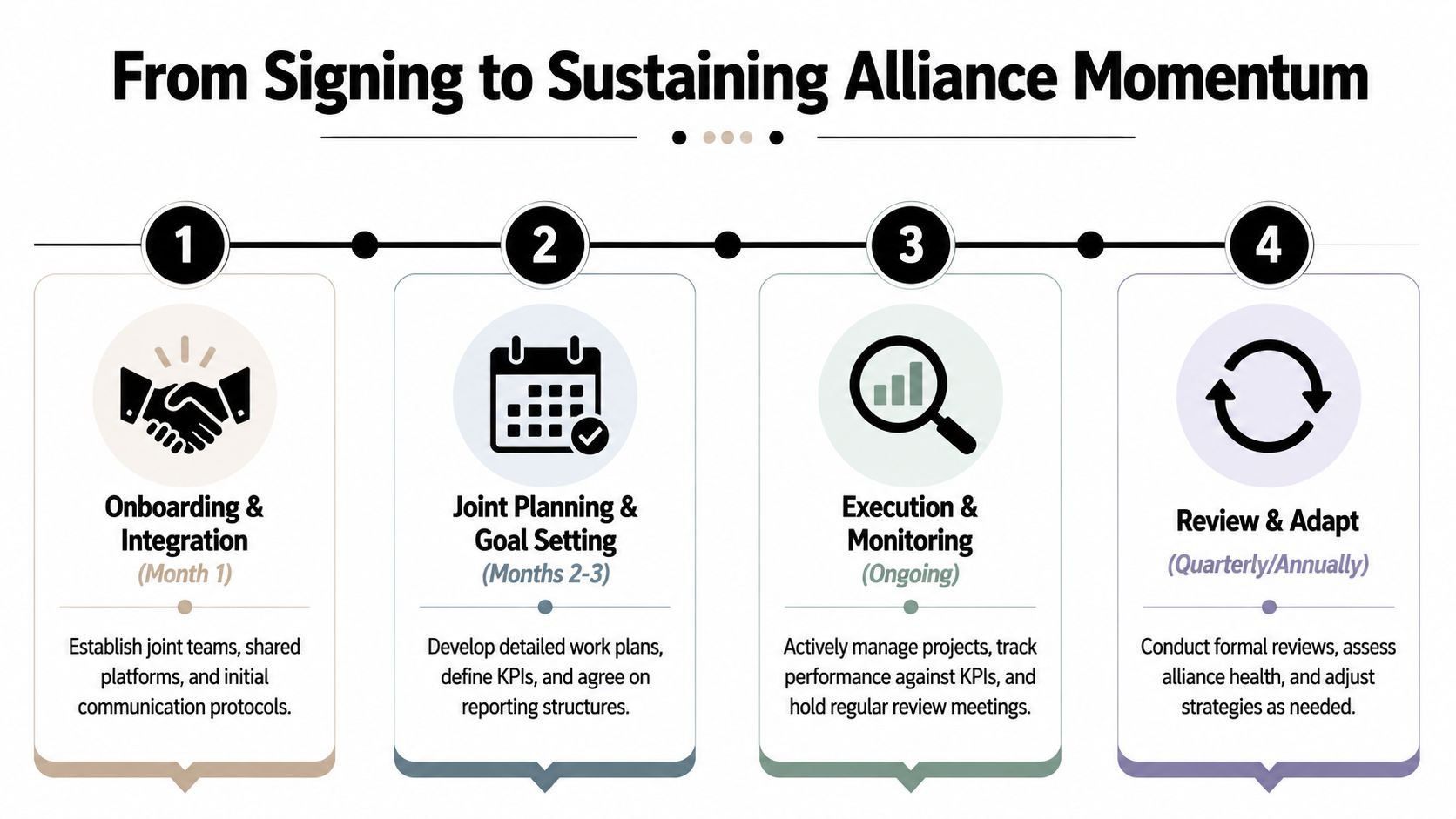
Structure the alliance by time horizon
A useful post-signature model separates alliance goals into three layers. BCG's guidance on strategic alliances recommends defining objectives across quick wins, medium-term goals, and ultimate goals, along with monitoring and exit conditions.
That sequence matters because alliances need early evidence of progress, not just a distant strategic promise.
A practical operating frame looks like this:
| Time horizon | Leadership focus | Common mistake |
|---|---|---|
| Quick wins | Build trust through visible progress | Choosing symbolic wins that don't prove anything |
| Medium term | Solve integration and execution issues | Letting meetings replace decisions |
| Ultimate goal | Validate whether the strategic thesis is real | Staying in the alliance after the rationale has weakened |
Install governance before conflict appears
Good governance isn't bureaucracy. It's pre-agreed clarity on who decides what, how issues escalate, and how both sides stay accountable.
Use a simple structure:
- Executive sponsor pair: One senior sponsor from each side who can unblock major issues.
- Alliance manager or owner: A named operator with authority to coordinate, chase decisions, and surface risk.
- Quarterly strategic review: A forum for recalibrating the alliance, not just reporting activity.
- Issue escalation path: A defined process for handling pricing disputes, delivery gaps, customer complaints, or scope creep.
Don't wait for the first serious conflict to decide how conflict will be handled.
Protect momentum with visible routines
Most partnerships don't collapse dramatically. They thin out. Response times stretch. Meetings get delegated downward. Shared plans lose relevance. The alliance still exists on paper, but it no longer has leadership energy behind it.
To prevent that drift, make the operating cadence visible and specific:
- Monthly operating reviews: Focus on delivery status, blockers, and next actions.
- Quarterly sponsor meetings: Reconfirm strategic relevance, resource support, and unresolved risks.
- Shared dashboard: Track agreed indicators of progress. Keep it lean enough that people use it.
- Decision log: Record major commitments, owners, and dates. Memory is unreliable, especially across organizations.
Leaders who want to increase their influence at work in complex stakeholder settings usually get better results when they pair relationship skill with process discipline. Alliances reward that combination.
Build the exit while goodwill is intact
Every serious alliance should include a graceful exit path. That isn't pessimism. It's professionalism.
If the expected synergy doesn't materialize, both sides need a way to unwind without reputational damage, customer confusion, or internal blame spirals. Define in advance what would trigger reassessment, what information must be reviewed, and how transition responsibilities would be handled.
An alliance with no exit logic often becomes politically harder to leave long after it has stopped making strategic sense.
Your Blueprint for Repeatable Alliance Success
Building strategic alliances is a leadership capability, not a side project for business development.
The companies that do it well are rarely the ones with the most charismatic kickoff meetings. They're the ones that define internal intent clearly, vet partner fit rigorously, negotiate with realism about power and trust, and manage the relationship after signature with visible discipline. That's what turns a promising connection into a working commercial asset.
Alliance value is tangible when the fit is right. Research from NYU Stern, in its study of strategic alliance announcements in financial institutions, found that alliance announcements can increase partner-firm shareholder value, especially when the partners bring non-redundant, complementary assets. That's the core lesson senior leaders should remember. Value comes from complementarity that is real, governable, and hard to replicate alone.
For international executives, there's one more layer. Your ability to frame risk, speak with authority, challenge respectfully, and hold alignment across cultures directly affects whether the alliance holds. In high-stakes partnerships, communication isn't support work. It is an operational multiplier.
If you're preparing for a strategic partnership, a board-level negotiation, or a cross-border alliance discussion, start with a clear view of how your communication lands under pressure. Intonetic offers a free Executive Communication Assessment that helps international professionals evaluate how they project authority, structure ideas, and build trust in senior-level conversations.