
Board Member Communication Guide for Effective Meetings
You're in the room, the packet is thick, the chair wants the decision framed cleanly, and half the directors are already skimming on their phones. This is the measure of board member communication. It isn't about sounding polished for its own sake, it's about helping smart people get to the right decision with the least friction, the clearest record, and enough trust to disagree without derailing the meeting.
For boards, communication has changed because governance changed. The SEC's adoption of the proxy access rule on August 25, 2010 became a turning point that pushed U.S. boards toward structured disclosure and more direct engagement with shareholders, even though the rule was later struck down in 2011. In practice, boards moved toward clearer agendas, more disciplined materials, and more intentional dialogue with owners. That shift still matters, because a board that communicates well tends to make better use of time, ask sharper questions, and leave fewer decisions to chance.
Understanding Key Principles of Board Member Communication
Board communication is the system behind good governance, not a soft skill on the side. It includes how directors receive information, how questions surface, how decisions are recorded, and how follow-through stays visible between meetings. When that system works, directors can prepare properly and challenge the right issues at the right time.
The biggest mistake is treating communication as volume. More email, more attachments, more updates, none of that guarantees better judgment. BoardSource recommends getting materials out early enough for directors to digest them, and Diligent emphasizes concise management reports, dashboards, and Q&A sessions so directors can review risks and strategic issues before they vote. That's the core principle, timing and format matter as much as content.
What strong board communication actually looks like
It's clear, complete, and ready when directors need it. It gives them the same factual baseline and leaves less room for confusion in the room. It also respects that directors process information differently, which is why early distribution in preferred formats, dashboards, summaries, or full reports, improves preparedness and participation, according to BoardSource.
Practical rule: send the decision context early, not just the supporting deck. If directors have to reconstruct the issue themselves, the meeting has already slowed down.
This is also where historical context matters. After 2010, board communication became more structured because boards couldn't rely on vague updates and annual moments alone. They needed cleaner disclosure, clearer ownership, and better engagement habits. That's still the bar now.
The best boards don't just ask, “Was the memo sent?” They ask, “Did this memo help the board decide?” That single shift changes how you write, how you brief, and how you follow through.
Preparing and Structuring Effective Remarks
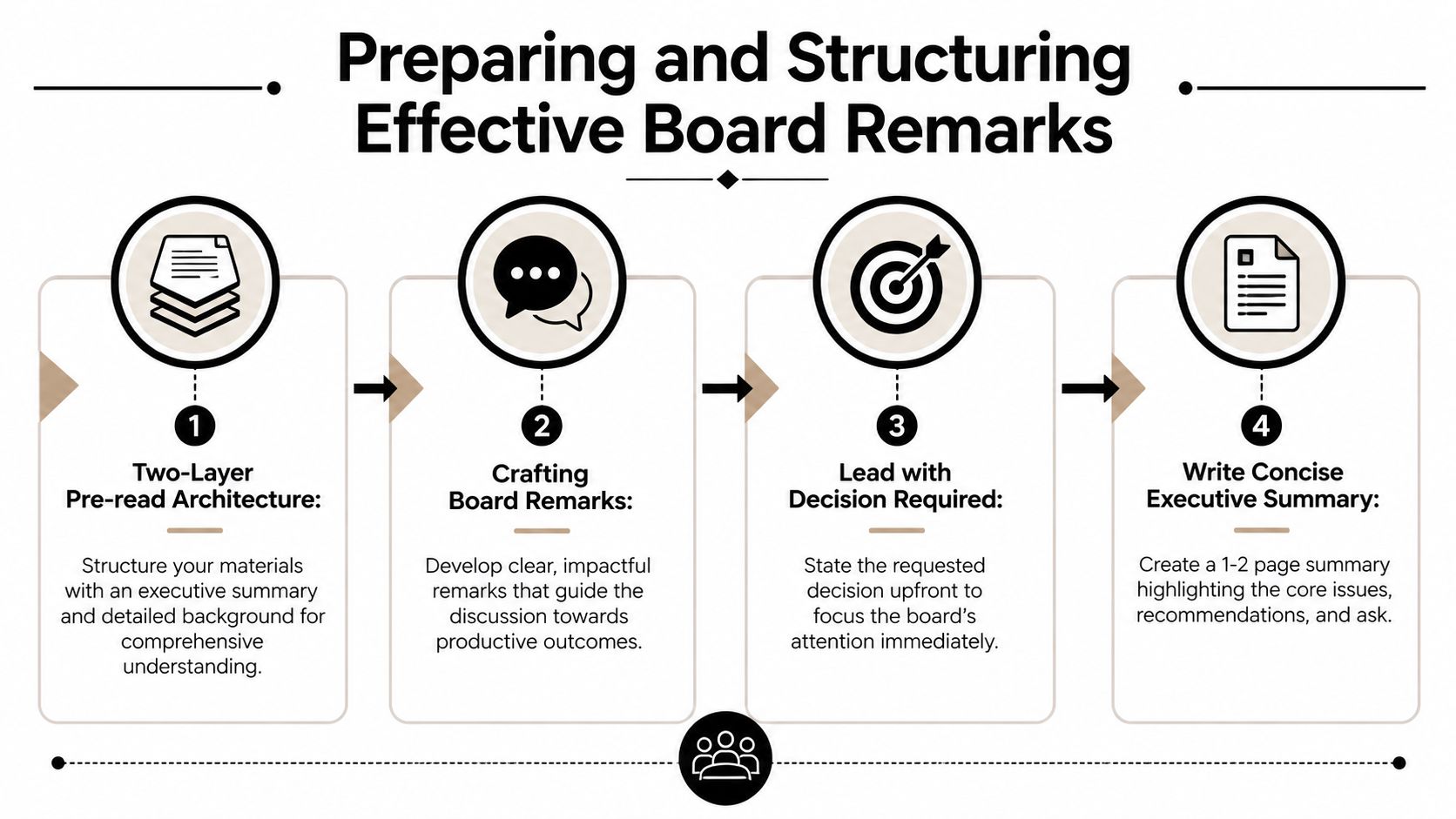
A director who walks into the room with a clear ask, a short rationale, and the actual trade-offs in view usually gets a better discussion than one who tries to cover every branch of the decision tree. Strong board remarks start before the meeting begins, because the board needs the decision, the logic behind it, and the consequences of choosing one path over another. A two-layer pre-read architecture supports that work, with a concise executive summary on top and supporting detail below.
The summary should stay tight, usually 1 to 2 pages, and it should state exactly what the board is being asked to do. Deloitte and PwC both recommend sending a concise executive summary plus appendices at least one full week before the meeting so directors arrive with informed questions. PwC also advises front-loading the most important information so it gets covered even if the discussion runs short. That is a practical way to respect the board's time and reduce last-minute confusion.
Build the message in the right order
Start with the ask. If the board is being asked to approve a capital move, endorse a policy change, or review an issue, put that upfront. Then separate the strategic point from the operational detail. The strategic line belongs in the summary, while the appendices can carry the dashboards, reporting, and background.
A clean board pack often follows this pattern:
- Decision needed first, so the board knows exactly what is being requested.
- Executive summary second, so the core issue is visible in a quick scan.
- Appendices last, so the detail is available without burying the lead.
That structure also helps when directors prefer different formats. Some want charts, some want narrative, and some want both. BDO's guidance points out a real gap in existing advice, many people warn against information overload but never explain what to cut or how to tailor the same message for different readers. In practice, that means keeping the board-level story in the summary and letting the appendix serve the data-heavy readers.
One more detail matters more than people expect, the subject line. If you need a quick reference on email subject line capitalization, use it to make the message easier to scan and trust. Clear, consistent presentation signals discipline before anyone opens the file. For a broader guide to the sequence of a deck or memo, this internal resource on how to structure a presentation is a useful companion.
Keep the ask visible in every document
If the document is for awareness, say so. If it's for endorsement, say so. If it's for approval, say so. PwC recommends tailoring the package to how the board wants to receive information and clarifying whether the request is decision, endorsement, feedback, or awareness. That distinction saves time and avoids the common boardroom problem of people debating the wrong layer of the issue.
For a practical check, I often ask whether the first page could stand alone if the meeting goes long and the deck gets cut short. If the answer is no, the document is not ready yet. The same discipline applies when directors work across cultures or in a second language. Clear sequencing, plain wording, and visible decision points reduce the chance that a careful reader still misses the point.
Projecting Vocal and Executive Presence
A strong packet can still fail if the delivery sounds unsure. Board members notice pace, confidence, and whether the speaker sounds like they own the room. That doesn't mean performing authority, it means reducing friction so the substance lands cleanly.
Your voice does more work than people think. Fast speech can read as nervousness or evasiveness, while flat delivery can make a serious issue sound routine. Executive presence comes from being deliberate, not louder. A steady pace, clean pauses, and a grounded posture help the board follow the logic instead of wrestling with the presentation style.
Use voice to mark the important parts
The fastest way to sound more credible is to slow down around the decision point. Don't race through the recommendation and hope people catch it. Pause before the ask, lower the tempo on the conclusion, and let the key line land.
A useful internal resource on using your voice can help with drills that support that kind of control. The practical idea is simple, train your mouth and breath to support clearer phrasing under pressure. That matters in boardrooms where one rushed sentence can create three follow-up questions.
A director trusts the speaker who sounds settled, even when the topic is difficult.
Match body language to the room
Posture and eye contact need to support the message, not compete with it. If you're reading every line from your notes, the board will assume the message isn't fully internalized. If you hold a stable stance, use the room deliberately, and stop fidgeting with papers or a clicker, the content gets more space to breathe.
A practical drill set helps here.
- Power stance before entry, because a settled stance reduces visible tension.
- Short pause before the first sentence, so you don't start in a rush.
- Eye contact on the decision line, because the board should hear conviction when the ask appears.
Executive presence intersects with governance. Directors don't need theatrical confidence. Instead, they require a speaker who can present a hard issue without sounding defensive, hurried, or over-rehearsed. When the delivery is clean, the board then focuses its energy on judgment, rather than decoding the speaker.
Navigating Q&A and Dissent
A director leans back, looks at the paper, and says the strategy sounds optimistic. Another asks why the downside case isn't stronger. The room goes quiet, and everyone can feel the temperature rise. That's the moment when board communication either hardens into defensiveness or turns into a useful exchange.
The wrong move is to answer too quickly. The better move is to listen long enough to name the concern accurately. When someone objects, they're usually testing risk, timing, ownership, or completeness. If you respond to the surface question only, you miss the actual issue.

Reframe before you defend
The best response often starts by restating the concern in neutral language. That doesn't mean conceding the point, it means proving you heard it. A phrase like, “The issue is whether the downside is fully covered,” keeps the conversation focused and reduces the chance of side arguments.
If you need a practical guide on tone and timing in disagreement, this internal resource on how to disagree respectfully fits naturally here. The value is in staying firm without sounding dismissive. Boards respect directness, but they don't reward ego.
Close the accountability loop fast
After the meeting, the board shouldn't wonder who owns what. A structured feedback-and-follow-through loop matters because it keeps the conversation alive after the room empties. Circulating minutes within 48 hours and assigning named owners to action items strengthens accountability and trust, according to the guidance from DESS.
That speed matters because delays create drift. If a concern was raised in the room, it should show up in the minutes, the action list, or the next update, not vanish into someone's inbox. The strongest boards use reminders and review prior action items as a standing agenda item so unresolved issues stay visible.
Later in the meeting, you can use a short reset if the discussion starts to fragment:
- Acknowledge the concern, so the director feels heard.
- State what's already known, so the board isn't repeating itself.
- Name the next step, so the conversation ends in motion instead of drift.
That combination, listening, reframing, and closing the loop, keeps dissent useful. It doesn't remove disagreement. It keeps disagreement from turning into confusion.
Adapting to Cultural and Language Differences
International boards add a layer of complexity that many communication guides ignore. A direct sentence that feels efficient in one room can feel abrupt in another. A casual phrase that works with native English speakers can create confusion for directors who process information more slowly or through a different language lens.
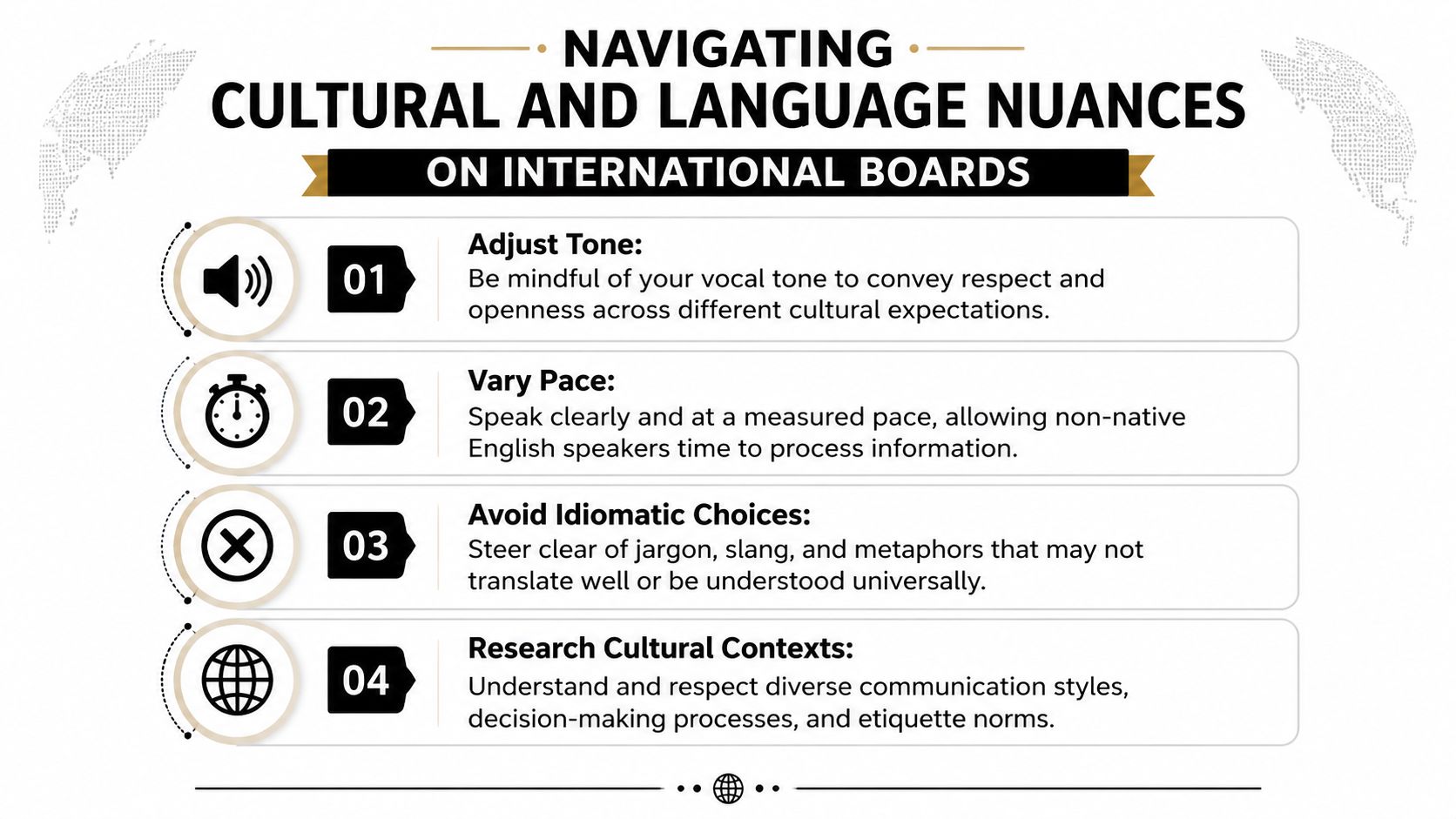
The goal isn't to flatten your style. It's to make the message easier to understand without sounding artificial. That means slowing the pace, reducing idioms, and checking comprehension in a way that doesn't embarrass anyone. Those changes can be small, but they change how much of your message lands.
Speak for clarity, not style
BDO points out a real problem, advice on avoiding information overload often doesn't explain what to cut or how to tailor the same message for directors who prefer charts versus narrative. That gap shows up even more sharply in cross-cultural rooms. Some directors want the headline first. Others want context before conclusion. Some need visual structure to process the meeting in real time.
A practical response is to make the spoken language simpler and the written support more explicit. Avoid idioms, insider shorthand, and jokes that depend on local context. If you're also preparing video or visual content for a global audience, this guide on video content localization is a useful reference point for thinking about how meaning changes across cultures.
Check understanding without putting people on the spot
You don't need to ask, “Does everyone understand?” That question often gets polite silence. A better move is to summarize the decision, then invite a specific reaction. “The ask is approval of the revised timeline. I'd welcome any concerns about scope or sequencing,” gives people a clear opening.
If a director speaks English as a second language, pace matters as much as vocabulary. Measured delivery gives them time to process, and clear structure helps them track the point even if a few words are unfamiliar. For those building confidence across cultures, this internal resource on cross-cultural communication training aligns well with that need.
A few practical habits help in the room:
- Use plain nouns, because concrete terms travel better than abstractions.
- Avoid packed sentences, because long clauses make live interpretation harder.
- Repeat the decision once, because not every director absorbs the first pass the same way.
That's where cultural adaptation intersects with executive presence. The most credible speaker in a global boardroom isn't the most elaborate. It's the one who can adjust tone, pace, and wording without losing authority.
Managing Materials Follow-up and Checklists
The meeting ends, but the communication work doesn't. Directors need materials early enough to prepare, then they need a quick, reliable way to see what changed, what was decided, and what happens next. BoardSource notes that early distribution of materials in preferred formats, dashboards, summaries, or full reports, improves director preparedness and participation, and that's the right standard to hold yourself to.
Use the same logic before, during, and after the meeting. Pre-meeting, focus on clarity and timing. In the meeting, keep the decision visible and capture dissent cleanly. Post-meeting, make the record useful fast. That's where accountability lives.
Board Communication Checklist
| Pre-Meeting | In-Meeting | Post-Meeting |
|---|---|---|
| Send the summary early so directors can review the ask and supporting detail in advance. | State the decision upfront so the board knows what it is being asked to do. | Circulate minutes within 48 hours so accountability stays fresh. |
| Use the format each director prefers when possible, such as dashboards, summaries, or full reports. | Capture objections clearly instead of letting them vanish into side comments. | Assign named owners to every action item. |
| Separate the summary from appendices so the strategic point doesn't get buried. | Keep the agenda moving and park unresolved items for later review. | Review prior action items at the next meeting so follow-through stays visible. |
A clean follow-up email helps reinforce the same discipline. If you want a simple model for that kind of message, this internal written email example is a useful template to adapt for board use. The point isn't style for its own sake, it's making sure directors can see what happened and what they're expected to do next.
The Gravitas Method is a 12-week one-on-one executive presence coaching program for international professionals who want to communicate with more authority and influence at senior levels. Coached by Nikola, it covers vocal authority, strategic framing, executive body language, and high-stakes communication. If boardroom presence is part of your growth path, the free Executive Communication Assessment is the right starting point.
A CTA for Intonetic. Start with the free Executive Communication Assessment, then use the findings to sharpen how you brief, speak, and follow through in high-stakes board conversations.