Assertiveness Training for Women: Lead with Confidence In
You make a clear point in a meeting. Nobody responds. Later, a male colleague says almost the same thing in a firmer tone, and the room suddenly treats it as strategic insight.
That moment is frustrating, but it's also diagnostic. The issue often isn't expertise. It's delivery, framing, timing, and the social cost attached to how women are perceived when they communicate directly.
That's why assertiveness training for women matters. Not because women need to become louder or more aggressive, but because many already have the substance and still aren't getting credit, room, or influence in proportion to what they contribute. This is even more complex for non-native English speakers, who often manage two pressures at once: saying the right thing and sounding senior while saying it.
Why Assertiveness Is a Skill Not a Personality Trait
A lot of women assume assertiveness is something you either have or you don't. That belief does real damage because it turns a trainable professional skill into a personality verdict.
Assertiveness isn't dominance. It isn't sharp elbows. It isn't speaking over people. It's the ability to express a view, set a boundary, make a request, or disagree clearly while staying respectful and controlled.
That distinction matters because skills can be built. Personality labels usually trap people.
What assertiveness actually looks like at work
In practice, assertiveness sounds like this:
- Naming your position clearly: “My recommendation is to delay launch until the reporting issue is fixed.”
- Setting a boundary without apology: “I can review this today, but I can't take on the full rewrite by tomorrow.”
- Reclaiming credit professionally: “Yes, that's the point I raised earlier. Let me build on it.”
- Disagreeing without escalating: “I see it differently. The risk isn't speed. It's adoption.”
Women often get taught the wrong binary. Be nice or be forceful. Stay agreeable or be labeled difficult. Real assertiveness sits in the middle. It protects your interests without disrespecting anyone else's.
A useful mental shift is to stop asking, “Am I naturally assertive?” and start asking, “Can I communicate my position in a way that's clear, credible, and hard to sideline?”
Training changes behavior under pressure
This isn't just a matter of confidence rhetoric. A clinical study of 1,623 women found that those with prior self-defense or assertiveness training were more likely to report that their resistance stopped an offender or made him less aggressive, and they also reported feeling angrier and less scared during the assault. That matters because it shows training can shape response under extreme pressure, not only in low-stakes practice conversations.
Practical rule: If a skill can be rehearsed, it can be improved. Assertiveness belongs in that category.
For women who freeze, soften, over-explain, or second-guess themselves in high-pressure moments, that should be encouraging. The right training doesn't try to replace your personality. It gives you access to better behaviors when stakes rise.
If you want a broader psychological lens on why people struggle with improving assertiveness skills, that resource is worth reading alongside leadership-focused work on the psychology of leadership. Together, they help explain why smart professionals can know what they think and still fail to land it in the room.
Developing an Assertive Mindset
The first barrier usually isn't wording. It's permission.
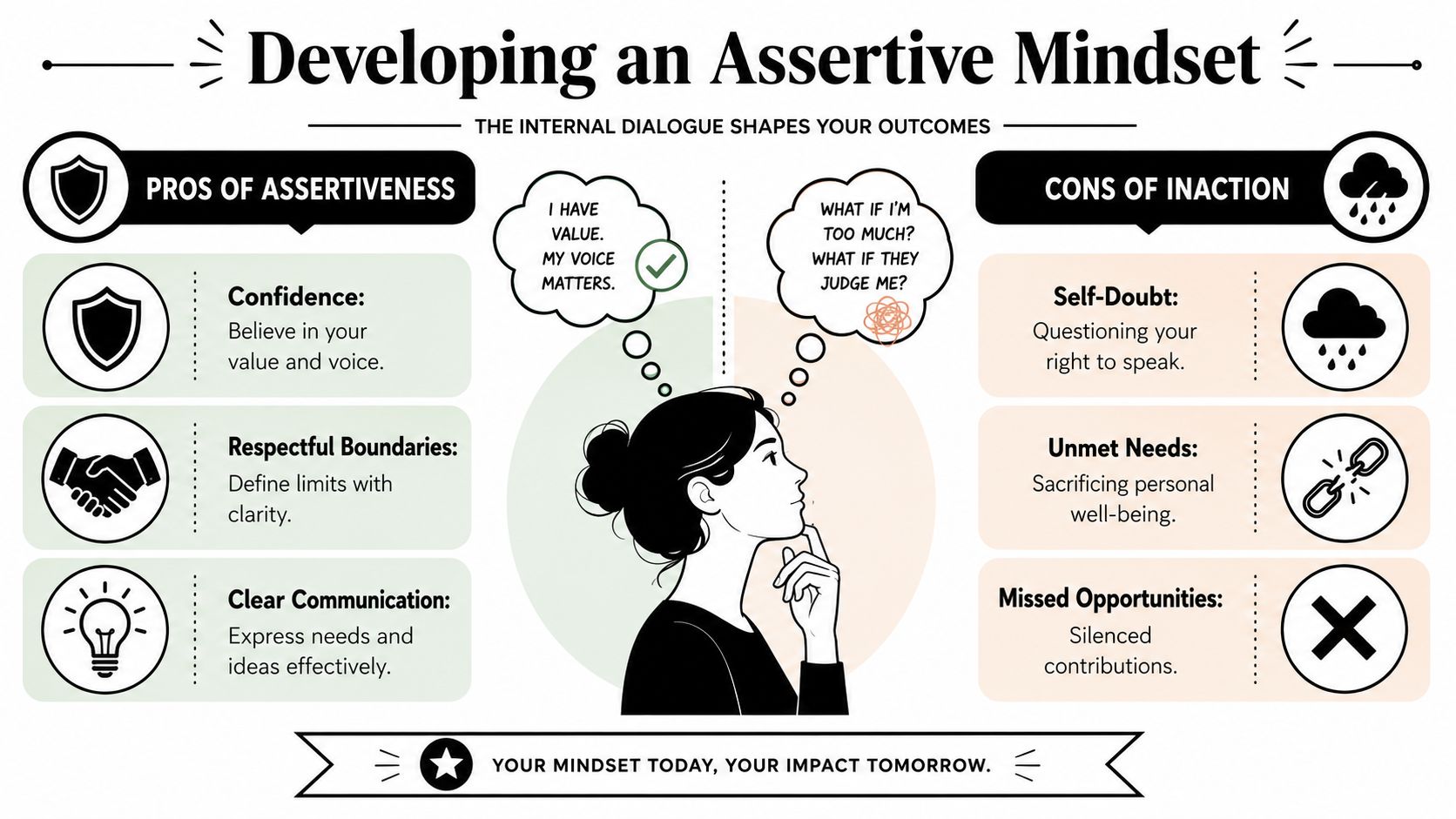
Many women know what they want to say, then edit themselves before anyone else has a chance to respond. They soften a recommendation, delay a boundary, or stay silent because they don't want to sound rude, emotional, underqualified, or hard to work with.
That internal negotiation is expensive.
Recent workplace survey data cited in an assertiveness research summary found that 88% of people think they are assertive at work, yet 55% said they had missed work opportunities because they were not assertive enough, and 43% said they had had to learn to be more assertive. The same source reported that 80% of women believe they are assertive at work (Acuity Training). The gap is the point. Self-perception isn't the same as workplace impact.
The beliefs that weaken delivery
I hear versions of the same beliefs repeatedly in coaching conversations:
- “If I'm direct, people will think I'm difficult.”
- “I need to be completely right before I speak.”
- “If my English isn't perfect, I should keep it brief.”
- “If I upset someone, I've handled it badly.”
None of these beliefs create better communication. They create self-monitoring, delay, and diluted language.
A stronger mindset is more operational:
| Unhelpful thought | Better replacement |
|---|---|
| I need everyone to like how I say this | I need the message to be clear and useful |
| I shouldn't speak until I'm fully ready | I can contribute at the level of what I know now |
| My accent weakens my authority | My structure, pacing, and clarity shape authority more than accent alone |
| Saying no is selfish | A clear boundary prevents resentment and poor work |
The double barrier for non-native English speakers
For international professionals, assertiveness often collides with culture. In some backgrounds, deference signals professionalism. In others, interruption is normal and not considered disrespectful. Then English enters the picture and adds hesitation, translation lag, and fear of sounding blunt by mistake.
That combination can make a highly capable woman sound less certain than she is.
You don't need perfect English to sound authoritative. You need clean structure, steady pace, and the willingness to finish your sentence without retreating from it.
That's why mindset work can't stay abstract. It has to change the question you ask yourself in real time. Not “Do I sound perfect?” but “Did I make my point in a way this room can follow?”
If boundary setting is part of your challenge, practical advice on how to prevent burnout and thrive at work is especially relevant. Assertiveness gets much easier when you stop treating every request as a test of your likability and start treating it as a decision about priorities.
A useful daily reset is this: your job isn't to make your message smaller so other people stay comfortable. Your job is to make it clear enough that people can respond to it. That same shift is central when you're learning how to talk with confidence.
Strategic Language for Professional Impact
You are in a meeting. A senior colleague cuts in halfway through your recommendation, someone else rephrases your point three minutes later, and now the room is reacting to their version. This is the moment where generic advice like “be more confident” stops being useful. You need language that protects your authority in real time.
For many professional women, especially non-native English speakers, the challenge is not having an opinion. It is delivering that opinion in a way that sounds clear, senior, and hard to dismiss without sounding harsher than intended. That is a language problem as much as a confidence problem.
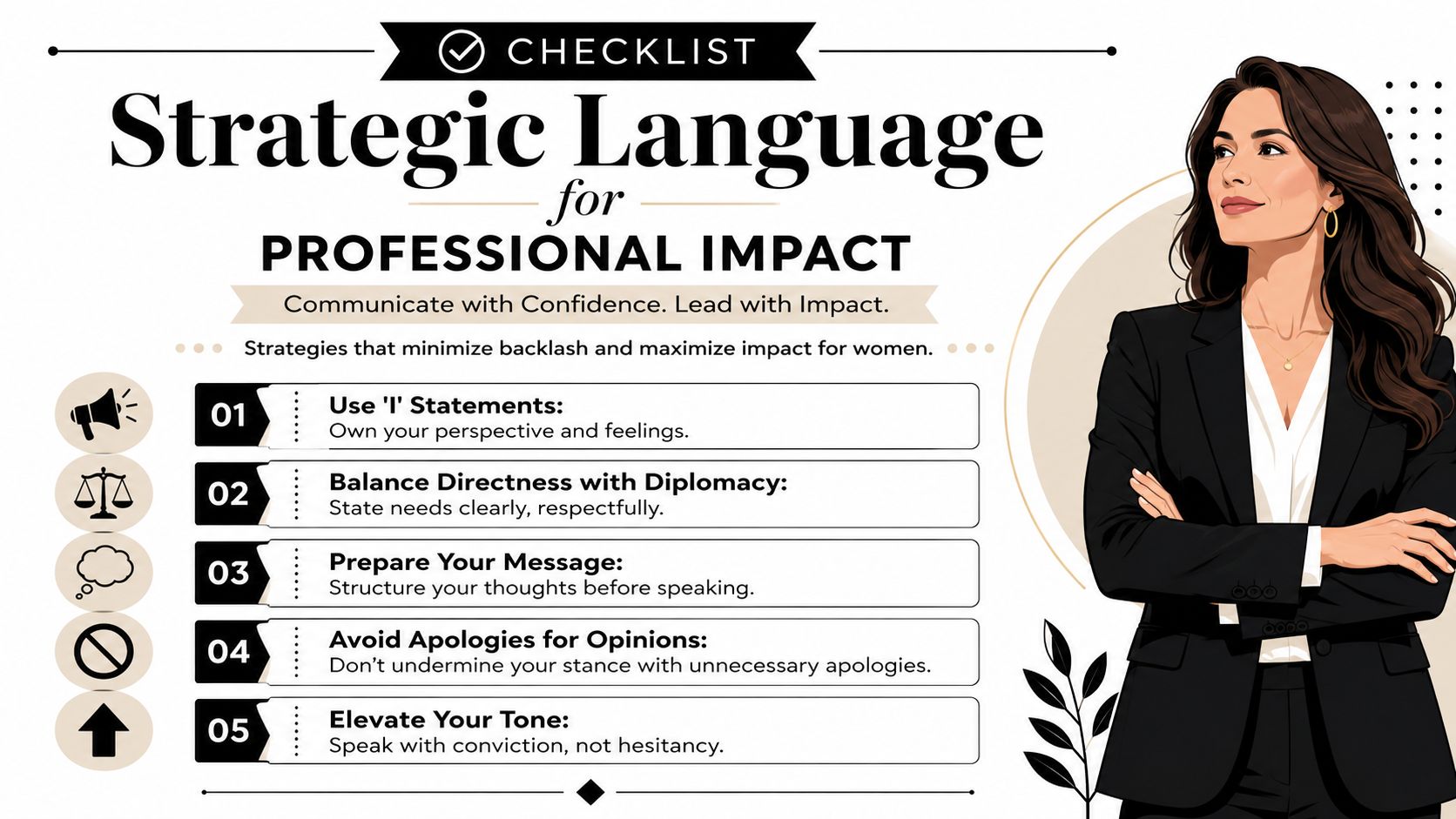
Research from Harvard Kennedy School on gender and negotiation backlash helps explain why. Women often anticipate social penalties for direct self-advocacy, and the authors point to communal framing as one way to reduce that friction. In practice, that means linking your position to outcomes the group already values, instead of presenting it as a personal demand.
Use communal framing without diluting your point
Communal framing works best when it stays concrete. The goal is clarity with alignment, not softening your message until nobody can act on it.
Instead of:
“I need more time.”
Say:
“To protect quality, I recommend we move the deadline by two days.”
Instead of:
“I disagree.”
Say:
“I don't think this approach gets us the result we want. The risk is retention after launch.”
Instead of:
“I deserve to lead this.”
Say:
“I'm well positioned to lead this phase because I know the client context and can keep execution consistent.”
That shift matters in senior environments. It shows judgment, not just preference.
For non-native English speakers, this approach also reduces the pressure to sound polished or charismatic. You do not need complicated vocabulary. Short sentences with a clear business rationale usually carry more authority than long explanations filled with qualifiers.
Cut the phrases that weaken your position
Strong ideas often lose force because of one unnecessary opening clause. I hear this constantly in coaching sessions. A director has the right answer, then starts with “Sorry, just one thought” and hands away status before the point even lands.
Use this table as an edit tool:
| Common habit | Stronger alternative |
|---|---|
| “Sorry, just one thought” | “I'd like to add a point” |
| “I may be wrong, but…” | “My read is…” |
| “This might sound silly” | “The issue I see is…” |
| “Does that make sense?” | “Let me pause there” |
These are small corrections with a real effect. In fast meetings, people react to your framing before they fully process your content.
Here's a useful explanation in video form before you start practicing your own phrasing:
Hold your ground without overexplaining
Under pressure, many women get more detailed when they should get more concise. That instinct is understandable. You are trying to sound reasonable. In practice, too much justification can make a clear boundary sound negotiable.
Two tactics help.
-
Repeat the decision with calm consistency.
“I can't take that on this week.”
“I understand the timeline is tight. I can't take that on this week.”
“I can help review priorities, but I can't take that on this week.” -
Acknowledge part of the pushback without giving up your position.
“You may be right that the timing is difficult. I still think we need to raise the issue now.”
If your answer gets longer each time someone questions it, stop and shorten it.
Script the moments that usually throw you off
High-stakes assertiveness is rarely spontaneous. It is prepared. The women who come across as composed in tense meetings usually have stock phrases ready for predictable situations.
Try these:
- When interrupted: “I'd like to finish the point, then I'm happy to come to you.”
- When someone repeats your idea: “Yes, that builds on what I raised earlier. My recommendation is still X.”
- When asked to absorb extra work: “I can support this, but I need clarity on what shifts off my plate.”
- When disagreeing with senior leadership: “I see the rationale. My concern is execution risk in the current timeline.”
Strong framing is part of communication as persuasion. It is not manipulation. It is deliberate message design.
Even visual cues can support that message. In some client-facing settings, details like precise fit, clean lines, and sleek patent pump fashion can reinforce a polished presence, but presentation never replaces clear language. The sentence still has to carry authority on its own.
The target is not to sound tougher. It is to sound settled. Clear. Hard to misread.
Commanding Rooms with Vocal and Physical Presence
You make a clear recommendation in a meeting. A minute later, someone restates it with less detail and gets the nod. In many cases, the problem is not the idea. It is the delivery.
Women run into a narrow margin here, especially in senior settings. Speak too softly and people question your confidence. Speak too forcefully and you risk being read as abrasive. For non-native English speakers, that margin can feel even tighter because accent, pacing, and word retrieval are judged unfairly. Presence helps close that gap. It makes your message easier to follow and harder to dismiss.

Build vocal authority first
A steady voice signals ownership. A rushed voice often signals caution, even when your content is strong.
Start with three adjustments that change how you are received fast:
- Lower the rush factor: Slow down the first sentence of your point. Senior speakers rarely sprint into their message.
- Finish statements cleanly: Let the end of the sentence drop slightly. If your tone rises every time, your recommendation can sound optional.
- Use the pause: Pause after your main point instead of filling the space. Silence often reads as composure.
Try this line aloud: “My recommendation is to delay the rollout until support is ready.” Record it. Then say it again with a slower first clause, a clean ending, and a one-beat pause after “ready.”
This matters even more if English is not your first language. Many women I coach try to compensate by speaking faster or adding extra explanation. That usually lowers authority. Shorter phrasing, cleaner stress on key words, and a deliberate pause do more for executive presence than trying to sound more native.
Make your body language support the message
Physical presence is usually about reducing apology signals.
At the table, plant both feet and keep your chest open instead of folding toward the laptop. If you stand, settle before you begin talking. If you gesture, make the gesture serve the sentence. Repetitive hand motion, face touching, and constant nodding can make a strong point look less settled.
Eye contact also needs strategy. In a meeting, deliver the key sentence to one person first, usually the decision-maker or strongest stakeholder, then widen your gaze. Scanning the room too early can make you look like you are checking for permission.
Stillness helps. So does taking up the space your role already gives you.
Appearance plays a supporting role for some women, especially in client-facing or high-visibility settings. Clothes do not create authority, but physical comfort affects posture, gait, and distraction level. If that layer matters to you, style references like sleek patent pump fashion can help you choose pieces that feel polished without making you self-conscious.
Use one drill for your next meeting
Do this once in a real meeting, not just in practice:
- Sit or stand still before speaking.
- Take one breath out.
- Deliver your opening sentence in a measured pace.
- Keep your hands quiet after the main point.
- Hold eye contact for one beat when you finish.
That sequence is simple. It also changes how people rank your authority very quickly.
In presentations, stakeholder updates, and hybrid meetings, the same habits help you hold attention in the room and on screen without sounding over-rehearsed. Presence is visible discipline. People hear it before they can name it.
Your Assertiveness Practice Plan and Scenarios
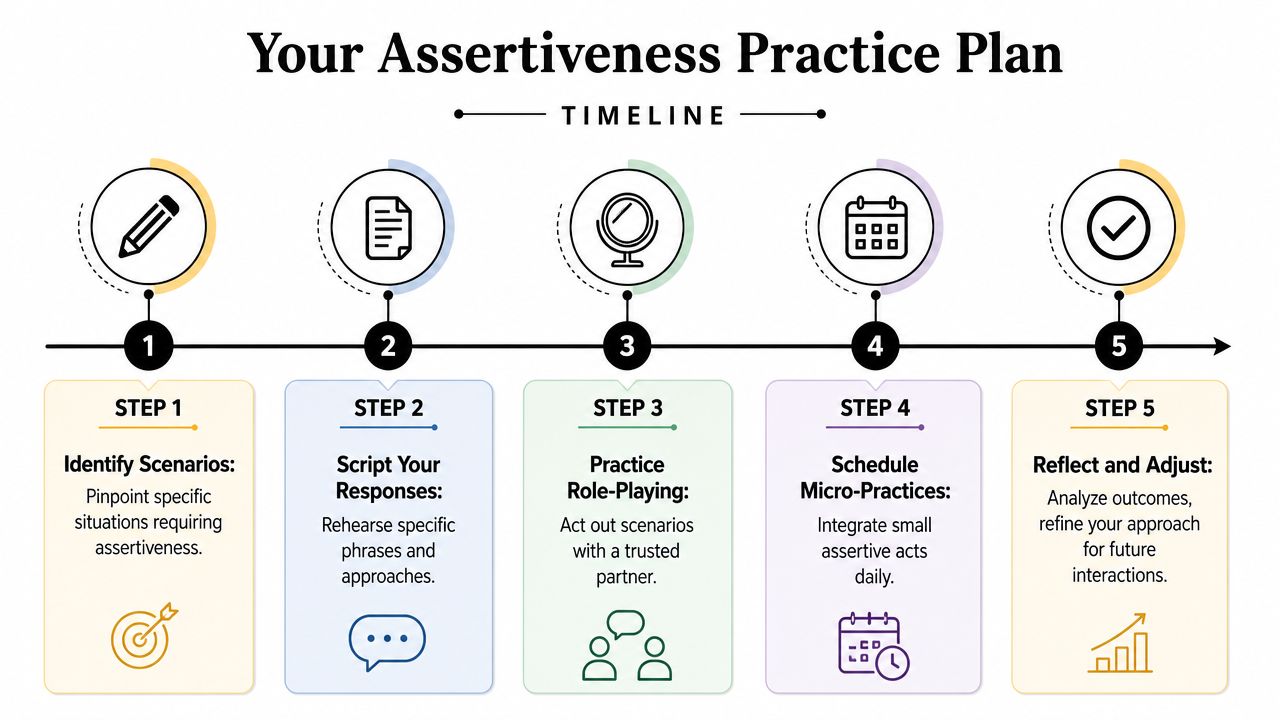
Reading about assertiveness doesn't create assertiveness. Repetition does.
Recent experimental evidence in negotiation shows that even minimal interventions can change behavior, but public advice often fails to bridge theory and high-stakes professional use. Effective training needs context-specific rehearsal (ScienceDirect).
That tracks with what works in real workplaces. Women improve fastest when they stop trying to become “more assertive” in general and start rehearsing a few exact moments that matter.
Four scenarios worth practicing
When someone interrupts you
Don't smile and disappear. Re-enter calmly.
Try:
“I'd like to finish the thought.”
Then continue.
If the interrupter is senior, use:
“Let me complete the point, because it affects the recommendation.”
When you get an unreasonable request
Don't answer too quickly. Buy time, then state limits.
Try:
“I can help with this. To do that well, I need to know what should be deprioritized.”
If needed:
“I'm not able to absorb that on top of current deadlines.”
When you're pitching a high-stakes idea
Women often over-explain at the start to prove they've thought carefully. That can weaken the opening.
Use this order instead:
- Recommendation.
- Business rationale.
- Key risk.
- Next step.
Example:
“My recommendation is to test this with the enterprise segment first. It gives us cleaner feedback and lowers rollout risk. The main concern is timeline pressure, so I'd suggest a smaller pilot team.”
When you disagree with a senior colleague
Don't frame disagreement as personal contradiction. Frame it as risk management or decision quality.
Try:
“I understand the logic. I see one issue that could affect execution.”
Or:
“I'm aligned with the objective. I'm not yet aligned with this route.”
Practice your hardest sentence first, not last. Most people rehearse context and then lose nerve when they reach the actual point.
A four-week practice rhythm
You don't need a dramatic reinvention. You need consistent exposure.
Week one
Choose two situations where you usually go passive. Write one sentence for each. Keep both sentences short enough to remember under pressure.
Week two
Practice delivery, not just wording. Say your lines aloud. Record them. Listen for speed, rising tone, trailing endings, and filler words.
Week three
Use one assertive behavior in live conversation each day. That could be holding eye contact through a sentence, declining a request cleanly, or speaking in the first third of a meeting instead of the last.
Week four
Review outcomes. Ask:
- What felt easier than expected
- Where I retreated
- Which sentence worked
- Which context still needs rehearsal
How to measure progress without overcomplicating it
Use a simple log after key interactions:
| Situation | What I said | What I did well | What I'll adjust |
|---|---|---|---|
| Team meeting | Stated recommendation early | Better pace | Stronger ending |
| Stakeholder request | Set limit clearly | No apology | Shorter explanation |
| Senior disagreement | Named concern respectfully | Stayed calm | Hold eye contact longer |
That log matters because assertiveness develops through pattern recognition. You'll start to see where you fold, with whom, and under what pressure.
A mentor or trusted colleague can help too, but ask for narrow feedback. Not “How did I do?” Ask, “Did I sound clear?” or “Did I hold the room when I made the recommendation?” Specific feedback is usable. General reassurance usually isn't.
Conclusion Building Your Authentic Authority
The strongest version of assertiveness doesn't feel fake. It feels cleaner.
You stop cushioning every opinion. You stop treating clarity as aggression. You stop assuming that if a message creates friction, the message must have been wrong. That's where authentic authority starts. Not with a new personality, but with fewer habits that hide your judgment.
The value of assertiveness training for women is that it gives structure to something many professionals have been trying to solve by instinct alone. Mindset matters. Language matters. Voice and body language matter. Rehearsal matters most when stakes rise and old habits return.
A controlled study with female adolescents found that assertiveness training produced significant gains in assertiveness after training and again two months later, and the same study also reported decreases in anxiety, stress, and depression (PMC). That's worth taking seriously. Better assertiveness doesn't just improve visibility. It can reduce the mental load that comes from constant self-silencing.
What authentic authority sounds like
It sounds like a woman who can:
- State a recommendation early
- Disagree without shrinking
- Set a limit without a guilt spiral
- Hold eye contact while making a difficult point
- Speak in English with structure and conviction, even if it isn't perfect
That kind of authority is earned through practice, not performance.
You don't need a different voice. You need better access to the one that already knows what it's saying.
If you're aiming for senior leadership, credibility depends on whether others can trust your judgment quickly. Assertiveness helps them hear it. Presence helps them believe it. Consistency helps them remember it. That combination is how women build the kind of professional identity that carries into promotion conversations, executive meetings, and high-stakes decisions. It's also closely tied to how to build credibility as a leader, especially when your expertise is strong but your delivery still gets underestimated.
If you want a clear starting point, begin with the free Executive Communication Assessment from Intonetic. It helps you identify where your authority is getting diluted, whether that's language, vocal delivery, executive presence, or how you handle pressure in senior conversations. From there, you can decide what to strengthen instead of guessing.