What Are Language Barriers: Overcome Them by 2026
You explain a strong idea in a meeting. You know the data. You know the risks. You even answer the follow-up question clearly. Then the room moves on as if you said something minor.
Later, a colleague repeats a simpler version of your point and people suddenly engage.
If you're an international professional, that moment can be exhausting. You start wondering whether the problem is your English, your accent, your confidence, or something harder to name. In many cases, it isn't a lack of expertise at all. It's a language barrier that doesn't look like a classic language barrier.
The Invisible Wall in Your Career
A senior analyst joins a strategy meeting. She has the strongest grasp of the numbers in the room. When she speaks, people stay polite, but they don't build on her idea. One executive asks her to “circle back in an email.” Another interrupts before she finishes. She leaves the meeting thinking, “I answered the question. Why didn't it land?”
That experience is common, and it's easy to personalize it. Many professionals assume the issue is vocabulary or grammar alone. But career-limiting language barriers are often more subtle. They show up in pacing, pronunciation, implied meaning, tone, and whether your message sounds immediately credible under pressure.
This isn't a niche problem. In the United States, nearly 66 million people reported speaking a non-English language at home in 2019, and language-discordant encounters are linked to worse outcomes and lower satisfaction in high-stakes settings, according to this overview of language barriers in America. That scale matters because it tells you something important. If communication breaks down, it isn't proof that you're less capable. It's proof that language barriers affect real decisions, real access, and real perception.
For ambitious professionals, one of the most frustrating versions of this problem is when your message is technically correct but socially discounted. That often overlaps with accent bias, which can shape how authority is perceived long before your content is fully considered. If that part feels familiar, how your accent really affects your career and what you can actually do about it offers a useful lens.
You can be fully qualified and still be underestimated if your message reaches people with friction.
When people ask, what are language barriers, they usually imagine translation problems. In professional life, the harder barrier is often invisible. It sits between what you meant, what they heard, and what they decided you meant.
Redefining Language Barriers Beyond Translation
Language barriers are often defined too narrowly. The common perception is that the barrier appears only when two people speak different native languages. In senior workplaces, that's often not what happens.
A better definition is this: a language barrier is any gap that prevents your intended meaning, credibility, or urgency from being understood the way you meant it.
When the signal is on but off-frequency
Think of communication like a radio signal. The channel is available. The sound is coming through. But the tuning is slightly off, so the listener catches fragments, fills in the blanks, and misses the most important point.
That is why a team can all be speaking English and still misunderstand one another. As Babbel's explanation of language barriers notes, barriers can come from differences in vocabulary, grammar, pronunciation, idioms, and technical jargon. In business, even a shared word like “urgent” can fail operationally if different people attach different meanings to it.
The professional version is more nuanced
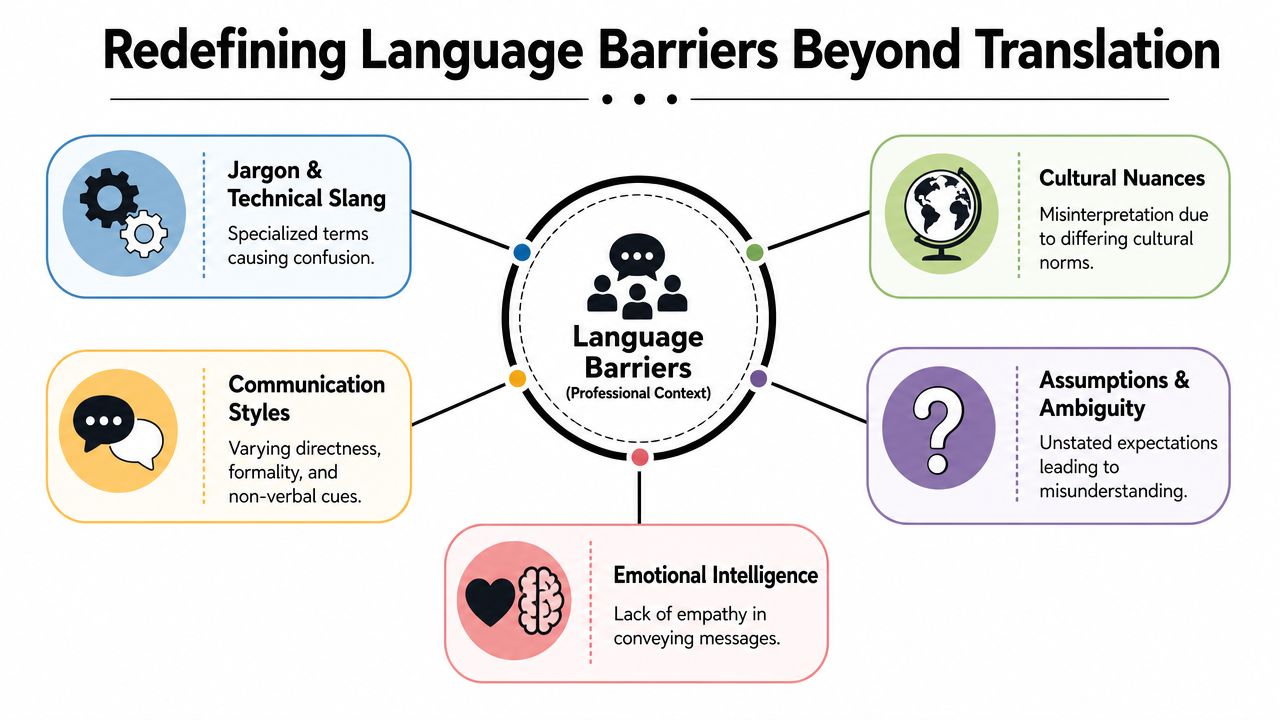
In career settings, invisible barriers usually appear in layers:
- Word choice problems: You know the idea, but the wording sounds more tentative, more blunt, or less strategic than you intended.
- Pronunciation friction: Listeners spend extra effort decoding your speech, so they absorb less of your message.
- Pragmatic gaps: You answer the literal question, but miss the implied expectation behind it.
- Cultural mismatch: Your style of politeness, disagreement, or self-promotion doesn't match the room.
- Emotional misread: Stress tightens your voice or shortens your answers, and people mistake that for uncertainty.
One reason these barriers are so frustrating is that they rarely produce obvious failure. They create softer damage. People hesitate. They ask someone else to confirm your point. They say you're “smart but not yet executive.” They describe you as “better in writing.”
If pronunciation is part of that friction, targeted practice can help. For professionals who want a specific resource on vowel clarity and spoken confidence, you can boost your English speaking confidence with Verse. And if the challenge is less about grammar and more about style, direct vs indirect communication at work can help you spot how cultural norms shape interpretation.
Practical rule: Shared language doesn't guarantee shared meaning.
That is the core shift. When you ask what are language barriers, the useful answer isn't “people speak different languages.” The useful answer is “people can use the same language and still miss each other in ways that affect trust, speed, and authority.”
The Five Types of Language Barriers in Business
In business, language barriers are easier to fix when you can name the type. If everything feels like one big communication problem, it's hard to know what to practice.
A simple diagnostic table
| Barrier Type | What It Is | Workplace Example |
|---|---|---|
| Linguistic | Gaps in grammar, vocabulary, sentence structure, or word precision | You mean “delay the launch,” but say “cancel the launch,” creating confusion |
| Accent and fluency | Pronunciation, rhythm, stress, and pace that make speech harder to process | Your insight is strong, but people ask you to repeat key words in meetings |
| Pragmatic | Gaps in implied meaning, politeness, tone, and how requests are framed | A leader says “it may be worth revisiting,” and you don't realize that means “change this now” |
| Cultural | Different norms around hierarchy, disagreement, feedback, and self-advocacy | You speak very directly to save time, but a client experiences it as abrupt |
| Jargon-based | Specialized terms that exclude or confuse people outside a function or team | Engineering, legal, and sales use the same term differently and leave with different assumptions |
What each type looks like in real life
Linguistic barriers are the most familiar. They involve wording, grammar, and accuracy. These matter, but at senior levels they usually aren't the only issue. A minor grammatical error rarely blocks promotion by itself. Repeated lack of clarity can.
Accent and fluency barriers are different. Here, the listener works harder to decode your speech. That extra effort can reduce attention, especially in fast meetings. The unfair part is that people may label this as a confidence issue when the actual problem is processing load.
Pragmatic barriers are some of the most expensive. Professional English is full of implied meaning. “Could you take another look?” may mean “This isn't acceptable yet.” “Interesting” may signal disagreement, not interest.
The barriers people miss most often
Cultural barriers often hide inside feedback like “be more concise,” “speak up more,” or “be more polished.” The instruction sounds simple, but it's tied to local expectations about authority, brevity, disagreement, and presence.
Jargon-based barriers show up when teams assume shared understanding that doesn't exist. A finance lead, product manager, and consultant may all use the same words but mean different things. The result isn't just confusion. It's misalignment, rework, and avoidable tension.
Here is the useful distinction:
- If people don't understand your words, the barrier is often linguistic or pronunciation-based.
- If people understand the words but respond oddly, the barrier is often pragmatic or cultural.
- If people nod and still execute the wrong thing, ambiguity or jargon is usually involved.
Once you know the type, the response becomes more precise. You stop trying to “improve your English” in a vague, discouraging way and start solving the exact barrier that is getting in your way.
The Measurable Impact on Your Career Progression
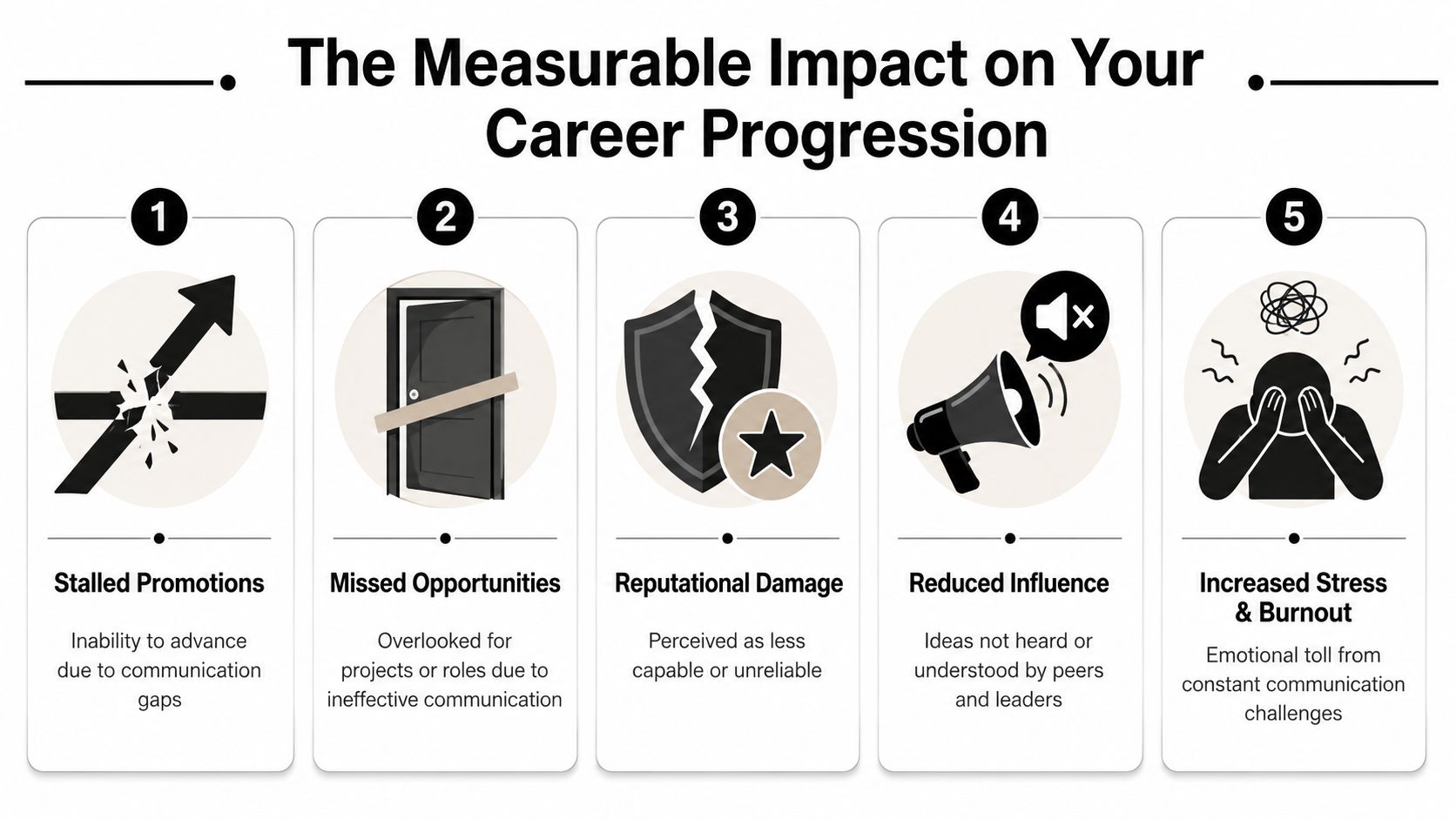
Language barriers don't only create awkward conversations. They shape decisions about trust, readiness, and leadership. In other words, they affect who gets heard, who gets visible assignments, and who is seen as promotable.
That may sound abstract until you look at how often language barriers create practical obstacles in high-stakes communication. In healthcare, where misunderstanding can have immediate consequences, about 26 million people in the U.S. have limited English proficiency, representing about 8% of people ages 5 and older, and about half of adults with limited English proficiency said they encountered at least one language barrier in healthcare within the past three years. Specific problems included 34% having trouble filling out forms, 33% difficulty communicating with medical staff, 30% struggling to understand provider instructions, and 27% having trouble filling a prescription or understanding how to use it, according to KFF's survey findings on language barriers in health care.
In corporate life, the stakes are different, but the pattern is similar. If language barriers can disrupt forms, instructions, and interpersonal communication in one system, it's not hard to see how they can also distort project ownership, stakeholder trust, and leadership visibility at work.
The career consequences are usually indirect
Most professionals are not told, “Your communication is the barrier.” They hear softer versions:
- “You need more executive presence.”
- “You're strong technically, but less client-ready.”
- “We need someone who can influence across functions.”
- “Your written work is excellent. Keep speaking up.”
Those phrases often point to a gap between expertise and perceived authority.
A second point matters just as much. Sometimes the problem isn't individual ability. It's organizational underuse. In one U.S. medical study summary, about 40% of physicians spoke a language other than English, but only 9.6% said they used their multilingual skills always or often in patient care, as summarized by the American Association of Surgery discussion on language barriers in medicine. That suggests a deeper issue. Institutions can have language capacity available and still fail to use it well.
Why this matters for senior roles
At senior levels, people don't evaluate communication only for correctness. They evaluate it for steadiness, speed, judgment, and influence. If your message takes extra effort to process, people may underestimate your strategic ability even when your thinking is strong.
That mismatch can lead to:
- Reduced influence in meetings: Your point lands late or gets credited elsewhere.
- Missed stretch roles: Leaders choose someone who feels easier for stakeholders to read.
- Reputational drag: Colleagues interpret friction as lack of confidence or weak leadership.
- Mental strain: You prepare more, rehearse more, and still feel misunderstood.
If this pattern sounds familiar, common forms of miscommunication in the workplace can help you identify where the breakdown is happening.
Career progression often depends on how easily others can trust your communication under pressure.
That doesn't mean you have to mimic someone else's personality. It means communication needs to carry your expertise with less friction.
Language Barriers in Tech Finance and Consulting
In high-performance industries, language barriers rarely look dramatic. They look like small moments of doubt that keep repeating.

Tech
A data scientist presents a model update to product and leadership. Her analysis is strong, but she explains it with long, dense sentences and highly technical wording. A few key terms are hard for the room to catch on the first pass. The product manager leaves unsure what decision is needed today.
Her problem isn't lack of expertise. It's that the message isn't calibrated for a mixed audience. In many tech settings, this overlaps with accent clarity and listener fatigue. That's one reason some professionals explore accent reduction for tech employees in high-stakes roles, especially when they need their recommendations to land quickly.
Finance
A finance professional produces excellent analysis and handles numbers with precision. Internally, colleagues trust his work. Externally, leaders hesitate to put him in front of clients because his communication feels too literal and too cautious. He answers questions accurately, but not always with the concise, commercially framed language clients expect.
This is a pragmatic barrier as much as a language one. The issue isn't whether he speaks English. It's whether he signals judgment, confidence, and relevance fast enough for a client-facing environment.
In senior finance conversations, people often reward the person who frames the implication clearly, not just the person who knows the numbers best.
Consulting
A consultant joins a workshop with a senior client team. Her recommendation is smart, but she presents it in a way that sounds deferential rather than decisive. She means to be respectful. The client hears uncertainty.
In situations where conversations involve legal, medical, or high-risk business stakes, formal language support can also matter. If your organization needs help understanding when interpretation is appropriate, this Translators USA professional interpreter guide gives a useful overview.
For spoken delivery, a short breakdown can help clarify what “authority” sounds like in practice:
Across tech, finance, and consulting, the pattern is the same. The invisible barrier isn't just language difference. It's the gap between being right and sounding immediately trustworthy to the people making decisions.
Practical Strategies to Overcome Language Barriers
Once you know what are language barriers in a professional sense, the next step is reducing friction systematically. You don't need to become a different person. You need communication habits that make your thinking easier to receive.
Start with lower cognitive load
One of the most reliable ways to reduce misunderstanding is to simplify how your message is delivered. Guidance summarized by InterExchange on overcoming language barriers recommends plain, structured communication: short sentences, active voice, defined terms, and open-ended checks for understanding such as asking, “What's your understanding of this process?”
That approach works in business because it replaces assumption with verification.
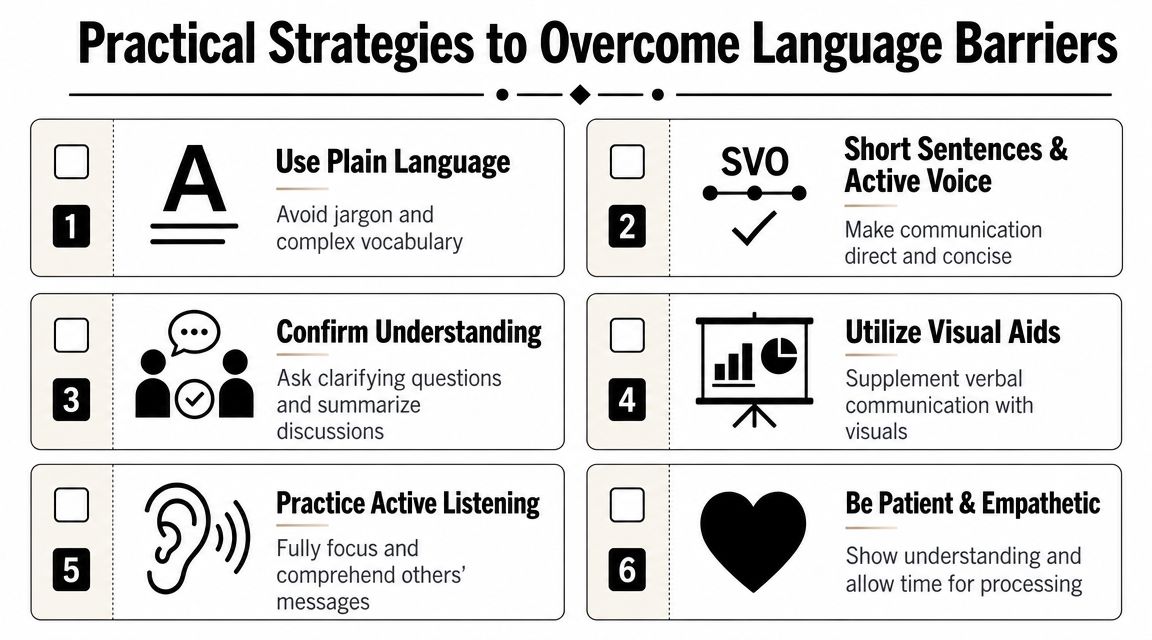
Six moves you can use this week
- Shorten the runway: Open with the conclusion first. Then add context. Senior listeners usually want the takeaway before the backstory.
- Replace fuzzy words: Terms like “soon,” “urgent,” “better,” and “maybe” invite interpretation. Use specifics about action, ownership, and timing.
- Cut idioms and local slang: Even fluent professionals can miss cultural shorthand. Clear language is not simplistic language.
- Check for understanding the right way: Instead of “Does that make sense?” ask the other person to summarize the next step in their own words.
- Use visual reinforcement: A short written recap, decision slide, or action list reduces listening pressure and helps everyone align.
- Slow down under pressure: Many professionals speed up when nervous. That often hurts clarity more than accent does.
One coaching prompt: Before an important meeting, ask yourself, “What is the one sentence they must remember if they forget everything else?”
Build systems, not just confidence
Personal effort helps, but structure matters too. If your workplace moves fast, ask for support that reduces preventable confusion.
Consider these adjustments:
- Written follow-ups: Send a concise summary with decisions, owners, and deadlines.
- Pre-reads for complex topics: Let listeners process key terms before the discussion.
- Terminology alignment: Define critical words at the start of cross-functional projects.
- Meeting repair habits: If you notice confusion, restate the point with simpler wording instead of pushing harder.
Some of the clearest teaching on this comes from education, because tutors constantly work through comprehension gaps in real time. These communication strategies for tutors are surprisingly useful for managers, consultants, and technical leads too.
For professionals who want structured support, one option is Intonetic. The Gravitas Method is a 12-week one-on-one executive presence coaching program for international professionals who want to communicate with more authority and influence at senior levels. The program is priced at $8,200 paid in full or $9,000 across three installments. Coached by Nikola, it covers vocal authority, strategic framing, executive body language, and high-stakes communication.
What to practice first
If you feel stuck, don't try to fix everything at once. Start here:
- Record one meeting update. Listen for pacing, sentence length, and whether your main point comes early.
- Choose one recurring phrase to simplify. For example, turn “I was thinking maybe we could potentially” into “I recommend.”
- Ask one open-ended check question per meeting. This reveals misunderstanding before it turns into rework.
Language barriers become smaller when communication becomes more observable. You hear what you're doing. Others understand what you mean. That is where confidence starts to feel earned, not forced.
Turn Your Communication Barrier Into a Bridge
Language barriers are real, but they are not a verdict on your intelligence, leadership potential, or value. Most professionals who struggle here are not underqualified. They're carrying expertise through communication patterns that create too much friction.
That can change.
When you identify the exact barrier, whether it's accent clarity, pragmatic mismatch, cultural interpretation, or message structure, you can work on it directly. What used to feel personal starts to feel solvable. And once your communication becomes easier to trust, your ideas have a better chance of being heard at the level they deserve.
The goal isn't to erase your identity. It's to make your authority easier to recognize.
If you want a clear, personalized next step, start with the free Executive Communication Assessment from Intonetic. It helps you identify which communication patterns may be weakening your authority, clarity, or executive presence, so you can focus on the changes that matter most.