
How to Stop Taking Too Long to Respond at Work
You're in a meeting, the room is moving, and someone with real power asks you for a view. Your mouth is ready, but your sentence isn't. In the gap, a lot gets decided. People aren't only hearing whether you have the answer, they're reading whether you're steady, whether you're hiding, and whether you belong at the level where the question was asked.
That's why taking too long to respond at work is rarely just about speed. For senior international professionals, response time becomes a signal, sometimes of composure and judgment, sometimes of hesitation or distance. The hard part is that the same silence can look authoritative in one room and costly in another, so the key skill is learning which pauses strengthen your position and which ones subtly weaken it.
The Moment Everyone Notices
The director is halfway through a board update when the CFO turns and asks, “What's your read on the risk?” The room goes quiet. Your Slack cursor keeps blinking under a question that landed twenty minutes ago, and your draft email is still open because one sentence feels too blunt and the other feels too soft.
That's the moment people notice. Not because you're incompetent, but because silence has a shape, and executives read that shape fast. A measured pause can say you're thinking at the right level, while a long stall can make even a strong leader look unready, overloaded, or unsure of the ground they're standing on.
If you want a practical contrast, look at how people use their devices under pressure. On Android, even small interface shortcuts can remove friction when you're moving fast, which is why resources like Verba's guide to Android shortcuts can be more useful than another productivity sermon. The point isn't efficiency for its own sake, it's reducing the little pauses that turn into visible hesitation.
There's also a reputational layer here that people underestimate. If you're trying to be seen as senior, you can't afford to look like every message requires a committee meeting inside your head. The question isn't whether you should think before replying, it's whether your thinking is being translated into calm, purposeful communication or into dead air.
A useful internal reference point is how to be taken seriously at work. Response speed is one of the clearest ways that seriousness shows up in real time, because people don't separate content from delivery nearly as much as they think they do.
What Slow Responses Actually Signal
Three readings people make
A delay usually gets interpreted through one of three lenses. The first is cognitive load, where people assume you're thinking carefully. The second is low confidence, where they assume you don't know. The third is avoidance, where they assume the message doesn't matter or the issue is uncomfortable.
The delay itself is the mechanism. In a controlled study of instant messaging, response delays decreased perceived partner involvement and liking and increased frustration, while typing indicators didn't significantly change that effect, which means the silence is doing the work, not the little “typing…” cue (ACM study). In practice, the room often gives you less credit for invisible effort than you think.
That's why context matters so much. A 12-hour gap with a peer may read as normal scheduling friction, while the same gap with a client can feel like the work is being deprioritized. Practical dating guidance even notes that delays longer than 12 hours can start to look like a more serious issue if there's no explanation, which is a reminder that expectation shapes meaning more than etiquette does (Elite Daily).
Practical rule: if your delay has no visible reason, people will invent one.
Diagnostic cues to watch in yourself
Not every silence is a problem. Some delays are read as thoughtful because the situation warrants careful consideration and the audience expects reflection. Other delays are read as evasive because the other side is waiting for certainty, not contemplation.
Ask yourself where you tend to get the benefit of the doubt. In technical debate, finance, or senior strategy conversations, a short pause can make your answer feel considered. In customer-facing messages, cross-functional blockers, or any situation where someone is waiting on you to move, the same pause can look like drift.
A good self-check is simple. If people usually describe you as calm under pressure, you can probably afford a beat. If they often ask for follow-up because your last reply was too vague or too late, your silence is likely costing you more than you realize. For a useful comparison on personal delay patterns, the procrastination lens at how to stop procrastinating is worth reading alongside your communication habits, because not every delay is a time-management issue, some are a signaling issue.
Framing Moves That Buy You Time Without Looking Stuck
The phrases that preserve authority
The cleanest way to avoid looking trapped is to stop treating every question as a yes-or-no reflex. A redirect gives you room to shape the frame, not just answer inside someone else's frame.
Use this line when the question is premature or too narrow, “Before I answer that, the context that matters is…” It works well in leadership meetings, investment conversations, and technical discussions where the first question hides the underlying issue. It backfires if you use it to dodge a direct ask from a senior stakeholder who needs a straight answer now.
A reframe is different. Say, “The way I'd frame the question is…” when the original wording is incomplete or slightly misaligned with the decision you need to make. That move is strong in strategy reviews and cross-functional discussions. It backfires if you use it to sound clever instead of useful.
The qualifier and the diagnostic duo
When the truth really does depend on context, use a qualifier. Try, “The honest answer depends on which of two scenarios you're in.” That line buys time while making your thinking visible, and it works best when there are genuinely two paths with different implications.
Then use the diagnostic duo, “Are you asking because X or because Y?” This is one of the most effective ways to turn hesitation into authority because it signals that you're sorting the decision before you answer it. It works especially well with executives, clients, and peers who are asking a question that may hide a deeper concern.
Practical rule: don't fill space with noise, fill it with structure.
If you want a more senior-facing version of this style, the guidance in how to talk to senior leadership is useful because it treats response quality as a leadership skill, not a chat habit.
One practice prompt
Pick one of those four moves and use it in your next meeting. Don't wait for a perfect opening. The point is to make your thinking audible before silence turns into uncertainty.

Pause Management and the Anchor-and-Return Drill
Train the pause, don't fight it
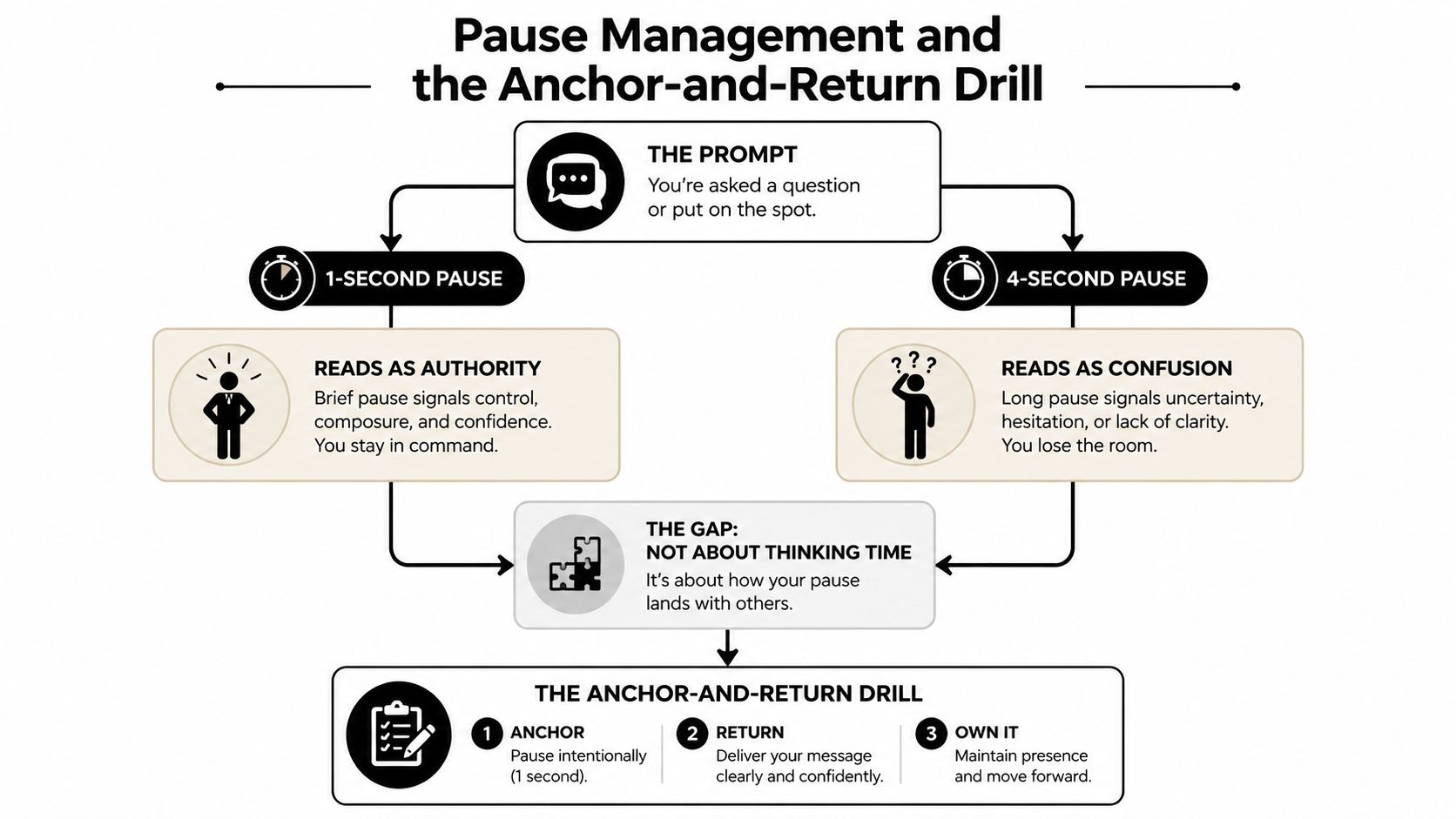
A one-second pause reads like composure. A four-second pause often reads like confusion. That doesn't mean you should rush every answer, it means the gap between stimulus and response has to be managed deliberately.
The problem isn't usually that you need more thinking time. It's that your body doesn't know what to do with the moment when attention lands on you. That's why the fastest fix is physical, not verbal.
Use the anchor-and-return drill before an important meeting. Pick one sentence you want to land, rehearse it three times aloud, and then return to it the moment the discussion starts. You're not memorizing a script, you're giving your mind a stable point so you don't wander into filler words or long silences.
The covert reset
When a question catches you off guard, use a breathing reset that nobody notices. Inhale for four counts, exhale for six. That longer exhale lowers the feeling that you need to answer before you've thought.
This works best when paired with a short opener, not a ramble. Say the first useful sentence, then stop. In executive rooms, overexplaining is often just another form of hesitation. The goal is to sound deliberate, not defensive.
For a useful reminder that silence can carry meaning when it's handled well, see silence as communication. The key is to make your pause legible as thought, not absence.
Practical rule: if you feel rushed, slow your breath before you speed your words.
A simple drill helps. Before the meeting starts, write your anchor sentence at the top of your notes. If you lose your thread, return to that line instead of trying to rescue the whole answer at once. That habit trims filler and keeps you from giving people the impression that you're searching for yourself in public.
Canned Responses and Templates Worth Saving
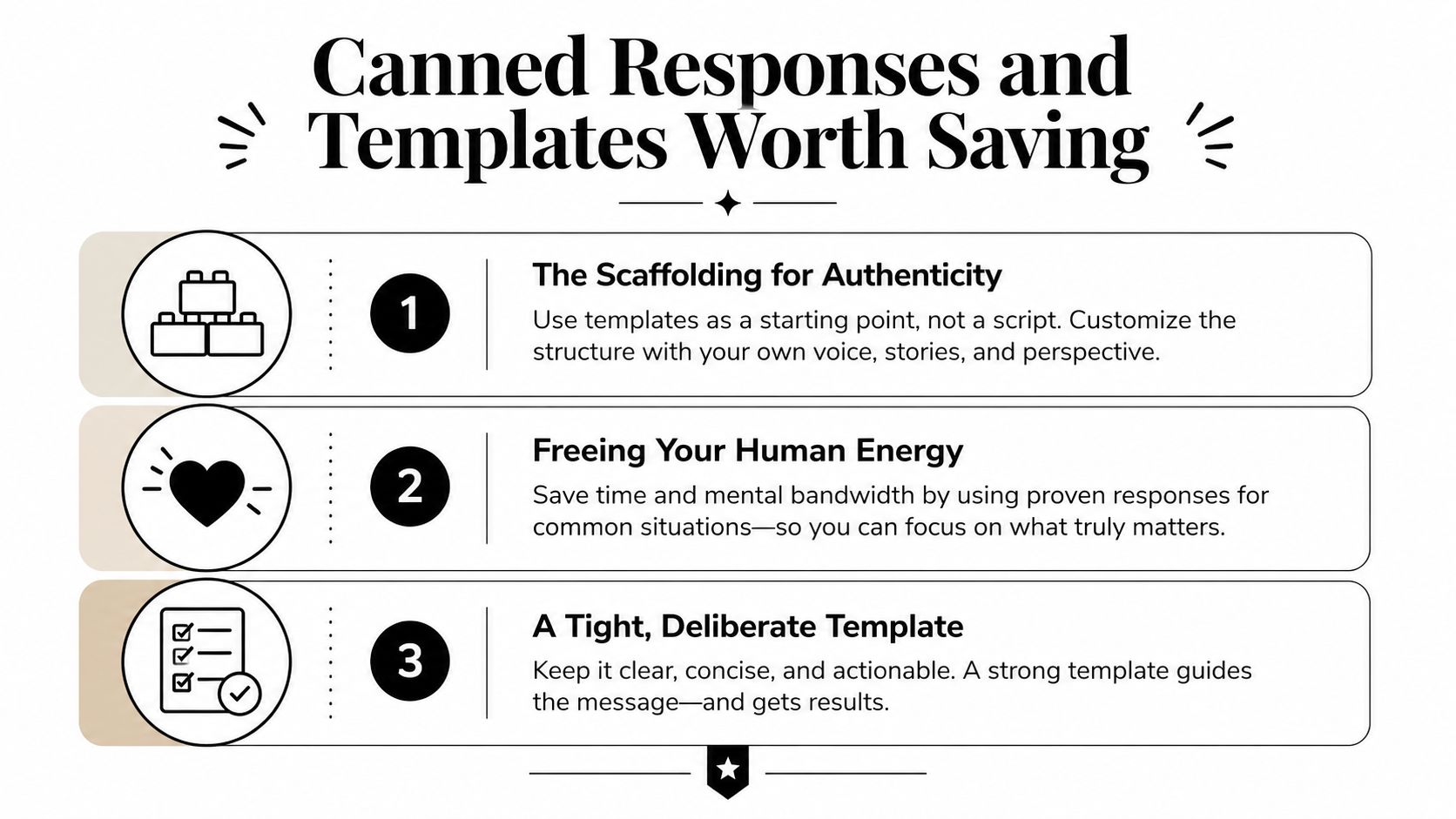
Templates are scaffolding, not a personality transplant
People often resist templates because they think templates sound robotic. In practice, the opposite is usually true. A tight template removes the panic of drafting from scratch, which leaves more of your attention available for the part that needs judgment.
A short library beats improvising every time. The point isn't to sound prewritten, it's to stop wasting energy on sentences you've already solved before. If you've written the same line three times this month, it belongs in a template.
A small library that covers real situations
Use this for a 90-minute acknowledgement email when you need to buy time without looking evasive.
Keep verbatim: “Thanks for sending this. I'm reviewing it carefully and will come back with a full response by [time].”
Personalize: the reason for the review and the exact return time.
Use this for a need-more-time reply when the issue is substantial.
Keep verbatim: “I want to give this the right level of attention, so I'm taking a bit more time before I respond fully.”
Personalize: the next checkpoint and whether you need anything from the other side.
Use this for Slack when you need to reset expectations without sounding defensive.
Keep verbatim: “Seen this. I'm on it and will circle back with a clear answer once I've checked two points.”
Personalize: the two points.
Use this for a meeting recap that protects you from being chased.
Keep verbatim: the decision, the owner, and the next date.
Personalize: the nuance, not the structure.
The meeting recap template matters more than people admit. It turns a hazy conversation into a visible record, which means you're less likely to be interpreted as slow or forgetful later.
If you want a useful model for email structure, written email example is a good reference point because it helps you separate clarity from overexplanation. Templates should protect your tone, not flatten it.
When to Delay on Purpose and How to Signal It
Deliberate silence can be the senior move
Some of the strongest communicators in a room do not answer immediately on purpose. An instant reply to a complex question can imply the question was easy, the stakes were low, or the speaker didn't need to think. That's not always the message you want to send.
Delay is the right move in three situations. First, high-stakes decisions, where a rushed answer can lock you into a bad frame. Second, emotionally loaded feedback, where speed usually hurts precision. Third, any reply you know you'll regret at 11 p.m., because late-night clarity is often just fatigue with confidence attached to it.
Make the delay visible
If you need time, say so. Use a holding line like, “I want to give this a proper response, I'll come back by Thursday morning.” That sentence does two things at once. It preserves your authority and removes the ambiguity that makes silence feel like avoidance.
Set team norms too. If your team knows that certain questions get considered replies, then silence reads as thought rather than neglect. Without that norm, people fill the gap with their own story, and the story is rarely flattering.
There's a practical side to this in email handling as well. Tools like set up delayed send in Gmail can help you avoid sending the wrong version of a reply when you're tired or irritated. Delayed send is not about hiding, it's about making sure the first message you send is the one you stand behind.
A quick roleplay
Director, “Can you sign off on the vendor change today?”
CFO, “I need two checks before I can answer that. I'll review cost and risk, then I'll send you a decision by tomorrow morning.”
That response sounds intentional. Compare it with, “I'm not sure yet, I'll get back to you,” and you can hear the difference immediately. One communicates disciplined judgment. The other communicates drift.
A 30-Day Practice Plan and Your Next Step
Four weeks, one skill stack
The fastest way to change this habit is to track it like any other leadership behavior. Start with a baseline, then layer in structure, then add templates, then practice intentional delay. Keep the review short, honest, and specific.
| Week | Focus | Daily Action | End-of-Week Checkpoint |
|---|---|---|---|
| Week 1 | Baseline | Record one meeting and count your long pauses | Identify your three most common hesitation moments |
| Week 2 | Framing moves | Use one framing move per day from the earlier section | Notice which move sounds most natural |
| Week 3 | Templates | Replace three recurring replies with saved versions | Keep the versions that feel crisp, drop the rest |
| Week 4 | Intentional delay | Use one holding line in a real exchange | Check whether the delay read as thought or avoidance |
During week one, don't try to fix anything. Just notice where your pauses show up. During week two, put one framing move in play every day so your brain stops treating structure as a special event. During week three, clean up the replies you keep rewriting. During week four, practice signaling delay instead of letting silence speak for you.
A good supporting habit is using a communication audit so you can see patterns before other people point them out. The communication audit template is helpful because it forces you to separate content problems from delivery problems.
The cleaner your response habits become, the more authority you project without forcing it. If you're ready to tighten the way you speak, pause, and respond under pressure, the free Executive Communication Assessment is the best place to start. Intonetic's Gravitas Method is a 12-week one-on-one executive presence coaching program for international professionals who want to communicate with more authority and influence at senior levels, it's $8,200 paid in full or $9,000 across three installments, and Nikola coaches clients on vocal authority, strategic framing, executive body language, and high-stakes communication.
If you want to stop taking too long to respond in boardrooms, Slack threads, and high-stakes conversations, visit Intonetic and start with the free Executive Communication Assessment. You'll get a clearer view of where your delivery is helping you and where it's weakening your authority.