Strategic Talent Development: Unlock Team Potential
A familiar leadership problem is unfolding in many companies right now. A strong engineer, analyst, or product lead gets promoted because their technical judgment is excellent. Six months later, their team is confused, peers work around them, and senior leaders still don't see them as ready for bigger scope.
The failure usually isn't technical. It's developmental. The person knows the work, but hasn't built the skills required for the next level: influence, coaching, judgment under pressure, and communication that creates confidence.
That gap is exactly why strategic talent development matters. It's not a nicer label for training. It's a business system for making sure the organization has the right capabilities, in the right people, before the business needs them. When companies miss this, the costs show up everywhere: stalled promotions, weak succession benches, expensive external hiring, manager burnout, and avoidable turnover.
The companies that handle this well stop treating talent as a replacement problem. They treat it as a capability-building problem. They build from within, identify where future leaders are likely to struggle, and intervene early. Sometimes that means technical upskilling. Sometimes it means management coaching. Often, especially at senior levels, it means developing the communication habits that separate a smart operator from a credible executive.
Beyond Hiring and Firing An Introduction
Most leadership teams still feel the drag of an old model. Someone leaves, HR opens a requisition. A high performer shines, the company promotes them. Performance dips, the organization reacts. That cycle feels busy, but it isn't strategic.
A better approach starts earlier. It asks what capabilities the business will need, which roles are mission-critical, and where internal talent is likely to break down under more responsibility. In practice, one of the most common breakdowns is communication. A technically brilliant leader can still lose trust if they ramble, hedge, over-explain, or struggle to command a room. Teams trying to improve workplace communication skills in real settings often discover that the issue isn't effort. It's a missing development system.
The promotion problem no one likes to name
A new director often inherits problems that training catalogs don't fix. They need to align multiple teams, push back on unrealistic requests, influence senior stakeholders, and make uncertain decisions sound grounded. If they can't do that, colleagues start reading the gap as lack of readiness.
That's why strategic talent development belongs in business planning, not just HR planning. It protects execution by preparing people for the demands of future roles before those roles become urgent vacancies.
Strong performance in one role doesn't automatically transfer upward. Organizations have to build the bridge.
What a strategic approach changes
Instead of asking, “Who can fill this role now?” strategic talent development asks better questions:
- Which capabilities matter most: Focus on the few skills that directly support growth, resilience, customer delivery, or leadership continuity.
- Where will talent stall: Identify the transitions where people routinely struggle, such as expert to manager or director to enterprise leader.
- How will development happen: Build learning into work through coaching, feedback, mobility, and targeted practice.
- What business result should move: Tie development to outcomes leaders already care about, such as readiness, retention, and stronger succession coverage.
That shift sounds simple. It isn't easy. But it's the difference between patching talent gaps and building an organization that keeps producing capable leaders.
What Strategic Talent Development Really Means
Think of traditional learning and development as paving a few roads when traffic gets bad. Strategic talent development is city planning. It looks at where the organization is going, what infrastructure it will need, and how different parts of the system must connect so growth doesn't create chaos.
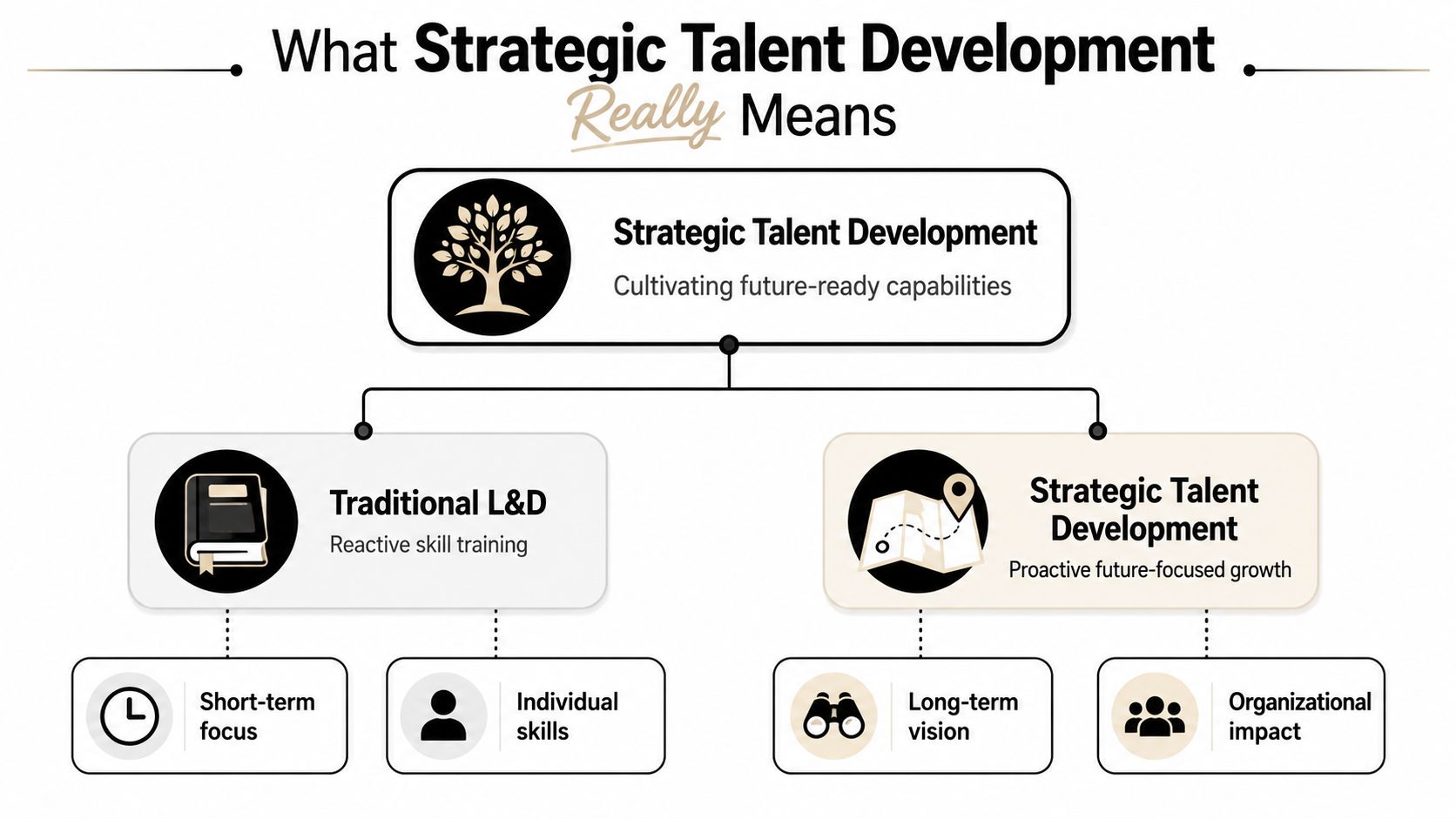
A workshop can be useful. A course library can be useful. But neither is a strategy on its own. Strategy starts when the business can explain which capabilities it needs, who needs them, how they'll be developed, and how progress will affect business performance.
The four pillars that make it strategic
Business alignment
Development has to connect directly to company priorities. If the business wants stronger client retention, smoother AI adoption, or a deeper leadership bench, talent programs should build the capabilities that support those outcomes. Generic training calendars usually fail here because they're designed around available content, not strategic priorities.
Future focus
A strategic approach doesn't only solve today's gap. It anticipates what the next layer of work will demand. That includes technical shifts, leadership transitions, and operating complexity. It also means recognizing that communication requirements change with seniority. A manager can succeed by being thorough. An executive often has to be concise, directional, and convincing.
Data-driven decisions
Competency models, assessment data, internal mobility patterns, performance signals, and manager input all matter. Technical implementation depends on competency models that define the skills and behaviors required at each level, plus integrated tools for assessment, LMS workflows, career pathing, and analytics to support data-driven hiring and promotion decisions, as outlined in this talent strategy deep dive.
Integrated across the employee lifecycle
This work can't sit in a silo. Hiring, onboarding, performance management, manager coaching, promotion criteria, and succession planning all need to reinforce the same capability model. If one part says “be strategic” and another rewards only short-term output, the system fights itself.
A simple self-check
If your current approach looks like the left column more than the right, it's still tactical.
| Area | Tactical approach | Strategic approach |
|---|---|---|
| Focus | Courses and events | Capabilities tied to business goals |
| Timing | Reactive | Planned around future needs |
| Ownership | HR only | Shared by business leaders and managers |
| Measurement | Participation | Readiness, mobility, retention, performance |
| Experience | One-size-fits-all | Personalized pathways by role and level |
One useful distinction is knowing when to use mentoring, coaching, or both. Founders and operators often benefit from understanding the key differences in founder guidance because the same distinction applies inside enterprises. Mentoring transfers judgment from experience. Coaching changes behavior through practice and feedback.
For teams building this capability internally, professional development coaching approaches can be especially effective when the issue isn't knowledge, but execution under pressure.
Practical rule: If a program can't explain what business problem it solves, it's probably training activity, not strategic talent development.
The Business Imperative for Talent Strategy in 2026
The business case is no longer subtle. Talent strategy has moved from a support function to an operating priority because skill disruption is happening faster than many companies can hire around it.
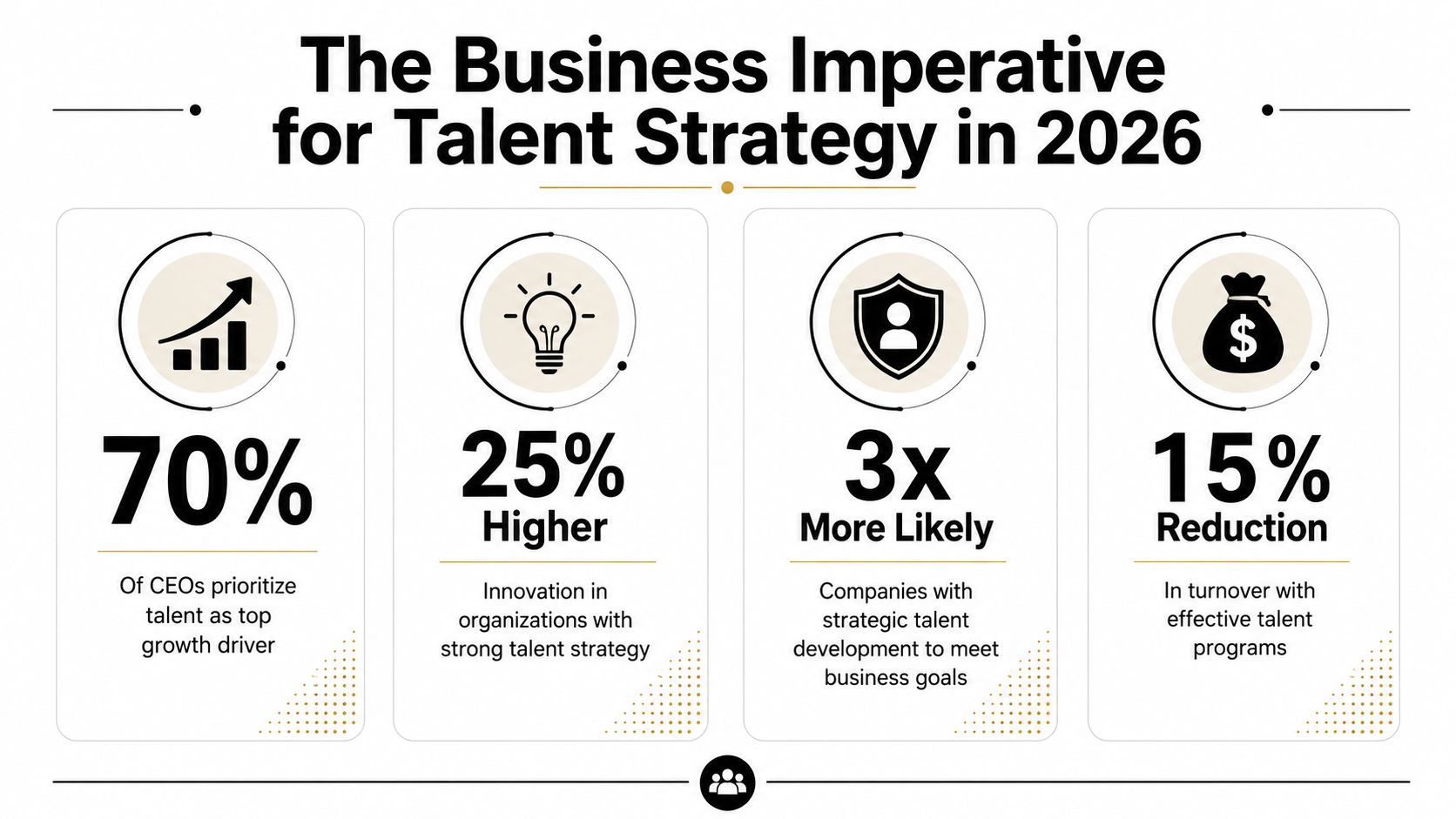
According to the World Economic Forum, 85% of global employers anticipate adopting upskilling over the 2025 to 2030 period to address macrotrends and technological disruption, skills-based talent strategies are 5 times more predictive of employee performance than hiring based only on credentials, and 50% of all employees will require reskilling due to rapid technological change. The same report notes that 42% of employers expect talent pools to decline between 2025 and 2030, which makes internal development a practical necessity, not an HR preference, in an AI-shaped economy where the ability to work alongside AI is the most anticipated workforce strategy in 45 out of 55 economies (World Economic Forum workforce strategies).
Why external hiring won't solve this on its own
When labor markets tighten and skill needs keep shifting, recruiting alone becomes an expensive lagging response. You can hire for proven expertise, but you can't buy a full leadership bench on demand. Even when companies bring in strong people, those hires still have to adapt to internal context, politics, decision rhythms, and stakeholder expectations.
That's why leaders should stop debating talent development as if it competes with hiring. It complements hiring by reducing dependency on the market.
The money tells the story
Institutional investment already reflects that shift. The global corporate training market was valued at USD 386.4 billion in 2022 and is projected to grow at a 9.8% CAGR from 2023 to 2030. Within that broader market, leadership development is estimated at USD 50 billion globally in 2023, the global coaching industry is forecast to reach USD 30 billion by 2028 with 6.7% CAGR, learning and development platforms are expected to reach USD 102.3 billion by 2030, and the Asia Pacific corporate training market is projected to post the highest regional growth at 11% CAGR (talent development market data).
These numbers matter for one reason. They show that companies around the world are reallocating capital toward capability building.
What executives should ask instead of “Can we afford this?”
Use sharper questions:
- Where is execution risk highest: Which roles would hurt the business most if internal readiness is weak?
- What skills are becoming essential: Not in theory, but for your strategy over the next planning cycle.
- Which transitions fail repeatedly: Technical expert to people leader, regional leader to enterprise leader, specialist to client-facing operator.
- What capability gap slows strategy most: Often it's not raw expertise. It's judgment, influence, or communication.
A clear strategic framework for capability building helps leadership teams connect those questions to investment decisions instead of defaulting to ad hoc programs.
A 4-Phase Roadmap for Implementation
Most talent strategies fail because leaders try to launch programs before they've diagnosed what the business needs. A better sequence is simple: diagnose, design, develop, then deploy and optimize.
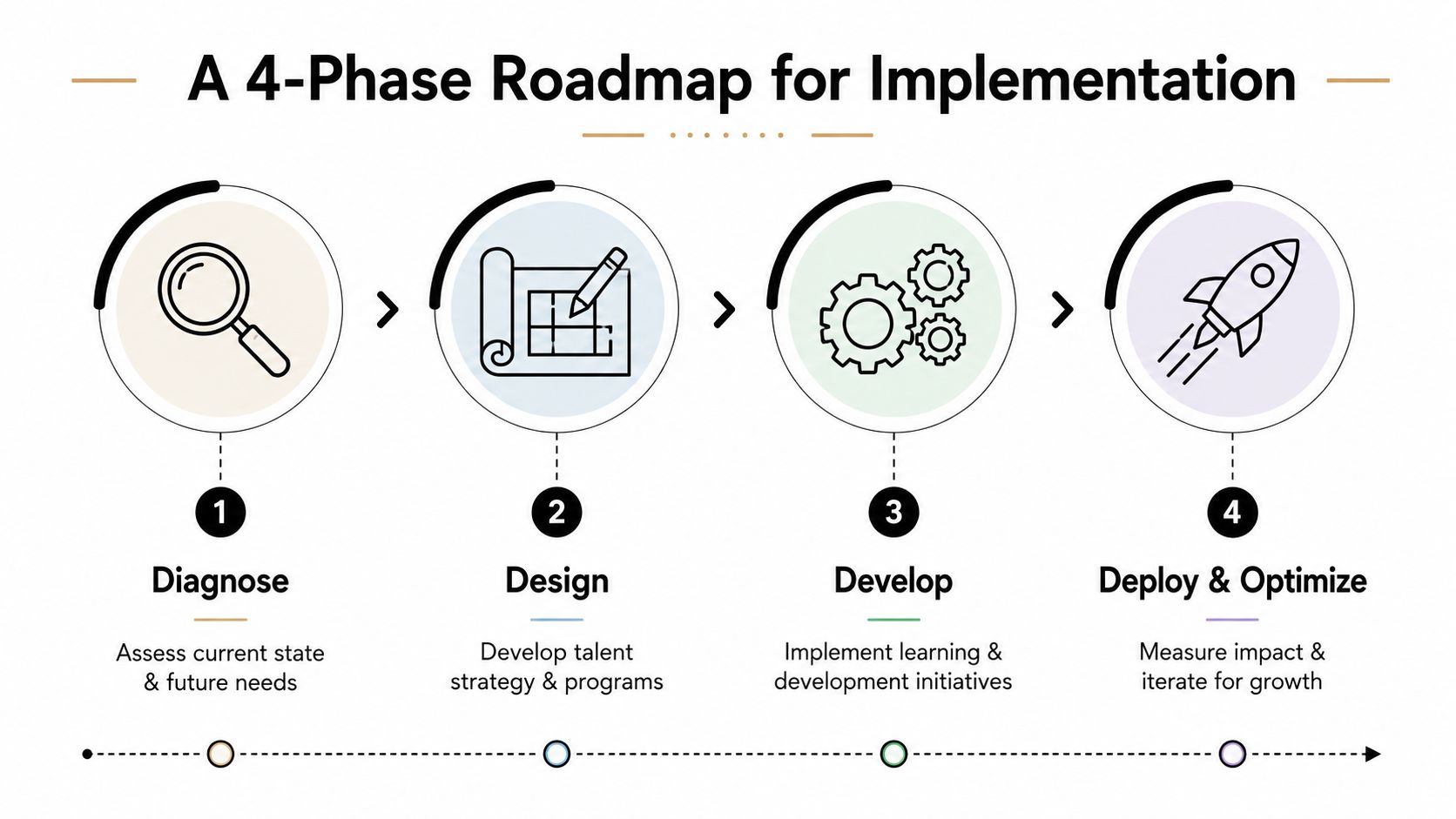
Phase 1 Diagnose
Start with business direction, not course catalogs. Look at the capabilities required for upcoming priorities such as expansion, automation, new product lines, or leadership succession. Then map those needs against current bench strength.
This step works best when HR, business leaders, and frontline managers all contribute. Managers know where performance breaks down. Executives know where strategy is heading. HR can translate both into role, level, and skills data.
Effective implementation requires a direct link between skills gap identification and business objectives. Organizations that train managers to act as coaches and enable internal mobility through clear career pathways capture a higher return on learning investment by reducing turnover and accelerating competency acquisition, as described in Phenom's talent development guide.
A practical diagnostic usually includes:
- Critical roles: Identify the positions that drive revenue, execution, innovation, or leadership continuity.
- Capability gaps: Define what people can do now versus what the business will require next.
- Transition risks: Surface where promotions most often fail.
- Behavior gaps: Separate knowledge deficits from execution deficits.
A weak diagnosis creates elegant programs for the wrong problem.
Phase 2 Design
Once the gaps are clear, design pathways that match the work. Generic role-based training is usually too broad. People need development tied to what they're expected to do differently.
That's where competency models matter. They turn abstract expectations like “be more strategic” into observable behaviors. For senior talent, that may include cross-functional influence, structured decision-making, concise communication, stakeholder management, and coaching others.
One technique that works well is micro-chunking. Instead of assigning “executive communication” as a vague topic, break it into narrower sub-skills like handling objections, delivering a recommendation, or structuring a board update. The same source above also highlights immediate feedback loops and an 80/20 view of sub-skills as practical ways to improve retention and focus.
For leaders building role-specific pathways, curated professional development activities often work better than one large program because they're easier to embed into real work.
Phase 3 Develop
Use a blended model. Formal training has a role, but it shouldn't carry the whole load. The greatest impact often comes from combining several methods.
- Manager coaching: Best for reinforcing day-to-day behaviors.
- Mentoring: Useful when people need pattern recognition and organizational wisdom.
- Stretch assignments: Strong test of readiness because they expose judgment under pressure.
- Internal mobility: Helps people build broader business fluency.
- One-to-one coaching: Effective when the gap is highly individual, visible, and consequential.
This short walkthrough shows how organizations can turn the roadmap into operating practice:
Phase 4 Deploy and optimize
Many organizations lose momentum. They launch with energy, then fail to build a feedback loop. Development should be reviewed the way any other strategic investment is reviewed: regularly, with evidence, and with willingness to adjust.
Use a simple operating rhythm:
- Review progress by role group rather than by program.
- Ask managers for observed behavior change rather than satisfaction scores alone.
- Track movement into bigger scope to see whether readiness is improving.
- Refine pathways when the business changes or the original design proves too generic.
A roadmap works when it becomes part of management, not an event on the calendar.
Measuring Success and Proving ROI
Here, many talent strategies run into resistance. Leaders approve development in principle, then ask the right question: what changed because of it?
The wrong answer is course completions. The better answer links capability development to outcomes the business can see: readiness for bigger roles, stronger internal promotions, retention of critical talent, and improved performance in high-stakes work.
Measure behavior before you measure belief
Soft skills get dismissed when they're assessed vaguely. If the goal is executive presence, “more confidence” isn't enough. Define observable changes. Did the leader become more concise in updates? Are they handling stakeholder challenge with more control? Are they getting clearer buy-in from senior audiences?
That's why baseline assessment matters. A before-and-after view of behavior gives talent leaders something concrete to discuss with finance and business sponsors. If you need a practical example of how that can look, this communication audit example shows the kind of behavioral signals that are easier to track than broad self-ratings.
Leading indicators and lagging indicators
Use both. Leading indicators show whether the process is working. Lagging indicators show whether the business felt the result.
| Indicator type | What to look for |
|---|---|
| Leading | Manager observations, practice completion, behavior shifts in meetings, quality of stakeholder communication |
| Lagging | Promotion velocity, internal mobility, retention of high-potential talent, readiness for critical roles |
A good review conversation sounds like this: “The participant now structures updates clearly, speaks with more authority, and is already being trusted with broader visibility.” That's stronger than “They enjoyed the workshop.”
The hard part of soft-skill ROI
This challenge is real. 81% of global L&D managers say they cannot prove ROI for soft-skill programs because they lack pre- and post-behavioral benchmarks tied to business outcomes. At the same time, emerging data shows that companies using personalized communication audits see a 3.2x faster promotion rate for international talent than those using generic training, which creates a much clearer link between communication development and career progression (Exec on talent development ROI).
That finding matters because it connects a micro-skill intervention to a business outcome executives care about. Promotion speed isn't everything, but it is a strong signal that the organization sees greater readiness.
For a broader HR view, Pauline Vuyelwa Muswere-Enagbonma's work on workforce training and development is useful because it frames development as an operating discipline rather than a menu of courses.
If you can't observe the behavior and connect it to role progression, you'll struggle to defend the budget.
Common Pitfalls and How to Avoid Them
Even well-funded talent strategies fail for predictable reasons. Usually, the problem isn't intent. It's design discipline.
Treating it like an HR side project
If business leaders delegate this entirely to HR, the strategy loses power quickly. Managers won't reinforce it. Promotion criteria won't reflect it. Budget pressure will hit it first.
What works instead: Put a business leader in visible sponsorship. Create a small steering group with HR, line leadership, and operational decision-makers. Talent strategy needs enterprise ownership.
Building one-size-fits-all programs
A common mistake is giving the same development experience to very different populations. High-potential engineers, new people managers, enterprise sales leaders, and international directors don't need the same intervention.
What works instead: Segment by role, level, and likely transition risk. Keep the core capability model consistent, but vary the path.
Separating development from performance
Many companies say development matters, but their managers only reward short-term output. Employees notice that contradiction fast. Learning then becomes optional theater.
What works instead: Tie development expectations to review conversations, promotion readiness, and succession discussions. If it matters, it has to show up in management routines.
Ignoring the manager's role
Programs often assume external faculty or HR will drive behavior change. They won't. Daily reinforcement lives with the manager.
What works instead: Teach managers how to coach, observe, and give feedback on specific behaviors. Don't ask them to become executive coaches. Ask them to become better translators of expectations.
Launching big and sustaining poorly
Large launches create visibility, but they can also hide weak follow-through. Once the first wave ends, people go back to normal habits.
A more durable model looks like this:
- Start narrow: Pilot in a critical role group where readiness matters.
- Build feedback in: Review what managers observe, not just attendance.
- Adjust quickly: Drop low-impact content and expand what changes behavior.
- Keep momentum visible: Share examples of movement, not slogans.
Strategic talent development succeeds when it behaves like an operating system. It fails when it behaves like an annual campaign.
Case Study The Role of Executive Communication Coaching
A pattern shows up in global firms with strong technical talent. The company has capable senior managers ready for bigger roles on paper. They understand the business, they deliver results, and they're trusted by their teams. But when they step into executive forums, something changes. Their message gets softer, longer, less structured. They sound knowledgeable, but not always authoritative.
That's the last-mile problem in leadership development. The organization has already invested in technical growth, performance coaching, and mobility. What remains is the visible layer of leadership that shapes perception in high-stakes moments.
Where communication becomes a strategic lever
Executive presence isn't mystical. It's a cluster of observable behaviors such as posture, vocal quality, pacing, listening, and emotional regulation. Vocal authority specifically includes using a lower vocal register and downward inflection to communicate certainty rather than arrogance, as described in Lepaya's explanation of gravitas and executive presence. In practice, leaders also improve by speaking in implications, reducing unnecessary word count, structuring updates around context, choices, risks, and outcomes, and using deliberate pauses, clear emphasis, projection, and short sentences rather than filling space with hesitation. Deep gravitas development typically requires 12 to 18 months of sustained effort, though many people see initial improvement within 30 to 60 days of consistent practice, with early gains often coming from removing filler words and building grounding routines during the first 3 months (Clear White Space on building gravitas).
That makes executive communication coaching a critical component of strategic talent development. It doesn't replace the broader system. It sharpens one of the most visible capabilities inside it.
A focused intervention for high-potential international leaders
In organizations with international talent pipelines, this intervention is often especially valuable. Many leaders have the judgment for senior roles, but they haven't been coached on how authority is perceived in English-language executive settings.
The Gravitas Method is a 12-week one-on-one executive presence coaching program for international professionals who want to communicate with more authority and influence at senior levels. The program is priced at $8,200 paid in full or $9,000 across three installments. Coached by Nikola, it covers vocal authority, strategic framing, executive body language, and high-stakes communication.
That kind of coaching works best when the company treats it as acceleration, not remediation. It's for people already delivering at a high level who need their communication to match their capability.
The final stretch to senior leadership is often less about knowing more and more about being perceived as ready for greater consequence.
If you're evaluating strategic talent development and want a practical place to start, use Intonetic's free Executive Communication Assessment. It helps identify whether a leader's growth bottleneck is communication under pressure, executive presence, message structure, or vocal authority. For international professionals and L&D leaders supporting high-potential talent, it's the clearest first step before deciding on broader coaching or development investment.