
Professional Development Coaching: The Ultimate 2026 Guide
You're doing strong work. Your results are solid. People rely on you.
But in senior meetings, something still feels off.
A peer with less expertise gets more traction. Your recommendation is technically right, yet it lands as a contribution instead of a direction. You explain clearly, but not always with the weight that signals executive readiness. For many international professionals, that gap isn't about intelligence or effort. It's about how authority is heard, seen, and interpreted under pressure.
That's where professional development coaching becomes useful. Not as remediation. Not as motivation theater. As a strategic intervention for people who already perform well and need their communication, influence, and leadership presence to catch up to their capability.
The market has moved in the same direction. The global professional coaching industry is projected to reach $5.34 billion in revenue by 2025, a 60% increase since 2019, with the number of professional coaches worldwide surging by 54% in the same period, according to coaching industry growth data. That kind of adoption tells you something important. High performers no longer see coaching as a fallback option. They see it as part of how senior careers are built.
Why Top Professionals Are Turning to Coaching
Professionals usually seek coaching at a specific inflection point. They're no longer asking, “Can I do the job?” They're asking, “Why am I not being perceived at the next level yet?”
For international leaders, that question often shows up in subtle ways. You may be invited into important rooms but not given the same deference as others. Your updates may be accepted, but your framing doesn't consistently shape the decision. You may notice that executive presence has less to do with speaking more and more to do with speaking with sharper structure, steadier pacing, and stronger signal.
The plateau isn't usually technical
At senior levels, promotions rarely hinge on raw expertise alone. Leaders look for judgment, clarity, and influence under scrutiny. That's why someone can be highly competent and still feel capped.
A few common signs show up repeatedly:
- Ideas get adopted slowly: People need extra explanation before they move.
- Your message sounds informed but not decisive: You know the material, but your delivery softens your authority.
- Visibility doesn't translate into sponsorship: Stakeholders respect your work, yet they don't advocate for your advancement with conviction.
Professional development coaching works best when the issue isn't knowledge, but translation. You know what you mean. The room isn't fully receiving it at the level you intend.
This is also why coaching has become part of serious leadership development. Senior professionals aren't using it because they're failing. They're using it because the margin between strong performance and executive perception is often narrow, invisible, and expensive to ignore.
Why coaching now feels mainstream
The shift is practical. Companies and individuals have become more deliberate about how they develop leadership capacity. Coaching helps people work on real situations, not hypothetical ones. Board updates, cross-functional negotiations, promotion conversations, investor pitches, conflict with senior stakeholders. Those are the moments that determine trajectory.
If you want a useful companion lens on why perception shapes advancement, Intonetic's piece on the psychology of leadership is worth reading.
Top professionals turn to coaching because they don't want to leave their next level to interpretation. They want their communication to make their seniority easier to recognize.
What Professional Development Coaching Actually Is
The term is often used loosely. That creates confusion.
Professional development coaching is a structured partnership focused on improving performance, decision-making, communication, and leadership behavior in a real work context. It is future-oriented. It helps a professional identify what's limiting impact, practice better responses, and apply those changes in situations that matter.
Coaching is not mainly about advice. It's about building the capacity to perform differently when the stakes are real.
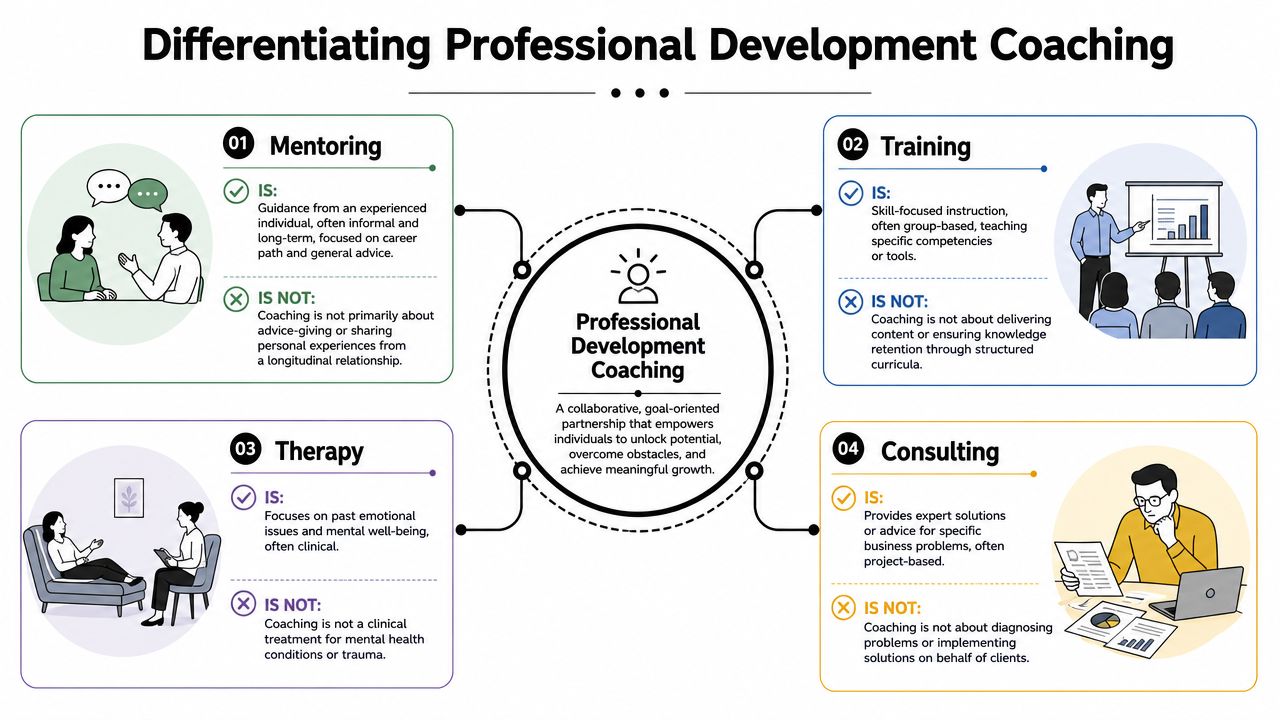
What coaching is and what it isn't
A simple analogy helps.
If a consultant gives you the fish, and a mentor teaches you to fish, a coach helps you discover the elite angler within yourself.
That's imperfect, but directionally right. A coach is less interested in handing you a script and more interested in helping you build repeatable judgment, presence, and execution.
Here's the distinction in plain terms:
| Support type | Primary role | Best use case | What it doesn't do |
|---|---|---|---|
| Coaching | Develops your performance through reflection, practice, and accountability | Communication, leadership, influence, transitions | It doesn't solve the problem for you |
| Mentoring | Shares experience and guidance | Career path, institutional navigation | It doesn't always create behavior change |
| Consulting | Diagnoses and recommends solutions | Business problems, systems, strategy execution | It doesn't focus on your personal capability |
| Training | Teaches a defined skill or framework | Group learning, technical skill acquisition | It doesn't adapt deeply to your individual habits |
| Therapy | Supports emotional and psychological healing | Mental health, trauma, personal distress | It isn't designed for workplace performance optimization |
Why the distinction matters for international professionals
Many senior international professionals don't need more information. They need better transfer.
They've read the books, attended the workshops, and watched the leadership seminars. What they haven't always had is a disciplined process for applying those ideas to the exact moments where perception changes. A coach can help with that. Especially when the challenge is nuanced. Speaking with authority without sounding rigid. Being concise without sounding abrupt. Leading in English without flattening personality.
If you're mapping coaching to a broader plan for mobility and advancement, this overview of international career planning gives useful context for how development choices fit into longer-term career moves.
For communication-specific work, Intonetic's page on coaching for communication skills is a relevant example of how coaching narrows from broad leadership goals into observable speaking behaviors.
Exploring Coaching Formats and Models
Not all coaching works the same way. Format changes the experience, the depth of personalization, and what kind of progress is realistic.
For a senior professional, the right question isn't “Which format is best?” It's “Which format matches the complexity of the problem I need to solve?”
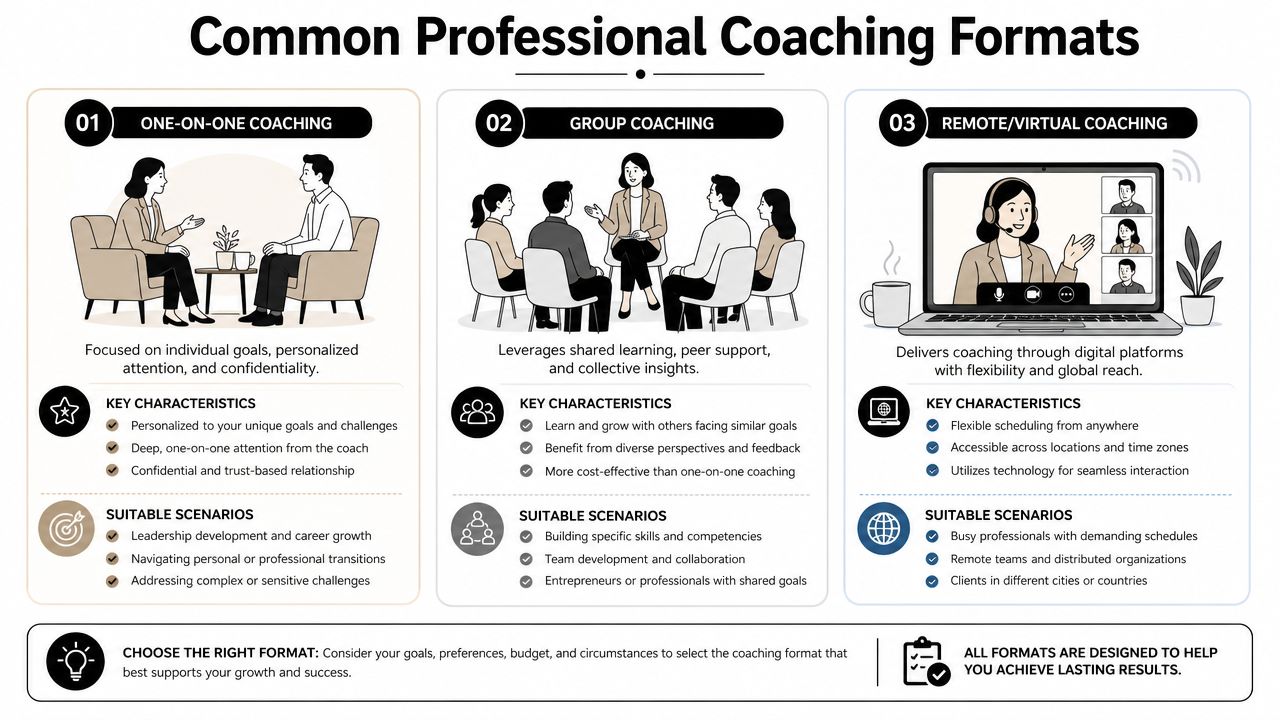
One-on-one coaching
This is the most precise option. It's usually the strongest fit when the issue involves executive presence, stakeholder influence, promotion readiness, or any communication pattern that is highly individual.
In one-on-one work, the coach can study your exact habits. How you structure answers. Where your tone weakens. When you over-explain. How you react when challenged. That level of observation matters because senior communication problems are rarely generic.
The trade-off is simple. One-on-one coaching requires more investment and more personal accountability. You can't hide in the group, and progress depends on whether you apply the work between sessions.
Group coaching
Group coaching can be useful when participants share similar leadership challenges. New managers, cross-functional leaders, or internal talent cohorts often benefit from hearing how others handle comparable pressure.
Its strength is perspective. You learn from peer questions, not only your own. You also see that many leadership struggles are not personal flaws but predictable developmental edges.
Its limitation is customization. If your challenge is highly specific, such as sounding more authoritative in a second language during board-level exchanges, group coaching may not go deep enough.
Practical rule: Use group coaching for shared leadership themes. Use one-on-one coaching when perception, communication, and influence depend on details unique to you.
Remote and virtual coaching
Virtual coaching has become normal for senior professionals because it matches how they work. Global calendars, travel, hybrid teams, and distributed leadership all make remote delivery practical.
It also has a hidden advantage. When communication is the issue, virtual sessions let the coach work inside the channels where performance already happens. Video meetings, online presentations, remote stakeholder updates, and recorded practice all become part of the coaching environment.
That said, convenience can create passivity if the program isn't structured. Remote coaching works when expectations are clear, practice is assigned, and follow-through is visible.
A useful reference if you're comparing this route is Intonetic's page on online executive presence training.
A quick comparison
| Format | Best for | Main advantage | Main limitation |
|---|---|---|---|
| One-on-one | Senior transitions, executive presence, difficult communication patterns | Deep personalization and confidentiality | Higher commitment |
| Group | Shared leadership development across teams or cohorts | Peer learning and broader perspective | Less individual tailoring |
| Remote or virtual | Busy global professionals, hybrid leaders, distributed teams | Flexibility and direct relevance to real work settings | Easy to underuse without accountability |
Executive coaching sits across these formats as a specialized model. It isn't defined only by seniority. It's defined by the level of consequence attached to the work. The higher the stakes, the more structure and specificity matter.
The Tangible ROI of Executive Coaching
Most coaching conversations become vague too quickly. People talk about confidence, growth, and better communication. Those outcomes matter, but they don't answer the question that buyers, managers, and serious professionals eventually ask.
Did this create measurable value?
That's where the discussion gets more interesting. Companies investing in professional development coaching report an average ROI of 7 times their initial investment, and a landmark Metrix Global study found 788% ROI from executive coaching through improvements in productivity and leadership effectiveness, according to executive coaching ROI statistics.
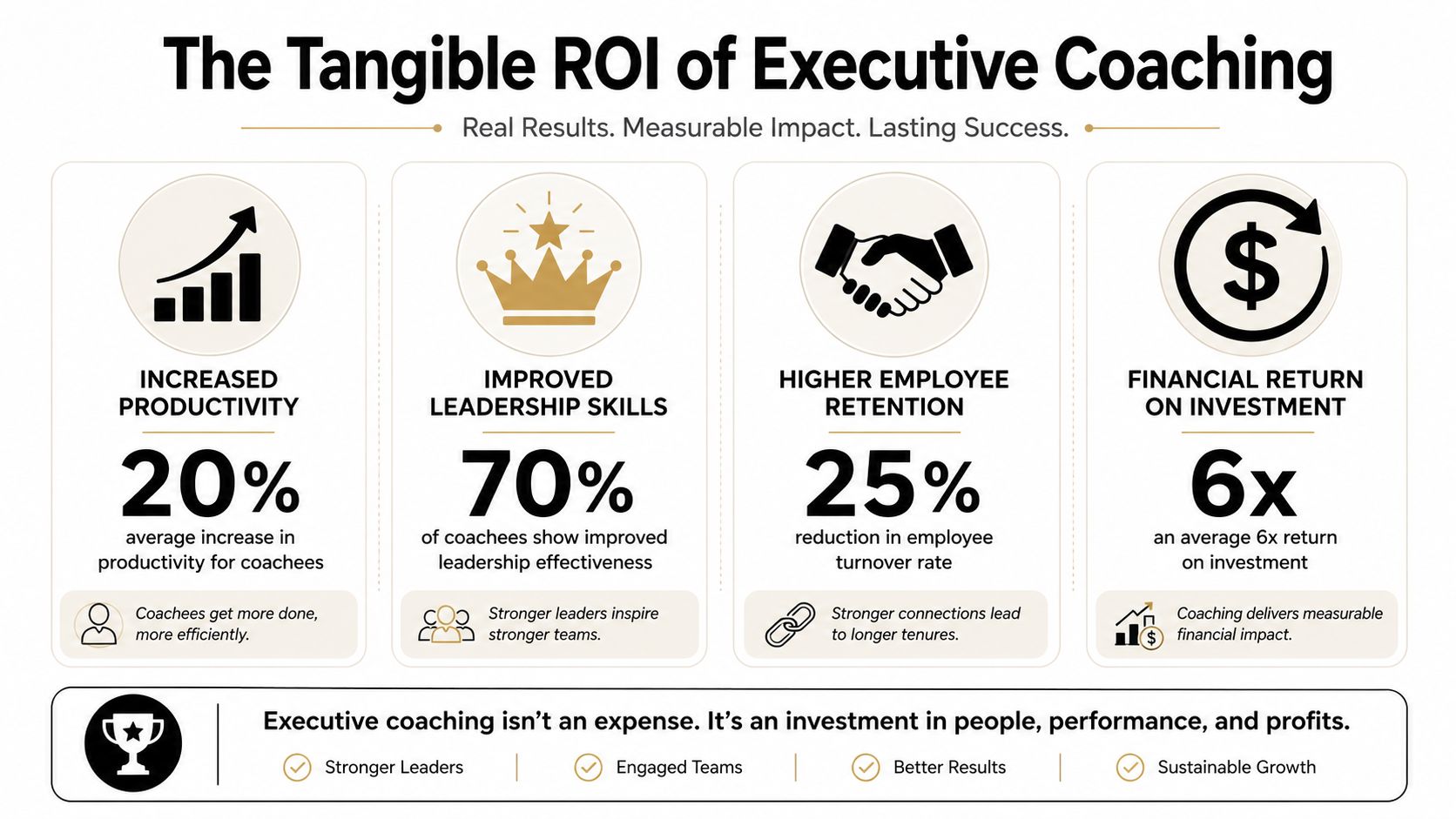
What ROI actually looks like in practice
In real executive work, ROI rarely appears as one clean line item. It shows up across decisions, relationships, and execution quality.
A senior professional who communicates with more authority may:
- Shorten decision cycles: Stakeholders understand the recommendation faster and resist it less.
- Handle high-stakes conversations better: Promotion discussions, negotiations, and difficult feedback become less reactive and more strategic.
- Lead teams with more clarity: Better framing improves alignment, which reduces drag inside the organization.
- Increase promotability: Senior leaders often advance people whose communication reduces risk, not increases it.
These are business outcomes, even when they begin as communication outcomes.
What weak measurement looks like
A lot of coaching gets undersold because it's measured badly. The program ends, people say it was valuable, and no one defines what changed.
That's a mistake.
Recent industry discussion highlighted by CoachVantage on professional development coaching points to a persistent gap around ROI and measurement. Many coaching conversations still stay at the level of broad benefits without clear baseline metrics, time-to-impact, or business outcomes.
A better approach is to track evidence before and after the engagement. Not just whether the client “felt more confident,” but whether specific behaviors changed and whether those changes affected performance.
Useful measures often include:
| What to measure | What it can reveal |
|---|---|
| Communication behavior | Whether the person became clearer, more concise, more authoritative |
| Manager feedback | Whether senior stakeholders perceive greater readiness |
| Meeting outcomes | Whether ideas gain traction faster |
| Promotion or retention outcomes | Whether the development changed career trajectory |
| Team response | Whether clarity and confidence improved followership |
Here's a short perspective that complements that business case:
Why this matters for international leaders
Senior international professionals often face a measurement problem and a perception problem at the same time. Their work is strong, but the communication signals that convey readiness may be inconsistent. If coaching sharpens those signals, you should be able to observe it.
That's why an initial diagnostic matters. A focused executive presence assessment can make the investment conversation more concrete by identifying where influence is leaking before the coaching begins.
The practical point is simple. Coaching should not be sold as a luxury. It should be evaluated like any other strategic intervention. If it improves behavior in high-stakes moments and that behavior improves outcomes, the value is real.
What a High-Quality Coaching Program Involves
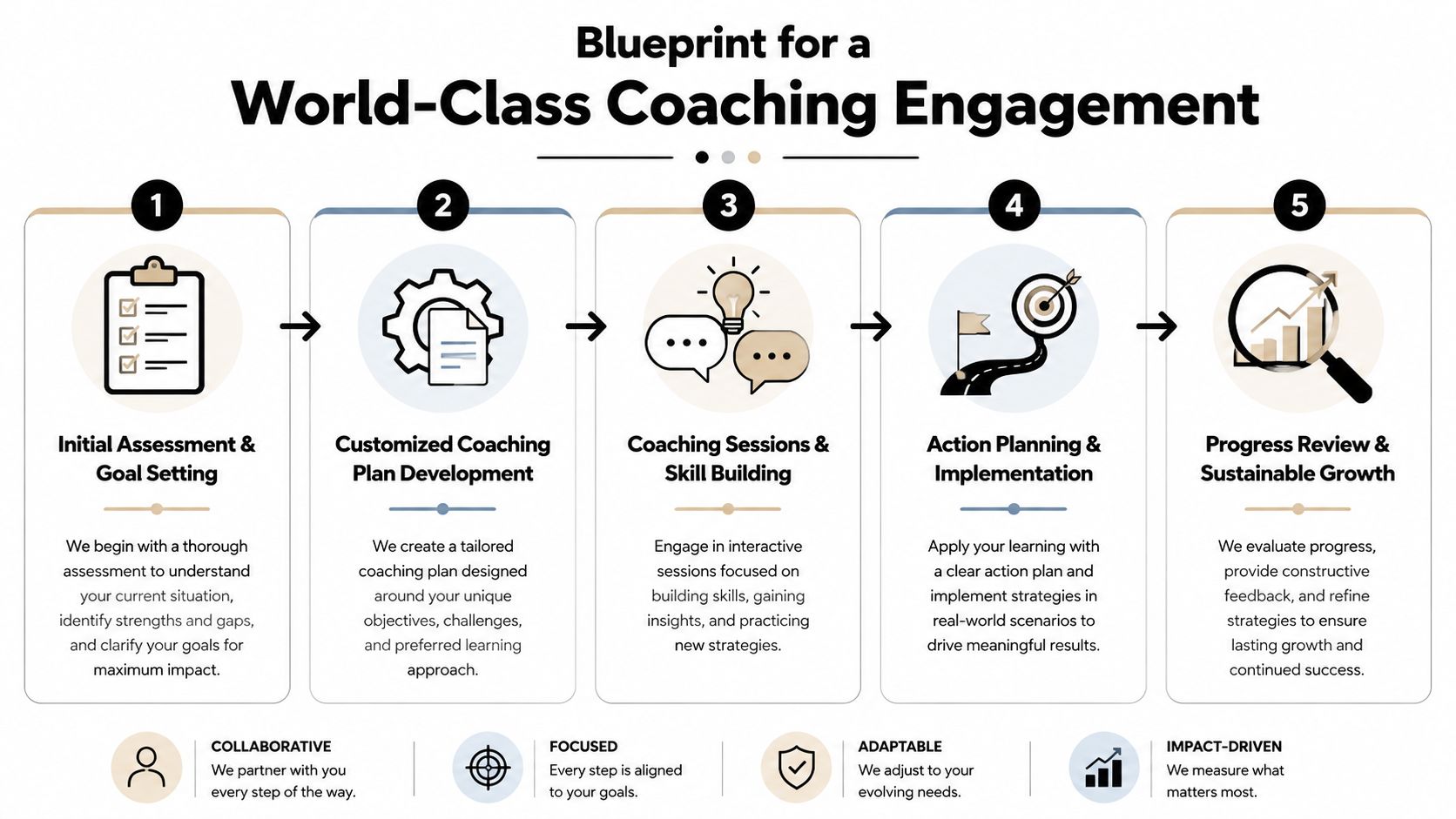
A strong coaching program is not a series of interesting conversations. It is a designed process.
When coaching disappoints, the cause is usually predictable. Goals are fuzzy. Sessions drift. Feedback stays abstract. There's no system for practice, no mechanism for accountability, and no way to tell whether the work is transferring into daily performance.
Start with diagnosis, not inspiration
The first requirement is a serious assessment. Before any coach starts “improving” your executive presence or leadership communication, they should know what is happening.
That means identifying patterns such as:
- Delivery gaps: weak vocal authority, rushed pacing, habitual upward inflection, or apologetic phrasing
- Structural issues: answers that start too broad, lose the main point, or bury the recommendation
- Presence signals: body language, facial tension, eye focus, and how you occupy silence
- Pressure responses: over-explaining, becoming defensive, or sounding less decisive when challenged
Without this diagnostic work, coaching tends to stay generic. Generic coaching feels pleasant. It rarely changes high-stakes performance.
Build a plan around real work
The next requirement is a customized plan tied to situations that matter. A quality program should be anchored in actual scenarios, not generic confidence exercises.
That includes things like executive updates, promotion interviews, board presentations, difficult stakeholder conversations, leadership Q&A, or cross-cultural communication under time pressure. The coach should know where you need to perform, how you are currently showing up, and what specific changes would alter perception.
One concrete example is The Gravitas Method, a 12-week one-on-one executive presence coaching program for international professionals who want to communicate with more authority and influence at senior levels. The program is priced at $8,200 paid in full or $9,000 across three installments. Coached by Nikola, it covers vocal authority, strategic framing, executive body language, and high-stakes communication.
That kind of specificity matters. You should be able to describe what the program works on, how long it runs, and what behaviors it targets.
Look for structured application
Good coaching turns insight into repetition. That means every session should create action, not just reflection.
A practical program often includes:
- A clear objective for each phase so the client knows what capability is being built.
- Practice assignments tied to real conversations rather than abstract exercises.
- Review loops where the coach examines what happened, what improved, and what still breaks under pressure.
- Accountability mechanisms that keep momentum from fading between sessions.
The best coaching sessions don't end with “That was helpful.” They end with “I know exactly what I'm going to do differently in my next meeting.”
For clients who want orientation before they start, Intonetic's page on what to expect in your first coaching session gives a useful picture of how a structured engagement should feel.
Follow-up support is not optional
One of the biggest quality markers is whether follow-up is built into the design from the start. Evidence from the CDC shows that embedding follow-up support within the initial training design strengthens transfer of new skills by 40% when participants practice with an expectation of confidence during the training itself.
That finding matters because many professionals mistake understanding for change. They leave a session with new insight, then default to old habits in the next stressful meeting. Strong programs anticipate that. They include reinforcement, review, and some form of continued application support rather than treating follow-up as an afterthought.
Data makes coaching sharper
Another marker of quality is whether the program uses evidence rather than intuition alone. In coaching, that can mean session records, learning logs, observed behavior patterns, and explicit needs assessment. The underlying principle is straightforward. When coaching is planned around real gaps and applied directly to practice, the intervention becomes more targeted and easier to evaluate.
You don't need a bureaucratic process. You do need a disciplined one.
A high-quality coaching program should leave you with more than motivation. It should leave you with clearer habits, stronger communication under pressure, and visible proof that your senior presence is becoming easier for others to recognize.
How to Choose Your Coach and Take the Next Step
Choosing a coach is partly about credentials and partly about fit. A coach can be experienced and still wrong for your problem.
If you're evaluating options, start with the basics and stay practical.
What to check before you commit
- Goal alignment: The coach should understand the difference between broad self-improvement and a concrete leadership objective. “Be more confident” is too vague. “Speak with more authority in executive meetings” is coachable.
- Relevant pattern recognition: If you're an international professional, the coach should understand the specific tension between clarity, cultural style, and perceived seniority.
- Method, not just personality: Chemistry matters, but method matters more. Ask how the coach assesses gaps, structures sessions, and measures progress.
- Evidence of application: Look for signs that the work is tied to real scenarios and repeated practice, not inspiration alone.
If you want a helpful external reference point, this guide on developing strong coaching qualities is useful for sharpening your own evaluation criteria.
Questions worth asking a coach
You'll learn more from a few direct questions than from a polished sales conversation.
| Ask this | Listen for this |
|---|---|
| How do you assess what needs work? | A concrete diagnostic approach |
| What happens between sessions? | Practice, accountability, follow-up |
| How do you tailor coaching to the client? | Real customization, not a canned script |
| How do you know the coaching is working? | Observable behavior change and outcome tracking |
A good coach won't just promise transformation. They'll explain the mechanism that produces it.
The next step doesn't need to be a full commitment. It should be a diagnosis.
If you want to understand how your communication currently reads at senior levels, start with Intonetic's free Executive Communication Assessment. It's a practical first step for identifying the specific gaps in authority, delivery, and strategic framing that may be limiting your influence, and for deciding whether coaching is the right move now.