10 Advanced Professional Development Activities for 2026
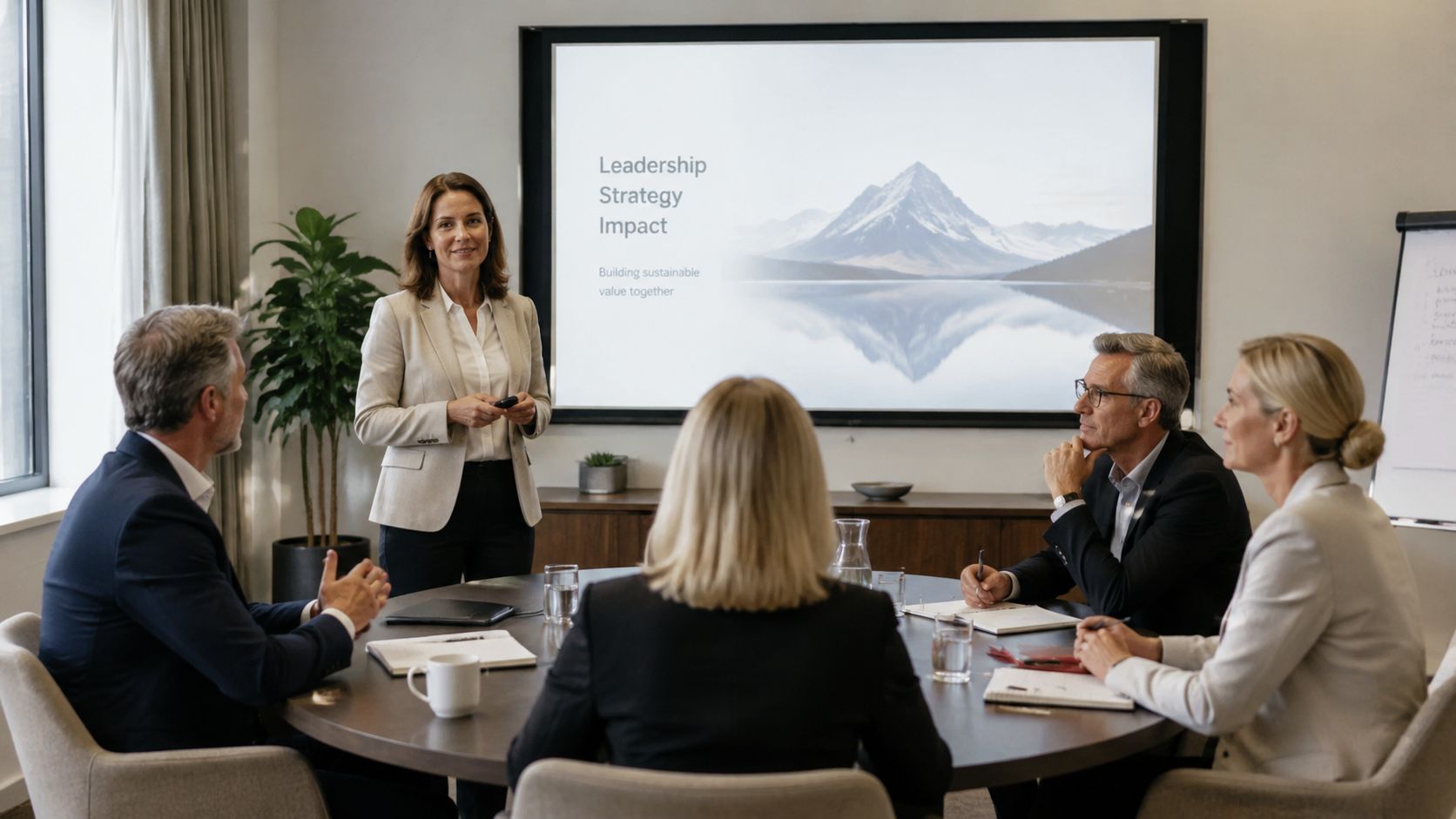
You are in a regional leadership meeting. The numbers are solid, the strategy is sound, and you know the market better than anyone on the call. Ten minutes later, a colleague with less operational depth is the one people describe as more strategic, more senior, and more ready for the next role.
That pattern is common among experienced professionals, especially in international roles. The gap is often not expertise. It is how expertise shows up under pressure, across cultures, in high-stakes conversations, and in rooms where brevity carries more weight than detail.
Standard development programs rarely address that problem well. Generic workshops and compliance-driven courses can help with baseline knowledge, but they do not do much for board-level communication, executive presence, promotion readiness, or influence across geographies. Senior people need development activities that improve judgment in real time, sharpen how they communicate, and hold up under actual business pressure.
That is also why continuous development works best when it is tied to the work itself, not treated as a side project or an annual HR exercise. The broader case for continuous professional development is familiar. What matters here is applying that idea with more precision for leaders whose stakes are higher and whose weaknesses are often subtle.
The ten activities below are not a generic HR list. They are the options I would seriously consider for executives, senior specialists, and internationally mobile professionals who need sharper communication, stronger leadership range, and clearer evidence that they are ready for broader responsibility. For professionals working specifically on senior-level communication, executive presence coaching for high-stakes business settings is one example of the kind of targeted support that fits this level of need.
1. One-on-One Executive Coaching Sessions
If the challenge is personal, the development format should be personal too. Coaching works best when the problem isn't “learn leadership” but “stop sounding tentative in board updates,” “handle pushback without rambling,” or “speak like a peer to senior stakeholders rather than a specialist asking permission.”
Senior international professionals benefit from coaching because the issues are often subtle. Vocabulary usually isn't the main blocker. Timing, framing, vocal authority, and how quickly you can structure an answer under pressure matter more.
For a sense of what that can look like, Intonetic's executive presence coaching focuses on communication patterns that affect perceived seniority in high-stakes settings.
What makes coaching worth the investment
A good coach doesn't just encourage you. They diagnose patterns you can't hear in yourself. That includes hedging, over-explaining, weak openings, defensive body language, and the habit of answering the question before clarifying the context.
Use coaching well by bringing live material into the room:
- Bring a real meeting challenge: Use upcoming presentations, promotion conversations, stakeholder conflicts, or Q&A sessions.
- Ask for observable feedback: Don't settle for “be more confident.” Ask what words, pauses, gestures, and sentence structures are weakening your message.
- Rehearse under pressure: Practice the same answer several times until it sounds concise and calm, not memorized.
- Track behavior change: Compare how you open meetings, summarize decisions, and handle interruption before and after several sessions.
Practical rule: If coaching stays abstract, it becomes expensive reflection. If it stays tied to live business moments, it becomes performance development.
A quick way to judge fit is simple. After the first few sessions, you should have specific language to use differently this week.
Here's a short talk that pairs well with this kind of work:
2. Professional Certifications and Credentials
Credentials don't automatically make someone better. They do, however, signal seriousness, fluency in a field, and commitment to a standard. That matters when you're moving across industries, geographies, or seniority levels.
For international professionals, certifications can also reduce ambiguity. If decision-makers don't yet know your background well, a recognized credential gives them a familiar reference point. PMP, ICF, NACD board certification, and executive education certificates all do this in different ways.
When a credential helps, and when it doesn't
A certification helps when it solves a credibility problem. It doesn't help much when the core issue is executive delivery. I've seen capable professionals collect impressive credentials while still speaking too technically, burying the recommendation, or losing authority in difficult conversations.
That's why the best approach is usually paired, not isolated. If your role depends on communication in English across functions and regions, combine formal study with business English communication skills development that sharpens how you sound in real workplace situations.
Choose credentials with discipline:
- Pick for market recognition: The name should mean something in your target industry or geography.
- Use the syllabus strategically: Let the program create structure for areas you'd otherwise postpone.
- Join the community fast: The peer network can be as useful as the certificate itself.
- Translate learning into visible output: Update your profile, share insights internally, and apply concepts to current projects.
One warning. Certifications are often excellent for knowledge validation and weak for behavior change. If your goal is promotion, ask whether the program changes how you think, speak, and lead in front of others. If not, it may improve your résumé more than your performance.
3. Mentorship Programs
Mentorship is still one of the most underrated professional development activities for senior talent, especially when the challenge is organizational navigation rather than technical growth. A good mentor helps you decode what isn't written down. Who influences decisions before the formal meeting. What senior leaders reward. Where your reputation is stronger or weaker than you think.
That's particularly useful for internationally mobile professionals. The official culture may say “speak up,” but the actual norm might favor brevity, stronger point of view, and sharper escalation judgment.

How to get more from a mentor
Don't ask for generic career advice. Ask for pattern recognition. A strong mentor can tell you where your communication creates friction, whether your executive presence matches your ambition, and how your style lands with people above your level.
That's where work on how to build credibility as a leader becomes practical, not theoretical.
Use the relationship deliberately:
- Choose signal over status: A famous senior leader isn't automatically the best mentor. Pick someone whose judgment and communication you respect.
- Bring decision points: Ask about a promotion strategy, stakeholder conflict, team reset, or meeting dynamic.
- Request direct observation: If possible, let the mentor watch you present or lead a meeting.
- Reciprocate appropriately: Share useful market insight, support an initiative, or show up prepared every time.
The best mentors don't just answer your questions. They improve the quality of the questions you ask.
If you're building a founder or leadership path in the Gulf region, this piece on essential guidance for UAE entrepreneurs through mentorship is also useful context for how mentoring accelerates judgment, not just access.
4. Executive Workshops and Seminars
Workshops are easy to dismiss because many are forgettable. The bad ones are content dumps with group discussion and little transfer. The good ones create concentrated practice, immediate feedback, and enough discomfort to expose habits you've normalized.
For senior professionals, the right workshop usually focuses tightly on one capability. Executive presence. Difficult conversations. Board-level presentations. Strategic storytelling. Not “leadership” in the broad, vague sense.
What to look for before you register
The strongest programs use challenge plus feedback, not attendance alone. That aligns with guidance summarized in Paycor's discussion of professional development activities, which emphasizes assessment, challenge, and support rather than generic participation.
Look for features that force behavior into the open:
- Recorded practice: If there's no playback, people leave with impressions instead of evidence.
- Live critique: You want specific feedback on structure, tone, pacing, and executive presence.
- Small-group application: Senior professionals learn faster when they test ideas with peers facing similar stakes.
- Post-workshop reinforcement: A follow-up coaching session or accountability group matters more than the workbook.
If presentations are part of your role, targeted executive presentation skills training can make a workshop much more transferable because you're applying the learning to live material, not classroom exercises.
A workshop is most valuable right before a high-stakes moment. An investor pitch, strategy offsite, board update, or promotion cycle gives you a real proving ground within days, not months.
5. Online Learning Platforms and Courses
Online learning is no longer the backup option. It's now the dominant delivery format in professional development. In 2024, more than 430 million professionals worldwide engaged in structured CPD activities, and over 72% of global CPD training was delivered through online platforms, according to Market Growth Reports' CPD market summary.
That scale matters because it changes the design standard. If your organization still treats digital learning as a desktop-only library people “should find time for,” it's already behind how professionals learn.
How to make online learning useful
The trap is obvious. People buy access and mistake access for progress. Online courses work best when they solve a narrow problem and feed directly into practice.
Mobile matters too. The same CPD summary reports that 61% of users accessed modules on smartphones or tablets. That pushes course design toward short lessons, stronger interfaces, and self-paced repetition rather than long passive viewing sessions.
A practical setup looks like this:
- Choose one live problem: Executive summaries, stakeholder updates, speaking clarity, or handling disagreement.
- Schedule it on the calendar: If it's “when I have time,” it won't happen.
- Take notes for application, not memory: Write the sentence you'll use, the slide you'll change, the habit you'll test.
- Add spoken practice: If English fluency and clarity are part of the challenge, an online English speaking course can pair well with communication-focused coursework.
Platforms like LinkedIn Learning, Coursera, and MasterClass can be useful. But the senior-level question is always the same: does this change how you perform in the next important interaction?
6. Peer Learning Groups and Communities of Practice
Some development problems don't need an instructor first. They need a room of credible peers willing to be honest. That's why peer groups such as Vistage, YPO forums, executive women's circles, and functional leadership roundtables remain powerful long after people stop needing basic instruction.
The value isn't just networking. It's comparative perspective. You hear how another leader handled a reorganization, addressed a political blocker, or reset expectations with a difficult executive sponsor. That shortens your learning curve because you borrow tested judgment, not theory.
Why peer groups work for senior leaders
This format is especially useful when your role is isolating. Many directors, founders, and functional heads don't have many places inside the company where they can speak candidly. A well-run peer group creates enough confidentiality to surface the actual issue, not the polished version.
De Beaumont Foundation guidance on engaging all employees in professional development also makes an important point that organizations often miss. Equitable development doesn't mean identical development. Peer groups are a good example of that. They're often more scalable and more inclusive than expensive external programs when budgets, geography, or schedules make access uneven.
Use the format carefully:
- Set confidentiality clearly: Without that, people perform instead of discuss.
- Keep the group small enough for candor: Bigger isn't better if airtime disappears.
- Use a structure: Case discussion, hot seats, rotating facilitation, or a coaching framework.
- Talk about communication directly: Many senior problems are influence problems in disguise.
Field note: The best peer groups normalize unfinished thinking. That's where sharper judgment starts.
7. Microlearning Modules and Bite-Sized Content
At 7:20 a.m., a regional VP is reviewing notes before a tense call with a country manager. There is no time for a course, a workshop, or a long coaching session. There is time to spend four minutes on one narrow skill: how to open with a recommendation, state the risk clearly, and stop over-explaining.
That is where microlearning earns its place.
For senior and international professionals, the value is not volume. It is timing, precision, and repetition. Short modules work well when the goal is to strengthen one behavior that will be used within hours, not absorb a full body of knowledge. I use this format for leaders who need fast reinforcement before board updates, cross-cultural meetings, performance conversations, or media interviews.
Where microlearning fits best
Use bite-sized content between larger development efforts. It is especially useful after coaching, during a role transition, or right before a high-stakes conversation where one communication habit can change the outcome.
The strongest use cases are specific:
- Pre-meeting refreshers: Review one technique before a presentation, negotiation, or stakeholder update.
- Between-session reinforcement: Repeat a single behavior, such as sharper executive summaries or cleaner responses under pressure.
- Spaced practice: Return to the same short lesson over several weeks so the skill holds under real conditions.
- Manager-led support: Share one focused module before team meetings, debriefs, or project reviews.
The trade-off matters. Microlearning improves recall and execution, but it does not replace deeper work. A five-minute lesson can help a leader tighten a recommendation or manage tone in email. It will not correct weak strategic judgment, low self-trust, or a long-standing pattern of avoiding conflict.
That is why the best L&D teams use microlearning as part of a larger system. Pair it with coaching, feedback, or live application. For senior leaders, one short module tied to a real meeting usually beats a larger library that never gets used.
Keep the standard high. If the content is generic, patronizing, or built for entry-level staff, experienced professionals will ignore it. Good microlearning is brief, context-specific, and immediately usable.
8. Action-Learning Projects and Real-World Application
A senior leader gets assigned to a market-entry project outside their home region. The brief looks strategic on paper. Development happens in the friction. Conflicting incentives, unclear authority, fast decisions, and stakeholders who do not automatically trust each other.
That is why I would protect this category even if the budget tightened. Stretch assignments show how someone handles ambiguity, influence, and pressure in a way no classroom session can match. For senior and internationally mobile professionals, that matters even more. Reputation is often shaped in cross-border work where context shifts fast and small communication mistakes carry outsized consequences.
Action-learning projects are especially useful when the stakes are real. Cross-functional launches, post-merger integration, cost restructuring, client recovery efforts, digital transformation, or regional expansion all create the right conditions. These assignments test judgment in public. They also produce visible evidence of growth, which makes them far more useful than development activities that stay private.

How to make the project developmental, not just demanding
A hard project alone does not guarantee growth. Some people repeat their existing habits under more stress. The development value comes from deliberate design, tight feedback, and review points during the work, not after it is over.
Use a structure like this:
- Choose a stretch with consequence: Pick work that requires a new level of strategic thinking, influence, or executive presence. Extra workload is not the same as development.
- Name the capability in advance: Define one priority clearly. It might be sharper stakeholder alignment, better decision-making under uncertainty, or stronger communication across cultures.
- Build feedback into the project rhythm: Ask sponsors, peers, and direct reports for specific observations while the work is still live. General comments at the end are less useful.
- Review real artifacts: Use meeting agendas, recommendation decks, project updates, and decision memos as evidence. Senior development improves faster when feedback is tied to actual output.
- Add reflection under pressure: Brief reviews after key meetings help leaders see patterns they miss in the moment, especially around tone, pacing, and authority.
There is a trade-off here. These projects produce stronger learning than study alone, but they also carry political risk. A poorly chosen assignment can bury someone in delivery work without giving them access to decision-makers, support, or room to practice new behavior. L&D teams and executives should screen for that upfront.
The best action-learning assignments sit at the intersection of business need and development need. They solve a real problem for the organization while forcing the leader to work at a higher level than before.
That is where growth becomes visible.
9. Professional Conferences and Industry Events
Conferences are often treated like rewards. They're more useful as rehearsal spaces. You test how you introduce yourself, how quickly you build rapport, how you discuss your work strategically, and whether you can ask sharp questions in public without overexplaining.
For senior professionals, the strongest payoff often comes from the edges of the event. Hallway conversations. Small dinners. Side meetings. Follow-up messages. If you only consume sessions, you're using conferences as content libraries. That's the least valuable part.
How to attend with intent
The conference itself isn't the development activity. Your behavior inside it is. Treat it as a live lab for visibility, positioning, and senior communication.
A few rules help:
- Set a narrow objective: One market trend, a handful of peer relationships, or a speaking opportunity.
- Prepare your introduction: Thirty seconds is enough if it's clear and relevant.
- Ask better questions: Senior presence often shows up in concise, high-value questions.
- Follow up quickly: Turn a conference contact into a real conversation while you're still remembered.
This category also matters because adult learning is common, but participation still isn't universal. The same 2026 career development summary notes that around 40% of adults in OECD countries participate in learning each year, which suggests conferences and events still serve as meaningful access points for people who won't join longer programs.
A conference should leave you with changed thinking, not just notes and badges.
10. Leadership Development Programs and Immersive Academies
Immersive programs can be excellent, but only when they match the level of challenge you need. Harvard Executive Education, INSEAD, IMD, Stanford, Yale, and Kellogg all offer respected formats. The question isn't prestige alone. It's whether the design changes how you operate.
The best programs combine faculty input, peer cohort learning, coaching, and direct application. They're useful for transitions into enterprise leadership, international scope, board exposure, or larger strategic responsibility.
What senior professionals should evaluate first
Digital delivery now dominates much of the market. Mordor Intelligence reports that online and virtual learning captured 76.41% of the professional development market in 2025, while AI-based coaching platforms held 40.62% of content-library revenue share and are projected to grow at a 13.86% CAGR through 2031 in its professional development market analysis. That means even immersive academies increasingly need to justify why live time is worth more than scalable digital alternatives.
Use a tougher screen before committing:
- Look for individual feedback: Cohort energy is valuable, but personal blind spots still need direct intervention.
- Check the participant mix: Your peers shape the learning as much as the faculty.
- Favor application-rich design: Simulations, labs, and real strategic work beat lecture-heavy formats.
- Plan the post-program phase: Alumni relationships and implementation support often determine whether the learning sticks.
One more caution. Prestige can hide a weak fit. A famous program that doesn't address your actual bottleneck may be less useful than a narrower option that targets communication, influence, and leadership behavior directly.
Top 10 Professional Development Comparison
| Option | 🔄 Implementation Complexity | ⚡ Resource Requirements (time / cost) | ⭐ Expected Outcomes | 📊 Ideal Use Cases | 💡 Key Advantages / Tips |
|---|---|---|---|---|---|
| One-on-One Executive Coaching Sessions | High, tailored plans, scheduling and rapport required | High time (weekly/bi-weekly) and cost | High, rapid, personalized improvement in presence and delivery | Senior professionals and non-native speakers preparing high‑stakes interactions | Establish measurable goals; record sessions for review |
| Professional Certifications and Credentials | Medium‑High, structured curriculum and assessments | High time (6–24 months) and financial investment | High credibility (credentialized validation) but limited personalization | Professionals seeking recognized validation and marketability | Choose industry‑recognized certs and pair with targeted coaching |
| Mentorship Programs | Low‑Medium, relationship driven, variable structure | Low cost, variable time commitment | Medium, contextual career guidance and network access | International professionals navigating culture and org politics | Define expectations and meeting cadence upfront |
| Executive Workshops and Seminars | Medium, event logistics and facilitation needed | Medium cost, short duration (1–3 days) | Medium, concentrated skill boosts; limited ongoing reinforcement | Busy executives wanting intensive short‑term development | Prefer workshops with video playback and schedule follow‑up coaching |
| Online Learning Platforms and Courses | Low, self‑paced setup and platform access | Low cost, flexible timing | Low‑Medium, good for foundational knowledge, limited feedback | Professionals needing flexible, on‑demand learning | Combine with peer accountability to improve completion |
| Peer Learning Groups / Communities of Practice | Low‑Medium, depends on group facilitation and norms | Low cost, recurring time commitment | Medium, strong peer feedback and accountability | Senior professionals seeking ongoing community and benchmarking | Set norms, rotate facilitation, use structured frameworks |
| Microlearning Modules / Bite‑Sized Content | Low, simple to deploy and consume | Very low time per session, low cost | Low‑Medium, effective for reinforcement, not deep skill building | Busy executives needing quick reinforcement between activities | Use as spaced reinforcement between coaching sessions |
| Action‑Learning Projects and Real‑World Application | High, requires project governance, stakeholder buy‑in | High time and organizational resources | High, measurable business impact and applied skill development | High‑potential leaders seeking tangible results and stretch assignments | Ensure executive visibility and schedule reflection cycles |
| Professional Conferences and Industry Events | Medium, planning, travel, and session selection | High cost (registration/travel) and time away | Medium, strong visibility and trend awareness, limited personalization | Leaders seeking networking, visibility, and market insights | Set objectives, prepare an elevator pitch, follow up promptly |
| Leadership Development Programs / Immersive Academies | High, cohort design, multi‑modal coordination | Very high cost and lengthy time commitment | High, comprehensive leadership development with cohort support | Mid‑to‑senior leaders seeking deep, cohort‑based development | Prioritize programs with coaching and strong alumni networks |
Putting Your Development Plan Into Action
A senior director finishes a leadership program, collects the workbook, and goes straight back into a week of board prep, cross-border calls, and a difficult stakeholder reset. Three months later, nothing has changed in how that leader speaks, delegates, or influences. The problem usually is not motivation. It is design.
Professional development works best as a portfolio, not a single event. Coaching helps surface blind spots that peers will not name directly. Mentorship adds political and cultural context, which matters even more for international professionals working across reporting lines, time zones, and communication norms. Workshops and courses can build knowledge fast, but without practice tied to real meetings, presentations, and decisions, the effect fades quickly.
The practical question is narrower than "How do I develop?" Ask instead, "What do senior stakeholders already experience as my limiting factor?" If the issue is executive presence, another certification will not fix it. If the issue is strategic judgment, microlearning will not be enough. Match the activity to the constraint.
For organizations, that means resisting the usual habit of offering the same menu to everyone at the same level. Senior leaders need different development architecture. They benefit from options with direct feedback, live application, and visible business stakes. L&D teams that treat development as a benefit often get low transfer. Teams that treat it as performance infrastructure usually get better retention, stronger bench strength, and clearer succession signals.
For individual leaders, I recommend a simple sequence. Start with one primary objective. Choose one core activity that addresses it directly. Add one reinforcement mechanism, such as peer accountability, manager observation, or structured reflection after high-stakes situations. Then set a review point 60 to 90 days out and look for behavioral evidence, not just course completion.
Intonetic is one example of a targeted option for communication-focused development. The Gravitas Method is a 12-week one-on-one executive presence coaching program for international professionals who want to communicate with more authority and influence at senior levels. It is coached by Nikola and covers vocal authority, strategic framing, executive body language, and high-stakes communication. Pricing is listed as $8,200 paid in full or $9,000 across three installments.
Before committing to any program, establish a baseline. That step gets skipped often, and it is one reason development plans become generic and hard to measure. If communication is part of your development priority, Intonetic offers a free Executive Communication Assessment that can help clarify strengths, blind spots, and likely friction points in senior-level interactions.
If you prefer a more deliberate reflection process alongside formal development, Maeve's guide to effective studying is a useful complement.
If you want professional development to change how you are perceived at senior levels, start with the behaviors other people already react to. Intonetic offers a free Executive Communication Assessment that helps you identify strengths, blind spots, and the gaps that may be holding back your executive presence.