
Nonverbal Communication Across Cultures: A Leader’s Key
You're in a boardroom, or on a video call that feels just as exposed, and your slides are solid. The logic is there, the numbers make sense, and your recommendation is careful. Yet the room doesn't seem to receive you the way you expected, because people are reacting to your pause, your posture, your gaze, and the way your voice lands before they fully process your actual words.
That mismatch is the core problem behind nonverbal communication across cultures. In global leadership, people often judge authority through delivery first and content second, especially when they're deciding whether you look confident, uncertain, warm, distant, or ready to lead. A simple wardrobe choice can also shape that first impression, which is why a practical style resource like the Dandylion Style office guide can be useful when you're trying to align appearance with the expectations of a particular workplace.
Why Your Words Are Not the Whole Story
A senior professional can say the right thing and still lose the room. The sentence is clear, the recommendation is sensible, but the person delivering it looks tense, avoids eye contact, or speaks in a way that makes the message feel unsure. In cross-cultural settings, that gap matters because people often decide how to read you before they've finished decoding your content.
Albert Mehrabian's widely cited 7-38-55 model helped popularize the idea that, in communication of feelings and attitudes, words account for 7%, vocal tone for 38%, and facial or body cues for 55%. Modern teaching materials warn against overgeneralizing it, but the core lesson still holds up, nonverbal signals can outweigh verbal content when the two conflict. The practical consequence for executives is simple, delivery, posture, and facial expression can shape perceived authority as much as the slide deck itself. More on the model and its limits/01:_Chapters/1.06:_Nonverbal_Communication)
Practical rule: if your words say “I'm confident” but your body says “I'm uncertain,” the body usually wins.
Many leaders attempt to address this by refining their phrasing alone. That is helpful, but it does not resolve the core issue when your counterpart interprets your tone, timing, or silence as the essential message. For a stronger basis on this, this guide to improving workplace communication complements the subject effectively, as it approaches communication as conduct, not merely word choice.
The Building Blocks of Nonverbal Communication
Nonverbal communication is easier to manage when you stop treating it like one big mystery and break it into channels. It is a mixing board in a studio, one slider controls movement, another controls space, another controls tone, and another controls time. If one channel is off, the whole performance can feel wrong even when the script is strong.
The eight channels that matter most
Kinesics is your body movement and gesture. It's the choreography of a conversation, the nods, hand movements, and posture shifts that tell people whether you're engaged, defensive, or steady.
Proxemics is your use of space. It's the invisible bubble around you, how close you stand, how far you lean in, and whether your distance feels friendly or intrusive.
Haptics is touch communication. In business, that usually means greetings, handshakes, and the boundaries around physical contact.
Vocalics is the layer under your words, tone, pace, rhythm, and volume. It's the soundtrack beneath the sentence.
Physical appearance is clothing, grooming, and presentation. It's the frame around the message, and people notice it before they notice your reasoning.
Artifacts are the objects you carry or display, such as a watch, a notebook, or accessories. They can signal role, status, or attention to detail.
Environment is the room itself, lighting, layout, background, and atmosphere. A formal boardroom and a casual open office do different things to the same person.
Chronemics is the use of time. It shows up in punctuality, pacing, silence, interruptions, and how long you hold a pause before answering.
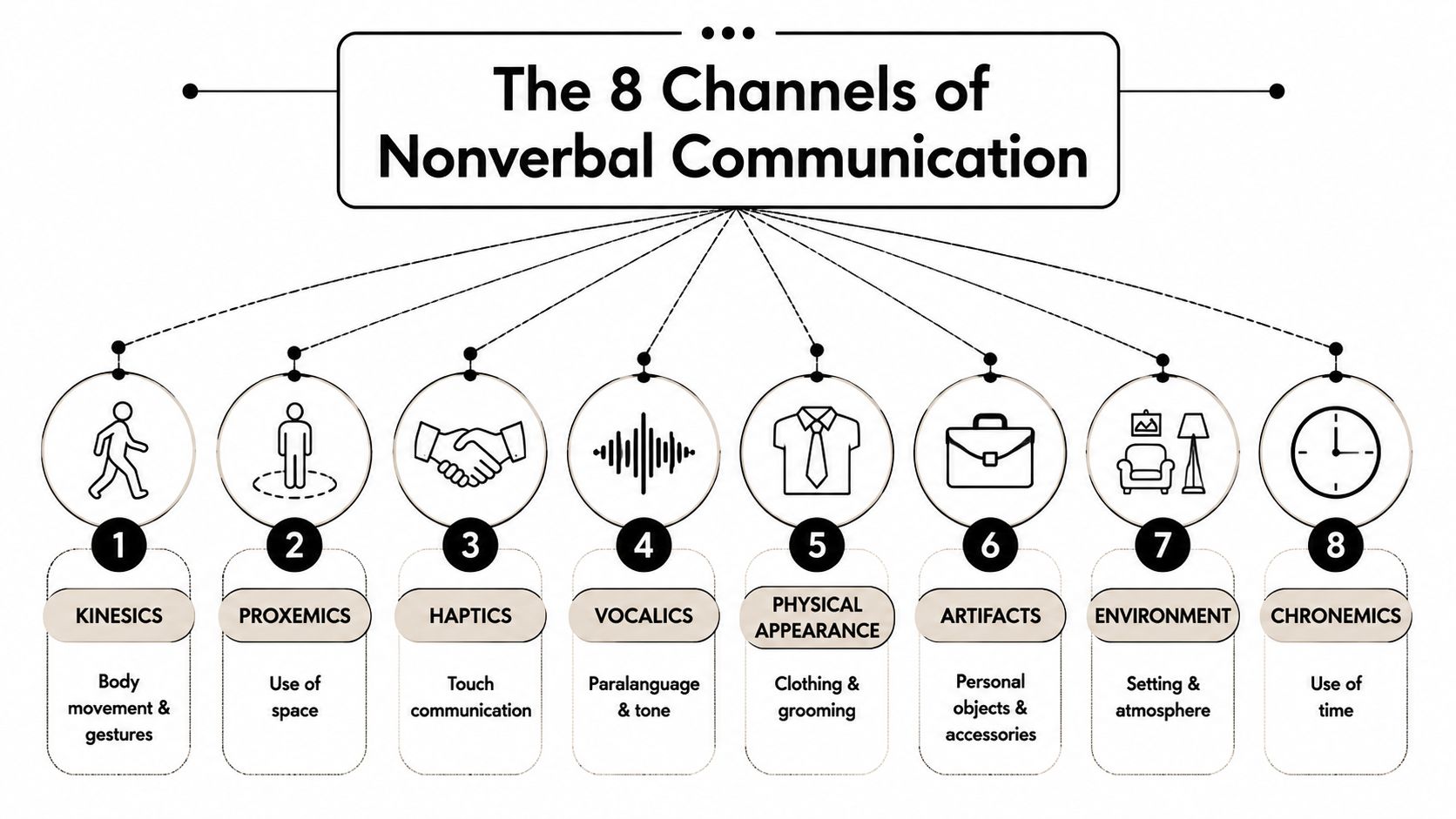
A useful way to think about these channels is that people don't always read them in the same order. One executive may focus on eye contact first, another on the firmness of your handshake, and another on whether your voice sounds composed. If you want a quick refresher on facial cues, this facial expression and meaning guide is a useful companion because it keeps the focus on how expression gets interpreted, not just how it looks.
High Context vs Low Context Cultures and What That Means for Your Body
High-context communication works like jazz musicians trading phrases. People share meaning through timing, implication, and what isn't said outright. Low-context communication works more like lawyers reading clauses, where the point is to make the message explicit so fewer assumptions are needed.
Why the same behavior changes shape by region
The Wiley reference linking Hall's high-/low-context framework with Hofstede's individualism/collectivism makes the key point clearly, nonverbal expressions are more common in high-context, collectivistic cultures, while low-context, individualistic cultures rely more on explicit verbalization. In practice, that changes how people read eye contact, silence, gesture density, and facial expressiveness. The same posture can project confidence in one market and feel pushy or overly direct in another. Read the cultural framework here
That's why a standardized global style rarely works as well as leaders hope. A room full of people from different regions is not just comparing what you said, it's comparing how much you said with your face, your timing, and your stillness. If you're trying to understand the broader idea behind this framework, the high-context culture overview is a clean starting point.
A practical analogy helps. In a low-context setting, speaking more directly can signal competence. In a high-context setting, speaking with too much force too soon can make you seem impatient, even if your content is excellent.
Use the room's grammar, not your home market's grammar.
That's also why shared activities matter early in cross-cultural learning. A light, structured reference like multicultural activities for preschool may sound unrelated at first, but it reinforces a basic truth, people learn cultural patterns faster when they can observe behavior in context rather than memorize rules in isolation.
Gestures, Eye Contact, and Personal Space Side by Side
People often ask for one clean map of gestures across regions, but the picture is messier. A head nod, a handshake, or direct eye contact doesn't carry one universal meaning, it changes with local norms, seniority, and the setting. The safest reading is to compare cues side by side before you walk into the room.
| Cue | US / UK | Germany / Northern Europe | Japan / Korea | China | India | Brazil / Latin America |
|---|---|---|---|---|---|---|
| Head nod | Often signals agreement or listening | Usually signals attentiveness and agreement | Can signal attentiveness, often more restrained | Can show listening, but context matters | Often used as active listening feedback | Often signals engagement and warmth |
| Thumbs up | Usually positive approval | Usually positive approval | Usually positive, but still context-based | Often positive in many business settings, but local context matters | Usually positive in many settings | Can be positive in many places, but always check the local norm |
| Eye contact | Commonly expected as confidence and sincerity | Often expected, especially in professional settings | Can feel intense if held too long | More moderate in many formal settings | Can vary with hierarchy and respect | Often warm and engaged, but intensity still matters |
| Handshake firmness | Moderate to firm | Often firm and brief | Usually lighter and more restrained | Often moderate and formal | Varies widely with context and hierarchy | Warmth matters, but not at the expense of comfort |
| Personal space | Moderate distance is typical | Often slightly more distance is preferred | More personal space is common | Moderate to larger space is often preferred | Can be closer in some contexts | Often less distance is tolerated than in Northern Europe |
A head nod is a good example of why direct translation fails. In Greece and Bulgaria, the same movement can mean “no”, while in many other places it reads as agreement. That's a simple gesture with a complicated life, and it's exactly why local context matters more than habit. A practical overview of cross-cultural gesture differences
Eye contact is just as tricky. In some cultures it signals respect and attentiveness, while in others it can feel confrontational or uncomfortable, so the “right” amount is culturally contingent rather than universal. The same is true of touch and distance, because personal space rules and greeting contact can feel warm in one context and invasive in another. See the eye contact guidance and the proxemics and touch overview
A gesture is never just a gesture. It's a local sentence with local grammar.
For leaders, the lesson is not to memorize every country on earth. It's to watch for the cues that shape first impressions most strongly, then let the local pattern set your baseline.
Three Cross-Cultural Scenarios That Expose the Real Risks
A senior Indian executive walks into a US board meeting with a strong recommendation and solid numbers. The board later says he seemed uncertain, even though the content was clear. The issue wasn't the logic, it was the excessive nodding and the way he avoided eye contact while making the ask.
A German manager leads a global team and gives a brief handshake, then keeps her expression controlled throughout the meeting. Her colleagues in Brazil read her as cold, even though at home her style signals professionalism and self-discipline. The adjustment that would have helped was a warmer opening, a little more facial warmth, and a touch more visible acknowledgment at the start.
A Chinese founder pitches US investors and is told to speak up more, even though her volume is perfectly audible. The problem is that her pitch is delivered with a flat vocal contour and very little gesture, so the audience reads low conviction. A more expressive tone and a few deliberate gestures would have made the same message feel stronger.
If you work with people who rely on nonverbal cues to communicate needs or comfort, this point becomes even more important. Resources like communicate clearly with deaf persons can sharpen your awareness because they remind you that meaning lives in more than one channel, and clarity often depends on how those channels work together.
The pattern across all three scenes is consistent, people don't just evaluate what you meant. They evaluate whether your body, voice, and facial expression made your meaning easy to trust. That's why a technically correct message can still miss its target.
A Practical Protocol for Reading the Room and Calibrating Your Presence
Strong cross-cultural leaders don't memorize infinite rules, they build a repeatable calibration habit. They notice the room before they try to own it, and they treat their delivery as adjustable rather than fixed. The goal is not imitation, it's alignment.
A five-step field protocol
-
Observe before you enter.
Watch how people greet each other, how far apart they stand, and whether the room feels formal or relaxed. If you can, let the local baseline set your starting point instead of arriving with your default style fully switched on. -
Mirror the local baseline.
Match the room's level of eye contact, greeting warmth, and gesture density without becoming theatrical. A slightly slower pace and a calm posture often travel better than high energy in an unfamiliar room. -
Lead with the channel the audience trusts most.
In some rooms, that's a direct verbal framing. In others, it's a steady tone, a brief pause, or a composed opening. Don't force the same entry everywhere. -
Make intent verbal when cues are ambiguous.
If silence could look like hesitation, say what the pause means. If a direct question could feel abrupt, add a brief framing sentence before you ask it. -
Debrief after the meeting.
Ask one trusted contact what landed well and what felt off. You're not asking for praise, you're building a pattern library for the next room.
This protocol works in a board meeting because it prevents overcorrection. It also works in stakeholder negotiations, where a short pause can signal respect instead of resistance if you frame it well. In cross-cultural presentations, it helps you use silence deliberately so it reads as authority rather than uncertainty.
A lot of senior professionals do better once they stop treating silence as empty space. Silence can be a tool, but only if the audience knows whether you're thinking, emphasizing, or inviting a response.
Calibration beats performance. The room doesn't need a perfect cultural impersonation, it needs a leader who can adjust quickly without losing authority.
The Harder Question Most Guides Skip
Most guides turn this topic into etiquette, which is too simple for real leadership settings. The harder issue is whether people are reading your nonverbal signals accurately when status, race, or power asymmetry shapes the interpretation. A gesture can be technically appropriate and still land badly if the listener's filter is distorted.
A systematic review found that culturally specific nonverbal empathy cues matter in clinical settings, and that race mismatch plus implicit bias can lead to ineffective information sharing. That matters beyond healthcare because it shows how quickly perception changes when the relationship is unequal or the interpreter brings assumptions into the room. Read the review on culturally specific empathy cues and bias
That's why experienced leaders sometimes feel misread even when they know the local norms. The issue isn't always ignorance. Sometimes the room is filtering their delivery through hierarchy, identity, or preconceived ideas about who looks authoritative.
So nonverbal fluency isn't performance for its own sake. It's perception management under ambiguity, which is a much more demanding skill. The goal is to make your intent easier to read when the audience doesn't share your assumptions.
Your Next Step Toward Cross-Cultural Authority
Use three cues to watch for in your next meeting, eye contact, gesture density, and silence. Use two cues to adjust, your opening pace and your facial expressiveness. Then rehearse one scenario, a room where you need to present a strong recommendation without overpowering the cultural tone in the room.
If you want a structured way to keep sharpening that skill, cross-cultural communication training can give you a more deliberate practice environment. The next layer of work is usually not about learning more rules, it's about making your delivery, framing, and body language consistent under pressure.
The Gravitas Method is a 12-week one-on-one executive presence coaching program for international professionals who want to communicate with more authority and influence at senior levels. It's priced at $8,200 paid in full or $9,000 across three installments, coached by Nikola, and it covers vocal authority, strategic framing, executive body language, and high-stakes communication. The most useful first step is the free Executive Communication Assessment, because it shows you where your presence is helping, and where it's costing you trust.
Intonetic helps international professionals strengthen the way they come across in senior settings, especially when delivery and cultural interpretation affect authority. If you're ready to close the gap between what you mean and what the room reads, start with the free Executive Communication Assessment and see what needs to change first.