Natural Delivery Techniques: Speak with Authority
You can have the right numbers, the right slide deck, and the right title, then watch the room drift anyway. A senior manager starts checking messages, the CFO asks a question that should have landed as routine, and your voice tightens just enough to make the answer sound less certain than the work deserves. That gap between expertise and delivery is where authority gets lost, and it's fixable.
Natural delivery techniques are usually framed as comfort tools for labor, but the deeper lesson is broader. Breath, position, movement, and support can be turned into a diagnosable performance system, with checkpoints, trade-offs, and observable outcomes. That same structure is useful in executive rooms, where smart people often sound uncertain not because they lack judgment, but because their body and language are working against them.
Why Smart People Sound Uncertain in the Room
A director can walk into a strategy meeting with the cleanest analysis in the room and still lose the room in the first two minutes. The content is sound, but the pacing is rushed, the voice rises at the end of sentences, and the body keeps apologising with small, nervous movements. By the time a more junior colleague speaks slowly and cleanly, they get the airtime.
That pattern is familiar because it looks like confidence, but it is really a performance system problem. Breath, stance, phrasing, and recovery under pressure can be trained the same way natural childbirth methods once broke labor preparation into workable parts. The point is not to copy the labor context. The point is to borrow the discipline of preparation, where controlled breathing, position, movement, and support are treated as separate levers with separate effects.

Practical rule: If the room stops listening before the facts land, delivery is leaking authority before content has a chance to help.
The fastest diagnosis comes from evidence, not memory. Listen back to a meeting recording or voice note and mark where the sentence breaks, where the pace jumps, and where your voice softens into doubt. A transcript from M4a to transcript makes those patterns easier to see, because filler words, hedging, and unfinished sentences become visible instead of hidden inside the moment.
Use the same lens you would use on any credibility problem at work. A practical guide on how to be taken seriously at work helps frame the issue in plain terms. The goal is not to sound louder or more performative. It is to make delivery stable enough that expertise does not get buried under tension.
Breath Control and Vocal Warm-Ups That Ground Your Voice
Start with breath, because pressure shows up there first. Under stress, many professionals breathe high in the chest, speak too quickly, and push air out in a way that makes the voice sound thin or urgent. A steadier exhale changes the signal immediately, even before the words improve.
The useful lesson from natural childbirth preparation is not the childbirth context itself. It is the discipline of treating breathing as one working part of a larger system, alongside position, movement, and support. That same logic applies in executive speaking. If the breath is shallow, the voice rides on tension. If the breath is controlled, the voice sounds more settled and deliberate.
A five-minute reset you can do anywhere
Use this before a board update, difficult feedback conversation, or presentation:
- Stand or sit tall for three slow breaths. Let the shoulders drop and keep the jaw loose.
- Exhale longer than you inhale. That steadier exhale helps the sentence start from a calmer place.
- Hum lightly for 20 to 30 seconds. The goal is to wake up resonance, not to perform.
- Slide from a comfortable low note to a comfortable mid note. Keep it easy, smooth, and unforced.
- Speak your first two lines out loud once at rehearsal speed. Not fast. Not dramatic. Just clear.
A voice that feels grounded usually sounds more credible than a voice that sounds “enthusiastic” but breathless.
A simple reset is also to use paced exhale drills between opening lines. If you tend to rush, place a full, silent breath before the first sentence and a smaller breath before the second. That pattern prevents the upward, uncertain lift that creeps in when people are trying to get through a point too quickly.
For a practical library of vocal work, the exercise set at voice lesson exercises is useful when you want something structured rather than improvised. The best sign the warm-up is working is not that you sound theatrical. It is that your voice sounds like it belongs to you.
The educational idea is straightforward, and it matches the same control logic used in labor preparation. One recent PubMed-indexed study on hospital natural-delivery settings linked that environment with more immediate breastfeeding, breastfeeding at discharge, a higher likelihood of vaginal birth, and lower postpartum pain, while earlier randomized evidence found no epidural reduction from breathing and relaxation training, with the epidural rate at 52% in both groups and no statistically significant difference in childbirth experience or parental stress PubMed. The takeaway for executives is blunt. A technique can help with control and comfort without guaranteeing every outcome.
Pacing, Pausing, and Phrasing for Executive Cadence
Once the voice is grounded, cadence does most of the credibility work. Senior rooms trust speakers who know where a sentence should stop. They also trust people who don't race through the parts that matter, especially numbers, constraints, and decisions.
The fastest upgrade is to slow down before the key noun. Not every sentence needs drama, but important claims need space. A pause after the conclusion gives the room time to absorb the point instead of hearing it as one more stream of words.
Before and after
Weak delivery:
“Our Q3 pipeline is under pressure and we need to adjust the forecast maybe by early next week if the account reviews hold.”
Stronger delivery:
“Our Q3 pipeline is under pressure. We need to adjust the forecast. We'll confirm that by early next week after the account reviews.”
Weak delivery:
“I think the incident was caused by a few different factors and maybe the root issue was escalation timing.”
Stronger delivery:
“The incident had multiple contributing factors. The primary issue was escalation timing. That's the part we need to fix first.”
The phrasing shift matters too. Textbook English often sounds stiff in senior meetings, especially when non-native speakers translate directly from their first language. Natural collocations, shorter sentence units, and clean transitions make the speaker sound more fluent because the listener doesn't have to work to decode the point.
Use silence after the claim, not before the point. Silence after the point reads as confidence. Silence before it can read as hesitation.
A useful adjustment is to replace “I would like to say” with “My view is,” replace “maybe we can” with “We should,” and replace “in my opinion, it seems” with a direct statement of judgment. That doesn't make you aggressive. It makes you easier to follow.
For a sharper sense of how quiet can carry authority, the piece on silence as communication is worth keeping nearby. In practice, the best cadence sounds calm, not polished to death. The room should feel the structure without noticing the mechanics.
Executive Body Language and Framing Under Pressure
Words do not carry the whole message in a senior room. Posture, stillness, and eye contact fill in what the sentence doesn't say. If the body looks unsteady, the message gets interpreted as less certain than it is.
The same biomechanics logic that drives positioning in birth also applies here. In natural delivery guidance, upright or supported positioning changes how the body works through labor, and the practical point is simple, position changes outcome. In executive presence, position means how you stand, sit, and orient yourself while speaking.
What reads as power
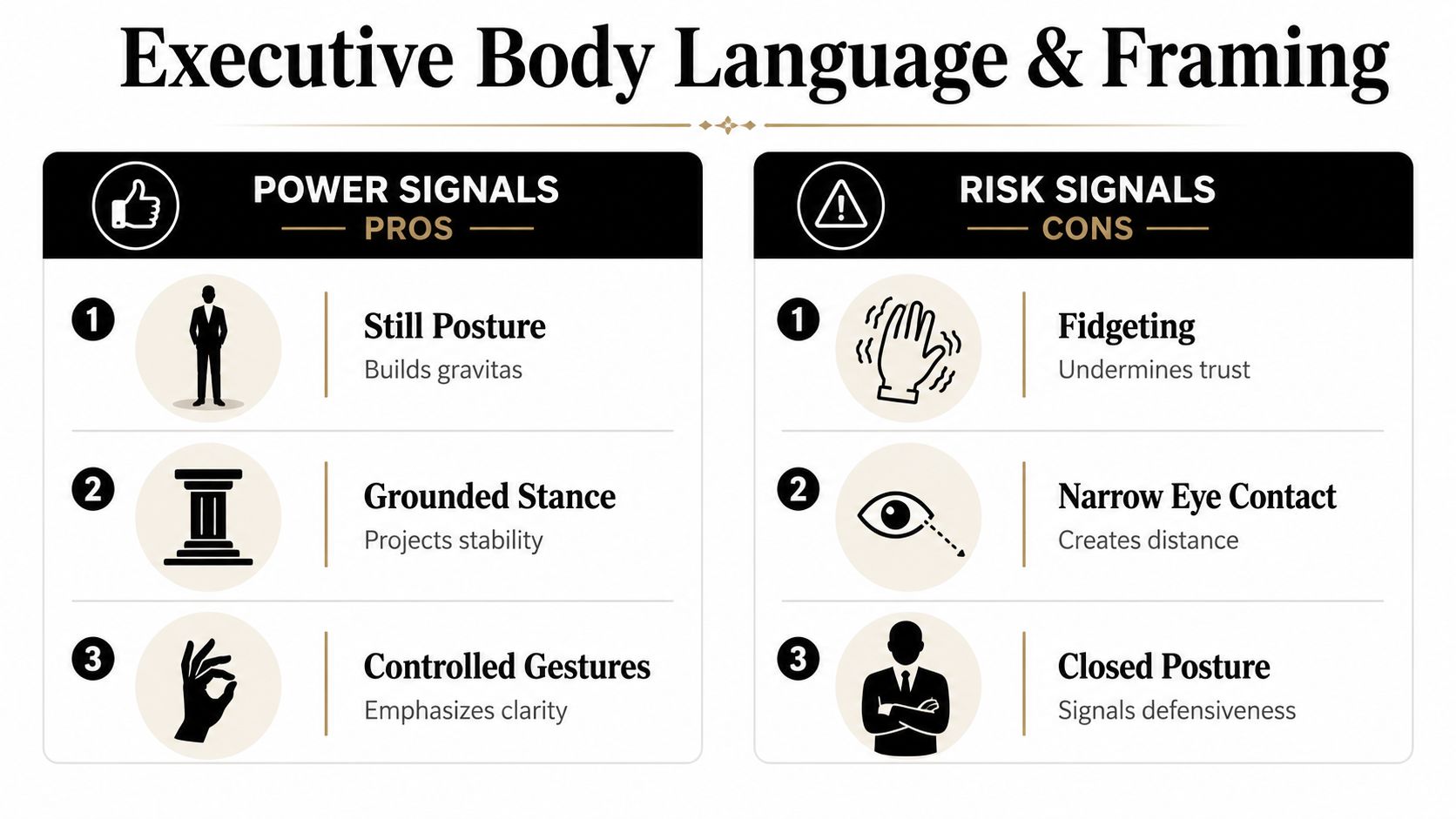
The most reliable signals are boring in the best way.
- Still posture. It tells the room you're not scrambling for approval.
- Grounded stance. Feet planted, weight balanced, no visible wobble.
- Controlled gestures. Hands that underline a point, not a nervous metronome.
The opposite signals are just as visible, and they cost authority fast.
- Fidgeting. Repeated touch points, pen tapping, paper shuffling.
- Narrow eye contact. Looking only at slides or only at one friendly face.
- Closed posture. Arms folded tight, shoulders curled forward, chest caved in.
A strong answer under pressure also needs a frame. When a senior stakeholder pushes hard, answer in three parts. First, name the point of disagreement. Second, give the factual response. Third, state the next step or decision boundary. That structure keeps you from sounding defensive or overexplained.
If you need a more detailed body-language lens for leadership situations, the guide on body language for leaders is a practical reference. Silence helps here too, but only if the body isn't signaling panic. A quiet pause with a grounded posture reads as control. A quiet pause with a collapsed posture reads as retreat.
Real Scenarios and Scripts You Can Steal
Scripts matter because pressure deletes improvisation. Under stress, people return to their default patterns, which is why a prepared line can save more authority than a clever answer delivered late. The goal is not to memorize theatre. It's to have usable language ready when the room turns sharp.
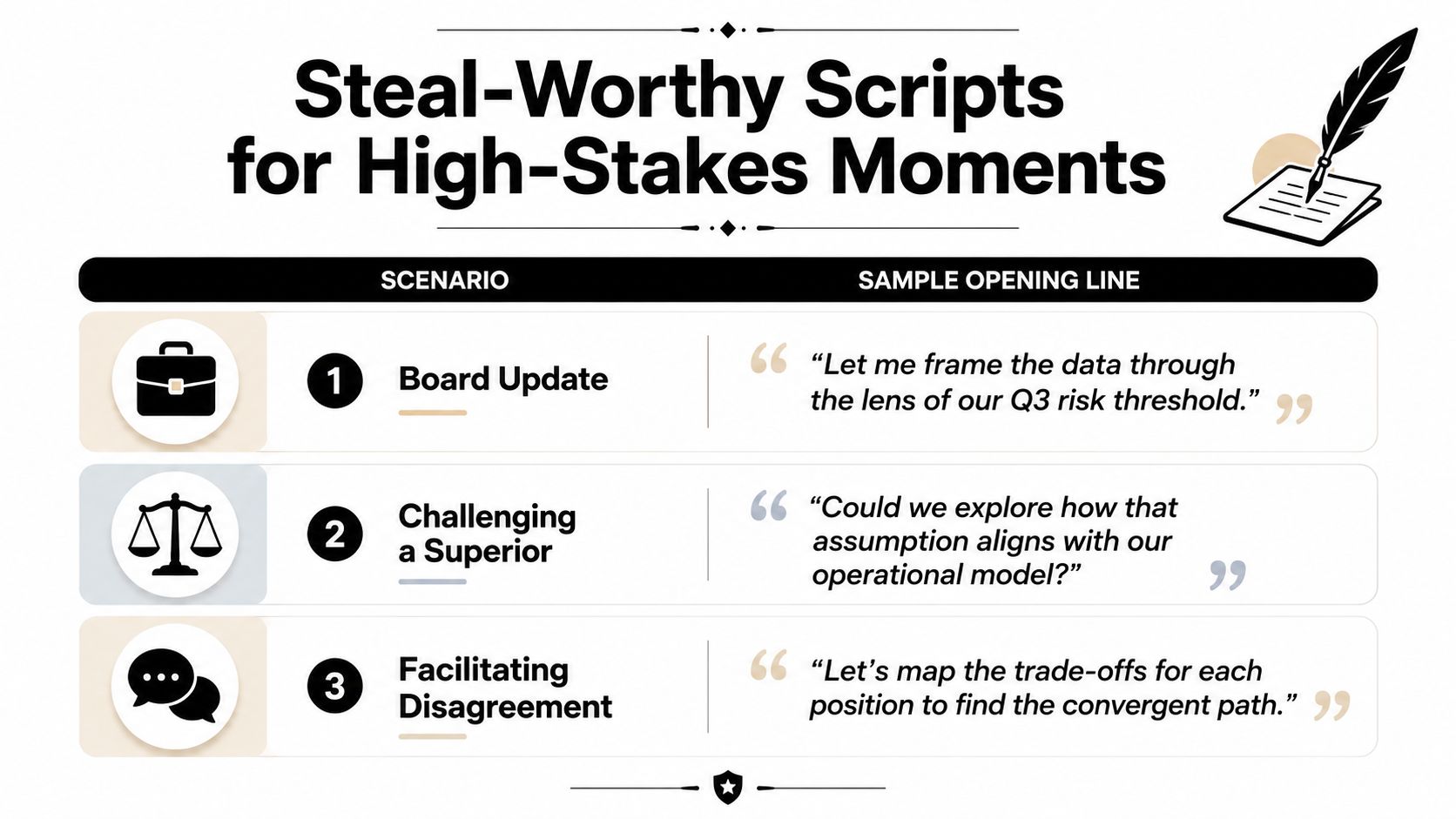
Board update
Try this opening:
“Let me frame the data through the lens of our risk threshold. The headline is stable, but two assumptions need review. I'll walk through those now.”
The delivery move is simple, slow the first sentence, then pause before the word “headline.” Don't rush into the caveat. If you bury the update under too much context, the room assumes the message itself is weak.
Challenging a superior
Try this when a senior person pushes back on your data:
“Could we explore how that assumption aligns with the operating model? If the assumption holds, I agree with the direction. If it doesn't, we'll need a different recommendation.”
That script does two things. It stays respectful without shrinking, and it moves the debate from personality to evidence. Avoid the reflex to say “sorry” before you've even explained the issue.
For a useful example of steering a hard conversation without losing the room, the article on changing the topic shows how redirection can stay professional instead of evasive. Use that idea carefully. Redirect only when the core issue has been acknowledged.
Facilitating disagreement
Try this in a tense stakeholder meeting:
“Let's map the trade-offs for each position and see where the overlap is. Then we can decide what has to be true for either option to work.”
That line slows the room down. It prevents people from talking over each other and keeps you in the role of organizer rather than referee.
A Two-Week Rehearsal Plan and Measurement Checkpoints
Delivery changes when rehearsal becomes measurable. Fifteen minutes of vague practice will not move much. A short, repeatable routine will, especially if you review yourself against specific behaviors instead of general impressions.
The cleanest mirror is your own recording. A recent natural-delivery study found that setting and intervention type affect birth and postpartum outcomes, a reminder that context changes results. In speaking, the same script lands differently depending on breathing, pacing, posture, and the stakes of the room.
Days 1 to 7
Practice one drill per day.
- Day 1. Record a two-minute status update.
- Day 2. Repeat it with slower sentence endings.
- Day 3. Add a pause before every key decision word.
- Day 4. Re-record while standing, not seated.
- Day 5. Use the breath warm-up before the recording.
- Day 6. Answer a mock challenge question out loud.
- Day 7. Review all recordings and pick the two patterns that need work most.
Treat each recording like a diagnostic sample. The point is not to sound polished on day one, it is to expose where your delivery breaks under pressure, then correct one fault at a time.
Days 8 to 14
Now tighten the system.
- Shorter openings. Cut the first sentence to one clean point.
- Cleaner transitions. Replace vague connectors with direct ones.
- More visible stillness. Stop moving after you make the point.
- Less filler. Track “um,” “maybe,” “just,” and “I think” when they dilute authority.
Record yourself on camera at least twice in the two weeks. Audio alone hides the body's habits.
The same discipline applies when teams compare YouTube editing workflows. If you want a useful parallel for review and trimming, compare YouTube editing and clipping tools, because the underlying habit is the same, review what the audience experiences, cut what weakens it, and keep what holds attention.
Three questions after every session
- Did I sound rushed at the start?
- Did I pause before the point that mattered most?
- Did my posture and face support the message, or work against it?
The best external signs are usually small. Fewer repeat questions, faster decisions in meetings, and more invitations into senior forums all suggest the system is landing. A clean rehearsal plan should make those changes visible.
Move From Self-Practice to Coached Transformation
Self-practice can take you far, but plateaus are real. That's especially true for international professionals, because the exact habits that reduce authority are often the ones they can't hear in real time. A coach sees the pattern faster, then shortens the path.
The Gravitas Method is a 12-week one-on-one executive presence coaching program for international professionals who want to communicate with more authority and influence at senior levels. It's priced at $8,200 paid in full or $9,000 across three installments, and it's coached by Nikola. The work covers vocal authority, strategic framing, executive body language, and high-stakes communication.
If you're deciding whether you need structured help, the first move is simple. Book the free Executive Communication Assessment at Intonetic, because that's the cleanest entry point into the program. You'll know quickly whether the next twelve weeks should be spent guessing, or building authority on purpose.
A CTA for Intonetic.