Elevate Your Impact: Influence and Persuasion Training
You present a solid recommendation. You know the numbers. You answer the objections before anyone raises them. Then the meeting moves on, and someone else repeats a simpler version of your point ten minutes later and gets the buy-in.
If you're an international professional, that experience is painfully familiar. The problem usually isn't your intelligence or your work quality. It's that senior environments reward not just good ideas, but ideas delivered with authority, framed for the room, and carried by a presence people trust quickly.
That's why influence and persuasion training matters. Not as polish. Not as corporate theater. As a practical leadership skill that determines whose ideas move, whose projects get funded, and who gets seen as ready for bigger responsibility.
Why Your Great Ideas Are Being Ignored
A lot of ambitious professionals misread what is happening in the room. They think, “My argument needs more data.” Often it doesn't. Often the room already has enough data and is waiting for a leader who can make the decision feel clear, low-risk, and aligned with business priorities.
That distinction matters. Stating facts is not the same as creating movement.
For senior professionals, influence isn't manipulation. It's the ability to help other people understand why your proposal matters to them, to the team, and to the organization. If your message lands as technically correct but strategically flat, people may respect your expertise while still withholding commitment.
Technical strength doesn't automatically create buy-in
Many international professionals rise because they are rigorous, prepared, and dependable. Those qualities get you into bigger rooms. They don't automatically help you dominate those rooms.
What gets in the way?
- Over-explaining: You try to prove competence by adding more detail, but senior stakeholders want direction before detail.
- Under-framing: You present what is true, but not why it matters now, for this audience, under current business pressure.
- Signal loss under pressure: Your voice tightens, your pacing speeds up, or your point arrives too late. The content may be strong, but the delivery weakens the message.
- Cultural over-correction: You stay too polite, too indirect, or too cautious because you don't want to sound aggressive. The room reads that as uncertainty.
Practical rule: If people describe you as “smart” but don't act on what you say, your influence gap is not knowledge. It's delivery, framing, and perceived authority.
This is one reason professionals who want to be taken seriously at work often need communication training that goes beyond presentation tips.
Influence is a leadership competency, not a personality trait
Some people still treat influence as something you're either born with or not. That view is lazy and expensive. It keeps strong professionals stuck in roles below their actual capability.
Influence is built from trainable behaviors:
- You read the audience's priorities before you speak.
- You frame your message around decisions, not information.
- You control your voice, pace, and pauses under scrutiny.
- You manage objections without sounding defensive.
If your ideas aren't landing, don't make it personal. Make it diagnostic. Ask where the breakdown happens. Is it your opening? Your executive presence? Your ability to hold the floor? Your habit of burying the headline?
When you solve the right problem, people don't just hear you. They move.
What Influence and Persuasion Training Really Means
A lot of influence and persuasion training is described too vaguely. That creates skepticism. Fairly so. Senior professionals don't need charm lessons. They need methods that help them align stakeholders, reduce resistance, and drive decisions.
A useful analogy is this. Basic communication is playing the notes correctly. Influence is conducting the whole piece so the right people come in at the right moment, with the right emphasis, toward a shared outcome.
What real training includes
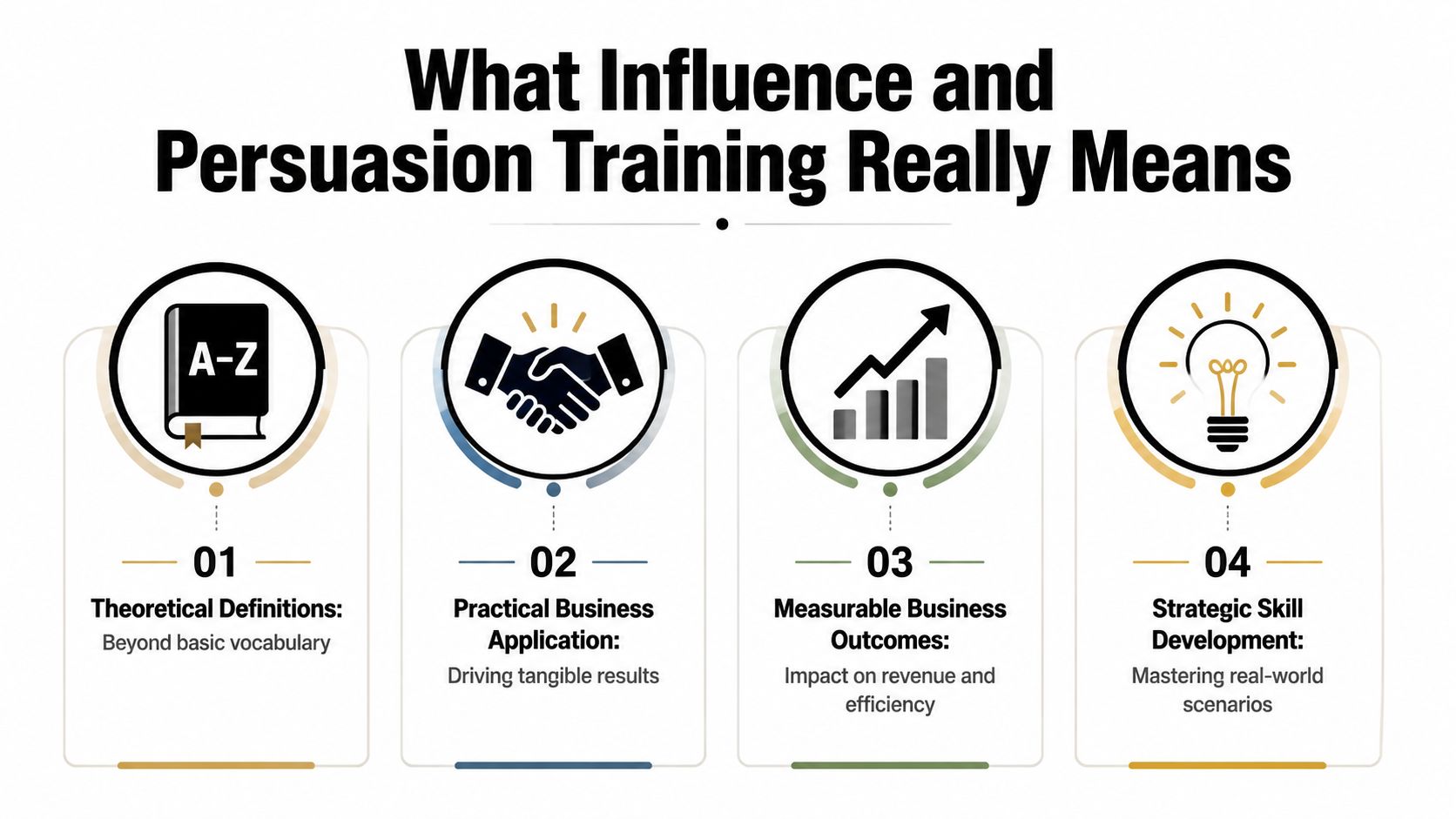
Strong influence and persuasion training usually develops four capacities at once:
- Audience diagnosis: Understanding what the other side values, fears, and needs to hear first.
- Message architecture: Structuring ideas so the business case is obvious early.
- Credibility signals: Using voice, language, and presence to sound like someone people should trust.
- Pressure performance: Staying composed when challenged, interrupted, or rushed.
If you've only learned persuasion as “use better words,” you've been undertrained. The actual work is strategic and behavioral.
According to a 2023 global study by the Harvard Business Review Analytic Services, 87% of senior executives identified “influence without authority” as a critical leadership competency, yet only 43% felt their organizations provided adequate training. Leaders who received formal training reported a 32% higher rate of project approval and stakeholder buy-in (Center for Creative Leadership on persuasion skills).
That gap explains why so many experienced professionals feel stalled. Their organizations expect influence, but don't teach it well.
For a deeper look at communication as persuasion, it helps to think less about sounding impressive and more about making agreement easier.
What doesn't work
The weakest training formats usually focus on surface tactics without context. They teach phrases, negotiation tricks, or body language hacks as if every conversation is the same.
That approach fails in senior environments because executive influence is situational. A board update, a cross-functional disagreement, a budget request, and a stakeholder repair conversation all require different choices.
Strong influence training doesn't teach you to “sound persuasive.” It teaches you to match message, timing, and delivery to the decision in front of you.
For international professionals, this matters even more. Generic programs often assume native fluency, cultural familiarity, and effortless vocal control under pressure. That's not the reality for many talented leaders working in English.
When the training is good, you don't become theatrical. You become more precise. Your message gets shorter. Your authority gets clearer. Resistance becomes easier to handle because you're no longer speaking only from expertise. You're speaking from strategy.
The Four Pillars of Influence for Senior Leaders
Senior influence is not one skill. It's a stack of skills that support each other. If one is weak, the others have to work too hard.
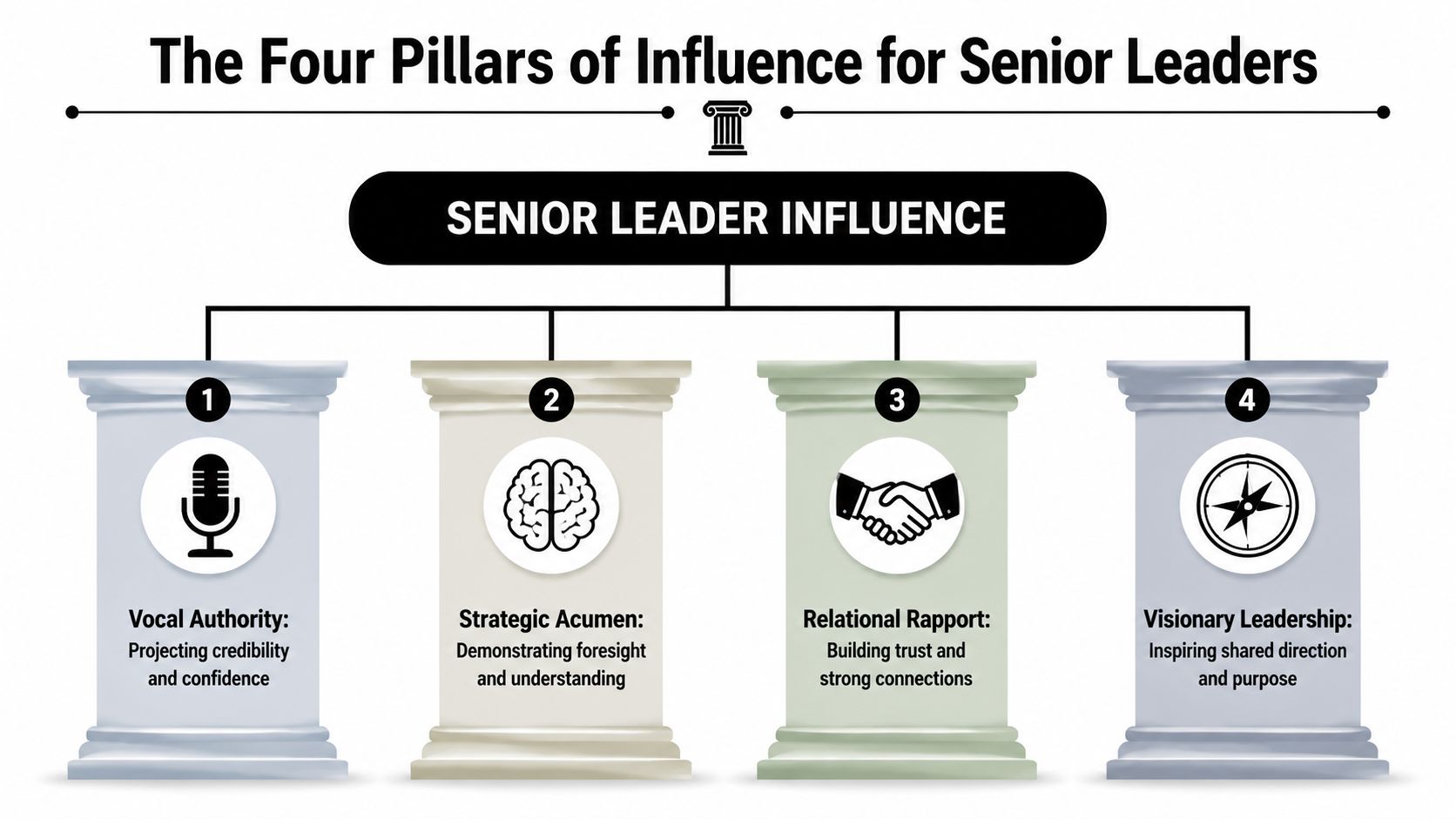
For international professionals, these pillars matter because the room isn't judging only your idea. It is also, often unfairly, judging whether you sound senior enough to lead it. A 2025 Harvard Business Review study on global leadership communication found that 65% of failed negotiations involving non-native speakers were attributed not to the logic of the argument, but to the speaker's inability to modulate vocal authority and body language to signal ethos effectively.
Vocal authority
Vocal authority is the sound of credibility. It includes pace, pause control, projection, tonal variation, and the ability to finish a thought without trailing off.
A common mistake is speaking too fast when stakes rise. Another is softening every recommendation so much that it sounds optional.
Before: “So, I was thinking maybe one possible direction could be to revisit the rollout timing.”
After: “We should adjust the rollout timing. The current sequence increases adoption risk.”
The content shift is small. The authority shift is large.
If you're building visibility as a senior expert, this also affects how people receive your external ideas. That's one reason it helps to understand how to master thought leadership strategy in a way that matches the authority you want to project internally.
A useful way to study this in action is to watch examples of executive delivery and notice where authority comes from.
Strategic framing
Many professionals present recommendations from their own perspective first. Senior leaders do the opposite. They begin with the audience's priorities.
That means you don't lead with effort. You lead with consequence.
- Weak frame: “My team analyzed three options and built a detailed model.”
- Stronger frame: “We have a narrow window to reduce delivery risk before the next investment cycle.”
One sounds like work completed. The other sounds like leadership.
For non-native speakers, framing can break down under pressure because language retrieval gets slower. You know what you mean, but the most strategic phrasing doesn't arrive quickly enough. Such situations require rehearsal to include not just content, but prioritization language.
Executive body language
Body language is not about becoming oversized or performative. It's about removing signals that undermine your authority.
The most common issues I see are collapsed posture, restless movement, over-nodding, and reactive facial expressions when challenged. These behaviors can make a highly competent person appear uncertain.
Use this test: If your words say certainty but your body says permission-seeking, the room will trust your body first.
A senior posture is usually quieter than people expect. Stillness helps. A stable eyeline helps. Intentional gestures help. None of that is cosmetic. It changes how your message is interpreted.
Handling high-stakes conversations
Everything becomes exposed. You can sound polished in prepared remarks and still lose authority in live pushback.
High-stakes communication requires you to:
- Answer without rambling
- Disagree without apology
- Slow down when challenged
- Return to your core point without sounding repetitive
One practical option in this category is The Gravitas Method, a 12-week one-on-one executive presence coaching program for international professionals who want to communicate with more authority and influence at senior levels. The program is priced at $8,200 paid in full or $9,000 across three installments. Coached by Nikola, it covers vocal authority, strategic framing, executive body language, and high-stakes communication.
The key is integration. You don't want isolated tips. You want a repeatable way to sound credible, frame decisively, and stay composed when the room gets difficult.
Measuring Your Growth in Influence
A lot of professionals judge progress too vaguely. They say they feel more confident, or that meetings seem better. That's not enough. Confidence matters, but if you want real return from influence and persuasion training, you need visible evidence in your work.
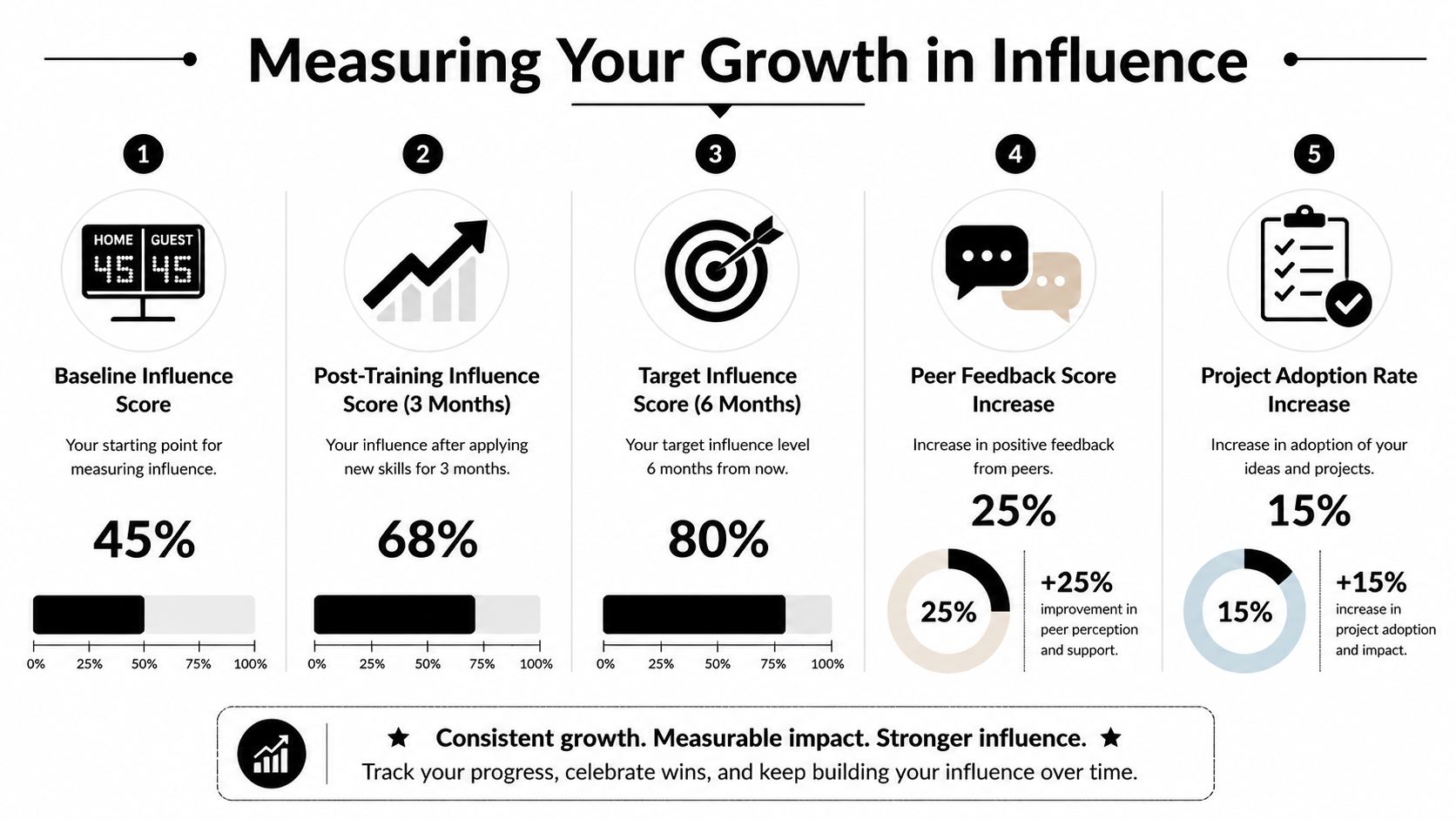
A 2022 longitudinal study from the University of Michigan Ross School of Business found that professionals who completed a 12-week influence training program demonstrated a 41% increase in successful negotiation outcomes and a 36% higher rate of promotion to senior leadership roles compared to a control group (Michigan Ross executive education on persuasion strategies).
The lesson is simple. Good training should change business outcomes, not just self-perception.
Leading indicators you can track weekly
Leading indicators show whether your behavior is changing before the larger career outcomes appear.
- Meeting traction: Are people interrupting you less? Are they letting you complete your recommendation?
- Decision influence: Are leaders asking for your view earlier, before positions harden?
- Message clarity: Can you summarize your recommendation in one or two sharp sentences?
- Pressure control: Do you keep your pace and tone stable when challenged?
These signals often move first. Pay attention to them.
Lagging indicators that matter professionally
Lagging indicators show whether improved influence is changing how the organization responds to you.
| Indicator | What to look for |
|---|---|
| Project approval | More proposals moving forward with less resistance |
| Stakeholder buy-in | Faster alignment across functions |
| Senior visibility | More invitations to present, lead, or represent the team |
| Career movement | Better performance feedback, stretch roles, promotion momentum |
One useful starting point is an executive presence assessment that helps identify where authority is breaking down in actual communication.
Track one behavior metric and one business metric at the same time. For example, pair “fewer filler words in steering meetings” with “faster approval on cross-functional proposals.”
This prevents a common mistake. People work on style in isolation and never connect it to results. Senior leaders won't reward communication improvement because it feels better. They reward it when it improves execution, alignment, and trust.
Choosing the Right Training Format for You
The format matters almost as much as the curriculum. A strong topic delivered in the wrong format often produces small insight and weak transfer.
If you're a senior professional with a specific communication ceiling, generic exposure usually won't solve it. You need to know what kind of learning environment can change your behavior under pressure.
Industry standards for high-stakes communication suggest that executive presence coaching focused on vocal authority and strategic framing typically requires a 12-week duration to produce measurable shifts in senior-level perception, as noted earlier in the discussion of persuasion skill development.
What each format is good for
Some professionals do well with self-study. Others need live correction. The right choice depends on how specific your problem is.
| Feature | Online Course (Self-Paced) | Group Workshop | One-on-One Coaching |
|---|---|---|---|
| Personalization | Low | Medium | High |
| Feedback quality | Limited | Generalized | Direct and specific |
| Accountability | Self-managed | Shared but light | Strong |
| Real work application | Depends on you | Sometimes relevant | Built around your meetings and scenarios |
| Best for | Foundations and theory | Team alignment and shared language | Senior-level behavior change |
Real trade-offs
A self-paced course can help if you need concepts, vocabulary, and a starting structure. It's affordable, flexible, and efficient. It usually doesn't correct delivery habits in real time.
A group workshop can be useful when a team needs a common influence framework. It can also help you hear how others approach persuasion. The downside is obvious. The feedback can't stay with your exact habits for long.
One-on-one coaching is slower, narrower, and more demanding. That's why it works for higher-stakes goals. If your issue is not knowledge but execution under pressure, specific correction matters far more than volume of content.
- Choose self-paced learning if you need a broad introduction and can coach yourself accurately.
- Choose workshops if your organization wants shared language around influence.
- Choose one-on-one support if your reputation, promotion path, or senior visibility depends on changing how you are perceived in live situations.
If you're evaluating remote options, executive presence training online makes sense when it includes personalized feedback, scenario practice, and accountability instead of just recorded lessons.
The central question is not, “Which format teaches the most?” It is, “Which format will change how I show up when the pressure is real?”
Your Next Step to Unlocking Executive Influence
Influence becomes learnable once you stop treating it as charisma. It is a system. You identify the behaviors that weaken your authority, then train the ones that increase trust, clarity, and decisiveness.
For international professionals, this system has to address more than tactics. It has to account for bias, accent perception, hesitation under pressure, and the extra mental load of operating in a second language while trying to sound senior. Generic advice rarely gets that right.
Industry data shows that 78% of successful senior leaders utilize an initial diagnostic to identify specific gaps in delivery before engaging in a 12-week coaching plan, with assessments measuring vocal authority, strategic framing, and body language to determine readiness for board meetings (Business Training Works on influencing skills training).
That is why the smartest first step isn't more random tips. It's diagnosis.
Start with evidence, not guesswork
A strong assessment should show you where communication breaks down in practice:
- Vocal authority: Do you sound steady, clear, and credible?
- Strategic framing: Do you lead with what the audience cares about?
- Body language: Do your nonverbal signals support your message?
- Pressure performance: Can you keep authority when challenged live?
If you're also trying to strengthen your public executive voice, resources like PostNitro's LinkedIn content ideas can help you think more clearly about what you say in visible professional spaces. But internal influence still starts with how you sound and structure ideas in the room.
The most practical next move is a free Executive Communication Assessment. It gives you a concrete starting point by identifying the specific habits that may be costing you authority in senior conversations.
You don't need to become a different person. You need your delivery to match the level of expertise you already have.
When that alignment happens, people stop overlooking your ideas. They stop second-guessing your readiness. They begin to treat you like someone who belongs at the table because you finally sound like you know it too.
If you're ready to stop guessing and start improving the way senior stakeholders experience your communication, Intonetic offers a free Executive Communication Assessment as the entry point. It helps identify gaps in vocal authority, strategic framing, body language, and high-stakes delivery so you can build a focused plan for stronger executive influence.