
Influence and Authority: How Senior Professionals Build Both
You deliver the analysis, solve the difficult problems, and keep international projects moving across time zones. Yet in the executive meeting, someone else presents a simplified version of your recommendation, receives the questions, and gets remembered as the strategic voice. Your work is strong, but your presence doesn't consistently signal seniority.
That gap frustrates high-performing professionals because competence feels like it should speak for itself. In practice, influence and authority determine whether people understand your expertise, trust your judgment, and act on your direction. Senior leadership requires more than being right. It requires making your thinking easy to follow, your decisions credible, and your presence steady under pressure.
Why Strong Performers Still Get Overlooked
A senior product leader once described this pattern to me after a board preparation session. She had built the operating model, identified the commercial risk, and prepared the recommendation. During the meeting, she answered every technical question accurately, but she opened with background details, softened her conclusion, and let a more forceful colleague summarize the decision. The board approved the recommendation, yet the colleague was perceived as the person who had led the discussion.
Nothing was wrong with her expertise. The problem was that her expertise arrived without enough authority in the delivery. She sounded prepared to contribute, not necessarily prepared to own the decision.
That distinction appears often among international professionals. A non-native speaker may choose cautious language to avoid sounding aggressive. A technical expert may explain every dependency before stating the business consequence. A thoughtful manager may wait for an invitation while less qualified colleagues claim the conversational space. These behaviors can protect accuracy and politeness, but they also create an invisible ceiling.
Practical rule: If people have to work hard to find your recommendation, they may remember your effort without recognizing your leadership.
Authority gives your message weight. It signals that you have the expertise, responsibility, and judgment to make a call. Influence helps people accept that call because they understand the reasoning, trust your intent, and see how the decision affects their priorities. Positional authority can secure compliance, but influence earns commitment. Senior professionals need both.
The first correction is not to become louder or imitate an aggressive executive. It's to make your existing capability more legible. Review the guidance on how to be taken seriously at work and ask a sharper question: does your communication make your level of thinking visible?
Executive presence isn't an innate performance style reserved for charismatic people. Research on executive presence identifies behavioral characteristics that shape perceived authority, including confidence, communication ability, engagement, integrity, expertise, and the ability to deliver outcomes. The perception is subjective, but the behaviors that influence it can be observed, practiced, and adjusted.
Understanding Influence and Authority as Distinct Competencies
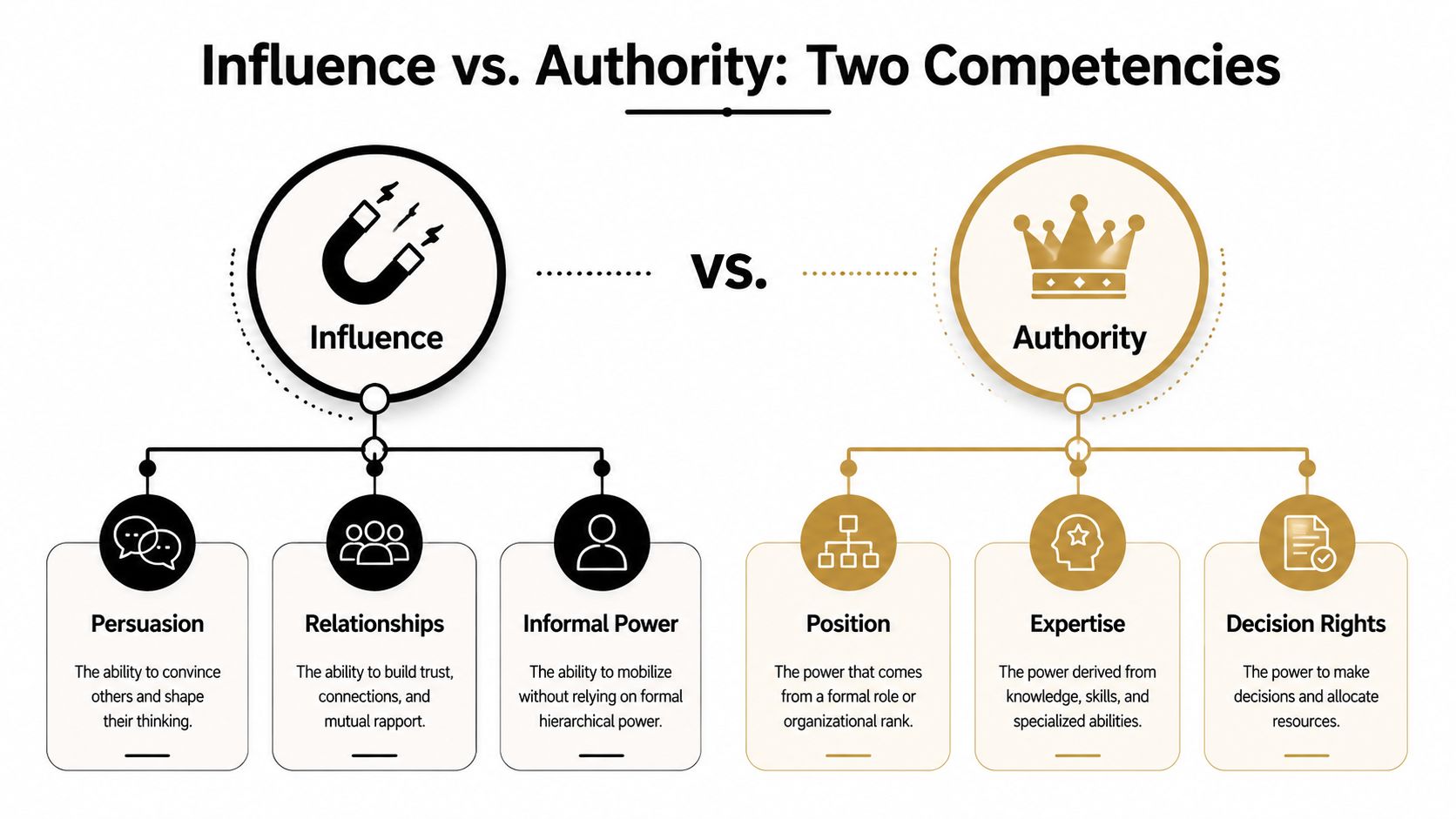
Influence and authority overlap, but they solve different leadership problems. Authority answers, “Why should this person's direction carry weight?” Influence answers, “Why should I engage with this person's direction and help move it forward?”
Authority can come from role, expertise, decision rights, or a consistent record of judgment. Influence grows through relationships, persuasion, credibility, and the ability to connect a recommendation to what other people care about. A director who announces a decision uses authority. A director who helps skeptical stakeholders understand the rationale and commit to execution is using influence.
A 2014 study based on interviews with 34 professionals identified 10 core characteristics that shape perceived executive authority, including projected confidence, communication ability, engagement skills, interpersonal integrity, intellect and expertise, and outcome delivery ability. The study also described executive presence as audience perception, which means a leader can extend influence beyond formal authority when others recognize these qualities. The executive presence study further distinguishes quick first impressions, shaped by cues such as confidence and communication, from judgments that accumulate through repeated interaction.
The three dimensions behind presence
A separate 2014 foundation in leadership research organizes executive presence around character, substance, and style, expressed through 15 behavioral facets. Its framework supports a scientifically validated assessment tool for executive presence and influence, reinforcing a point many technically trained professionals resist: senior authority isn't only positional or intellectual. It's also visible in consistent behaviors that affect whether others follow your lead. The underlying executive presence framework provides a useful lens for diagnosing the gap.
- Character covers integrity, composure, and how people experience your intent.
- Substance includes expertise, judgment, strategic thinking, and the quality of your decisions.
- Style includes voice, language, body language, appearance, and the way you occupy attention.
These dimensions explain why a technically excellent professional can still struggle to gain senior recognition. Substance may be strong, while style obscures it. Or style may look polished while character and judgment remain unproven. For a practical inventory of technical capabilities that should support your leadership narrative, review how to list hard skills on your resume from Resumey.Pro. Your résumé should establish substance, while your presence makes that substance influential in live interaction.
Coqual's executive-presence research found that senior executives said executive presence accounts for 26% of what it takes to get the next promotion. Its framework uses appearance, communication, and gravitas, and was developed through 18 focus groups and about 50 interviews. Coqual's executive presence overview is valuable because it treats presence as a promotion-relevant factor rather than a vague personality preference.
The practical conclusion is straightforward. Don't choose between sounding authoritative and building trust. Use authority to provide clarity and accountability, then use influence to create understanding, ownership, and durable cooperation.
Building Vocal Authority That Commands Attention
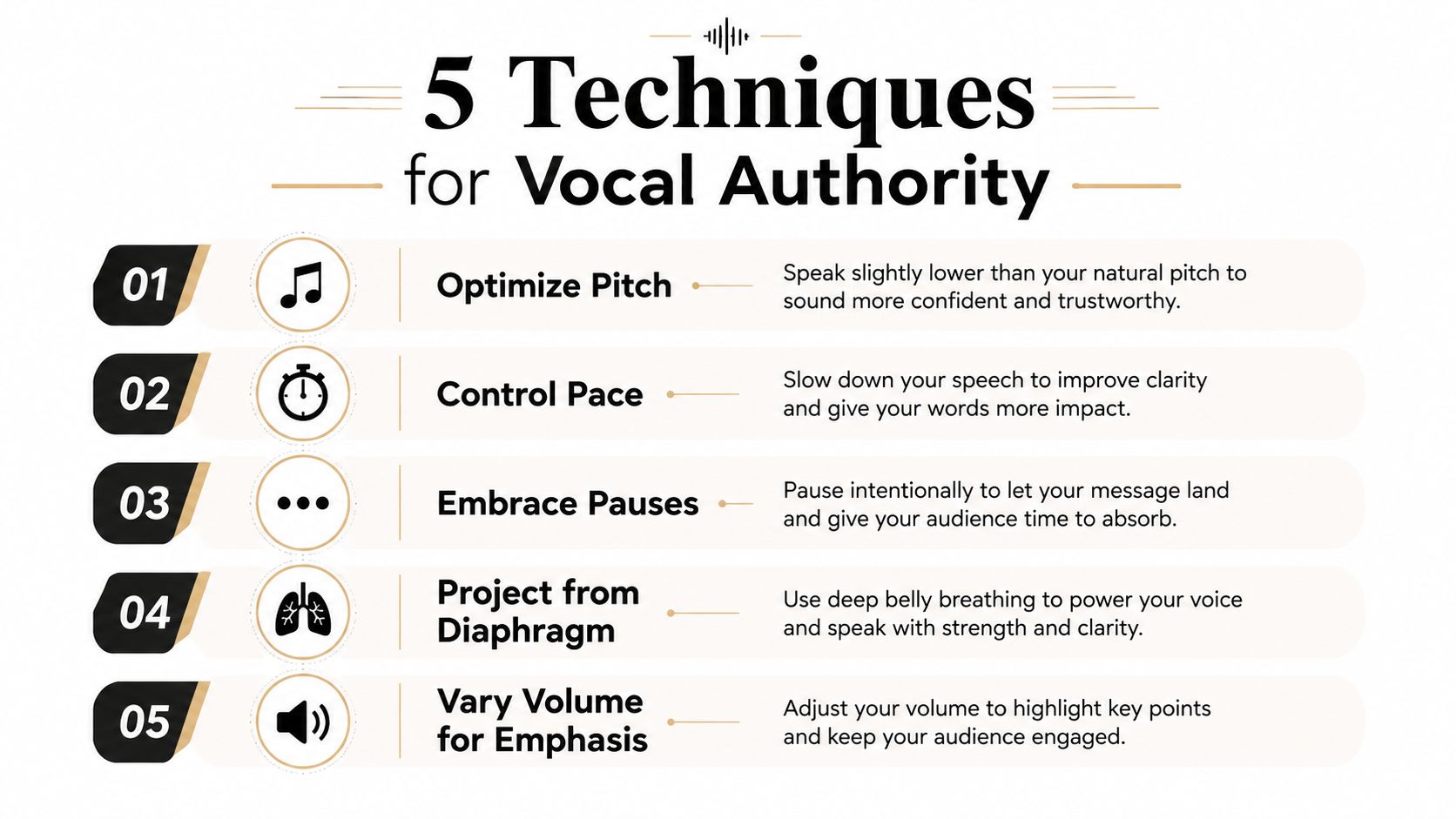
A technically strong recommendation can lose influence when the delivery sounds uncertain, rushed, or difficult to follow. Your voice signals status before listeners have processed the full argument. A meta-review of voice-pitch research found that lower fundamental frequency is generally associated with stronger perceptions of dominance, leadership, and social power, including perceived leadership suitability and dominance judgments in experimental settings. Do not force your voice lower. Artificial deepening creates tension and sounds performed.
For international professionals, the practical priority is comprehensibility, not accent removal. Research on non-native speech indicates that credibility penalties relate less to accent alone than to how easy the speech is to understand. Clear speech, controlled pauses, and a narrower tonal range can support trustworthiness, while poor comprehensibility makes strong expertise harder to perceive. Improve clarity and control without treating your identity as a problem.
A short daily voice practice
Use a brief recording routine. Listen for observable behaviors rather than deciding whether you “sound executive.”
-
Mark the decision. Read a recommendation and underline the sentence containing the conclusion. Say it once with a natural, stable pitch. Repeat it while allowing the final stressed word to finish without an upward inflection.
-
Insert strategic silence. Pause before and after the recommendation. The pause should separate ideas, not break a phrase. If silence feels uncomfortable, count mentally before continuing.
-
Reduce information density. Read a complex explanation in short thought groups. Put one idea in each phrase, then breathe. Senior listeners need a clear hierarchy, not every internal step at once.
-
Practice emphasis through contrast. Repeat one sentence with emphasis on the business consequence, the risk, and the proposed action. Notice how vocal emphasis changes what listeners treat as important.
-
Review for intelligibility. Record a short update and transcribe it manually. Mark words you blurred, swallowed, or connected too quickly. Practise those phrases slowly, then return to conversational speed.
What to measure
Measure whether listeners can identify your recommendation, next step, and key risk without asking you to repeat them. Ask a trusted colleague which sentence sounded most important and whether your pauses felt deliberate or hesitant.
Short-form recording can also help you rehearse concise delivery. These templates for Shorts and Reels provide a useful structure for opening with a point, developing one idea, and closing cleanly, even when the goal is executive communication rather than social media.
For targeted work on clarity, pronunciation, and vocal control, professional voice training can provide feedback that self-recording cannot.
Use the video below to observe how pacing, pauses, pitch, and emphasis work together in professional delivery.
Strategic Framing and Structured Messaging Under Pressure
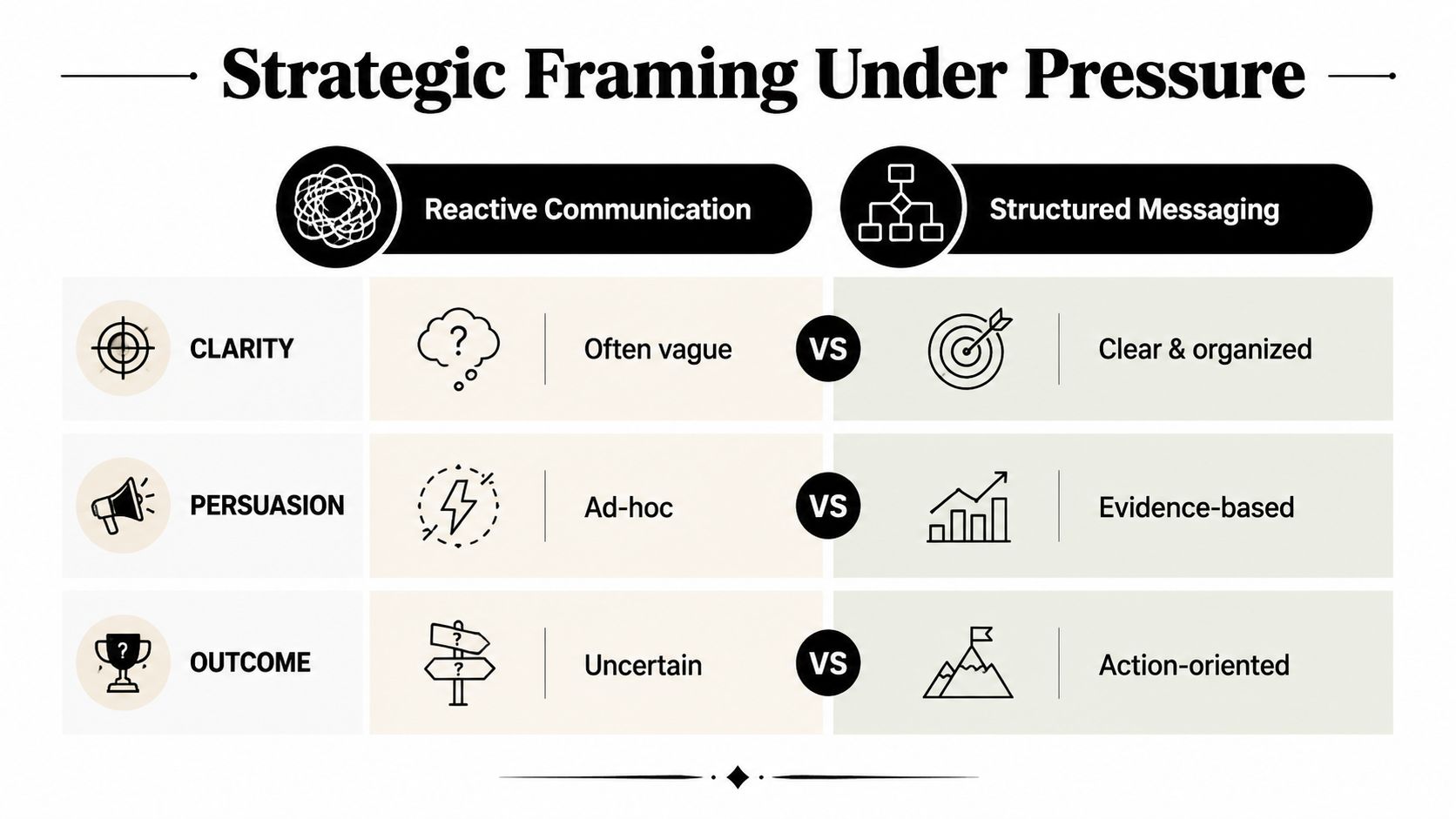
Under pressure, a senior communicator gives the decision-maker a usable frame before providing the full analysis. Technical professionals often begin with their process because the reasoning matters to them. Executives usually need four things first: what changed, why it matters, what you recommend, and what decision or support you need.
Use this sequence when the situation is critical.
- State the situation. Name the business condition in one sentence.
- Explain the implication. Connect it to revenue, risk, customers, capacity, or strategic priority.
- Make the recommendation. Say what should happen and give the reason.
- Clarify the decision. Identify the approval, resource, or action required.
- Name the trade-off. State what the organization gains and what it gives up.
A weak opening sounds like this: “We reviewed several implementation options, and there are some dependencies with the current architecture. The team also has concerns about timing, and we may need to involve security before we move forward.”
A stronger version is: “The current architecture creates a delivery risk for the next release. I recommend moving the integration work into the platform team's roadmap, because that reduces duplication and gives us a clearer ownership model. I need approval to shift the capacity, and the trade-off is a narrower feature scope this cycle.”
The stronger version gives the listener the issue, your judgment, and the decision path in a form they can act on. That is how technical competence becomes visible seniority under pressure.
Language for resistance
Pushback often sends international professionals into excessive explanation. Acknowledge the concern, then state your position and the reason for it.
- Stakeholder: “This sounds expensive and disruptive.”
- Reactive answer: “Yes, there are definitely some costs, although we could perhaps look at different approaches.”
- Structured answer: “You're right that the change has a near-term cost. I still recommend it because the current approach leaves ownership unclear, and that risk will remain in the next planning cycle.”
For upward communication, lead with the executive question: “The decision I need from you is whether we prioritize reliability or feature breadth this cycle.” For a recommendation, use: “My recommendation is X, because Y. The main trade-off is Z.” For disagreement, try: “I see the concern. My assessment differs because the evidence points to A.”
These phrases preserve directness without turning confidence into dominance. Recent research on social influence shows that people do not interpret persuasive, coercive, and authoritative communication consistently. The same technique can be read differently across audiences and contexts, so calibrate directness, humility, and authority rather than applying one universal executive style.
Use a practical guide to structuring a presentation to rehearse the logic before rehearsing the words. Clear structure reduces the amount of work your delivery must do.
Executive Body Language and Digital Presence
A technically strong recommendation can lose force before you finish delivering it. In a boardroom, authority usually looks less like constant movement and more like physical availability. Sit with both feet grounded, keep your chest open, and let your hands rest where they can move naturally. When you state the recommendation, look first at the person who owns the decision, then include the wider group while explaining the reasoning.
Avoid two common errors. Collapsing into the chair can make a capable speaker appear uncertain. Rigid posture, fixed eye contact, or expansive gestures can make the same person look rehearsed or domineering. Senior presence is controlled responsiveness, matching physical signals to the moment rather than performing confidence continuously.

Adjusting for the channel
Hybrid meetings remove many small cues that create connection. Address the camera when making a key point, then look at the screen while listening. Use names selectively, acknowledge a contribution before presenting a different view, and summarize decisions aloud so remote participants do not have to infer what happened from body language.
Before a video call, check four elements:
- Camera position: Place it close to eye level so you are not looking down at colleagues.
- Framing: Keep your head and upper torso visible, with enough space for natural gestures.
- Light: Put the strongest light in front of you, not behind you.
- Background: Remove visual distractions that compete with your face and message.
Your digital presence also depends on how you package expertise in public channels. Research analyzing WHO social media posts the study of digital authority cues found that authoritative claims, personalization, visuals, and hashtags increased affirmative resonance in that setting. Credibility is communicated through more than credentials. Format, interface, and audience attention influence whether expertise is accepted and amplified.
Audit one recorded meeting, if policy allows, or ask a colleague to observe you. Note when you look away, speak over someone, disappear from the conversation, or use gestures that contradict your words. Select one adjustment for the next meeting and review practical guidance on body language on camera before rehearsing it.
Real Transformations From International Professionals
A factual coaching practice has to be honest about evidence. The available information here doesn't provide verified client names, industries, before-and-after percentages, or timelines for individual transformations. Those details shouldn't be manufactured to make executive presence sound more predictable than it is.
What can be stated responsibly is that international professionals commonly work on recognizable patterns. A software leader may have deep technical substance but bury the recommendation beneath implementation detail. A finance professional may provide rigorous analysis but use tentative language when challenging a senior stakeholder. A consultant may build strong relationships yet lose authority when answering unexpected questions because the response lacks a clear structure.
The intervention differs by gap:
- Vocal authority: The professional records key messages, identifies rushed phrasing and unstable endings, then practices pauses, intelligibility, and emphasis.
- Strategic framing: The professional converts detailed analysis into situation, implication, recommendation, decision, and trade-off.
- Executive body language: The professional adjusts posture, eye contact, gesture, and camera setup so the physical message supports the verbal one.
- High-stakes communication: The professional rehearses disagreement, delegation, upward communication, and difficult conversations using real workplace scenarios.
Research on communication needs among senior Hong Kong business professionals shows that workplace communication demands change as professionals move through ranks. Junior-role tasks give way to higher-level communication expectations, which means advancement requires a shift in communicative repertoire, not merely more speaking. The research on senior professional communication needs supports a useful diagnosis: you may be performing the communication your current role rewarded while preparing for a role that evaluates something different.
Meaningful development can begin with a single observed meeting, but durable change depends on consistent application in relevant situations. The goal isn't to perform a borrowed version of confidence. It's to make your judgment, intent, and leadership responsibility easier for other people to recognize.
Your Next Steps to Build Executive Presence
Start with an audit, not a personality makeover. Review a recent meeting, presentation, or difficult conversation and score the experience qualitatively across four areas:
- Vocal authority: Did your voice remain clear and steady when challenged? Did your pauses separate important ideas?
- Strategic framing: Did you lead with the business implication and recommendation, or make listeners assemble the point themselves?
- Executive body language: Did your posture, gaze, gestures, and camera setup support the message?
- High-stakes communication: Could you disagree, delegate, communicate upward, and make a decision without becoming vague or defensive?
Ask two colleagues for specific observations. “How did I come across?” usually produces polite feedback. “What made me sound less senior in that discussion?” produces usable evidence. Ask them to identify one behavior that increased confidence in your judgment and one behavior that weakened it.
Then choose one recurring scenario. Don't work on every communication problem at once. Write the opening sentence you want to use, record it, practice the pause before the recommendation, and prepare one response to likely resistance. Reuse the structure until it becomes available under pressure.
For professionals who want a guided process, The Gravitas Method is a 12-week one-on-one executive presence coaching program for international professionals who want to communicate with more authority and influence at senior levels. The program is priced at $8,200 paid in full or $9,000 across three installments. Coached by Nikola, it covers vocal authority, strategic framing, executive body language, and high-stakes communication. It's designed to connect these elements into one presence system rather than treating them as unrelated soft skills.
The most sensible first step is an assessment. This guide to improving executive presence can help you identify where your current communication creates friction, but an external review is often more revealing than self-diagnosis.
Start with Intonetic's free Executive Communication Assessment to identify the specific vocal, framing, body-language, and high-stakes communication patterns affecting your perceived seniority. Visit Intonetic to explore a focused path from strong performance to clearer influence and authority.