How to Speak with Confidence in English: A Proven Method
You speak in a meeting, make a solid point, and the room stays flat. Two minutes later, a native speaker says almost the same thing and people nod. Most international professionals don't need more ideas. They need their ideas to land with authority.
That's the problem behind searches for how to speak with confidence in English. It isn't usually a vocabulary crisis. It's a delivery problem under pressure. The voice gets faster, the body tightens, the sentence structure collapses, and the message loses force before the content has a chance to do its job.
Confidence isn't a personality trait. It's a communication skill built through repeatable mechanics: how you prepare, how you pace, how you pause, how you frame a point, and how you hold the room while you speak.
The Real Reason You Feel Unheard in English
A lot of professionals assume they feel unheard because their English isn't perfect. In practice, that's rarely the deciding factor in a business setting.
Research shows that 65% of communication effectiveness in business settings is determined by vocal tone, pacing, and body language rather than lexical accuracy, and professionals who master these are perceived 40% more senior by their peers according to EC English's English language statistics summary. That changes the problem completely. If delivery drives perception, then confidence is trainable.
Many international leaders misdiagnose the issue. They keep studying grammar when the visible gap is elsewhere: rushed delivery, weak pauses, low vocal presence, and a body that signals apology instead of authority.
What people often get wrong
Three habits usually make strong professionals sound less certain than they are:
- Overexplaining: You add too much context before the main point.
- Rushing: You speak quickly to avoid mistakes, but speed reduces clarity.
- Hiding physically: Folded arms, dropped chin, and weak eye contact make good ideas look tentative.
If you're not sure which of these shows up in your own communication, a practical starting point is this HR communication skill assessment, which helps you identify whether the friction is in clarity, delivery, or interaction style.
There's another layer too. Some professionals internalize negative feedback that was never really about competence. If that pattern sounds familiar, it's worth understanding accent bias in the workplace, because many people confuse biased perception with lack of ability.
Practical rule: Stop asking, "Was my grammar flawless?" Start asking, "Did I sound clear, steady, and easy to follow?"
The people who sound confident in English aren't always the most advanced speakers. They're often the ones who make their message easier to process.
Master Your Mindset Before You Speak a Word
The biggest confidence problem isn't language. It's anticipation of failure.
A 2022 British Council study found that 78% of non-native English professionals attribute their lack of confidence to fear of failure, not vocabulary. Those who prepared 5–10 keyword anchors before speaking reported a 47% reduction in speech anxiety in the British Council guidance on becoming a confident speaker.

That finding matches what shows up in real meetings. People don't go silent because they know too few words. They go silent because they believe one imperfect sentence will damage how others see them. Then they try to compensate by scripting too much, and the script breaks the moment the conversation shifts.
Replace scripts with anchors
Full scripts create fragility. Keyword anchors create flexibility.
Before a meeting, write down 5 to 10 words or short phrases that represent the structure of your point. Not full sentences. Not polished paragraphs. Just the verbal stepping stones that keep your thinking organized.
A simple set might look like this:
- Problem: delayed launch
- Cause: approval bottleneck
- Impact: customer confusion
- Recommendation: single owner
- Next step: decision today
With anchors like these, you're no longer trying to remember exact wording. You're remembering direction. That lowers pressure and makes you sound more natural.
Fix the inner commentary
Most nervous speakers run a private loop in their head:
- Negative prediction: "I'll mess this up."
- Status fear: "They'll think I'm not senior enough."
- Language panic: "I need the perfect word."
That loop needs a replacement. Use short, credible self-talk that points to capacity, not fantasy.
Examples that work better:
- Grounded reminder: I know this topic well.
- Communication priority: Clarity matters more than perfection.
- Recovery mindset: If I miss a word, I can rephrase and continue.
If nerves spike before a presentation or meeting, these techniques pair well with practical routines like the ones in this guide on how to calm nerves before a speech.
Confidence grows faster when you stop treating mistakes as proof and start treating them as data.
What works and what doesn't
A quick comparison helps.
| Approach | What happens |
|---|---|
| Memorizing full paragraphs | You sound rigid and lose control when interrupted |
| Preparing keyword anchors | You stay structured but flexible |
| Trying to eliminate all mistakes | You become tense and cautious |
| Accepting minor mistakes while staying clear | You sound more composed and credible |
The trade-off is simple. Perfection feels safe before you speak, but it often makes you less effective when the conversation becomes real.
Engineer Your Vocal Authority
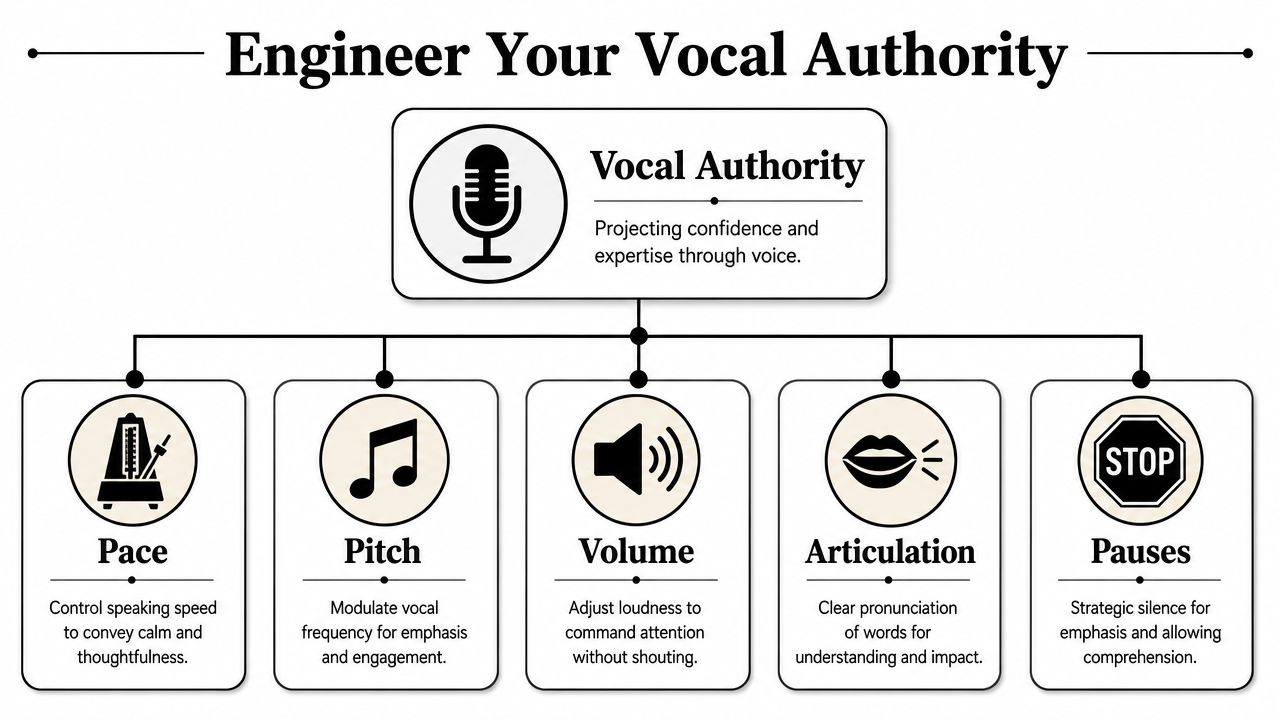
People decide whether to trust your delivery before they fully evaluate your content. Your voice carries rank signals. If it sounds thin, rushed, or uncertain, the room reads that quickly.
IMD's executive presence coaching guidance recommends that leaders use voice control and pacing, speaking clearly and deliberately while incorporating strategic pauses to emphasize key points and control conversation flow, as outlined in IMD's article on executive presence.
Start with breath support
If your breath is shallow, your voice will usually sound unstable. That's when people trail off at the end of sentences, speak too softly, or rush because they don't have enough air.
Use a simple drill:
- Inhale low: Let the breath expand your lower ribs and abdomen.
- Exhale on voice: Speak one sentence on the out-breath.
- Finish cleanly: Don't squeeze the last words.
Practice with short business statements:
- The key issue is timing.
- My recommendation is to simplify the decision path.
- We need alignment before launch.
This doesn't make you theatrical. It makes you audible and steady.
Control pace instead of chasing fluency
Fast speech often comes from anxiety, not skill. Slowing down feels uncomfortable because silence feels risky. But in professional settings, measured pace usually reads as thoughtfulness.
Use this drill for two minutes a day:
- Read slowly on purpose: Go slower than feels natural.
- Mark key words: Stress the important nouns and verbs.
- Insert a brief pause: Pause after your main point, not before it.
For many non-native professionals, this is the fastest way to sound more senior. You're giving listeners time to process, and you're signaling that you don't need to race for approval.
Use pauses as a status signal
Weak speakers fill silence. Strong speakers use it.
A pause works in three places:
- Before the conclusion: "My recommendation is this. [pause] We assign one decision-maker."
- After a key point: It gives the room time to absorb the idea.
- When searching for language: Pause instead of using filler.
If you often present online, clean audio matters too. Poor sound makes even good delivery seem less polished. For remote meetings, this practical guide to clearer audio and reducing background noise helps remove distractions that weaken vocal presence.
A pause is only awkward when you look apologetic during it.
Train articulation without sounding forced
Many professionals overcorrect and start punching every syllable. That creates stiffness. Better articulation is simpler than that. Open your mouth enough, finish consonants clearly, and separate ideas into phrases.
A strong daily routine is:
- Warm up with short read-alouds
- Record one minute of business language
- Review for dropped endings, blur, and speed
- Repeat with cleaner phrasing
If you need focused drills for voice stability, projection, and speech clarity, structured vocal therapy exercises can help build the muscle control behind a stronger speaking voice.
Frame Your Ideas for Maximum Impact
A confident speaker doesn't just sound better. They think in cleaner units.
Under pressure, two things usually happen. Some professionals freeze because they're searching for the perfect word. Others keep talking until the point disappears. Both patterns make listeners work too hard.
Think in chunks, not paragraphs
One of the most useful methods for high-pressure speaking is chunked planning. Instead of mentally drafting a long response, break your message into the next thought only.
That might sound like this in a meeting:
- We have one core problem.
- The current process creates delay.
- The commercial risk is growing.
- I see two realistic options.
- My recommendation is option one.
This structure matters because speech is linear. The audience can only process one idea at a time. When you think in chunks, your delivery becomes easier to follow and easier to recover if you lose a word.
Working line: Don't plan twenty minutes of language. Plan the next sentence.
Replace fillers with structure
Replacing filler words like "um" and "like" with intentional pauses projects confidence and steadiness under pressure, a tactic highlighted in this discussion of Sylvia Hewlett's three-pillar model.
That change is small but powerful. Filler tells the room you're losing control of the thought. A pause tells the room you're choosing your words.
Use sentence starters that let you stay composed while you think:
| Situation | Better phrase |
|---|---|
| You need to clarify | What I mean is… |
| You need to disagree | I see it differently for one reason… |
| You need time | Let me think about that for a moment. |
| You lost a word | The simpler way to say it is… |
| You want to redirect | The main issue is… |
These phrases reduce panic because they give you a stable opening. Once the first few words are out, the rest of the idea usually follows.
Build persuasive shape into every answer
A strong response usually needs three parts:
- Point
- Reason
- Next move
For example:
- Point: I don't think we should expand the scope this quarter.
- Reason: The team is already carrying delivery risk.
- Next move: I'd keep the target narrow and revisit after launch.
That's a persuasive structure, not just a language trick. If you want to strengthen this further, the principles in communication as persuasion are useful because they train you to frame ideas around decisions, not just descriptions.
What doesn't work is speaking in circles while hoping confidence will appear halfway through the sentence.
Command the Room with Executive Presence
Voice matters, but the room also reads your body before you finish your first line. Executive presence isn't cosmetic. It's a visible cue that tells people whether to treat your message as leadership.
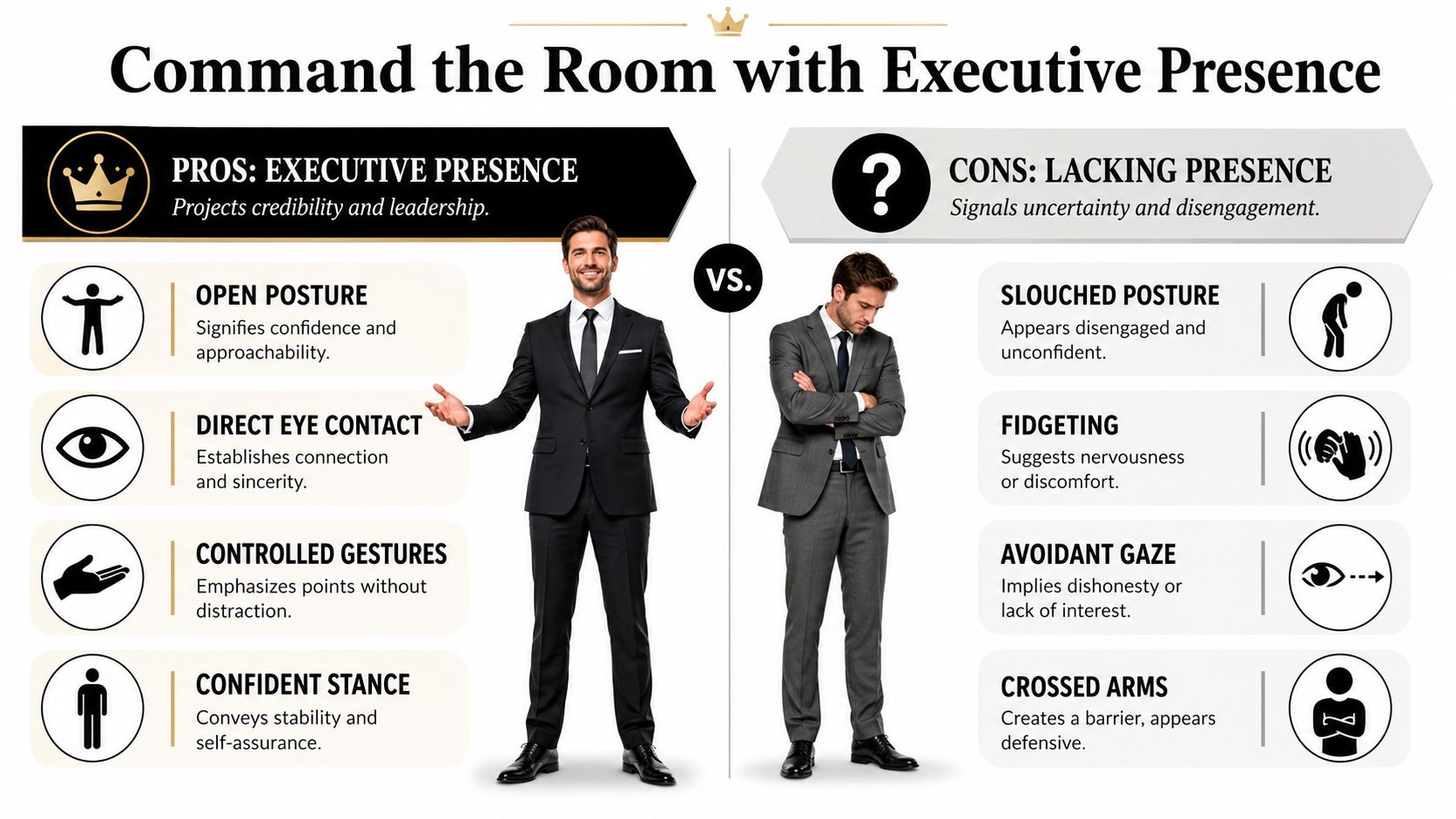
Sylvia Hewlett's Center for Talent Innovation study found that senior leaders weigh gravitas at 67% of executive presence, with gravitas defined by confidence, decisiveness, and emotional intelligence, as summarized in this analysis of executive presence.
Do this, not that
Use this as a working checklist.
- Open posture, not collapse: Stand or sit tall with space across the chest. Don't fold inward or shrink your frame.
- Purposeful gestures, not busy hands: Let gestures underline key points. Don't fidget, touch your face, or keep adjusting your clothes.
- Steady gaze, not avoidance: Hold eye contact long enough to finish a thought. Don't look down the moment you say something important.
- Grounded stance, not sway: Keep your body still when making a decision statement. Don't rock or shift constantly.
A good visual presence also extends beyond live meetings. If your role involves leadership bios, speaking events, or investor-facing materials, polished images help support a senior impression. For that, executive headshots for professional profiles can be a useful practical resource.
Here is a short video example you can study for posture, presence, and delivery cues:
Read the room while you speak
Confident speakers don't just deliver. They observe.
Watch for:
- Leaning in: engagement
- Still faces and note-taking: concentration, not necessarily disagreement
- Side glances or laptop shifts: lost attention or skepticism
- Interrupted breathing before someone speaks: a likely objection coming
That lets you adjust in real time. Slow down. Clarify. Shorten the sentence. Ask a direct question.
For professionals who want a structured way to work on this, The Gravitas Method is a 12-week one-on-one executive presence coaching program for international professionals who want to communicate with more authority and influence at senior levels. The program is priced at $8,200 paid in full or $9,000 across three installments. Coached by Nikola, it covers vocal authority, strategic framing, executive body language, and high-stakes communication.
Your 12-Week Practice Blueprint for Measurable Progress
Confidence improves when practice has a target. Random exposure helps, but targeted repetition changes behavior faster. You need a progression that moves from low-stakes drills to live application.
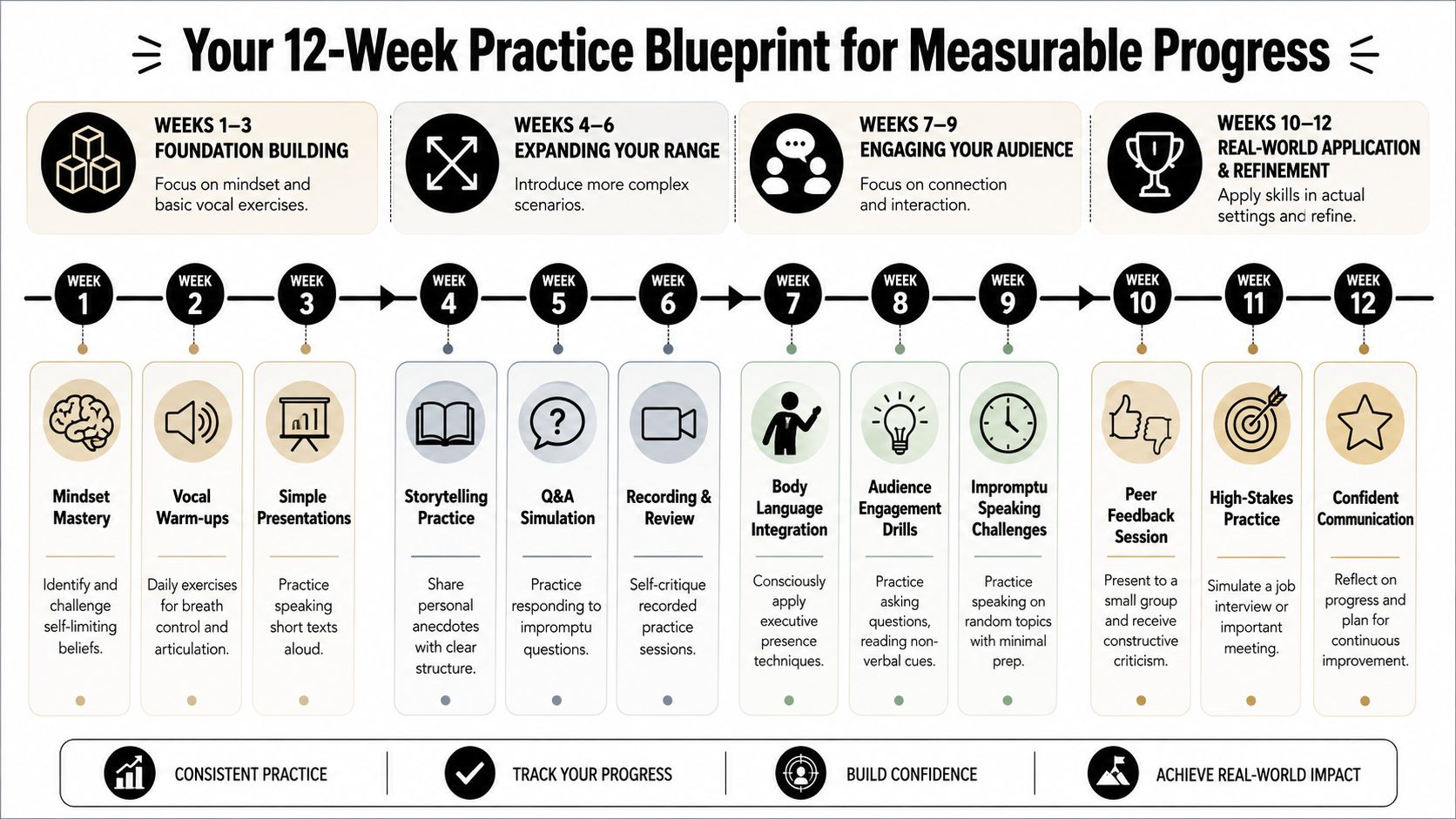
A useful principle here is repetition, reflection, and feedback. Practice the skill, review what happened, then get input from someone who can accurately assess clarity, presence, and delivery. If you want more speaking reps outside formal presentations, this guide to business English speaking practice gives you practical ways to create them.
The operating rules for the full 12 weeks
Keep the process strict enough to produce change:
- Record often: Your ear needs evidence, not guesswork.
- Practice aloud: Silent preparation doesn't build delivery skill.
- Track one variable at a time: Don't try to fix pace, posture, phrasing, and pronunciation in one drill.
- Use real scenarios: Practice with updates, objections, recommendations, and disagreement.
12-Week Confident Speaking Blueprint
| Weeks | Core Focus | Key Drill | Measurable Milestone |
|---|---|---|---|
| Weeks 1-2 | Mindset and speaking awareness | Record short answers to common work questions and review for tension, speed, and hesitation | You can identify your top three breakdowns consistently |
| Weeks 3-4 | Breath and pacing | Read business material aloud slowly for two minutes daily with clean sentence endings | Your speech feels more controlled and less rushed in recordings |
| Weeks 5-6 | Keyword anchors and chunked planning | Prepare short meeting responses from keywords only | You can speak for one minute without relying on a script |
| Weeks 7-8 | Pauses and filler replacement | Deliberately replace fillers with silence in mock answers | Fillers become less frequent and pauses sound more intentional |
| Weeks 9-10 | Body language and eye contact | Practice project updates standing or on camera with still hands and direct gaze | Your physical delivery looks more composed on video review |
| Weeks 11-12 | High-stakes simulation | Rehearse disagreement, recommendation, and Q&A scenarios with feedback | You can recover from interruption or wording mistakes without losing structure |
Sample drills for difficult moments
Use live language, not classroom language.
Project update drill
Say this out loud:
We have one delay risk, and it's concentrated in approvals. My recommendation is to assign one owner so decisions move faster this week.
That sentence trains brevity, authority, and structure.
Disagreement drill
Try this pattern:
- I see the goal.
- I disagree with the current approach.
- The risk is execution, not intent.
- I'd suggest a smaller rollout first.
That works better than hedging for thirty seconds before saying your view.
Recovery drill after a mistake
Panicking after one language slip can lead to three more. Train the reset line:
- What I meant to say was…
- Let me rephrase that.
- The clearer point is this…
Those phrases keep momentum. They stop your brain from locking onto the error.
Troubleshooting common setbacks
A few issues show up almost every week.
| Problem | Adjustment |
|---|---|
| You still rush in meetings | Start slower than you think you need to |
| You lose words mid-sentence | Return to chunked planning and shorten the thought |
| You sound flat on video | Add clearer stress to key words and finish sentences fully |
| You freeze when interrupted | Pause, acknowledge, then restate the main point in one line |
The deeper shift usually happens when you stop treating confidence as mood and start treating it as system design. You rehearse the mechanics until they hold under pressure. That's when other people begin to hear the seniority that was already there.
If you want a clear diagnosis of what is weakening your delivery, start with Intonetic's free Executive Communication Assessment. It's the most useful first step if you want specific feedback on vocal authority, strategic framing, body language, and how you come across in high-stakes English conversations.