
How to Negotiate in English with Confidence and Authority
You know the moment. The meeting is going fine, then the other side pushes back on price, timeline, or scope, and your brain starts working harder than your mouth. You know what you want to say, but finding the words in English fast enough feels like a second negotiation happening inside your head.
That's where many non-native professionals lose ground. Not because their ideas are weak. Not because their English is poor. They lose ground because hesitation gets misread as uncertainty, and over-explaining gets misread as low authority.
A strong negotiator in English doesn't sound perfect. A strong negotiator sounds clear, deliberate, and hard to rush. That matters more than accent, and often more than advanced vocabulary. If you're learning how to negotiate in English, focus less on sounding impressive and more on controlling the structure of the conversation.
A Harvard Business School study found that 98% of negotiators are not naturally gifted but learn through practice, and that people who receive formal training increase their pay by an average of 13% compared with those who don't, according to this summary of Harvard negotiation findings. That should reset your expectations. Negotiation skill is built, not inherited.
For many professionals, confidence improves once they stop trying to improvise every sentence. If speaking under pressure is the weak point, building confidence in English conversations is part of negotiation prep, not a separate skill.
Introduction to Negotiating in English
Negotiating in English usually breaks down at predictable moments. The opening is often manageable. Small talk is familiar. Agenda-setting is fine. Then actual bargaining starts, and language pressure rises fast.
A procurement lead hears, “That budget won't work for us.” A founder gets, “We need more flexibility before we can commit.” A senior manager is told, “We can approve the promotion, but not at that compensation level.” In each case, the problem isn't knowing the subject. The problem is responding with authority before silence turns awkward.
What authority sounds like
In English negotiations, authority often sounds like short sentences, concrete numbers, and a calm pace. It doesn't sound like filling every gap with “maybe,” “I think,” or “sort of.” It doesn't sound like talking longer to prove fluency.
Speak to move the deal forward, not to prove your English level.
Most negotiations follow a simple sequence:
- Preparation: decide your target, fallback position, and phrasing
- Opening: build rapport and set the frame
- Proposal: state your ask clearly
- Pushback: hold ground without becoming defensive
- Closing: confirm terms and next steps in precise language
What non-native speakers need to watch
The biggest trap is the hesitation penalty. When a non-native speaker pauses visibly during a counter-offer, people may read that as indecision rather than processing. That's unfair, but it's common in executive settings. The fix isn't to speak faster. The fix is to make your pauses look intentional.
Body language matters here too. Sit still. Keep your shoulders open. Hold eye contact long enough to finish the point. If you're taking notes, don't drop your head for too long right after hearing a difficult offer. That posture can signal retreat before you've even answered.
Preparation Strategies for English Negotiations
Ten minutes before the call, a buyer asks for revised pricing. You know your numbers. Then you start translating your response in your head, and the pressure rises. That is the moment preparation has to carry you.
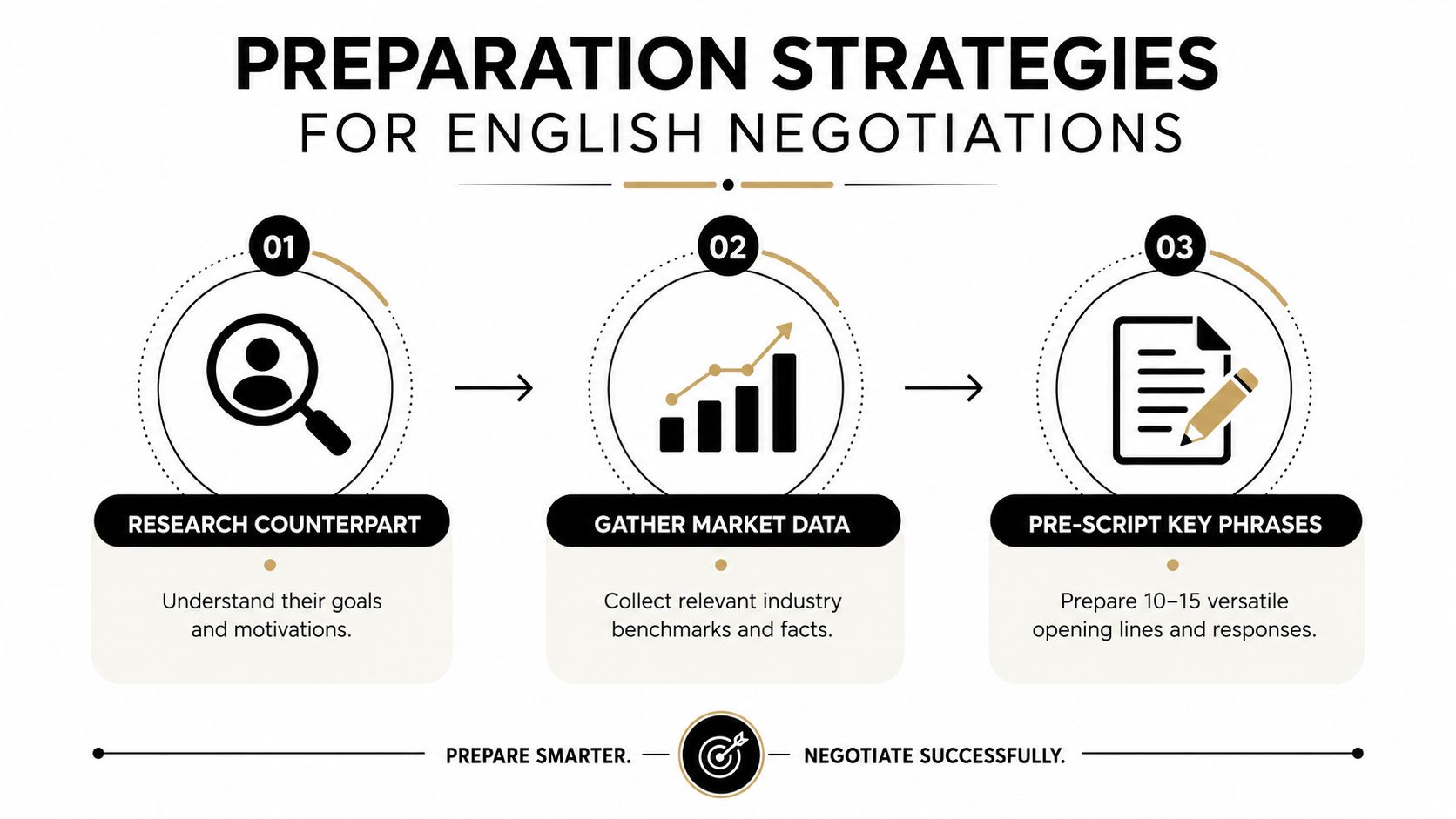
Strong preparation for English negotiations has two tracks. One is commercial. The other is linguistic. If either track is weak, fluency drops under pressure and you start paying the hesitation penalty.
Build a phrase bank you can actually use under pressure
A practical method taught in workplace English programs is to prepare short phrase banks by function instead of memorizing a full script. That works because negotiation rarely follows a script. It moves in stages, and each stage needs a different kind of sentence.
Prepare lines for these moments:
- Framing the discussion: “Before we get into numbers, I'd like to clarify priorities.” “It would help to align on scope first.”
- Stating your position: “Our proposed structure is as follows.” “We can offer this at the current volume.”
- Buying thinking time: “Give me a moment to assess that.” “Let me think that through.”
- Resisting pressure: “We can be flexible on delivery dates, but not on quality standards.” “That level would be difficult for us to approve.”
- Testing options: “If we adjust the term, would you be open to revisiting price?” “What would make this workable on your side?”
- Confirming terms: “Let's confirm what we've agreed so far.” “I'll summarize the points in writing after the meeting.”
Keep each line short enough to say without searching for grammar.
Word choice matters too. Small vocabulary upgrades can make you sound clearer and more precise. A list of tier-2 words for clearer professional English helps if your negotiation language feels basic or repetitive.
Prepare by stage, not by topic
Non-native professionals often prepare facts in one document and language in another. In live negotiation, that separation breaks down. A better approach is to prepare one sheet that follows the actual flow of the conversation.
I use five stage prompts:
| Stage | What to prepare |
|---|---|
| Before the ask | Your objective, your preferred outcome, and the one sentence that frames the discussion |
| First proposal | Your exact opening number, structure, or terms |
| Expected resistance | The top three objections you are likely to hear |
| Counter-response | One calm sentence for each objection, plus one question to test flexibility |
| Final confirmation | The exact wording you will use to restate agreement and next steps |
English-specific preparation pays off. Instead of thinking, translating, and deciding at the same time, you reduce the load to choosing from prepared options.
Decide your limits before the meeting starts
Many weak concessions happen because the speaker has not separated three things clearly enough: target, fallback, and walk-away point.
Write them down in plain English.
- Target: the result you want
- Fallback: the adjustment you can accept without hurting the deal
- Walk-away point: the condition that makes the deal unacceptable
That distinction changes your language. If delivery date is flexible but price is fixed, say so directly: “We have room to discuss timing. We do not have room to reduce the fee further.” If scope can move but contract length cannot, prepare that sentence before the call, not during it.
Good negotiators do not prepare one polished answer. They prepare decision branches.
Rehearse the pause so it looks deliberate
For non-native speakers, silence after a counteroffer can be misread. Preparation should include the pause itself.
Practice this sequence out loud:
- Hear the offer.
- Hold eye contact for one second.
- Use a buffer line: “Let me consider that.”
- Breathe once.
- Give your response.
Body language matters here. Keep your shoulders open. Nod once to show you heard the point. If you need to write, jot a brief note and look back up quickly. Looking down for too long after a difficult number can make your position sound weaker than it is.
Use a one-page prep sheet
Your prep sheet should stay short enough to scan during the meeting. If it runs to three pages, you will stop using it.
Include:
- the outcome you want in one sentence
- your first offer in exact wording
- your fallback options
- your stop point
- three likely objections
- three response lines
- one sentence that explains your value
- one sentence that closes the agreement clearly
Formal training improves this skill over time, as noted earlier in the article. The practical lesson is simpler. Negotiation in English is learnable when you prepare language for the specific stage you are entering, and when you rehearse the sentences until they come out under pressure.
Opening Moves in English Negotiations
You join the call on time. The other side asks one friendly question, then turns to price within sixty seconds. For many non-native professionals, that shift is where the hesitation penalty starts. The English is good enough, but the opening sounds softer than the position itself.

Start warm, then set the frame
The opening stage in English has a specific job. Build enough rapport to lower tension, then move clearly into structure before the discussion starts drifting. Analysts at WiFi Talents found that small talk before substantive negotiation increases trust, and that strategic pauses can improve concession rates. Both matter in the first few minutes because they affect how your English is interpreted under pressure.
Use a sequence like this:
- Rapport: “I hope your week's been going well.”
- Context: “I'm glad we could get everyone together.”
- Frame: “I'd like to use our time to review scope, timeline, and commercial terms.”
- Control: “If that works for you, I'll start with scope so we're discussing the same deliverables.”
That last line matters. It sounds cooperative, but it also sets order. In real negotiations, the side that sets order often shapes the outcome.
If your small talk tends to sound rehearsed, review these small talk topics for professional conversations. They help you sound natural without wandering into personal or awkward territory.
Let your body language support your English
Opening authority is not only verbal. Non-native speakers often lose force by looking down too early, smiling through disagreement, or speaking while still arranging notes.
Use simple cues:
- sit or stand upright with relaxed shoulders
- look at the other side when you state your agenda
- nod once when they speak, not repeatedly
- keep your hands still when giving your opening number
- pause before your first proposal instead of explaining it too soon
These details change how your words land. A calm pause with steady eye contact sounds prepared. A rushed explanation sounds negotiable before the discussion has even started.
State the opening position in one clean sentence
Your first proposal should be easy to say and easy to hear.
Try this:
“Based on the scope and delivery requirements, our proposal is 185,000.”
Pause.
“That reflects the level of support required on our side.”
Many professionals damage their opening by adding defensive language after the number. In English, extra words often signal uncertainty even when the commercial logic is sound.
Compare the difference:
- Weaker opening: “We were thinking maybe something around 185,000, but of course we can discuss and be flexible depending on what you had in mind.”
- Stronger opening: “Our proposal is 185,000. That aligns with the scope, delivery timeline, and support required.”
The trade-off is real. A shorter sentence can feel blunt, especially if your natural style is polite and indirect. Keep the courtesy in your tone and structure, not in unnecessary softening around the number.
Drill the first ninety seconds
I advise clients to practice the opening as a script, not because they should sound robotic, but because the first stage is where hesitation costs the most.
Use this drill out loud:
- Greet the other side.
- Make one sentence of small talk.
- Set the agenda in one sentence.
- State your opening position in one sentence.
- Hold a two-second pause.
- Add one value sentence only.
If you can deliver those six moves without rushing, your English will sound more senior, more controlled, and harder to push off course.
This short video breaks down some of the delivery choices that help with that shift.
Crafting Proposals and Responding to Pushback
You state the proposal clearly. The other side replies, “That's higher than we expected.” Many non-native professionals lose control at that moment, not because their offer is weak, but because hesitation shows up in their English before their reasoning does.
A strong proposal in English usually has three parts: the term, the business reason, and a pause. That pause matters. If you keep talking, you often start discounting your own position.
Build proposals in short, firm sentences
Use a simple pattern:
- State the proposal: “Our fee is 185,000.”
- Give the basis: “That covers implementation, training, and post-launch support.”
- Hold the pause: Stop for two seconds and let them respond.
That structure works well in English because it sounds settled without sounding aggressive. It also helps non-native speakers avoid the hesitation penalty. Long run-up sentences, nervous laughter, and extra justification make the other side hear uncertainty first and value second.

Compare these versions:
| Less effective | Stronger |
|---|---|
| “I think we could maybe do Friday.” | “We can deliver by Friday.” |
| “We're sort of looking for a higher budget.” | “We're looking for a higher budget.” |
| “Maybe we can consider another structure.” | “A different structure would work better here.” |
Delivery changes the impact. Keep your chin level, shoulders still, and palms relaxed on the table or desk. If your voice rises at the end of the sentence, the proposal can sound like a request for approval instead of a business position.
Respond to pushback without rushing
Pushback is normal. Speed is the problem.
When someone challenges price, timing, or scope, buy a little thinking time with language that sounds composed:
- To slow the pace: “Let me look at that for a moment.”
- To acknowledge the concern: “I understand the budget pressure.”
- To protect your position: “That number reflects the delivery timeline and support level.”
- To redirect the discussion: “If budget is fixed, we should adjust scope.”
- To keep the tone constructive: “Let's find a structure that works for both sides.”
I coach clients to pair those lines with one physical cue. Breathe once before answering. That single beat reduces filler words and stops the instinct to over-explain.
If you want more phrasing for commercial objections, these objection-handling phrases for sales and negotiation are useful practice material.
If your first answer to pushback runs longer than twenty seconds, you are probably giving away ground.
Hold one argument at a time
A common mistake is stacking every possible defense into one reply. Price, quality, team experience, urgency, service, market rates. Once that starts, your English gets crowded and your point gets weaker.
Pick one line and make it clean:
- “The price reflects the speed of delivery.”
- “That timeline requires extra support from our side.”
- “We can meet the budget if we reduce the scope.”
- “The current structure gives you faster approval and less implementation risk.”
This is a real trade-off. Short answers can feel exposed, especially if you are used to proving your credibility with detail. In negotiation, though, too much detail too early often sounds defensive. Give one reason first. Add more only if they ask.
Use a simple drill for difficult objections
Practice these three stages out loud:
- Acknowledge: “I see why that feels high.”
- Re-anchor: “Our fee is based on the delivery window and support required.”
- Redirect: “If cost is the priority, we can revise the scope.”
Repeat the drill until the wording feels natural at normal speed. Then practice it again while looking at the camera or a colleague, with a two-second pause after stage two. That is how you train English that sounds calm under pressure, not memorized.
Closing Techniques in English Negotiations
You finish the call. Everyone sounds positive. Then the follow-up thread starts, and one side says the timeline was tentative, the other says pricing was agreed, and nobody owns the next step. That usually happens in the last three minutes.
Closing in English is its own stage. For non-native professionals, the risk is not only unclear terms. It is the hesitation penalty. If your voice trails off, your summary gets too long, or your final question sounds unsure, the other side often treats the agreement as flexible.
Close by naming the deal in three parts
Use short, controlled sentences at the end of the conversation. One sentence for the decision. One for ownership. One for timing.
- Decision: “To confirm, we're aligned on the revised scope and the delivery date.”
- Ownership: “Your team will send the updated draft by Thursday.”
- Timing: “Once we receive that, we'll approve internally on Friday.”
This structure works because it leaves less room for polite ambiguity, which is common in English business meetings. It also helps you stay fluent under pressure. Long summaries often create new confusion.
Sound firm without sounding aggressive
Tone and body language matter here. Sit still before the final summary. Keep your hands visible. Maintain eye contact for a beat after each key sentence. Then stop talking.
A practical target is a steady pace with brief pauses after each commitment point. SpeakFect's guidance on building gravitas is useful on delivery, but the main principle is simple. Calm speech sounds more credible than fast speech, especially when you are speaking in a second language.
A strong close often feels slightly blunt to the speaker and reassuring to the listener.
That discomfort is normal.
Ask for confirmation with direct English
After the summary, ask a confirmation question that expects a real answer. Avoid soft endings like “if that's okay” or “I guess we can proceed then,” because they reopen the negotiation.
Use one of these instead:
- “Are we aligned on that?”
- “Can we treat that as agreed?”
- “Is anything still open from your side?”
- “Are you comfortable confirming those next steps now?”
The trade-off is real. Softer phrasing can feel more polite, but it also makes the close weaker. In cross-border business English, clarity usually serves the relationship better than excessive cushioning.
Put it in writing the same day
A verbal close is only half a close. Send a written recap while the conversation is still fresh. Keep it short enough to scan in under a minute.
Include:
- what was agreed
- what is still open
- who owns each action
- the deadline for each action
If writing fast English under pressure is difficult, practice with short business English speaking and follow-up drills so your spoken close and written recap use the same structure.
A clean closing message can be as simple as this: “Thanks for today. To confirm, we agreed on the revised scope, Friday delivery of the draft, and internal approval from our side after receipt. The open point is legal review of clause 4. Your team will send the draft by Thursday.”
That is clear, firm, and hard to misread.
Practice Drills and Role-Play Exercises
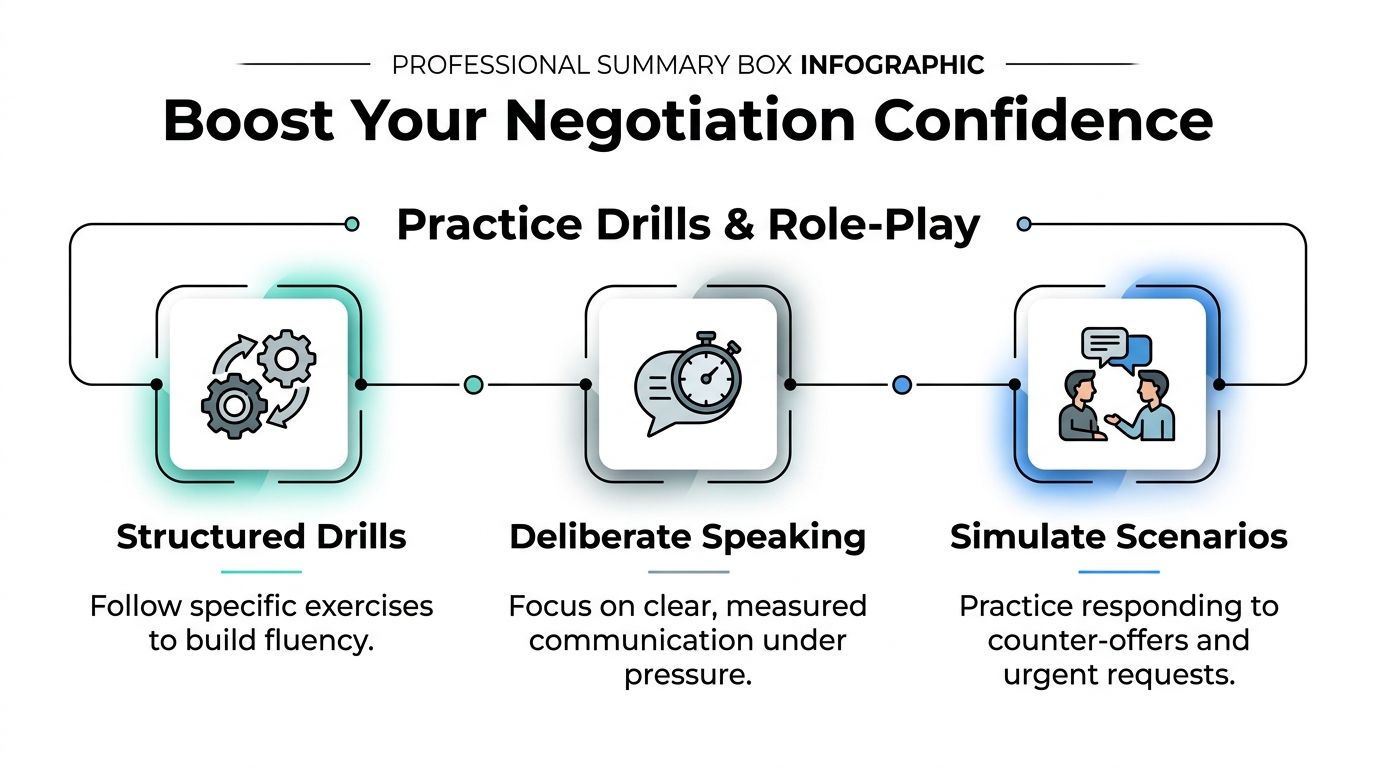
Most professionals don't need more theory. They need rehearsal under pressure. If you hesitate during live bargaining, the fix is to practice the moments where hesitation usually appears.
Communication audits described by Loora's guide to English for negotiation show that non-native professionals who hesitate visibly during counter-offers are often perceived as less decisive, which can lead to lower settlement values. Role-play directly targets that problem.
Drill one with delayed response training
This drill is simple and effective. Have a partner give you five objections in random order. After each one, you must:
- hold eye contact
- pause
- answer in one or two sentences only
Use prompts like:
- “That budget is too high.”
- “We need a faster delivery timeline.”
- “Another vendor offered better terms.”
- “We can move ahead, but only if you reduce scope.”
The goal isn't elegance. The goal is control.
Drill two with role reversal
Switch roles halfway through. Let the other person negotiate against you, so you can identify which phrases sound firm and which sound defensive.
If you don't have a coach or colleague available, record yourself doing this kind of Business English speaking practice and review three things only:
| Review point | What to look for |
|---|---|
| Pace | Are you rushing once pressure appears? |
| Fillers | Do “um,” “so,” or “maybe” show up before key points? |
| Length | Are your answers getting longer when you feel less certain? |
Drill three with fixed language constraints
Give yourself strict rules for a mock negotiation:
- no hedging words
- no answer longer than two sentences
- one deliberate pause before each counter
- one written summary at the end
That kind of constraint forces discipline. It also helps useful phrasing become automatic.
Rehearsal should feel slightly uncomfortable. That's how you know you're training the moments that matter.
English Negotiation Checklist and Next Steps
You are in the final two minutes of a call. The other side asks for one more concession, and your English gets faster right when precision matters most. That is the hesitation penalty. A short checklist prevents it.
Use this before any negotiation in English:
- Stage your opening line. Write the first two sentences you will say out loud, not just the number you plan to propose.
- Set your floor and your trade. Decide your minimum acceptable outcome and the one concession you can exchange for movement.
- Prepare exact pushback language. Script three responses for the objections you are most likely to hear, in plain English you can deliver under pressure.
- Control your physical signals. Sit still, keep your hands visible, hold eye contact at the end of key sentences, and pause before you answer.
- Close in writing. Send a short summary that confirms decisions, owners, and deadlines while the conversation is still fresh.
This checklist works because negotiation in English is not one skill. It is a sequence. Opening, proposing, resisting pressure, and closing each require different language. Non-native professionals often know what they want to say but lose force during the switch from one stage to the next. Preparation reduces that lag.
If you want an outside read on how your English comes across in high-stakes conversations, start with Intonetic's free Executive Communication Assessment. It helps identify whether pacing, phrasing, vocal delivery, or body language is weakening your authority at the table. For professionals who want deeper support, Intonetic also offers The Gravitas Method, a 12-week one-on-one executive presence coaching program for international professionals who need stronger vocal authority, sharper framing, and steadier body language in senior-level conversations. The program is coached by Nikola and is priced at $8,200 paid in full or $9,000 across three installments.