
How to Handle Difficult Conversations with Authority
You're in a regional review, and the forecast on the screen is wrong. Not slightly wrong, but built on an assumption that will distort the board discussion. The CFO is moving quickly, the room is senior, and everyone appears aligned. You know you need to challenge it. What leaves your mouth, however, is a softened question about whether there might be “another way to look at the numbers.”
The moment passes. The forecast stays.
That hesitation doesn't mean you lack expertise. It means the conversation carries more than its stated topic. Status, cultural context, accent, hierarchy, reputation, and composure are all operating at once. That's why learning how to handle difficult conversations at senior levels requires more than finding polite wording. You need a structure that helps you stay clear when the other person has more positional power, more social capital, or more control over the room.
Why Difficult Conversations Feel Harder at Senior Levels
Difficult conversations are routine leadership work, not unusual interpersonal emergencies. A 2025 SHRM report found that 39% of U.S. workers have a difficult conversation with a co-worker at least weekly, which illustrates how often professionals must address tension, disagreement, and correction in ordinary working life (SHRM's workplace communication research).
At senior levels, though, the risk is asymmetric. A peer may be able to challenge an idea without threatening the relationship. A director pushing back on a CFO, a non-native English speaker correcting a fluent executive, or a leader redirecting a high-performing employee with greater tenure faces a different calculation. The speaker is managing the issue while also protecting credibility, authority, and future access.
I've watched capable executives prepare excellent analysis and then lose control of the exchange in the first sentence. They over-explain, apologize for raising the point, or turn a clear disagreement into a question so broad that nobody knows what decision is required. The other person then answers the softer version, and the original concern disappears.
The business cost of that silence can be substantial. Research summarized in workplace communication studies estimates that employees spend 2.8 hours per week dealing with conflict, representing approximately $359 billion in paid time annually and roughly 385 million working days lost in the United States (Understanding the Conversation Gap). The same source estimates that every difficult conversation not held can cost an organization about $7,500 and more than seven lost workdays. Those figures don't mean every tense exchange should become a formal confrontation. They do show why delaying a necessary conversation is not a neutral act.
Decide what you need before you decide what to say
Before entering the room, write three sentences. Not a page of context. Three sentences.
- Objective: “The objective of this conversation is to secure agreement that we will revise the forecast assumption before it reaches the board.”
- Framing: “I am framing this as a joint risk check, not a challenge to the CFO's judgment.”
- Worst-case response: “If they dismiss the concern publicly, I will acknowledge the pressure, restate the specific assumption, and ask for a follow-up review with the relevant data.”
The objective must describe the decision or behavior change, not the subject. “Discuss the forecast” is a topic. “Agree to test the regional conversion assumption before finalizing the forecast” is an objective.
The framing protects the other person's status without weakening your point. You can position the conversation as shared problem-solving, a protection against business risk, or a check on something you may be missing. That language gives the other person a way to engage without first defending their competence.
The worst-case scenario prevents emotional improvisation. Decide in advance what you'll do if the person interrupts, becomes cold, shifts blame, or turns the exchange into a public status contest. You aren't trying to control their reaction. You're deciding how you'll protect the objective.
Practical rule: Respect the person's status, but don't surrender the decision.
Prepare the room as carefully as the message
A difficult conversation is also a meeting-design problem. If you're planning a review, webinar, board discussion, or stakeholder session, practical AONMeetings planning resources can help you think through objectives, participants, sequencing, and follow-up before the interpersonal pressure begins.
Your preparation should answer four operational questions:
- Who needs to be present? Don't create a public correction when a private conversation would protect dignity and improve candor.
- What evidence is essential? Bring the smallest set of facts that makes the issue discussable.
- What decision belongs in this meeting? Separate information gathering from commitment.
- What will happen afterward? Decide how agreement, disagreement, and ownership will be recorded.
This is closely related to what executive presence means. Authority isn't loudness or performance. It's the ability to make the important point legible, hold your position under pressure, and keep the exchange useful for everyone involved.
The Three Conversations Happening at Once
Harvard's Difficult Conversations Initiative describes a difficult exchange as three conversations happening simultaneously: the what happened conversation, the feelings conversation, and the identity conversation (Harvard's Difficult Conversations Initiative).
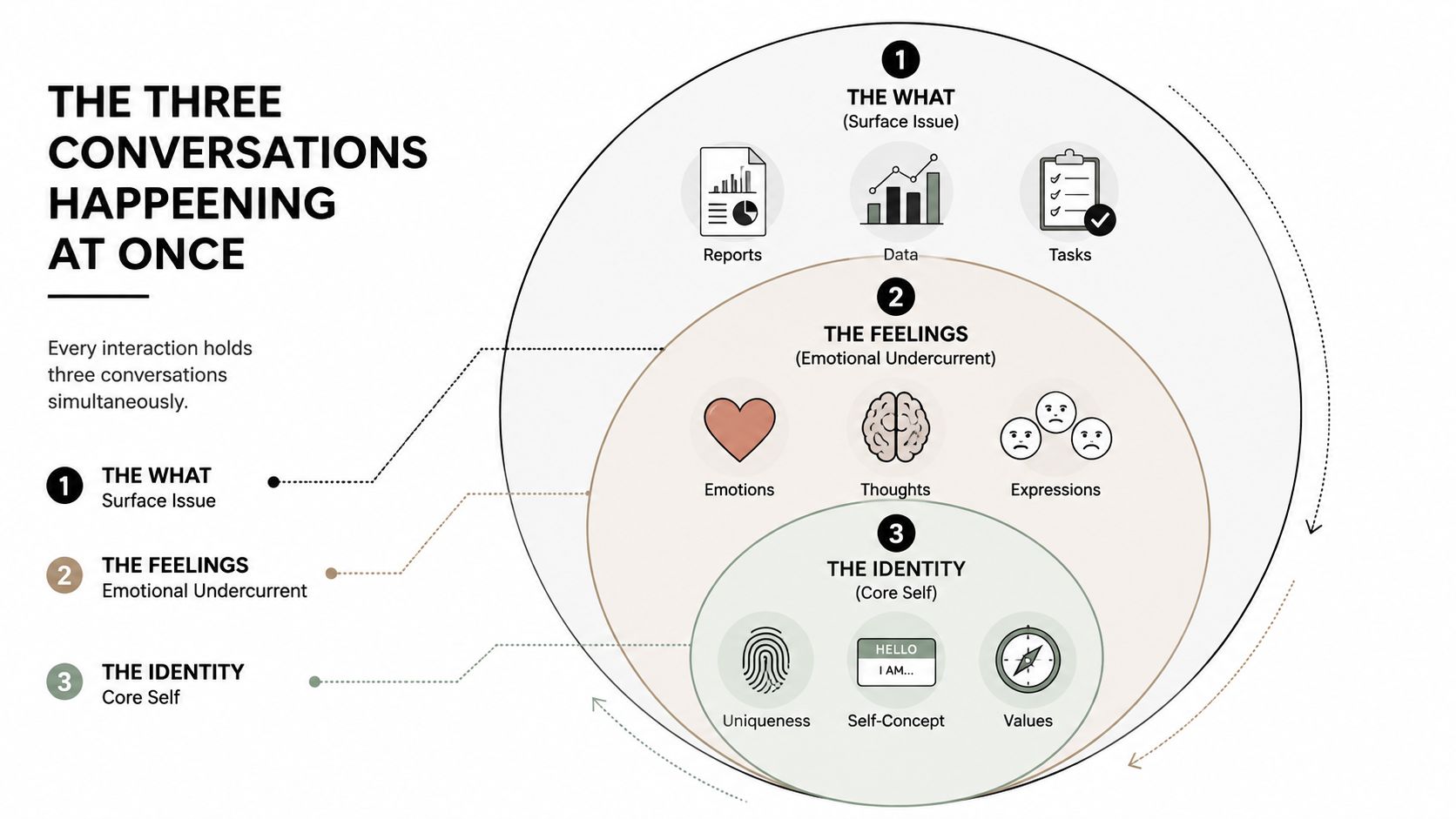
The what conversation contains the visible disagreement. Which assumption is wrong? Who owns the decision? What happened in the meeting? What standard applies? This layer needs observable facts, specific examples, and a clear distinction between what you know and what you infer.
The feelings conversation carries what people may not say directly. The CFO may feel publicly undermined. The director may fear being labeled disloyal. A high-performing direct report may feel that their authority is being questioned. Pretending those emotions aren't present doesn't remove them. It usually makes them leak into tone, interruptions, withdrawal, or counterattack.
The identity conversation asks what the exchange means about each person. Am I still trusted? Do I belong in this room? Am I competent? Does this leader see me as a serious operator? A person who experiences the conversation as an attack on identity will often defend themselves even when the factual issue is straightforward.
Each layer needs a different response:
- Facts for the what: “The assumption uses last quarter's conversion rate, while the current regional data shows a different pattern.”
- Acknowledgment for feelings: “I recognize that raising this in the review could feel like a public challenge.”
- Respect for identity: “I'm not questioning your judgment. I'm asking us to test a variable that could affect the board's decision.”
You can win the factual argument and still lose the conversation. If the other person leaves embarrassed, threatened, or unclear about their standing, they may comply in the moment and resist later. Effective leaders address the issue without forcing the other person to choose between accepting the correction and preserving their dignity.
Opening Lines Voice and Body Language
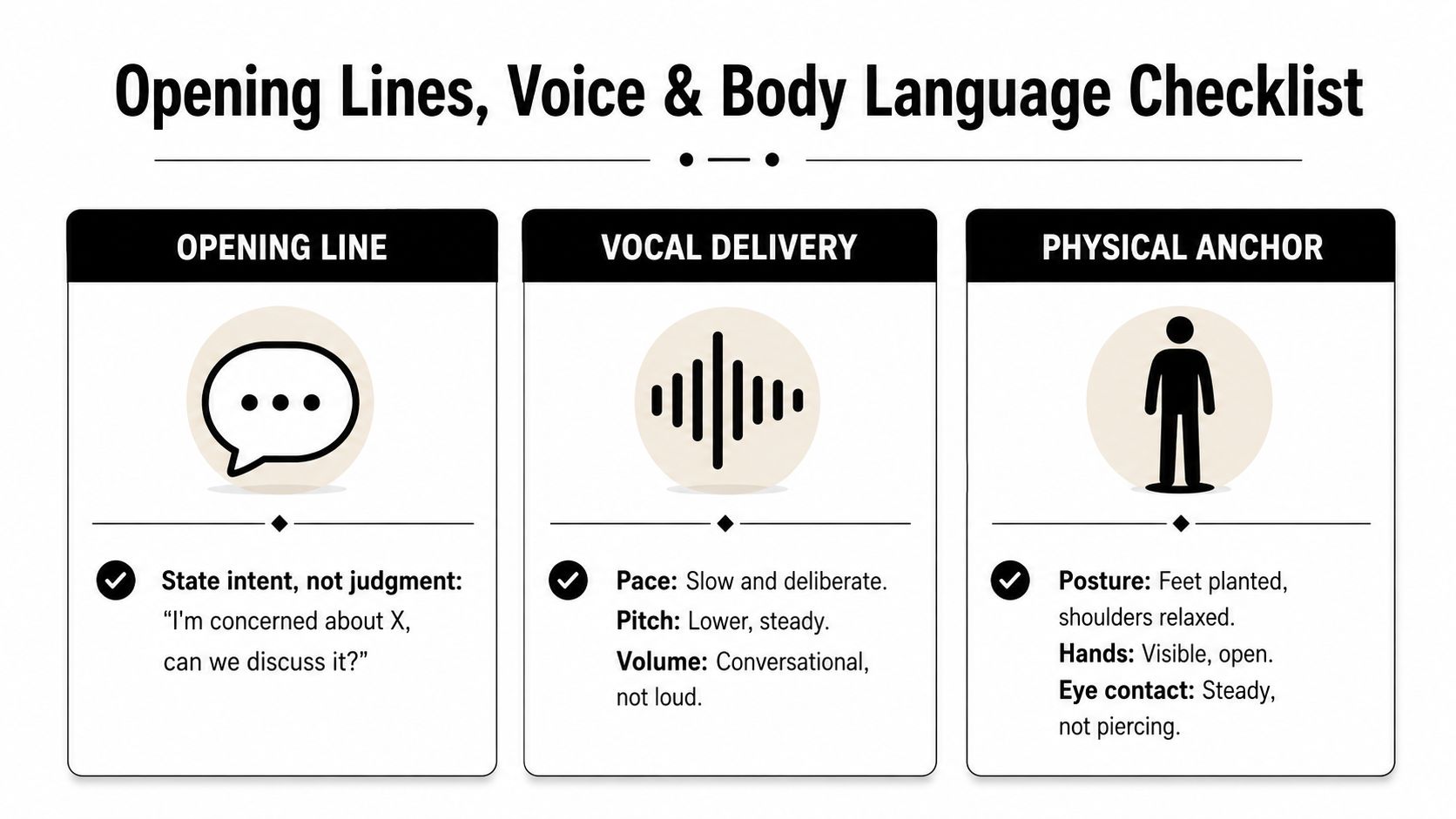
The first minute establishes whether the conversation feels like a joint review or a disguised attack. Control three levers: the opening line, vocal delivery, and physical anchor.
For an upward pushback, state the business risk without dramatizing it:
“I'm concerned that this forecast assumption may not hold across the region, and I'd like us to test it before we finalize the number.”
For a lateral correction, keep the relationship level:
“I see the logic in your methodology. I've found one issue in how the sample is being interpreted, and I want to walk through it with you.”
For a downward redirect with a senior or socially established direct report, separate respect from expectation:
“Your experience is valuable here, and I need the current delivery standard to be met consistently.”
Rehearse each line with the annotations below:
- “I'm concerned about the forecast assumption. [Pause for 0.5 seconds. Lower pitch on forecast assumption.]”
- “I've found one issue in the methodology. [Pause for 0.5 seconds. Use a steady, downward inflection on one issue.]”
- “I need the current delivery standard to be met. [Pause for 0.5 seconds. Lower volume and finish firmly on met.]”
Make your body reinforce the sentence
Stand or sit with your feet planted at shoulder width. Keep your shoulders relaxed, place one hand lightly on the table edge if you need a physical anchor, and keep your hands visible. Hold eye contact approximately 60 percent of the time, and don't nod during your first statement. Nodding too early can signal that you're seeking approval before you've completed the point.
Use a deliberate pause after the opening. Don't fill it with “just,” “maybe,” or “I'm sorry.” Speak slightly more slowly than your normal conversational pace, and use a deliberately lower volume than the other person expects. Lower volume isn't weakness when your articulation remains clear. It gives the room a reason to quiet down.
The physical details belong to a broader practice of body language for leaders. Your posture should communicate availability without submission, and firmness without threat.
The aim isn't to sound like someone else. International professionals often damage their authority by trying to erase every trace of an accent or cultural communication style. The more useful target is intentional delivery. Make the key noun audible, make the request complete, and let the pause show that you're finished.
Handling Pushback Without Losing Composure
Pushback usually follows recognizable patterns. Your task isn't to produce a perfect rebuttal. It's to identify the move, keep your nervous system out of the driver's seat, and return to the objective.
| Pushback Pattern | Response Move | Example Line | Vocal Shift |
|---|---|---|---|
| Deflection | Acknowledge and park | “I hear that's connected. Let me note it and come back to it. First, the issue in front of us is the forecast assumption.” | Keep your pace even and avoid chasing the new topic. |
| Blame-shift | Name responsibility | “I'm not asking who caused it. I'm asking what we do next.” | Drop your pitch on what we do next. |
| Silence | Use the five-second hold | “I'll pause there. What's your view?” | Stay quiet after the question. Don't soften it. |
| Emotional escalation | Lower the temperature | “I can hear that this is frustrating. I want to keep the discussion focused on the decision we need to make.” | Lower volume by 30 percent and slow your pace by 20 percent. |
The deflection response acknowledges relevance without allowing the conversation to scatter. Blame-shifting often tempts you into defending your own record. Don't take that invitation. Return to ownership and action.
Silence is where many senior professionals lose composure. They interpret the pause as failure and start explaining, qualifying, or offering concessions. Hold the silence for five seconds. The other person may need the space to think, or they may be testing whether you'll abandon your point.
Emotional escalation requires containment, not emotional mirroring. Name what you can observe without diagnosing motive. “You're angry” is accusatory. “I can hear that this is frustrating” recognizes the temperature without declaring why it exists.
The person who controls the pace often controls the quality of the decision.
Avoid sarcasm, “with respect,” exaggerated apologies, and phrases that turn the conversation into a contest. If you want more language for preserving firmness while reducing friction, review this guide to how to be diplomatic. Diplomacy isn't vagueness. It's the discipline of making a hard message easier to hear without making it less true.
Closing With Clarity and a Forward Plan
A difficult conversation isn't complete when everyone feels calmer. It's complete when the decision, ownership, and follow-up are clear.
Use a three-part close.
State the decision
Say what has been decided in one sentence:
“So we're agreed that the regional assumption will be revised before the board deck is finalized.”
Avoid: “I think we're broadly aligned.” That describes a feeling, not an outcome.
Name one owner and one deadline
Make the next move observable:
“Marcus owns the revised board deck, and he'll circulate it by Friday.”
Avoid: “Let's revisit this next week.” No owner, deliverable, or deadline exists in that sentence, so the issue can drift back into ambiguity.
Confirm the follow-up
Close the loop before people leave:
“I'll review the revised assumption with you on Friday afternoon, and we'll confirm whether the board version is ready.”
The conversation should remain future-oriented. Evidence summarized in a field study of feedback effectiveness found that the strongest predictor was whether the exchange focused on plans for the future rather than analysis of the past. Participants in that study reported an average of 3.8 feedback conversations in 3 weeks (field study on feedback conversations).
Send the confirmation email within 24 hours. Keep it neutral and short:
Subject: Confirmed next steps
Thanks for today's discussion. We agreed to revise the regional forecast assumption before finalizing the board deck. Marcus owns the revised deck and will circulate it by Friday. I'll review it with him Friday afternoon, and we'll confirm the final version then.
Close styles vary across cultures. A direct close may feel natural in US and UK contexts. In parts of APAC, a consensus-confirming close may be more appropriate: “Before we finalize this, I'd like to check that everyone is comfortable with the ownership and timing.” The structure stays firm. Only the route to explicit agreement changes.
Practice Drills That Build Real-Time Skill
A polished message can't substitute for live capability. Recent survey coverage reports that 63% of workers have used AI to avoid a difficult conversation at work, while 51% say AI has made spontaneous conversation feel harder (Preply's AI and workplace communication survey). Among Gen Z respondents, 66% say spontaneous conversation feels harder after using AI, according to the same source.
Use AI to organize your thinking, identify possible objections, or test whether your objective is clear. Don't let it become a hiding place. The skill that fails in the room is usually real-time phrasing, pacing, listening, and recovery, not the ability to produce a polished paragraph.
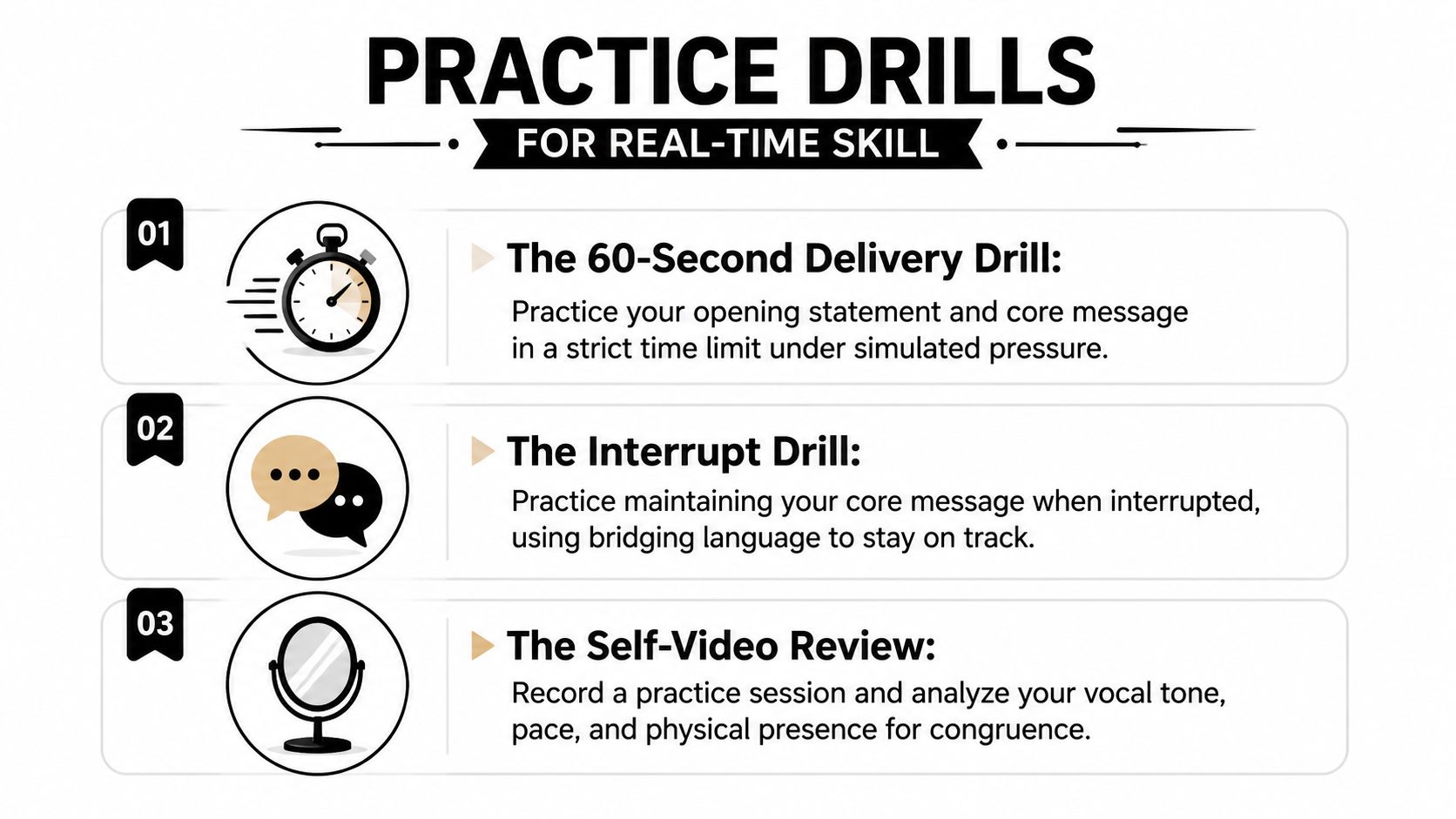
Drill one is the 90-second elevator reset
Choose a conversation you'll have this week. Record yourself delivering the opening, objective, and request in 90 seconds. Listen once, and assess only two things: whether your pace stays controlled and whether your key nouns end with a downward inflection.
Score yourself from one to five for each. Log the phrase where you sped up or lifted your pitch. Don't record repeatedly until you sound polished. The point is to notice the pressure pattern your body produces automatically.
Drill two is the pushback loop
Ask a trusted colleague to give you five minutes of deflection, blame-shift, silence, and emotional escalation. You practice the response moves without defending, over-explaining, or changing the subject.
Afterward, record:
- Trigger: Which pushback pattern changed your pace?
- Recovery: Did you return to the objective?
- Language: Which sentence kept you composed?
- Leak: Did you apologize, laugh, justify, or fill silence?
If you're building broader fluency, short Polychat fluency exercises for beginners can provide additional low-pressure speaking practice. Use them to develop flexibility, but rehearse your actual executive scenario with a real person whenever it matters most.
Drill three is the silent close
Rehearse the final 20 seconds using only the decision, owner, deadline, and follow-up. Remove buffer words such as “maybe,” “hopefully,” and “I just wanted to check.”
Score the close for clarity, brevity, ownership, and vocal steadiness. A useful practice target is to finish without adding a justification after the agreement. That restraint is central to mastering impromptu speaking skills, because real authority depends on recovering cleanly when the conversation doesn't follow your script.
Putting It Together and Your Next Step
A senior director needs to challenge the CFO's regional forecast during a cross-regional meeting. Before the call, the director writes:
- Objective: “The objective is to secure agreement to test the conversion assumption before the board deck is finalized.”
- Framing: “I'm framing this as shared risk management.”
- Worst case: “If the CFO dismisses the point publicly, I'll restate the assumption and request a focused follow-up.”
The director opens with: “I'm concerned that this forecast assumption may not hold across the region, and I'd like us to test it before we finalize the number.” There's a short pause, a lower pitch on “forecast assumption,” and no apologetic nodding.
The CFO responds, “This is a broader planning issue, and your team has missed inputs before.”
The director doesn't defend the team or chase the new topic. “I hear that's connected. Let me note it and come back to it. First, the issue in front of us is the conversion assumption.” When the CFO goes quiet, the director holds the silence, then asks, “What's your view of the regional data?”
The CFO explains that the assumption came from an earlier planning cycle. The director paraphrases the explanation, acknowledges the pressure of the board timeline, and returns to the decision. “I'm not questioning the planning judgment. I'm asking us to validate this variable before we lock the number.”
The close is equally specific: “We're agreed that the assumption will be tested. Marcus owns the revised analysis and will circulate it by Friday. I'll review it with him Friday afternoon, and we'll confirm the board version then.”
That exchange works because the director doesn't choose between authority and care. The facts remain visible, the emotional temperature is acknowledged, the CFO's identity and standing aren't attacked, and the next action has an owner.
The next step is diagnosis. A free Executive Communication Assessment can identify how your personality, communication skills, and emotional intelligence affect the way you handle authority, disagreement, and pressure. Use the Executive Communication Assessment to turn a broad framework into a targeted practice path, especially if you know what you want to say but lose precision when hierarchy enters the room.
The Gravitas Method is a 12-week one-on-one executive presence coaching program for international professionals who want to communicate with more authority and influence at senior levels. The program is priced at $8,200 paid in full or $9,000 across three installments. Coached by Nikola, it covers vocal authority, strategic framing, executive body language, and high-stakes communication.
Start with the free Executive Communication Assessment at Intonetic to identify the specific patterns affecting your difficult conversations. You'll receive a personalized learning path, and you can use it to decide whether focused coaching on vocal authority, strategic framing, body language, or live rehearsal is the right next move.