
How to Give a Toast That Commands the Room
You're at a client dinner. The meal is ending, glasses are being filled, and the host turns to you with a polite smile: would you say a few words?
That moment feels small until it happens to you. Then it feels public, fast, and strangely high stakes. You're not just choosing words. You're being read for composure, rank, judgment, and ease under pressure.
For senior professionals, especially those working in a second language, this is why learning how to give a toast matters. A strong toast doesn't sound theatrical. It sounds clear, brief, and well judged. That's exactly why it carries weight.
Why a Great Toast Is a Test of Leadership
A toast often arrives without much warning. At an awards dinner, an offsite, a retirement gathering, or a closing meal with partners, you may get only a few seconds to stand, settle yourself, and speak. People don't evaluate you only on the content. They evaluate whether you look like someone who can handle attention without losing shape.
That's why a toast is a leadership test in miniature. You have to read the room, respect the occasion, choose a message quickly, and deliver it without rambling. If there's a formal event host and guide running the room, the structure will help you. If there isn't, your judgment matters even more.
According to Sylvia Hewlett's Center for Talent Innovation study of 4,000 professionals, gravitas is the dominant component of executive presence, weighted at 67%, while communication is 28% and appearance is only 5%, making it the most critical factor for senior leaders evaluating presence, as summarized in this review of executive presence research. A toast puts both gravitas and communication on display at once.
What people hear beyond your words
A weak toast usually fails in one of three ways:
- It wanders: The speaker keeps adding context instead of making a point.
- It performs: The speaker tries to be funny, clever, or emotionally grand.
- It shrinks: The speaker sounds apologetic, rushed, or uncertain.
A strong toast does the opposite. It lands one message, honors the moment, and stops.
A toast is short-form leadership. You don't need brilliance. You need control.
That's especially true if English isn't your first language. Your accent isn't the issue. The issue is whether your message is organized, your pace is steady, and your delivery signals authority. That's the same core skill behind effective business communication in senior roles.
The Three-Part Structure of an Unforgettable Toast
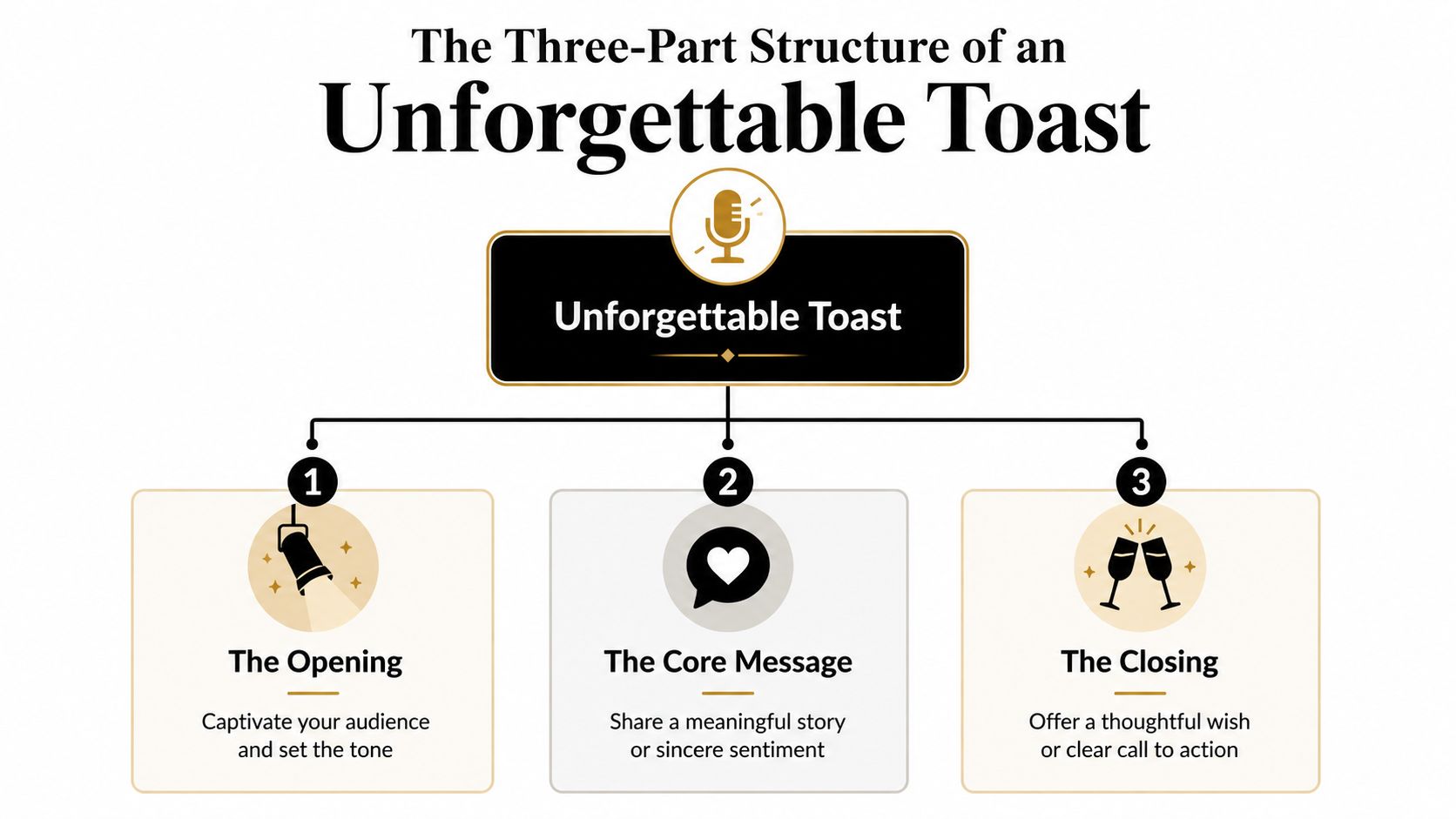
Most bad toasts start with good intentions and no structure. The speaker searches for the right opening, tells too much backstory, then ends awkwardly. The fix is simple. Use a repeatable three-part frame.
Expert guidance on wedding toasts, which translates well to formal professional occasions, recommends a clear structure: an introduction establishing your relationship to the subject, a body with 2–3 curated anecdotes, and a conclusion with congratulations and a sincere wish for the future, with a 3–5 minute delivery for major events, according to Zola's guide to giving a great wedding toast.
Start by establishing your right to speak
Your opening has one job. It tells the room why you are the right person to say these words.
Good opening:
“I've had the privilege of working with Elena over the past three years, first as a client and then as a partner on some of our most demanding work.”
Weak opening:
“Hi everyone, for those of you who don't know me, I wasn't expecting to speak, so this will be very informal.”
The first version creates relevance. The second lowers your status before you've said anything meaningful.
Use your opening to do three things quickly:
- Name your connection: colleague, client, manager, partner, friend of the firm.
- Name the occasion: farewell, celebration, recognition, milestone.
- Set the tone: warm, respectful, and calm.
Build the middle around selected proof
The body of your toast needs substance, not biography. Choose 2–3 short examples that reveal character, contribution, or impact. Don't give a chronology. Don't list every achievement. Pick moments that show how the person or team operates.
Practical rule: If an anecdote needs too much setup, cut it. A toast is not a presentation.
Before:
“James joined in a difficult quarter, then there were many meetings, and over time he became an important part of the group.”
When James joined, he had the rare habit of bringing clarity into tense discussions. He didn't need to speak first. He listened, found the core issue, and helped the team move.
That second version gives the audience something they can see.
A useful discipline is to write your body as three bullets, not a script. Then turn each bullet into one or two spoken sentences. That keeps your delivery more natural. It also helps you maintain eye contact and avoid reading word for word. If you tend to over-explain, study how to build a cleaner conclusion of a presentation because the same discipline applies here.
A short demonstration can help:
End with a clean lift
The ending is where many otherwise capable speakers lose authority. They start strong, speak well, then trail off into “so yes” or “anyway.”
Your close should be brief and upward looking. Congratulate, appreciate, or wish success. Then invite the room to raise glasses.
For example:
- “Please join me in thanking Daniel for his steady leadership and wishing him every success in what comes next.”
- “To the team, and to the work ahead.”
- “To our partnership, and to many more milestones together.”
That's enough. Stop after the toast line. Don't reopen the speech.
Phrasing for Every Professional Occasion
Most professionals don't struggle because they lack ideas. They struggle because they can't find language quickly under pressure. A few adaptable phrases solve that problem.
The key is to sound specific without sounding scripted. You want language that gives shape to the moment, then leaves room for your own voice. If you over-polish it, you'll sound ceremonial. If you improvise too loosely, you'll drift.
Match the tone to the occasion
A toast for a project win should sound collective. A farewell should sound appreciative. A welcome toast should build confidence in the person joining. A client toast should sound respectful without becoming flattering.
Use this table as a starting point.
| Occasion | Sample Opening | Sample Closing |
|---|---|---|
| Team success | “Tonight is a chance to recognize what this team achieved together, especially under pressure.” | “To the team, and to the standard you've set.” |
| Farewell to a colleague | “I've had the pleasure of working alongside Priya, and what stands out most is her steadiness.” | “Please join me in thanking Priya and wishing her success in the next chapter.” |
| Welcoming a new leader | “We're pleased to welcome someone whose reputation arrived before they did, in the best sense.” | “To a strong start, and to the work we'll build together.” |
| Honoring a client or partner | “Our work together has been defined by trust, candor, and shared ambition.” | “To the partnership, and to what comes next.” |
Keep your language senior and simple
Senior speakers don't usually sound more complicated. They sound more deliberate. That means fewer filler phrases, fewer private jokes, and stronger verbs.
Try these substitutions:
-
Instead of “I just wanted to say a few words”
Say “I'm glad to recognize this moment.” -
Instead of “She's amazing and incredible in so many ways”
Say “She leads with clarity, consistency, and generosity.” -
Instead of “We've all been through a lot together”
Say “This team has met real pressure with discipline.”
If you're speaking in a second language, don't chase elegance. Chase precision. A short sentence delivered cleanly always beats a long sentence you can't land. For that reason, many international professionals benefit from practicing how to speak professionally in shorter, stronger phrasing patterns they can trust under pressure.
Delivering Your Toast with Executive Presence
Content matters. Delivery decides whether the room feels your authority.
Hewlett's research identifies “speaking skills and ability to command a room” as the top communication traits selected by senior executives when evaluating presence, and the same summary notes that 38% of professionals avoid alcohol at work events, with many reporting anxiety about being perceived as less senior when not clinking glasses, in this overview of the executive presence formula.

Use voice to create authority, not volume
The strongest toast delivery is usually slower than the speaker's nervous system wants. When people feel adrenaline, they rush. That makes them sound less sure, not more dynamic.
Control three things:
- Your first sentence: Start slightly slower than normal conversation.
- Your pauses: Pause after the opening line and before the final toast.
- Your finish: Lower speed at the end rather than speeding toward relief.
For non-native English speakers, pace does more than improve clarity. It increases perceived authority because it gives your pronunciation time to land. If you tend to compress words when nervous, mark two pause points in advance and commit to taking them.
If you want to sound senior, don't hurry to prove you belong. Speak as if the room can wait for you.
Hold your body still enough to look in command
Executive presence in a toast comes from controlled movement. Not no movement. Controlled movement.
Stand balanced on both feet. Keep your shoulders open. Let one hand hold the glass and the other stay relaxed until you need a gesture. Don't sway. Don't fidget with cutlery, a napkin, or your jacket button.
Eye contact matters, but don't try to lock onto every face. Divide the room into sections and speak to each one. If the room is small, include the honoree, the host, and then the wider group. This is the same principle strong speakers use to engage the audience without looking scattered.
Close the non-drinker authority gap
If you're toasting with water or another soft drink, don't compensate by overacting. That's where many professionals lose presence. They smile too much, raise the glass too high, or try to signal that they're still participating.
You don't need to justify your drink. You need a steady frame.
Use this approach:
- Hold the glass at chest level: Not near your face, not waving outward.
- Lift it once, with intention: A small, controlled motion reads as confidence.
- Keep your wrist quiet: Unnecessary movement looks nervous.
- Let the words carry the moment: Gravitas comes from delivery, not from alcohol.
A non-drinker with a still posture, grounded voice, and clean phrasing will always read as more senior than a drinker who looks performative.
Common Pitfalls and Essential Etiquette
Many people think a toast succeeds because it feels spontaneous. In practice, most memorable toasts feel spontaneous because they are disciplined.
A foundational etiquette rule is a strict 3-minute maximum, because long speeches bore listeners. The same etiquette guidance also says that the person being toasted must never drink to themselves, and the host has the right to make the first toast, according to this guide to toasting etiquette.
What ruins the moment
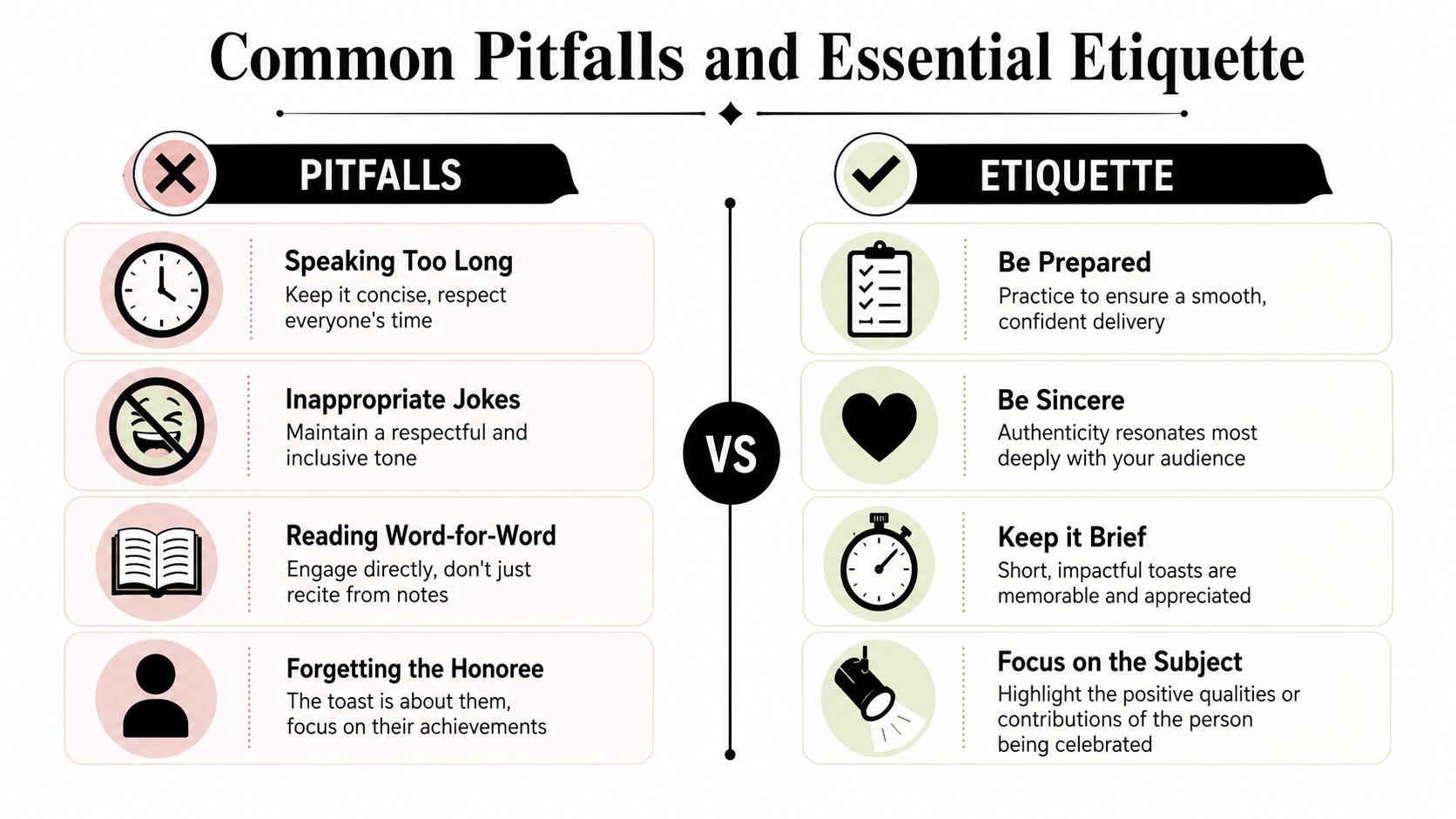
These mistakes are common because they feel harmless in the moment:
- Speaking too long: Respect for the audience shows up as brevity.
- Using inside jokes: If part of the room doesn't understand, the room divides.
- Adding risky humor: Work events don't reward edge. They reward judgment.
- Reading from a phone: It collapses eye contact and lowers your authority.
- Making yourself the main character: The toast is about the person, team, or occasion being honored.
Professional settings also bring cultural variation. If alcohol service is part of the event and you're unsure about norms, a practical primer on wine basics and etiquette can help with handling, serving, and social cues around the table.
What to do instead
A better toast usually follows this checklist:
- Confirm speaking order: If you're not the host, wait for the host to open.
- Keep one message: Choose a single quality, contribution, or hope to emphasize.
- Practice once or twice: Enough to sound prepared, not memorized.
- Acknowledge protocol: If you are the honoree, receive the toast. Don't drink to yourself.
- Respect culture: Formality differs across companies and countries, especially in mixed international rooms.
Checklist: Brief, warm, specific, and well timed beats funny, personal, and long.
International professionals sometimes underestimate how much etiquette shapes credibility in U.S. and U.K. business settings. A toast that ignores hierarchy, timing, or tone can make a polished executive seem out of step with American workplace culture and similar professional norms.
From Toast to Trusted Leader
A toast is brief, but it isn't trivial. It shows whether you can speak under social pressure without losing structure, warmth, or authority. Leaders get remembered for that.
This is why learning how to give a toast has value beyond the dinner itself. You're building skills that transfer directly into executive life: reading the room, framing a message, speaking concisely, and holding attention without force.
When you can do that consistently, people trust you with larger moments. Not because you gave a perfect toast, but because you looked like someone who can carry weight in public.
The Gravitas Method is a 12-week one-on-one executive presence coaching program for international professionals who want to communicate with more authority and influence at senior levels. The program is priced at $8,200 paid in full or $9,000 across three installments. Coached by Nikola, it covers vocal authority, strategic framing, executive body language, and high-stakes communication.
Start with the free Executive Communication Assessment from Intonetic. It's the best first step if you want to understand how your voice, structure, and delivery are shaping your executive presence in high-stakes moments.