
Conclusion of Presentation: End With Impact
You finish a demanding presentation. The analysis was sharp. The recommendation was solid. The room stayed with you.
Then the last minute arrives, and your language gets vague. Your voice speeds up. You glance at the final slide, say “So, that’s all,” and open the floor.
That’s where many strong presenters lose authority.
The conclusion of presentation isn’t a courtesy ending. It’s the moment where people decide what your message meant, what they should remember, and how senior you seemed while delivering it. For international professionals, that pressure is even higher. The content may be excellent, but if the final minute sounds hesitant, overloaded, or apologetic, the audience often remembers uncertainty instead of leadership.
A good conclusion does three jobs at once. It sharpens the message, directs action, and leaves a calm impression of command. That requires structure, yes. But in high-stakes rooms, it also requires delivery. Your pacing, pauses, eye contact, and final sentence often matter as much as the slide behind you.
Why a Weak Conclusion Can Undo Your Entire Presentation
The problem usually shows up in the last 45 seconds.
I see it with senior international professionals who have handled the hard part well. They explain complex material clearly, answer difficult questions, and hold the room. Then the close gets rushed. Their voice speeds up, their posture softens, and the final message arrives with less authority than the rest of the talk.
That shift changes how the audience reads the entire presentation. A disciplined presentation can feel less decisive if the ending sounds improvised or physically uncertain. In executive settings, people often judge confidence from delivery cues as much as from content. A hesitant final sentence, a downward glance at the screen, or an open-ended “any questions?” can weaken a strong recommendation.
I have coached many non-native English speakers through this exact issue. The challenge is rarely expertise. It is often vocal control under pressure. By the conclusion, mental load is higher, breathing gets shallower, and sentence endings start to rise in pitch. Listeners may hear doubt even when the speaker is completely prepared.
A weak close usually creates one of three impressions:
- You are still thinking, not deciding. This happens when the final recap keeps expanding or new details appear too late.
- You are asking the audience to sort out the priority. A long summary without a clear final line forces listeners to choose the takeaway themselves.
- You are giving away status at the worst moment. Filler words, rushed pacing, and immediate surrender to Q&A reduce executive presence fast.
Your final minute shapes memory, but it also shapes rank. Senior audiences listen for control.
That is why delivery matters so much in the conclusion. The audience is no longer evaluating only the logic of your case. They are evaluating whether you sound ready to stand behind it. Strong presenters slow down here, lower physical tension, finish sentences cleanly, and let key words breathe. If pronunciation tends to blur under pressure, targeted practice in English pronunciation for public speaking helps you keep the final lines crisp.
The trade-off is real. Some presenters try to sound fluent by speaking faster. That usually hurts them at the end. A slightly slower close with clear stress, firm eye contact, and one deliberate pause projects far more authority than a fast close with perfect grammar.
For professionals who also want stronger written framing around final remarks, this guide on conclusion writing that drives growth offers useful examples. In the room, though, spoken authority is what protects the value of everything that came before it.
A presentation rarely falls apart in the middle. It often slips in the conclusion, when the speaker stops leading and starts winding down. That is exactly the moment to sound most settled, most selective, and most certain.
The Three-Part Structure for a Powerful Conclusion
A strong conclusion works best when it’s simple enough to repeat under pressure. The framework I recommend has three parts: Strategic Recap, Memorable Moment, and Clear Call to Action.
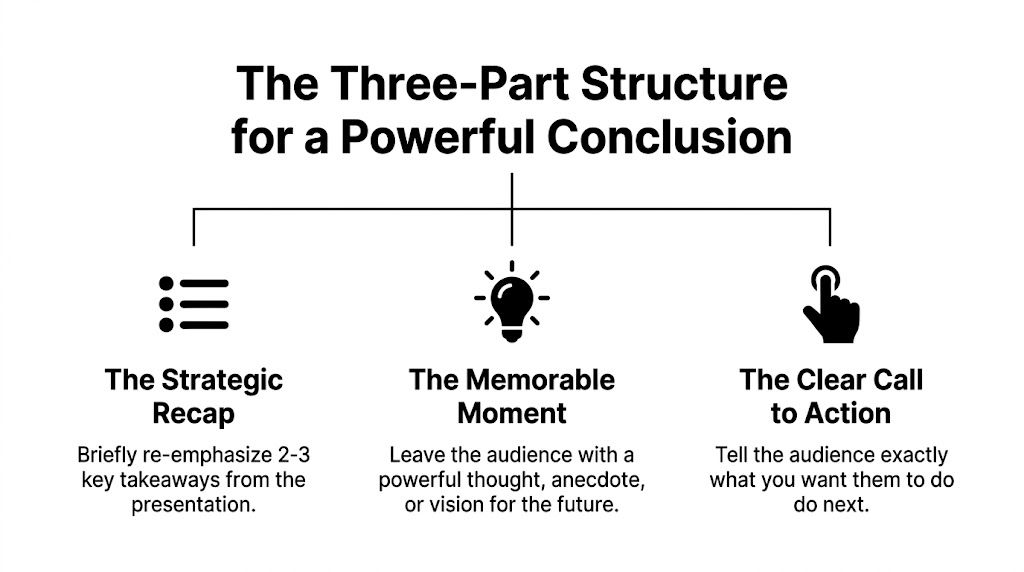
The Strategic Recap
Don’t replay your agenda. Restate your thesis.
The most effective version is the full-circle restate. You return to the opening idea, but now with a stronger conclusion attached to it. Used well, this method can produce a 55% memorability uplift in enterprise presentations according to Harvard Business Review’s guidance on high-impact presenting.
If you opened with risk, close with resolved risk. If you opened with uncertainty, close with a decision path. That gives the presentation shape.
Use only two or three points in this recap. More than that starts sounding defensive or overloaded.
A simple formula works well:
- Return to the opening question or tension
- State what’s now clear
- Name the priority takeaway
For presenters who want stronger spoken clarity in this moment, focused practice on English pronunciation for public speaking helps because the conclusion is where compressed language often becomes harder to follow.
The Memorable Moment
After the recap, give the audience one thought that lifts the ending above a routine summary.
This can be:
- A short forward-looking statement
- A compact story
- A single insight that reframes the issue
- A carefully chosen conclusion line that captures the stakes
At the conclusion, many presenters either overdo emotion or remove it entirely. Both are mistakes. The memorable moment should feel intentional, not theatrical.
One useful principle appears in Narrareach’s piece on conclusion writing that drives growth. Strong conclusions don’t merely restate content. They convert information into a final takeaway with direction. That applies in presentations too. Your audience doesn’t need another bullet list. They need meaning.
Practical rule: If your memorable moment can be cut without changing the impact, it wasn’t memorable enough.
The Clear Call to Action
Most endings fail here because the action is vague. “Let’s keep discussing.” “Think about this.” “Reach out anytime.” None of those creates movement.
A specific micro-action works better. Harvard Business Review notes that adding a specific CTA such as “Email one takeaway by EOD” can boost implementation by 35% in the cited guidance above.
Good CTAs usually sound like one of these:
| Situation | Better CTA |
|---|---|
| Decision meeting | Approve the pilot this week so the team can begin. |
| Stakeholder update | Send your feedback on the two open risks by tomorrow noon. |
| Team presentation | Choose one priority from today and assign an owner before we leave. |
If your audience can’t describe the next step in one sentence, your conclusion is still too soft.
Sample Scripts for a Clear and Confident Close
Many non-native speakers don’t struggle because they lack ideas. They struggle because the last minute happens fast, and under pressure they start translating mentally instead of speaking from a prepared verbal pattern.
That’s why scripts help. Not because you should sound memorized, but because prepared phrasing reduces cognitive load.
Stronger lines for the recap
Skip weak openings such as “So, to summarize” or “That’s basically it.” They shrink the authority of what follows.
Use phrases like these instead:
- “The central point I want to leave you with is this…”
- “If you remember one thing from today, it should be…”
- “We started with a clear challenge, and now the answer is equally clear…”
- “The decision in front of us isn’t whether to act. It’s how quickly we move.”
These lines sound more deliberate because they frame the ending as leadership, not housekeeping.
A script you can adapt in business settings
Here’s a simple model:
“We began with the problem of inconsistent execution across teams. What the data and discussion now show is that the issue isn’t effort. It’s alignment. So the main takeaway is straightforward. We need one decision framework, one reporting rhythm, and one owner per workstream. If we commit to that now, we reduce confusion and move faster with better accountability.”
Notice what this script does. It doesn’t list every slide. It names the problem, the conclusion, and the action.
For speakers who want cleaner articulation in these final lines, practice with tools from this guide on how to enunciate better. Endings often fall apart at the level of consonants, not ideas.
How to use story without sounding sentimental
Stories work when they’re brief and relevant. An analysis of 500 TED Talks found that 65% of the most successful presentations used personal stories, and audiences remember information far better when it is told as a story, with 63% retention versus 5% for raw statistics alone according to SketchBubble’s summary of presentation research.
In business presentations, that doesn’t mean telling a long personal anecdote. It means using a compact human example.
Try this pattern:
- Situation: “Three months ago, our team handled the same issue manually.”
- Shift: “That created delays, handoffs, and avoidable rework.”
- Meaning: “What changes now is not just the process. It’s the level of control we have.”
That’s enough. The point is to help people feel the implication of the recommendation.
Clean transitions into Q&A without losing authority
When you need discussion, use language that keeps your conclusion intact.
Try these:
- “I’ll take your questions, then I’ll close with one final recommendation.”
- “Let’s address the open points, and then I want to leave you with a final takeaway.”
- “I’m happy to discuss objections now. After that, I’ll return to the decision we need to make.”
Those phrases matter. They tell the room you still own the ending.
Mastering Your Delivery and Executive Body Language
A strong conclusion often weakens in the final 30 seconds. The speaker reaches the key message, then speeds up, glances at the laptop, smiles too early, or lets the voice drift upward as if asking for approval.

I see this often with senior international professionals. The logic is sound. The language is prepared. The pressure shows up in delivery. In a conclusion, listeners judge certainty through pace, breath, eye contact, and physical stillness as much as they judge it through wording.
That is why the close deserves separate practice. Non-native English speakers are often managing pronunciation, sentence order, and audience reaction at the same time. Under pressure, that mental load usually shows up in two places first: the voice gets faster, and the body starts to retreat.
Use pause to project control
Silence is part of executive presence.
A short pause before your final point tells the room you are in command of the message. A pause after it gives people time to absorb it. A pause before the call to action prevents the ending from sounding rushed or defensive.
Use pauses in three specific spots:
- Right before the final takeaway
- Right after the sentence you want repeated later
- Right before the action, decision, or recommendation
Count in your head if you need to. One beat is often enough. Two beats can feel long to you and still sound composed to the audience.
Make your voice easier to trust
In the conclusion, authority usually sounds calm, not energetic. Senior audiences respond well to a voice that is steady, slightly slower, and complete at the end of each sentence.
Focus on four adjustments:
- Use shorter sentences. They are easier to deliver cleanly under pressure.
- Finish the last word fully. Do not let the sound disappear at the end.
- Drop your pitch at the end of key statements. This helps the close sound decided.
- Take a visible breath before the final line. It resets pace and lowers tension in the throat.
If remote meetings are part of your role, practicing clearer English on video calls and presentations helps because microphones exaggerate rushed pacing and clipped consonants.
Let your body settle before you speak the last line
The audience reads your body before it processes your sentence. If your feet are shifting or your hands are fidgeting, the close feels less certain, even when the words are strong.
Use this checklist:
| Cue | What to do |
|---|---|
| Stance | Plant both feet and stop moving for the final statement |
| Hands | Gesture once with purpose, then let the hands rest |
| Eye contact | Hold one decision-maker, then include the wider room |
| Shoulders | Keep the chest open and the shoulders relaxed |
One coaching note matters here. Many international professionals over-correct and try to look very formal. That can make the body look rigid. Stillness works better than stiffness. The goal is grounded, not frozen.
If you want a more objective rehearsal method, record yourself as you narrate Google Slides presentations. It is one of the fastest ways to catch filler words, upward endings, facial tension, and distracting movements before a high-stakes meeting.
A short demonstration can help you observe these cues in motion:
Designing Your Final Slides for Maximum Impact
A weak final slide creates a split screen in the audience’s attention. People start reading while you are trying to land the message. Your conclusion loses force in the last few seconds, which is often the exact moment senior stakeholders decide whether you sound clear, credible, and ready.

For international professionals, this matters even more. If English is not your first language, a crowded slide invites the audience to read ahead and stop listening to your voice. That removes one of your strongest tools in the close: controlled delivery. A clean final slide keeps attention on your pacing, your pause before the last line, and the confidence in how you say the ask.
What belongs on the final slide
The strongest final slides are easy to process in one glance. In practice, that usually means one clear idea on screen, with wording that supports your spoken close instead of competing with it.
Use one of these formats:
- A short recap with only the main takeaway
- A single visual that reinforces the final message
- A decision prompt or next-step statement
- A CTA with only the required action
I often coach speakers to cut their final slide until it feels slightly bare. That discomfort is usually a good sign. In a conclusion, less content gives your voice more authority.
What to remove immediately
Final slides lose impact when they ask the audience to do too much at once.
Cut these elements:
- A paragraph of text
- More than one chart
- A list of minor sub-points
- A decorative quote that does not support the decision
- A “thank you” message with no takeaway
A final slide should carry the message your audience needs to remember and act on.
A practical design test
Run a three-second test before the meeting. Show the slide. Hide it. Then answer two questions:
- Could the audience identify the main point immediately?
- Could they tell what you want them to do next?
If either answer is no, simplify again.
I also recommend rehearsing the last thirty seconds with the slide visible on screen. Watch whether your eyes stay with the audience or keep dropping back to the slide. If they do, the slide may still be too busy, or you may not know the closing language well enough yet.
If you want a practical rehearsal method, visual aids and mirror exercises for accent improvement can help you coordinate spoken emphasis, facial control, and slide timing. That combination is especially useful for non-native speakers who want their final sentence to sound deliberate rather than rushed.
A strong close often comes down to one line on screen and one line spoken with calm authority. That is usually what people remember.
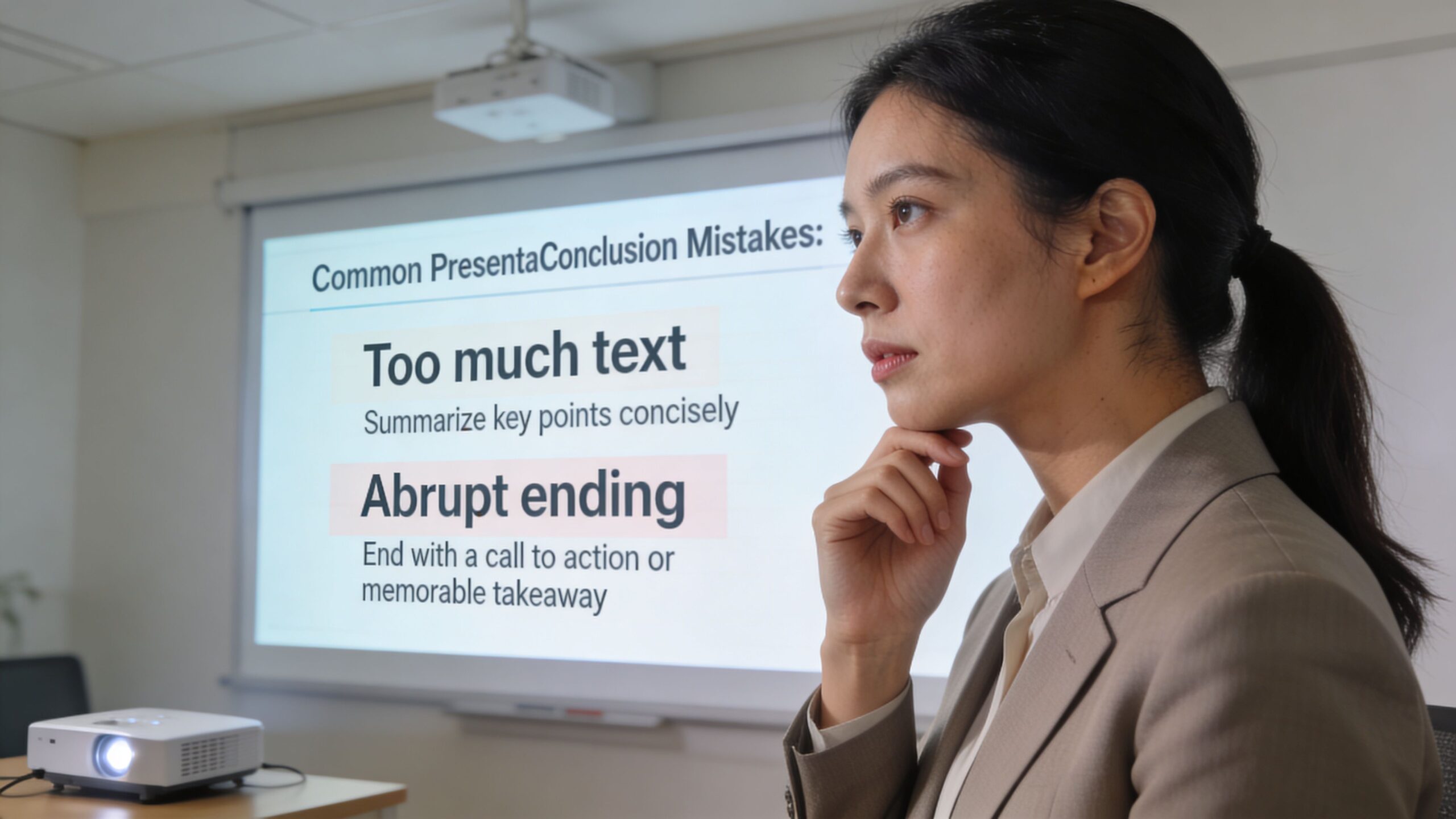
Common Conclusion Pitfalls and How to Fix Them
Most poor endings don’t fail because the presenter lacked expertise. They fail because of a few habits that feel normal but weaken authority fast.
Ending with Q&A
This is the most common mistake. Presentation audits cited by Moxie Institute found that 68% of presenters end with Q&A, which dilutes the core message, while a structured Plus-One Close after Q&A can produce 40% higher action compliance than abrupt endings according to Moxie Institute’s guidance on how to end a presentation.
The problem is simple. If the final thing people hear is an off-topic or skeptical question, that becomes the emotional end note.
Fix: Take questions before your final close. Then end with one short reinforcing statement and your CTA.
Over-explaining the recap
A recap becomes weak when it turns into a second presentation.
If you repeat too much, people stop listening because they assume nothing new or important is coming.
Fix: Limit the close to the core thesis and only the most decision-relevant points.
Adding new information
This usually happens because the presenter suddenly remembers a useful detail and wants to squeeze it in.
Don’t. New material at the end confuses priority.
Fix: If the detail changes the decision, move it earlier in the deck. If it doesn’t, leave it out.
Ending with a polite fade-out
Many professionals finish with “Thank you” as their final line. It sounds courteous, but it doesn’t lead.
A weak final sentence leaves the audience with social closure, not strategic clarity.
Fix: Make “thank you” the courtesy, not the conclusion. Your actual final sentence should state the takeaway or the action.
A quick diagnosis table
| Pitfall | What it signals | Better move |
|---|---|---|
| Q&A as the ending | Loss of narrative control | Take Q&A first, then close |
| Too many final points | Unclear priorities | End with the core message only |
| New data at the end | Poor message discipline | Move it earlier or cut it |
| Rushed final lines | Anxiety or fatigue | Slow down and pause before the last sentence |
| “Thank you” as the close | Passive finish | End with a decision or action statement |
Strong presenters don’t just know how to finish. They know what to remove from the ending.
Your Next Step to a Room-Commanding Presence
A strong conclusion doesn’t happen by accident. It comes from choosing what the audience must remember, shaping that into a clean structure, and delivering it with control.
That’s the shift many international professionals need to make. Stop treating the ending as a summary of what you already said. Treat it as your final act of leadership. The close is where you name the meaning of the presentation, show confidence in the recommendation, and make the next step unmistakable.
The practical standard is simple. End with a focused recap, one memorable insight, and a clear action. Then deliver it with slower pacing, cleaner sentence endings, steadier eye contact, and visible composure. When those pieces work together, your conclusion of presentation stops sounding like an exit. It sounds like direction.
If you want to understand where your own communication weakens under pressure, especially in high-stakes English-speaking environments, start with Intonetic’s Executive Communication Assessment. It’s the most useful first step if you want objective insight into how your delivery, structure, and executive presence are landing.
If you’re ready to build a more authoritative speaking style for board meetings, stakeholder presentations, and promotion-critical conversations, Intonetic can help. Start with the free Executive Communication Assessment, identify the specific habits limiting your senior presence, and get a clearer path to communicating with more influence.