
Communication Under Pressure: A Practical Playbook for 2026
You're halfway through a quarterly board presentation when the CFO interrupts with a question you didn't prepare for. Your heart rate rises, your breathing becomes shallow, and the sentence you had in mind disappears. You answer quickly, add unnecessary context, and hear your voice become sharper. The room hasn't necessarily lost confidence in your strategy, but your delivery has started working against it.
That moment is familiar to international professionals presenting in a second language, negotiating across cultures, or answering senior stakeholders without warning. Communication under pressure isn't mainly a test of vocabulary or intelligence. It's a test of whether your practiced behaviors remain available when your body is signaling danger.
The practical challenge is closing the gap between knowing what to say and being able to say it with authority when scrutiny is highest.
Why Pressure Changes How You Communicate
The boardroom response
The CFO asks, “Why should we believe this forecast when the last one missed?”
You understand the question. You may even know the answer. But your body reacts before your reasoning catches up. Your breathing gets shallower, your muscles tighten, and your attention narrows toward the perceived threat. In a second language, the pressure can feel stronger because you're managing the content, the wording, the cultural expectations, and your own self-monitoring simultaneously.
The result rarely looks like a dramatic collapse. It usually appears as a small change in behavior:
- Rushed speech: You speak before deciding what matters most.
- Defensive framing: You explain why the problem wasn't your fault instead of addressing its impact.
- Overqualification: You surround the main point with caveats until nobody can find it.
- Withdrawal: You give a short answer, avoid eye contact, or defer unnecessarily.
- Control: You interrupt, reject the premise, or take over the conversation.
These reactions can make a capable executive sound less composed than a less experienced colleague who has stronger pressure habits. For a useful overview of how stress affects the body and mind, the pressure and stress guide by reVIBE Mental Health offers accessible context without reducing the issue to simple advice such as “just stay calm.”
Why international professionals feel the gap
Professionals working across cultures often face an additional execution burden. Directness may be expected in one environment and interpreted as aggression in another. A pause may signal thoughtfulness to one audience but uncertainty to another. Eye contact, interruption, vocal volume, and disagreement all carry cultural meaning.
That doesn't mean you need to imitate one narrow model of executive behavior. You need a reliable range. You should be able to remain direct without becoming abrupt, measured without sounding hesitant, and transparent without surrendering authority.
Practical rule: Pressure reveals your default behavior, not your preferred behavior.
A 2018 survey of 1,334 people found that one in three managers was incapable of handling high-stakes or high-pressure situations. Under stress, 53% became close-minded and controlling, while 45% became emotional and upset and another 45% ignored or rejected rather than listened. The same findings recorded avoidant behavior in 37% and less transparent behavior in 30% of managers. These figures, reported by Workforce, show why pressure communication is an organizational risk, not merely a private confidence issue.
The response is not to eliminate stress. Senior work will always contain uncertainty, challenge, and reputational risk. The response is to train breathing, pacing, framing, listening, and physical stillness until they remain accessible when your nervous system wants to rush, fight, or withdraw.
The Research Behind Communication Breakdown Under Stress
Communication breakdown under stress follows recognizable patterns. It isn't random, and it isn't always caused by a lack of preparation. Pressure changes how leaders process information, select words, and respond to other people's contributions.
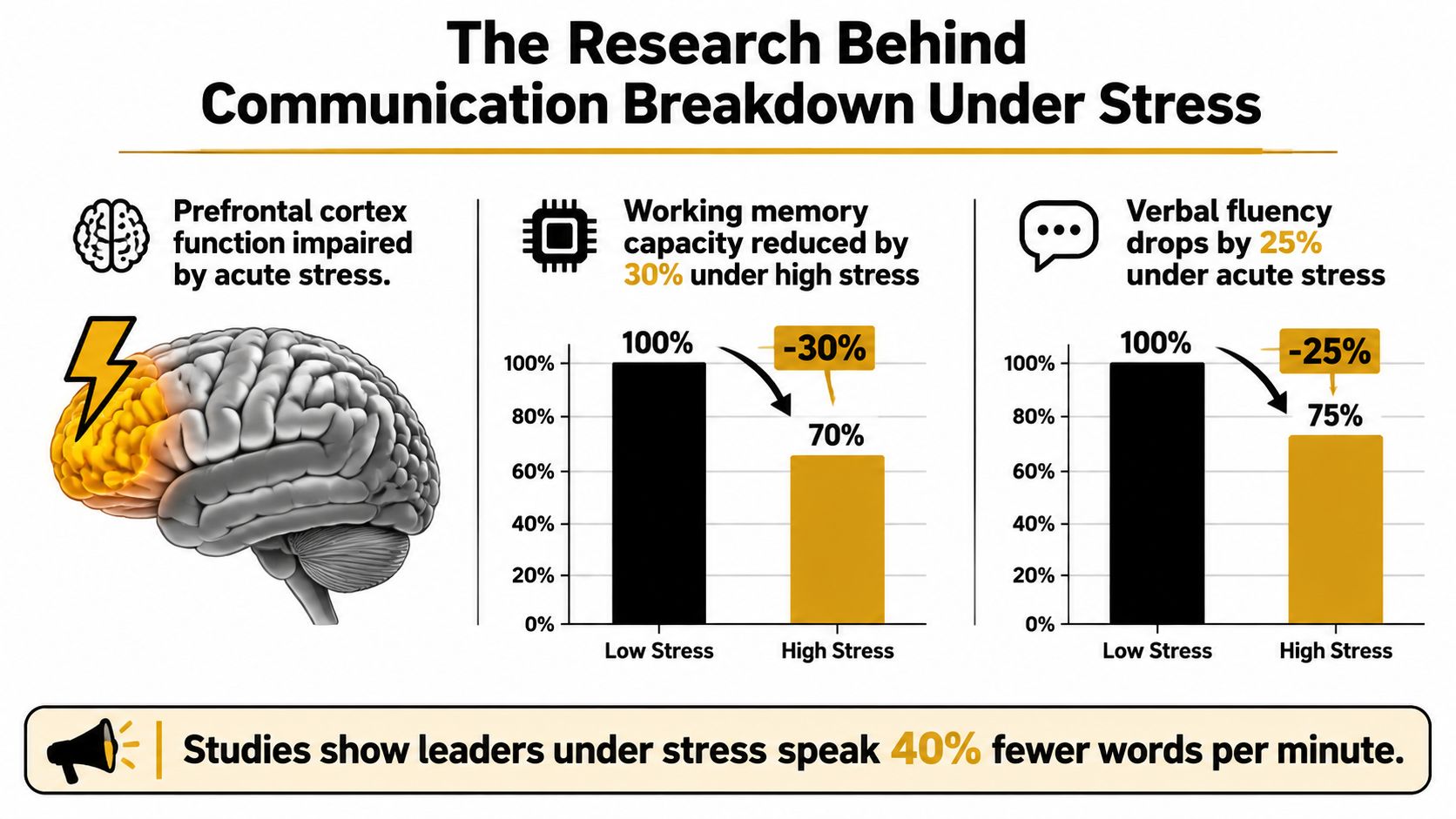
A 1990 integrated model in Communication Research connected workplace stress and burnout with factors such as participation in decision-making and social support. Later work found that group and individual communication variables were more closely related to work stress than organizational communication variables. One study reported an R-square of .951 for a combination of role conflict, role overload, career development, and group support, as summarized in this review of communication, stress, and burnout.
The practical meaning is important. Communication doesn't merely transmit information after stress appears. The way leaders exchange information can influence whether people experience clarity, support, and manageable expectations. In high-pressure environments, leadership communication marked by information consolidation, consistency, and two-way exchange was associated with stronger perceptions of support and lower stress and burnout among emergency-department frontline workers, according to the same review's discussion of 2021 research.
Speed can improve while clarity collapses
One workplace study reported message clarity falling from 7.8/10 at baseline to 4.2/10 under high pressure, while response time improved from 3.2 hours to 0.6 hours. The trade-off is familiar: stress can produce faster responses that contain less usable meaning. The analysis of how leaders respond under pressure also recommends slowing speaking pace by about 20%, pausing before responding, and using the structure Acknowledge, Position, Invite.
The organizational cost appears in meetings, negotiations, earnings calls, and crises. A leader who speaks rapidly may look decisive to themselves while forcing listeners to work harder to understand the decision. A leader who rejects questions may preserve control in the moment but reduce the information entering the conversation.
That's why a communication audit should examine more than grammar or presentation polish. Review where your message loses structure, where you stop listening, and what your voice and body do immediately after a challenge. An example of a communication audit can help you evaluate those behaviors systematically.
Stress management also begins outside the meeting room. Sleep, recovery, and preparation influence how much regulation you have available before scrutiny starts. Practical tips for calming stress before bedtime can support that broader foundation, although no evening routine replaces rehearsal for the specific conversation you'll face.
Breathing and Vocal Techniques for Immediate Control
Your first intervention should be physical because your body changes faster than your reasoning. Before answering a difficult question, create a small amount of physiological space. You don't need to leave the room or announce that you're regulating yourself.
Use the breath without making it visible
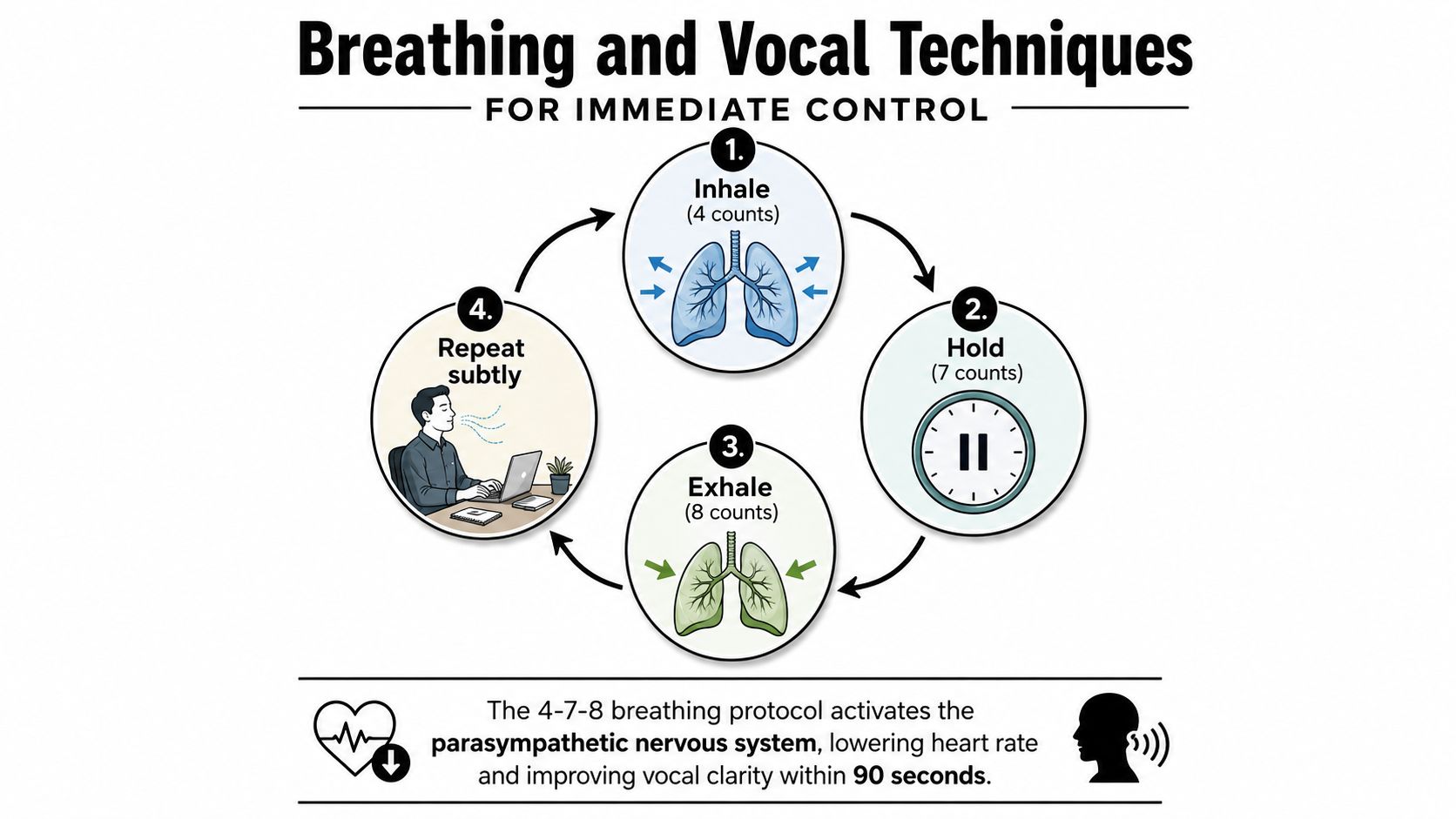
Adapt the 4-7-8 breathing protocol for professional settings:
- Inhale for four counts. Breathe through the nose if possible.
- Hold for seven counts. Keep the shoulders relaxed rather than lifting the chest.
- Exhale for eight counts. Let the exhale remain smooth and unforced.
- Repeat subtly. Use the pattern before entering the room, while someone else is speaking, or during a natural pause.
The longer exhale encourages a shift away from the reactive state and gives your voice more stable support. In practice, you may not complete a full cycle during a live exchange. Even a controlled inhale, brief pause, and extended exhale can interrupt the impulse to answer immediately.
For additional speech-focused practice, see these breathing exercises for clearer English speech. The objective isn't to produce a lower voice artificially. It's to stop pushing sound from a tight throat and allow the breath to support resonance.
Make authority audible
Use diaphragmatic support by allowing the lower ribs and abdomen to expand gently as you inhale. Start your sentence after the exhale has settled. Keep the first phrase short, and avoid beginning with filler such as “basically,” “I think,” or “so.”
A practical pacing range for executive speech is 120 to 150 words per minute, with deliberate pauses after the main point rather than only at the end of a long explanation. End important statements with downward inflection. That doesn't mean making every sentence sound final or severe. It means avoiding an upward lift that makes a clear position sound like a request for permission.
Try this micro-drill:
- Select a paragraph from a presentation or report.
- Mark the central sentence.
- Read it aloud once at your normal speed.
- Read it again with one breath per sentence.
- Pause after the central sentence before continuing.
- Record both versions and listen for rushing, throat tension, and upward endings.
A short drill can reveal the execution gap immediately. You may know that pausing helps, yet discover that you fill every pause with extra words when the recording begins.
The accompanying video demonstrates the breathing and vocal-control concept in practice:
Strategic Framing for Rapid Responses
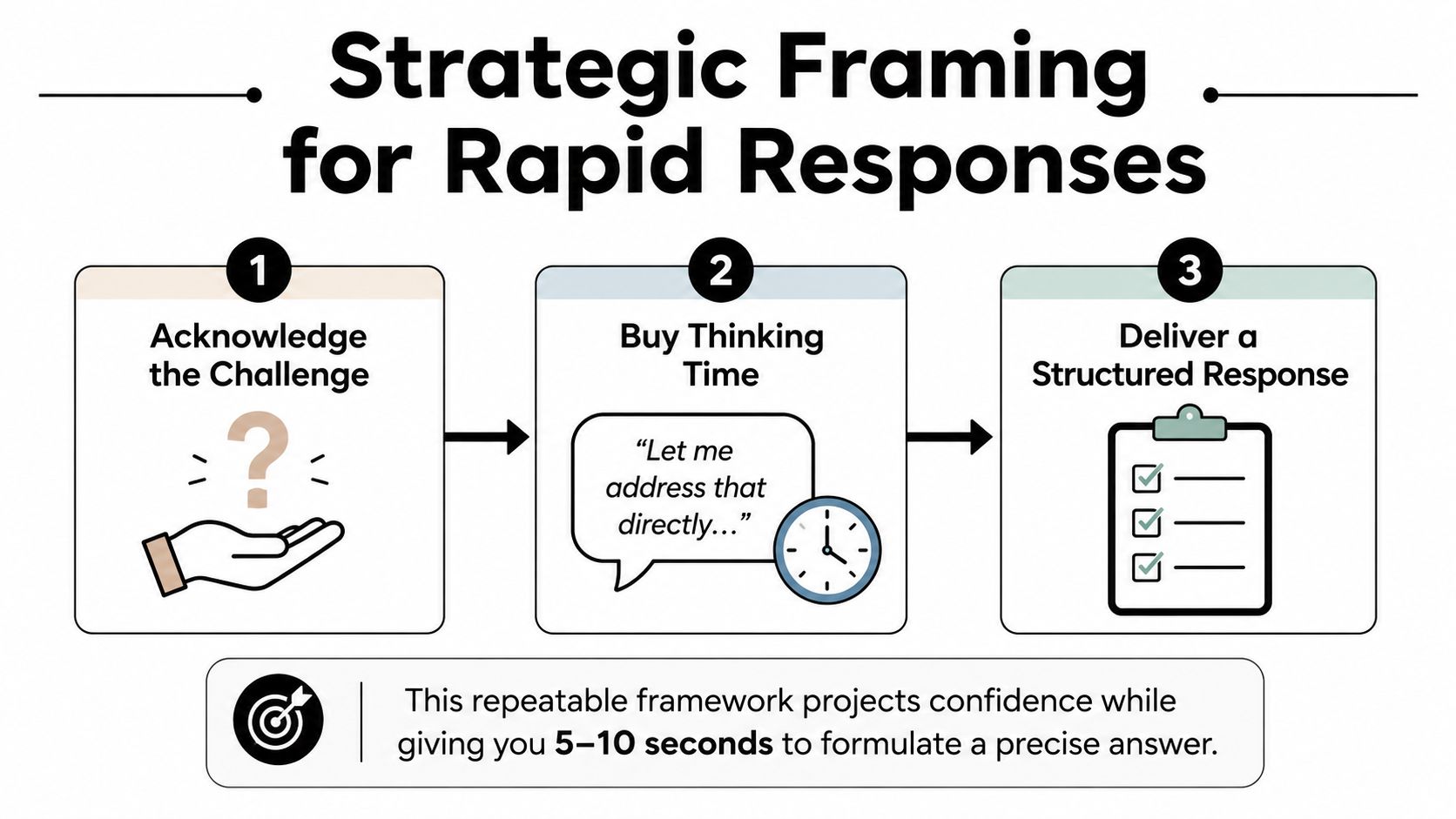
A difficult question becomes easier when you don't have to invent the architecture of your answer. Use Acknowledge, Position, Invite, or API, as a compact response structure that gives you thinking space without sounding evasive.
Acknowledge without surrendering your position
Start with one sentence that proves you heard the concern. Don't repeat the entire question, and don't agree with a premise you haven't examined.
Board challenge: “That's the right concern, particularly given the previous forecast.”
Negotiation deadlock: “I understand that implementation speed is your primary requirement.”
Media inquiry: “I recognize why people want a clear answer while the facts are still developing.”
The acknowledgment lowers friction because the other person no longer has to fight to be heard. It also gives you a moment to choose the response rather than react to the emotional temperature.
Position with one declarative sentence
Your position should identify the point you want the listener to remember. Use a simple subject, verb, and object structure when speaking in a second language.
For the board:
“Our position is to keep the forecast, but attach a tighter review trigger to the next operating cycle.”
For a stakeholder:
“We can meet the quality requirement, but we won't remove the validation step.”
For a crisis inquiry:
“We're confirming the impact, supporting the affected people, and will provide the next verified update through the designated channel.”
Avoid building authority through excessive detail. Detail can follow, but the first sentence should establish direction.
Invite the next useful exchange
The final step controls what happens next. Don't end with “Does that make sense?” unless you genuinely want an open-ended discussion. Invite a specific question, decision, or action instead.
- “Would you like me to address the assumptions behind that trigger?”
- “Can we compare the two implementation paths against your deadline?”
- “I can confirm what's known now, or explain what we're verifying next.”
API also works in short-form communication when you need to respond under time pressure. Practicing professional short-form communication helps you remove unnecessary clauses while keeping the message complete.
The framework isn't a script to recite mechanically. It's a sequence that protects listening, direction, and dialogue. When the situation changes mid-conversation, acknowledge the new information, reposition the core message, and invite the next decision. That's more credible than pretending your first answer still fits.
Executive Body Language That Signals Authority
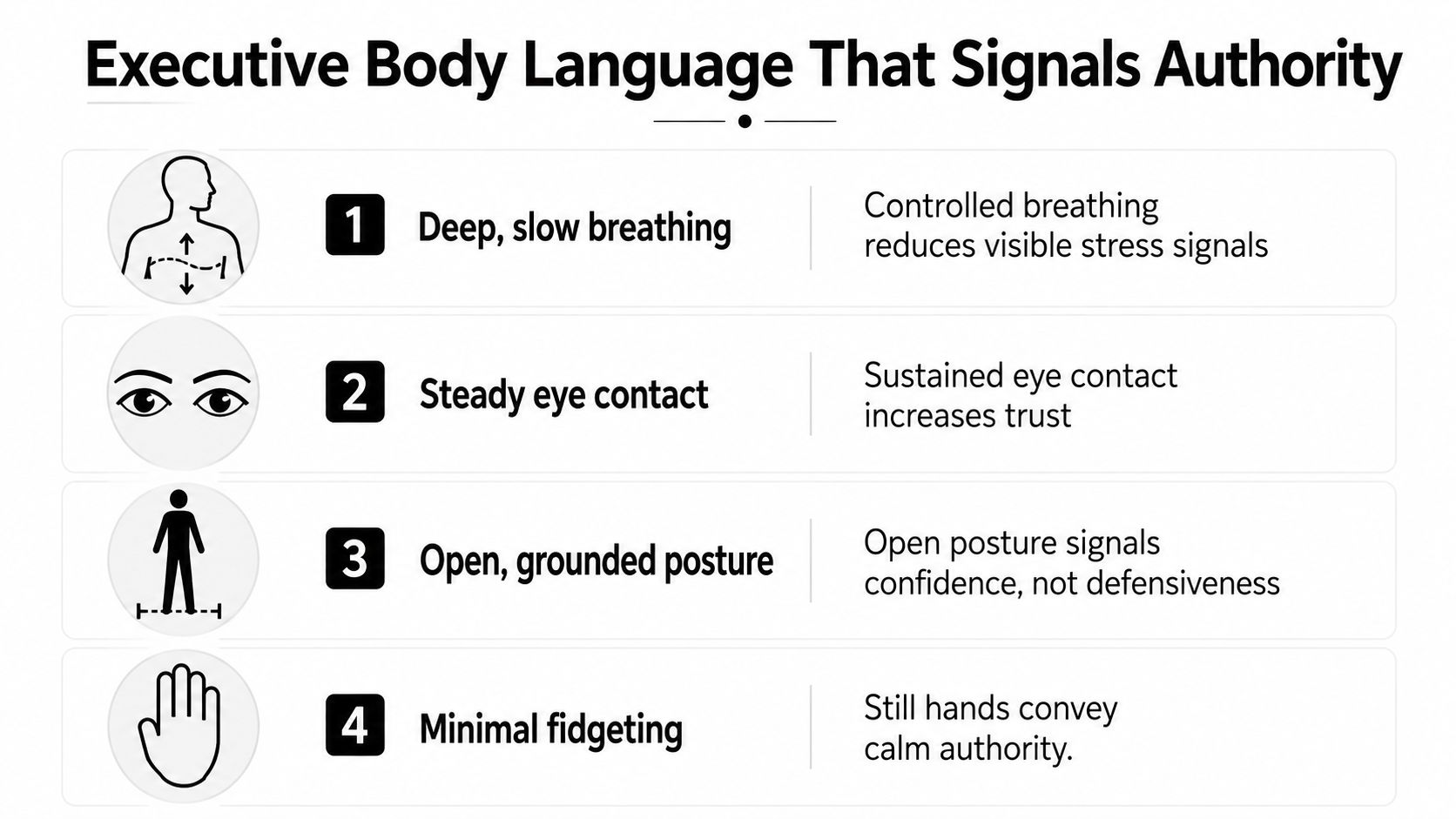
Your body often announces stress before your words do. A tightened jaw, disappearing eye contact, shoulders pulled inward, or hands searching for an object can make a measured sentence sound less trustworthy.
The goal isn't to become motionless. Executives use movement, gesture, and eye contact to guide attention. The goal is controlled movement that supports meaning rather than exposing panic.
Stabilize the first five seconds
The opening moments establish the physical pattern you'll probably maintain. Before speaking:
- Place both feet on the floor.
- Release your shoulders downward.
- Keep your hands visible and still.
- Exhale before beginning.
- Look at the questioner, then include the wider group.
Seated, keep your spine lengthened without leaning aggressively toward the table. Standing, distribute your weight evenly instead of shifting between feet. These adjustments reduce the visible signs of bracing and give your voice a steadier base.
Eye contact requires cultural calibration. During confrontation, hold the questioner's gaze long enough to show that you're not avoiding the issue, then soften your expression when moving toward collaboration. In cultures where prolonged eye contact can feel overly forceful, use a natural pattern of looking at the person, briefly looking away while thinking, and returning to them for the key sentence.
Remove stress tells, keep purposeful gestures
A gesture should clarify the sentence it accompanies. Use an open hand when distinguishing options, a small contained movement when sequencing points, and stillness when stating the decision. Don't choreograph every motion. Over-rehearsed gestures can appear theatrical under scrutiny.
Audit your own stress signals with these questions:
- Do you click a pen, touch your face, or adjust clothing?
- Do you look down immediately after a challenge?
- Do your hands disappear under the table?
- Do you lean back defensively or forward aggressively?
- Do you interrupt before the other person finishes?
- Does your gaze move rapidly around the room?
- Does your expression become harder when you're concentrating?
The body language guidance for leaders is useful when you need to turn these observations into specific adjustments rather than general reminders to “look confident.”
A senior presence doesn't require a dominant posture. It requires congruence. Your face, voice, hands, and words should communicate the same message: you heard the concern, you understand the stakes, and you can lead the next step.
Practice Drills with Real High-Stakes Scenarios
Techniques fail when they remain conceptual. Pressure rehearsal should recreate the interruption, ambiguity, time constraint, and emotional charge that cause your normal behaviors to disappear.
Start with a voice recorder and one scenario. Read the prompt aloud, wait for a breath, and answer using API. Review the recording for clarity, composure, structure, and presence. Don't judge your accent as a whole. Identify one observable behavior to change in the next attempt.
Build difficulty progressively
Use this sequence:
- Solo rehearsal: Give yourself a challenging question and answer in one clear position.
- Recorded interruption: Play an interruption immediately after your first sentence, then recover without speeding up.
- Paired practice: Ask a colleague to challenge your assumptions and withhold agreement.
- Simulation: Add competing questions, incomplete information, or a demand for an immediate public statement.
- Debrief: Note where you stopped listening, overexplained, qualified, or lost physical stillness.
A useful response to a hostile board question might sound like this:
“You're right to question the forecast after the previous miss. Our current position is based on different demand assumptions and includes a specific review trigger. I'll walk through those assumptions first, then address the downside case.”
That response doesn't evade accountability or promise certainty. It acknowledges the concern, states a position, and controls the next exchange.
Use the matrix to match the drill to the skill you need to develop.
| Scenario | Pressure Trigger | Drill Format | Key Skills Targeted |
|---|---|---|---|
| Missed board target | Hostile or skeptical question | Recorded solo answer, followed by interruption | Acknowledgment, concise framing, vocal pace |
| Cross-border negotiation | Unexpected escalation on price, timing, or scope | Paired role-play | Listening, boundaries, downward inflection |
| Crisis conversation | Demand for an immediate statement with incomplete facts | Leadership-team simulation | Transparency, sequencing, calm delivery |
| Cross-cultural disagreement | Directness interpreted as aggression | Paired role-play with cultural debrief | Tone calibration, eye contact, respectful challenge |
Score each attempt using a simple qualitative scale: unclear, developing, reliable. Review whether you stated the position early, paused before answering, maintained a stable breath, and invited a useful next step. Repetition matters because it converts a deliberate technique into an available behavior.
Your 12-Week Roadmap to Measurable Improvement
A twelve-week plan works when each phase increases pressure only after the previous behavior is stable. Track observable outcomes rather than relying on a vague feeling of confidence.
Weeks 1 to 4
Practice breath control and vocal pacing daily in low-stakes settings such as internal calls. Record short answers and track filler words, sentence length, pause frequency, and whether your voice trails upward at the end.
Weeks 5 to 8
Add API framing and body-language control during cross-functional reviews and stakeholder updates. Ask a trusted colleague to rate clarity, composure, structure, and presence after selected conversations. Your aim is not to sound polished in every interaction. It's to recover faster when challenged.
Weeks 9 to 12
Introduce deliberate high-pressure simulations. Rehearse board presentations, crisis questions, executive negotiations, and interruptions with incomplete information. Compare recordings across the phases and track whether your core message arrives earlier, your pauses remain available, and your physical stress signals reduce.
Use business English speaking practice to reinforce language access alongside executive delivery. Fluency helps, but pressure performance also depends on structure, breath, listening, and physical regulation.
For professionals who recognize that knowing these techniques isn't the same as performing them consistently, The Gravitas Method is a 12-week one-on-one executive presence coaching program for international professionals who want to communicate with more authority and influence at senior levels. The program is priced at $8,200 paid in full or $9,000 across three installments. Coached by Nikola, it covers vocal authority, strategic framing, executive body language, and high-stakes communication.
Start with the free Executive Communication Assessment to identify where pressure disrupts your voice, framing, listening, or presence, then visit Intonetic to explore coaching designed around the conversations you need to lead. Your next high-stakes meeting is a practical opportunity to train one behavior, measure it, and make authority easier to access when the room turns challenging.