Master Communication Etiquette: Professional Strategies
You send a concise email to a senior stakeholder. They reply with a decision that doesn't match what you meant. In the next meeting, someone more fluent, more culturally aligned with the room, restates your point and gets immediate buy-in. Nothing dramatic happened on the surface. But your credibility moved.
That's how communication etiquette usually fails at work. Not through obvious rudeness. Through small signals that make people work harder to understand you, question your judgment, or misread your authority.
For international professionals, communication carries increased importance. You're often balancing language precision, cultural expectations, hierarchy, and speed at the same time. Basic manners aren't enough. Communication etiquette at senior levels is about reducing friction, protecting trust, and helping other people read you as clear, credible, and composed.
The Unspoken Cost of Poor Communication
A common breakdown looks harmless at first. A manager sends a vague email with three separate issues buried under one subject line. A colleague answers only one of them. Another person joins a meeting assuming a different objective. The discussion drifts, the decision gets delayed, and afterwards everyone blames “misalignment.”
That word often hides an etiquette problem.
Poor communication isn't just awkward. It's expensive. Poor communication in the workplace incurs a direct financial cost of $10,000 to $55,000 per employee annually, with Grammarly estimating a specific average loss of $9,284 per worker, which aggregates to $9.3 million annually for every 1,000 employees in a company, according to these workplace communication statistics.
For ambitious professionals, the personal cost can be just as serious. People rarely say, “I don't trust your judgment because your follow-up was late and your message structure was messy.” They say you seem unclear. Or not quite ready. Or not yet senior enough.
Small habits create big reputations
I've seen strong professionals lose influence because they treated etiquette as cosmetic. They answered too slowly when speed mattered. They overexplained simple points. They copied too many people. They used meetings to think out loud instead of moving the room toward a decision.
Practical rule: If your communication creates extra interpretation work for other people, they won't experience you as efficient, even if your intentions are good.
That's why etiquette belongs in the category of business performance, not polish. It shapes how people interpret your judgment under pressure.
If this pattern sounds familiar, it's worth looking closely at the dynamics behind miscommunication in the workplace. Most professionals don't have a competence problem. They have a signal problem.
The Four Pillars of Communication Etiquette
Rules help, but rules alone break down in unfamiliar situations. A better approach is to judge every interaction through four pillars: clarity, respect, empathy, and adaptability.
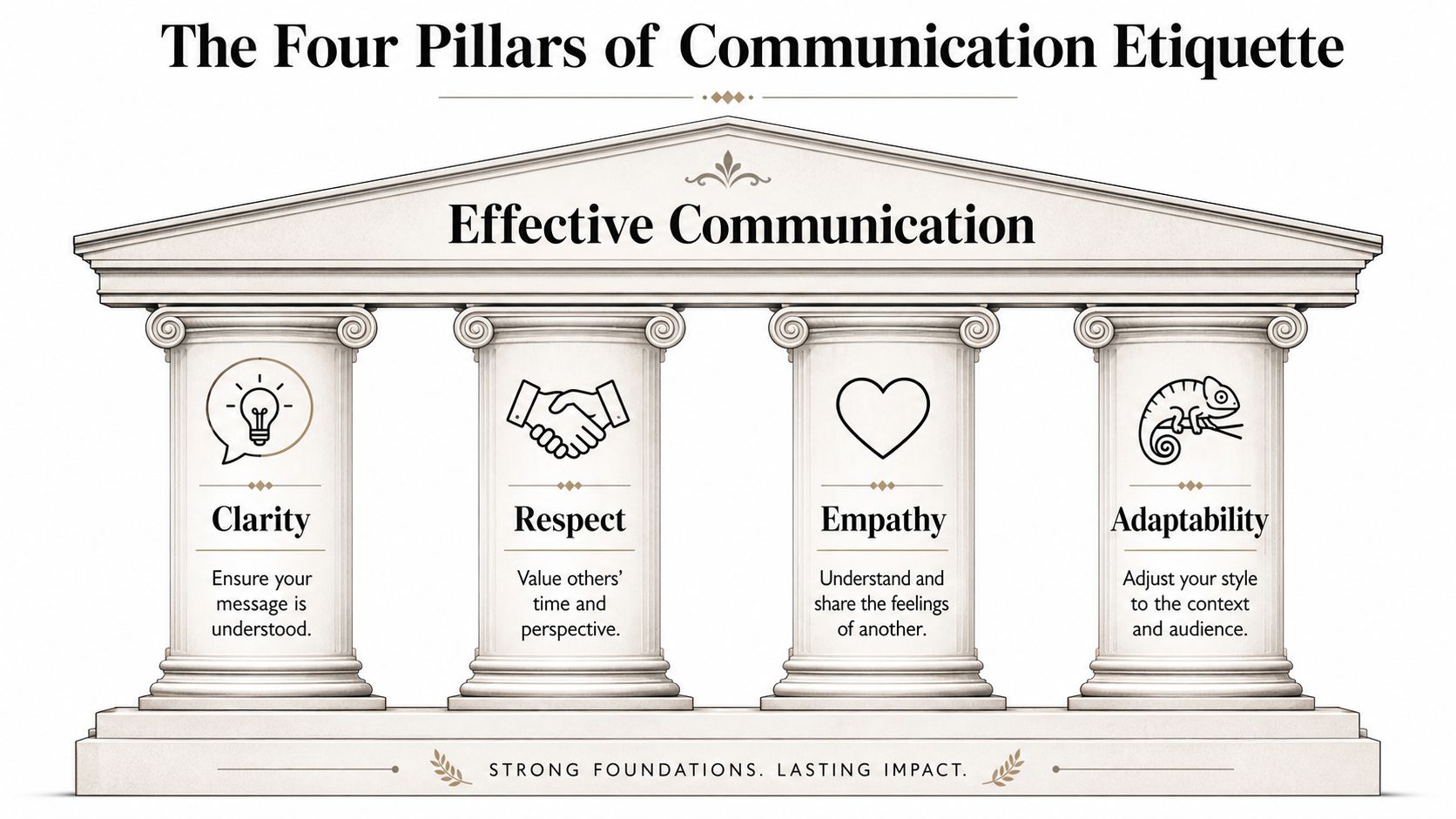
Clarity
Clarity means the other person understands your point the first time. It sounds simple, but many professionals confuse detail with clarity. They add context, caveats, and background until the main point disappears.
When you speak or write, lead with the decision, request, risk, or recommendation. Then support it. If your tone tends to become softer under pressure, tone of voice in communications matters as much as your wording.
Respect
Respect is visible in how you handle time, attention, hierarchy, and disagreement. It's not just saying “please” and “thank you.” It's showing that you considered what the other person needs in order to respond well.
A respectful message is easy to scan. A respectful meeting contribution is concise. A respectful challenge addresses the issue without cornering the person in public.
Empathy
Empathy doesn't mean lowering standards. It means recognizing how your message will land for this audience, in this context, at this moment.
For example, a direct correction may be efficient with one executive and destabilizing with another team. The point is not to avoid candor. The point is to deliver candor in a form the audience can absorb.
The best communicators don't just ask, “What do I need to say?” They ask, “What will help this person hear it?”
Adaptability
Adaptability is what separates polished professionals from rigid ones. Every workplace has its own rhythm. Some leaders want a recommendation first. Others want options. Some cultures read quick disagreement as healthy debate. Others read it as disrespect.
A useful mental model:
- Use clarity when the issue is ambiguous.
- Use respect when pressure is high.
- Use empathy when emotions or status are involved.
- Use adaptability when the room is mixed and norms are unclear.
If you can apply these four pillars consistently, you won't need a script for every scenario. You'll make better judgments in real time.
Mastering Etiquette Across Communication Channels
Most communication problems come from using the wrong behavior in the wrong channel. Professionals often write chat messages like emails, turn meetings into brainstorming dumps, or send emails that should have been a two-minute call.
The fix isn't “communicate more.” It's match your etiquette to the medium.
Email rewards structure. In technical communication, structuring email subject lines to reflect a single, specific topic prevents thread confusion, while quoting only the pertinent parts of preceding messages directly improves readability and response efficiency, as noted in this technical guidance on email threading and readability.
That principle's power is frequently underestimated. One topic per subject line forces one decision path. Selective quoting prevents the reader from digging through clutter to find relevance.
If your email endings tend to feel abrupt or generic, this guide on writing B2B email closings is useful because it shows how to close with clarity without sounding stiff.
Meetings
Meetings are where etiquette becomes visible fast. People notice who rambles, who interrupts, who summarizes clearly, and who can disagree without derailing the room.
Good meeting etiquette means you know why you're speaking. Are you clarifying, advancing, challenging, or deciding? If you can't answer that, stay silent until you can.
Instant messaging
Slack, Teams, and similar tools feel informal, but they still create a record of your judgment. The fastest message isn't always the best one. A rushed chat can create more back-and-forth than a short, well-framed note.
Use messaging for lightweight coordination, quick clarifications, and momentum. Don't use it for emotionally charged feedback, complex negotiation, or anything likely to be misunderstood without tone.
For a broader breakdown of types of professional communication, it helps to think in terms of channel fit rather than habit.
Channel specific communication do's and don'ts
| Channel | Do | Don't |
|---|---|---|
| Use one clear topic per subject line. State the purpose early. Quote only the relevant part of prior messages. | Bury multiple requests in one thread. Forward long chains without context. End without a clear next step. | |
| Meetings | Enter with a point of view. Contribute briefly. Signal whether you're raising a risk, asking a question, or making a recommendation. | Think out loud for too long. Repeat what others already said. Challenge someone publicly without a constructive path forward. |
| Instant messaging | Keep messages focused. Add enough context that the recipient can answer quickly. Use asynchronous pacing when a response isn't urgent. | Send fragmented bursts of one-line messages. Use chat for sensitive conflict. Assume “seen” means agreement. |
A useful test is simple. If the other person has to guess your purpose, your etiquette is weak even if your grammar is perfect.
Navigating Remote and Hybrid Work Communication
You join a cross-functional video call from Singapore at 9 p.m. A colleague in London keeps their camera off. The U.S. lead gives a quick verbal decision, then leaves before anyone confirms ownership. By the next morning, three people have acted on three different interpretations. Remote work creates this kind of confusion fast, especially in international teams where silence, speed, and brevity carry different meanings.
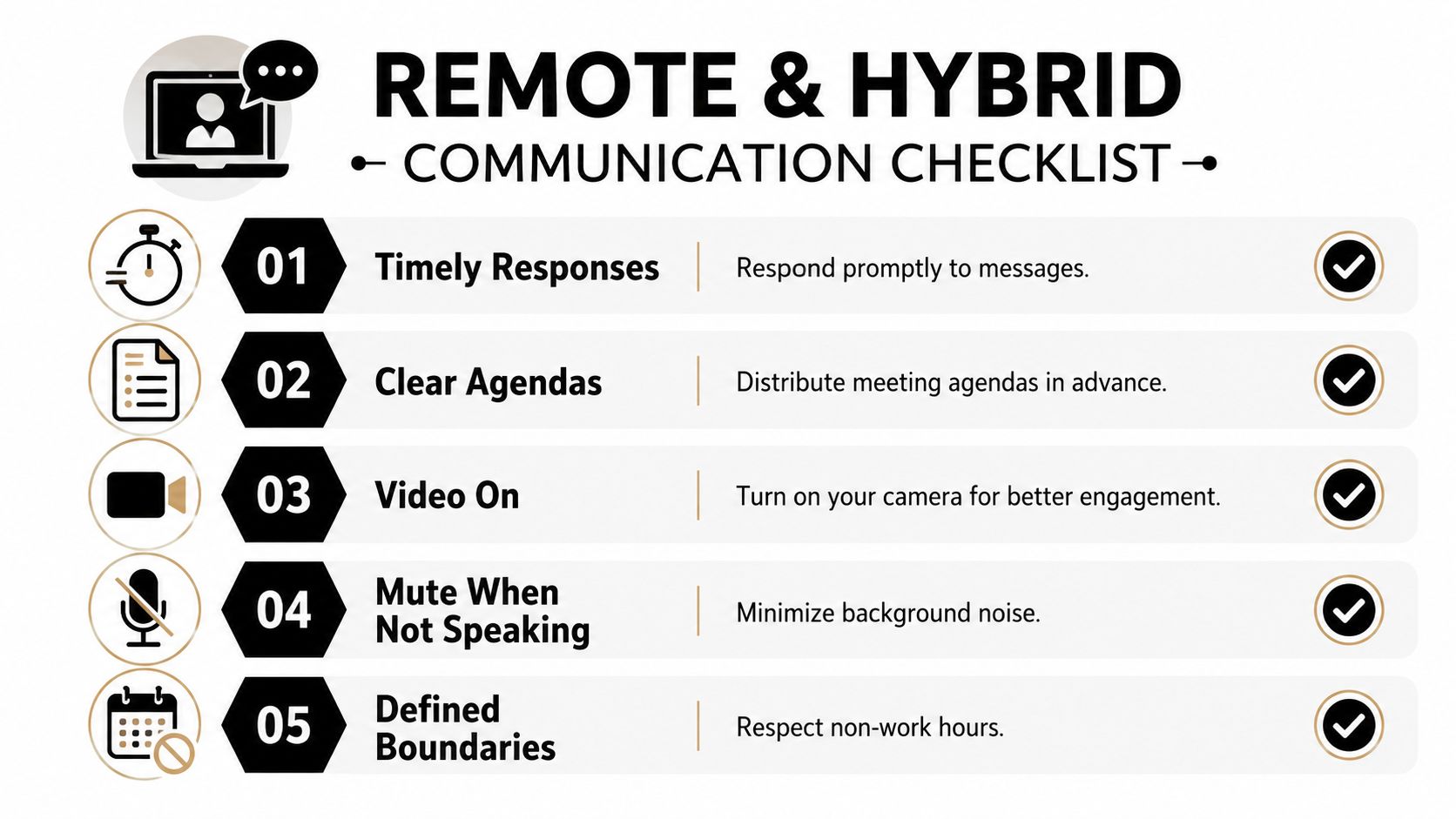
The problem is rarely effort alone. It is signal management.
In distributed settings, people judge reliability through small cues. Response timing. Calendar discipline. Whether you state a decision clearly. Whether your silence reads as thoughtful restraint, confusion, or disengagement. Senior professionals ignore these cues at their own cost because hybrid environments reward people who reduce ambiguity for others.
What remote etiquette actually signals
Gallup found employees want more communication from their employers, while poor communication still wastes time and creates unnecessary friction at work, as reported in this summary of workplace communication findings. In remote and hybrid teams, that friction usually shows up as unclear ownership, repeated follow-ups, and meetings that exist only to repair weak written communication.
Three practices separate credible operators from noisy ones.
- Write for people who are reading between meetings: Put the decision, owner, deadline, and open question near the top. International teams often work across time zones, so a vague message can stall progress for a full day.
- Use meetings for judgment, not paperwork: Status updates belong in writing. Meetings earn their place when trade-offs are unclear, stakes are high, or the group needs a decision in real time.
- Treat on-camera behavior as executive presence: Looking distracted, joining late, or reacting visibly to disagreement affects trust more than many professionals realize. Strong body language on camera helps you look composed and credible when the room is virtual.
Remote etiquette also includes knowing when not to speak immediately. Strategic silence can signal thoughtfulness in one culture and lack of preparation in another. In hybrid settings, do not leave that interpretation to chance. If you need time, say so directly: “I want to give you a considered answer. I'll respond by 3 p.m. London time.”
This short video captures several practical habits that matter in virtual environments.
Preventing proximity bias
Hybrid work still favors the people leaders see and hear most often. Good work helps. Visible judgment matters more.
I often tell clients to create a written trail of their thinking, not just their activity. Send brief updates that show progress, risk, and decision logic. After meetings, confirm what was decided, what changed, and what needs executive input. That gives your work shape in the minds of people who are not in the room with you.
This matters even more if part of your influence depends on recorded communication across markets. Teams producing training, product explainers, or stakeholder updates can improve clarity across regions with these effective YouTube video translation tips.
If senior leaders cannot quickly see how you think, they will often back the person whose judgment is easiest to observe.
Adapting to Cross-Cultural Communication Norms
You join a regional leadership call expecting a straightforward decision. Ten minutes in, one executive is waiting for a senior sponsor to speak first, another is reading silence as disagreement, and a third is frustrated that no one has stated a clear position. The risk is not poor intent. The risk is being judged by rules no one explained.
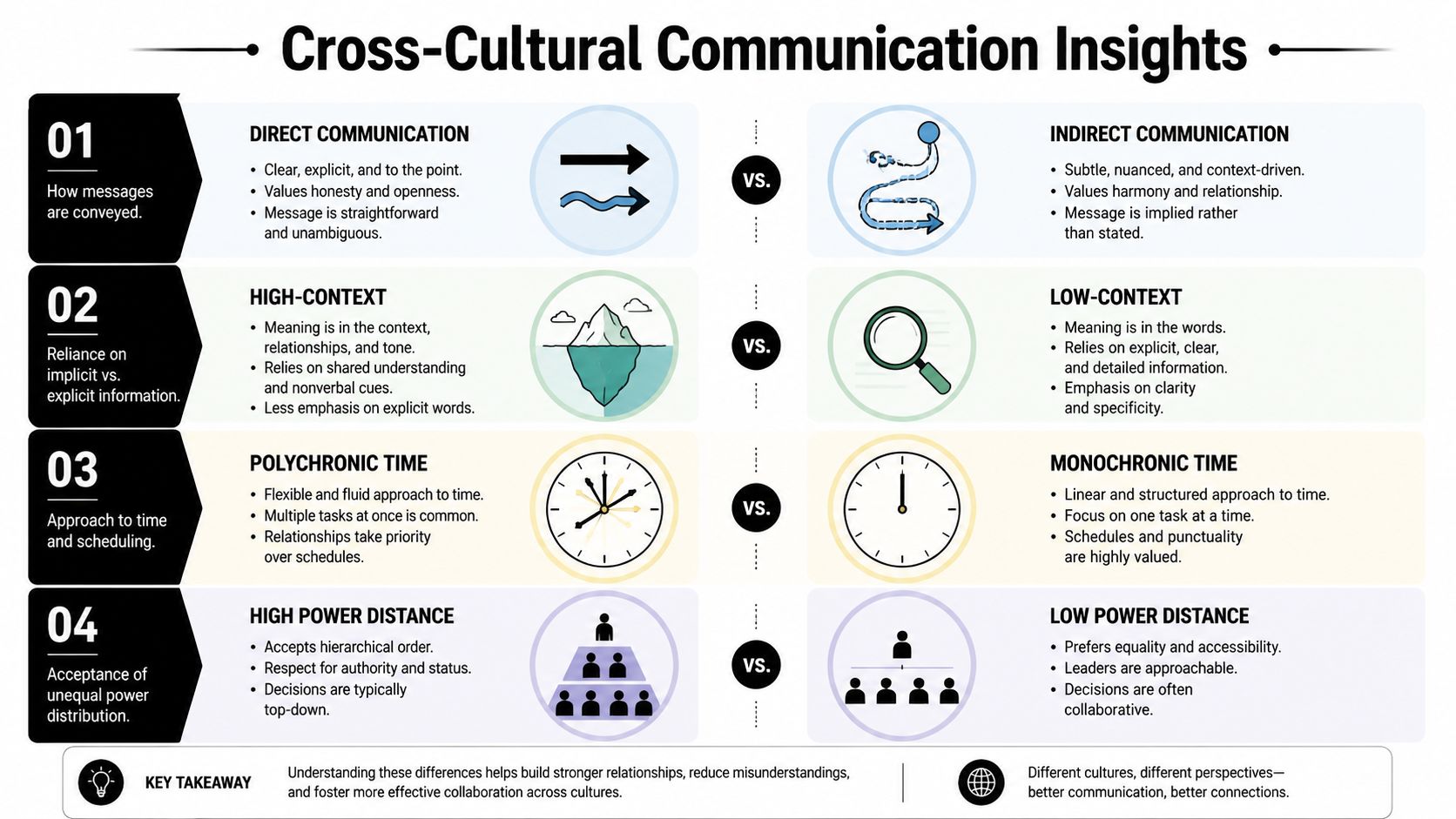
International professionals rarely struggle because they lack manners. They struggle because strong etiquette in one setting can reduce credibility in another. Direct disagreement may read as competence in Germany and unnecessary force in Japan. A carefully softened response may protect the relationship in China or India, but leave a blunt stakeholder unsure where you stand.
The practical standard is clear intent with calibrated delivery.
Directness without unnecessary friction
In mixed-cultural rooms, saying exactly what you mean still matters. The method changes. Erin Meyer's work on global communication styles is useful here because it shows how cultures differ in the degree of explicitness they expect in business communication, from low-context environments like Germany to higher-context environments such as Japan and China, as outlined in INSEAD's overview of communicating across cultures.
That is why high-performers should build a repertoire of precise alternatives to the flat “no.”
Instead of rejecting a proposal bluntly, use language that keeps your position clear while protecting working trust:
- Redirect the issue: “I agree with the objective. I have concerns about the timing.”
- State a condition: “I can support this once we have ownership for implementation.”
- Separate respect from approval: “I appreciate the work behind this. I would not approve it in its current form.”
These phrases are not softer for the sake of politeness. They reduce ambiguity about your decision while lowering the odds of public friction.
Status signals matter more than etiquette trivia
Many professionals overfocus on visible customs and miss the fundamental question: how is status handled here? The answer changes your timing, your level of challenge, and even where disagreement should happen. The Japan External Trade Organization notes that Japanese business communication places strong value on formality, careful listening, and relationship-building before direct confrontation, which affects how disagreement is usually expressed in professional settings, as explained in JETRO's guide to business etiquette in Japan.
South Korea presents a related but distinct pattern. Speech levels, titles, and age or rank can shape meeting dynamics more strongly than many Western professionals expect. The Korea Business Central resource on Korean business culture highlights how hierarchy and respect conventions influence introductions, turn-taking, and decision-making in professional contexts, covered in this guide to Korean business etiquette.
India adds another layer. Teams may sound highly relational and flexible in discussion, yet become very clear on authority once a senior decision-maker enters the process. China often places greater weight on preserving group harmony and avoiding public embarrassment than many Anglo-American professionals are trained to expect. You do not need a stereotype. You need pattern recognition.
For professionals producing multilingual updates, onboarding, or training for global teams, these effective YouTube video translation tips help because translation often breaks down on tone, hierarchy, and implied meaning rather than vocabulary alone.
How to handle conflicting norms in the same meeting
Use a simple sequence.
- Read the room before you set your tone. Notice who speaks first, who gets interrupted, and whether disagreement is public or deferred.
- Match formality, not personality. You are adjusting your delivery, not performing a caricature of the culture.
- Make your intent explicit. Say, “I want to be respectful and direct about the risk,” if the room could misread either quality.
- Test the preferred process. Ask, “Would it be more useful to raise concerns here or with you afterward?”
- Confirm the decision in writing. This protects against different interpretations of what was implied versus what was agreed.
I often tell clients that cross-cultural etiquette at senior levels is less about memorizing rules and more about managing interpretation. If people must guess whether you are hesitant, disrespectful, or decisive, you lose influence fast.
If cross-border work is central to your role, cross-cultural communication training for global teams gives you a method for reading these patterns instead of relying on trial and error.
Communication Etiquette for Executive Leadership
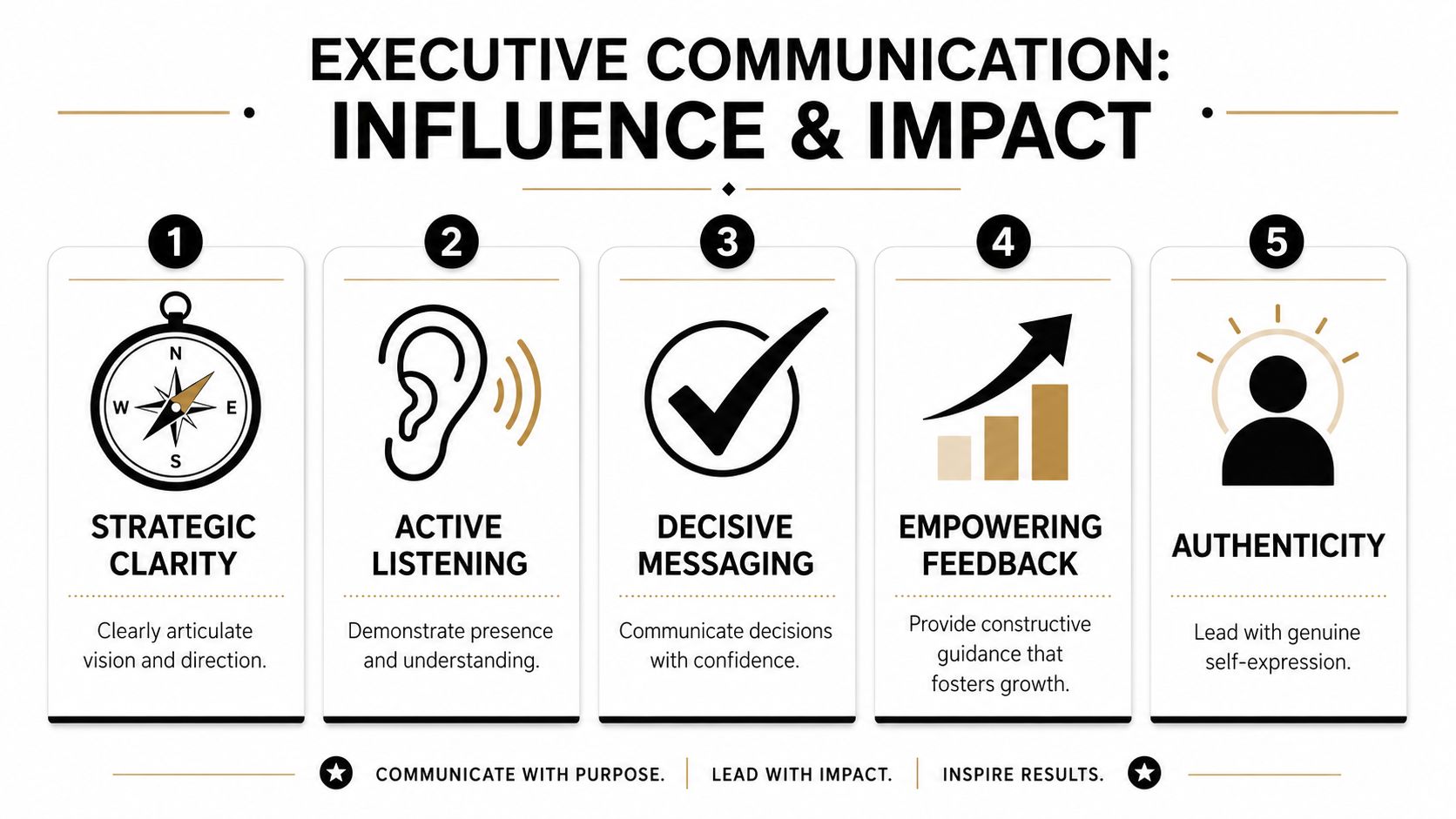
At junior levels, etiquette is often judged by correctness. At senior levels, it's judged by effect. Did your communication steady the room, sharpen the decision, and increase confidence in your leadership?
That's where many high-performing international professionals get stuck. They're intelligent, prepared, and respectful. But under pressure they speak too fast, fill silence too quickly, and add explanation where authority would use restraint.
Gravitas is not a vague quality
According to Sylvia Hewlett's Center for Talent Innovation study of 4,000 professionals, gravitas constitutes 67% of executive presence, while communication accounts for 28% and appearance only 5%, establishing gravitas as the dominant pillar for senior authority, as summarized in this review of Hewlett's executive presence research.
That finding matches what shows up in real boardrooms. People don't promote someone because they speak the most. They trust the person whose communication feels weighted, deliberate, and credible.
Strategic silence and vocal authority
One of the least taught parts of executive communication etiquette is silence. Many non-native English professionals rush to fill pauses because silence feels risky. They worry the room will mistake a pause for hesitation, language insecurity, or lack of command.
In practice, the opposite is often true.
Research summarized by IMD on executive presence notes that executive presence coaching targets voice control, pacing, and strategic pauses because pauses help leaders control conversation flow and increase perceived authority in high-stakes settings.
Silence is persuasive when it follows a clear point. It tells the room your words can carry weight without immediate rescue.
A stronger executive style often includes:
- Shorter answers: Say the core point first, then stop.
- Lower reactivity: Don't treat every challenge as a cue to defend yourself at length.
- Deliberate pacing: Let key conclusions land before you add detail.
- Aligned signals: Your voice, facial expression, and message should all suggest the same level of confidence.
Strategic framing matters too. In high-stakes communication, leaders need to say more with fewer words, align verbal and non-verbal signals, and connect with the audience before landing the message, as described in this executive framing guide.
For ambitious leaders, The Gravitas Method is a 12-week one-on-one executive presence coaching program for international professionals who want to communicate with more authority and influence at senior levels. The program is priced at $8,200 paid in full or $9,000 across three installments. Coached by Nikola, it covers vocal authority, strategic framing, executive body language, and high-stakes communication.
How to Practice and Improve Your Communication Skills
Most professionals try to improve communication etiquette by consuming more advice. That helps less than they think. Improvement usually comes from tighter feedback loops and repeated practice in real situations.
A better practice system
Start with a few controlled habits:
- Record one meeting recap: After an important call, record yourself summarizing the decision in under a minute. Listen for pace, filler, and whether your main point arrives early.
- Set one channel rule: For one week, keep each email to one clear topic and one visible ask.
- Use deliberate pauses: In your next high-stakes conversation, pause briefly after your recommendation instead of justifying it immediately.
- Audit your listening: Strong etiquette includes how you receive, not just how you deliver. This article on understanding coaching listening levels is useful if you tend to prepare your response before the other person has finished.
Get feedback that exposes the real pattern
A validated 90-day executive presence development plan requires scheduling three to five 360-degree feedback conversations with peer or senior colleagues, asking one specific question, “What one thing do I do that undermines my credibility in senior rooms?”, and recording feedback verbatim before interpretation to identify the top presence gap, according to this executive presence development framework.
That question works because it removes vagueness. Don't defend yourself. Don't explain context. Write down the words exactly.
Most communication growth starts when you stop asking whether you were “good” and start asking what signal you consistently send.
If you're serious about improving, don't guess where your biggest gap is. Get it diagnosed clearly.
If you want a practical next step, start with Intonetic's free Executive Communication Assessment. It's the best entry point if you want a clearer read on how your communication is perceived, where your authority drops, and what to fix first so you can show up with more influence in senior rooms.