
Unlock Success: Why Business Communication Is Important
Miscommunication costs U.S. businesses about $1.2 trillion every year, or $12,506 per employee annually, and teams lose an average of 7.47 hours per week to communication inefficiencies, according to Grammarly's State of Business Communication report introducing the 2024 State of Business Communication. That's why business communication isn't a courtesy skill, it's a financial control, a leadership signal, and a career accelerant.
Poor communication drains value through rework, unclear handoffs, missed decisions, and frustrated customers. Strong communication does the opposite, it helps leaders align teams, reduce hidden risk, and build the kind of presence that opens senior opportunities.
Why Business Communication Matters
The case for why business communication is important starts with the scale of the loss. When organizations lose time to confusing emails, vague meeting notes, and sloppy handoffs, that friction does not stay small. Grammarly's research shows the cost lands at $1.2 trillion annually across U.S. businesses, with a per-employee hit of $12,506 and 7.47 hours lost each week to inefficiency.
That matters because communication failures do not just create annoyance. They produce lower morale, lost productivity, customer churn, and wasted time redoing work. In a company with only a few hundred employees, those losses can accumulate into serious operational leakage, especially when the same message has to be clarified across teams, time zones, and functions.
Practical rule: if a message needs three follow-ups to become usable, it was never clear enough in the first place.
Communication also determines how quickly people can execute. A weak update from a manager can slow an entire project, while a precise one keeps priorities, roles, and constraints visible. If you want a closer look at the workplace cost of this problem, this breakdown of miscommunication in the workplace shows how quickly confusion turns into business drag.
The personal stakes are just as real. People who can explain ideas cleanly, frame decisions sharply, and speak with authority are easier to trust in high-pressure rooms. That is why communication shapes not only business outcomes, but also who gets invited into the next level of leadership. For professionals focused on building a powerful brand for creators, the same discipline helps turn clear messaging into stronger executive presence.
How Communication Drives Organizational Performance
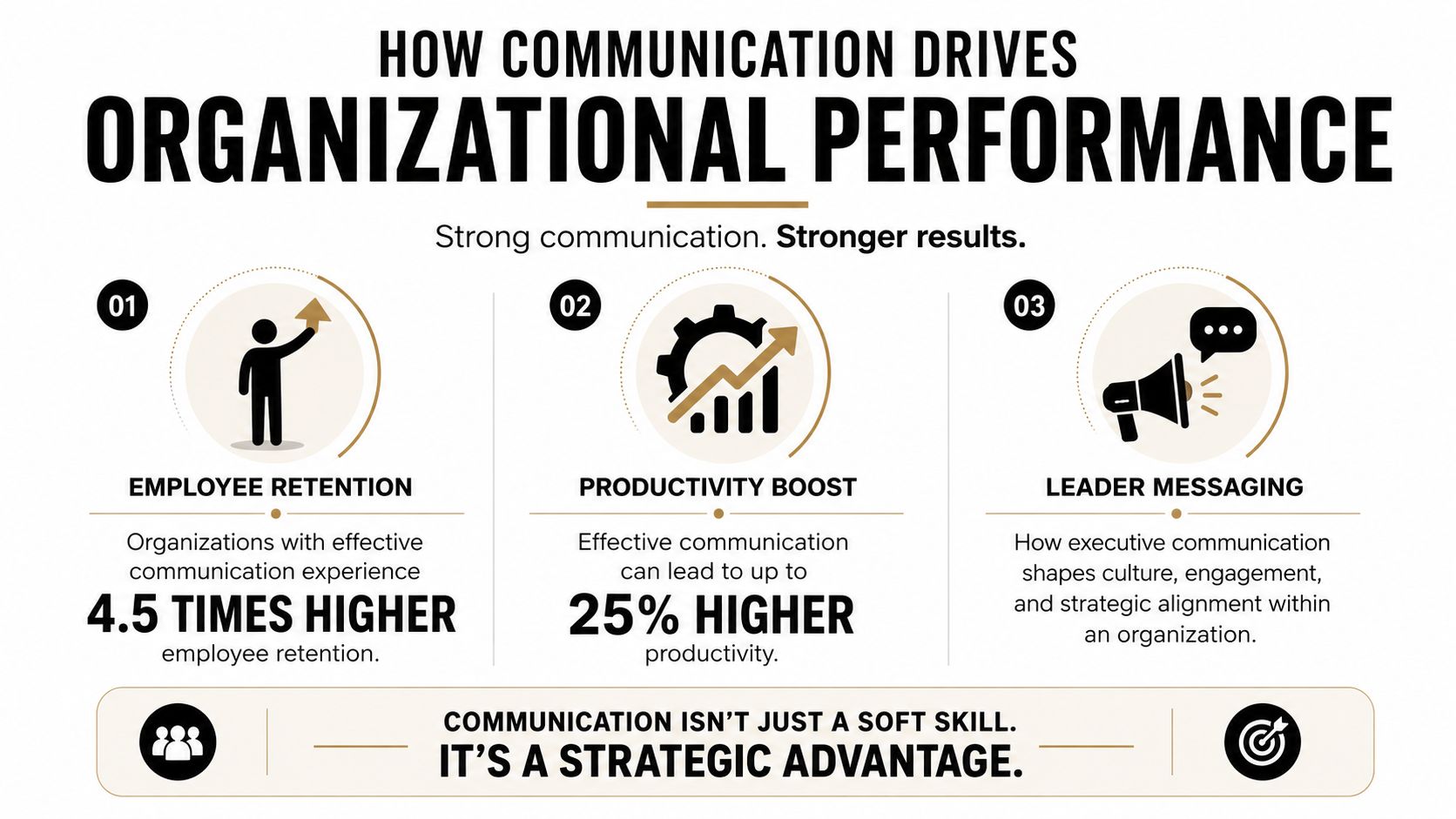
Effective communication is one of the clearest links between leadership behavior and business results. Surveys summarized by Sociabble associate strong communication strategies with 4.5 times higher employee retention and up to 25% higher productivity. The same research notes that 79% of employees say leader communication affects how well they understand organizational objectives Sociabble's communication statistics.
That alignment effect is often underestimated. When employees understand goals, they don't spend as much time guessing what matters, which tasks can wait, or which trade-offs leadership wants. Better understanding reduces confusion, and that shows up in faster execution, fewer internal conflicts, and less churn in teams that otherwise lose people to frustration.
Communication as an operational control system
Clear communication works like a control system because it makes work repeatable. Technical communication guidance emphasizes that step-by-step, easy-to-understand instructions help employees complete tasks more successfully, prevent information overload, and identify problems earlier, which directly supports operational efficiency and product safety technical communication guidance.
That's especially important in global teams where a single unclear instruction can ripple across functions. A product manager, finance lead, or operations director may think they've been precise, but if the audience leaves with different assumptions, the organization pays later in rework and delay. Clear communication lowers that hidden risk because it makes expectations visible before errors spread.
Communication quality is easiest to ignore when things are going well. It becomes visible when deadlines slip, compliance questions appear, or customers start asking the same question twice.
Why leaders should treat communication like infrastructure
Leader messaging matters because it sets the tone for everything downstream. Internal communication research linked to connected employees shows that productivity can improve by up to 25% in organizations where employees are connected, which reinforces that communication isn't a side activity, it's part of the operating model ACC-linked communication research.
External communication matters too. Business communication includes information shared both inside and outside the organization, and effective communication supports efficiency, error reduction, decision-making, problem-solving, innovation, and growth Nextiva's business communication overview. That's why communication isn't just an HR concern or a management soft skill. It sits at the center of execution, governance, and customer experience.
If you're mapping communication quality in a more structured way, this communication audit example is useful because it shows how leaders can move from intuition to measurement. Organizations are increasingly treating communication as a system, not a personality trait, and that shift is where performance gains become repeatable.
Here's a short way to think about it. Clear communication protects margin, because it reduces waste. It also protects momentum, because teams spend less time decoding what leaders meant and more time doing the work.
For teams that need clearer messaging across functions, building a powerful brand for creators offers a useful reminder that message discipline isn't just about internal alignment, it also shapes how people experience credibility from the outside.
Key Components of Effective Communication
The best communicators don't rely on charisma alone. They build four habits that make their message easier to trust and act on, verbal clarity, strategic framing, executive body language, and active listening. Each one solves a different failure point, and together they make communication feel calm, deliberate, and credible.
Verbal clarity and strategic framing
Verbal clarity means saying the thing cleanly the first time. Use shorter words, fewer qualifiers, and one main point per sentence in critical situations. If you can't summarize your point in a few lines before a meeting, you're probably still thinking out loud instead of leading.
Strategic framing is about shape, not decoration. Comparable to setting a camera lens, the scene doesn't change, but the audience's understanding does. If you open with context, then define the decision, then show the implication, your message lands differently than if you dump facts without a structure.
Useful test: if your audience asked, “So what?” after your update, the frame needs work, not the facts.
A practical exercise helps here. Take one complex idea and explain it in two versions, one for a technical peer and one for a senior executive. The content can stay similar, but the order, emphasis, and vocabulary should shift to match the listener's priorities.
Executive body language and active listening
Body language gives your words weight. Open posture, steady eye contact, and controlled gestures signal that you're composed enough to guide the room. In meetings, especially virtual ones, people read nonverbal cues fast, and those cues often decide whether they treat your idea as tentative or decision-ready.
If you want a deeper taxonomy of formats, types of professional communication is a helpful reference for separating the channel from the message. That distinction matters because a written update, a board presentation, and a negotiation call all need different levels of formality and pace.
The final pillar is active listening. You're not just waiting to talk, you're checking for meaning, tension, and missing assumptions. A good habit is to repeat back the decision in plain language before the meeting ends, then invite correction. That single move catches misunderstanding before it becomes operational risk.
Real World Examples of Effective Business Communication
A software engineering lead working across borders often faces a familiar problem, everyone is competent, but assumptions still diverge. One team hears “urgent” and starts immediately, while another waits for a formal ticket. The fix isn't more volume, it's tighter wording, written confirmation, and explicit ownership before work starts.
A finance director faces a different challenge in the boardroom. Raw numbers rarely move people on their own, so the message has to be framed around risk, timing, and business impact. When the director leads with the decision the board needs to make, then supports it with the financial logic, stakeholders can respond to the issue instead of getting lost in the spreadsheet.
An international consultant has to do even more with less room. In virtual meetings, posture, pacing, and camera presence shape authority before the first slide is fully read. If the consultant speaks too quickly or disappears behind a wall of data, the room may miss the strength of the recommendation.
The hardest part is that communication can fail even when people are highly capable. Cultural fluency, dominant speaking styles, and rapid agendas can overshadow expertise, and non-native speakers may be read as less authoritative even when their ideas are strong customer communication strategies for trust and retention. That's not a content problem alone, it's a delivery and power-dynamic problem.

A useful lens for senior professionals is this, communication isn't just about being understood, it's about being believed at the right moment. That's why people who master pacing, framing, and nonverbal authority often advance faster, even in roles where technical competence is already expected. If you're trying to sharpen that persuasion layer, communication as persuasion is a smart starting point.
Practical Steps to Improve Executive Presence
Executive presence becomes visible through repeated behavior, not personality alone. Start by recording yourself answering a hard question, then review your pace, filler words, posture, and whether you reach the point before you drift into detail. A baseline matters because you cannot improve what you are unwilling to hear. For a more detailed framework, see how to improve executive presence.
A simple improvement routine
- Self-assess. Watch one presentation clip and note where your voice weakens, your framing gets muddy, or your gestures look uncertain.
- Set a narrow goal. Pick one behavior, like cleaner openings or slower pacing, and work on it for a full week instead of trying to fix everything at once.
- Practice under pressure. Explain a complex idea in under a minute, then repeat it with fewer words.
- Ask for structured feedback. Do not ask, “How did I do?” Ask, “Where did I lose clarity, authority, or pace?”
Strong habit: practice the exact moments that normally shake your confidence, not just the parts you already like.
A communication system is easier to improve when you treat it like an operational workflow. Many organizations now monitor communication quality through signals such as CSAT and first-contact resolution, because those measures surface hidden risk in complex workflows RingCentral's communication systems overview. The same logic applies to individuals. If your message breaks down at the opening, during transitions, or under pressure, you can identify the pattern and correct it with intent.
For professionals who want targeted support, The Gravitas Method is a 12-week one-on-one executive presence coaching program for international professionals who want to communicate with more authority and influence at senior levels. It is priced at $8,200 paid in full or $9,000 across three installments, coached by Nikola, and it covers vocal authority, strategic framing, executive body language, and high-stakes communication.
If your communication already gets you in the room but does not fully reflect your seniority, pair your video practice with optimizing LinkedIn video content so your external presence matches your in-room delivery. Consistency across channels helps people see the same executive signal everywhere you show up.
Embracing Communication Excellence
The evidence points in the same direction from multiple angles. Miscommunication drains money at enterprise scale, effective communication improves retention and productivity, leader messaging shapes alignment, and the core skills can be practiced systematically. That makes communication a learned competency, not an inborn gift.
For international professionals, the opportunity is bigger than sounding polished. Strong communication reduces hidden operational risk, builds trust faster, and helps expertise land with more authority in senior rooms where every minute counts. Small upgrades in clarity, framing, and presence compound into stronger decisions and faster advancement.
If you want to see where your own communication breaks down, a structured assessment is the fastest place to start. A clear baseline turns vague frustration into specific next steps, and specific next steps create real momentum.
Intonetic helps international professionals build executive presence through communication assessment and coaching that focus on authority, framing, and delivery at senior levels. If you're ready to close the gap between strong ideas and strong influence, start with the free Executive Communication Assessment and see where your message needs to sharpen.