
Strategic Communication Planning: A Guide for Executives
You're likely dealing with this right now. The strategy is sound. The board deck is polished. The talking points have been reviewed three times. Then the meeting ends, and instead of momentum, you get hesitation, side questions, and polite silence.
That isn't always a content problem. Often, it's a planning problem.
Senior leaders rarely fail because they have nothing to say. They fail because they haven't built a strategic communication planning process that connects the message to the audience, the moment, the stakes, and the behavior they need to change.
Why Most Executive Communication Fails
A senior leader announces a reorganization. She believes she has been clear. She explains the business rationale, shares the timeline, and tells the team what happens next. On paper, the communication is competent.
But within days, managers are improvising answers, employees are filling gaps with rumor, and peers are asking whether the move is defensive rather than strategic.
The issue usually isn't that the leader lacked conviction. It's that she communicated the same way many capable executives do under pressure. She focused on what she wanted to say, not on what each audience needed to hear, when they needed to hear it, and what resistance would likely surface.
That's why high-stakes communication often breaks down. Leaders confuse information delivery with influence. They assume one strong town hall, one board presentation, or one leadership note will do the job. It won't.
A communication failure at this level carries real cost. It slows decisions, weakens trust, and creates inconsistent execution across teams. In global organizations, the problem compounds when different regions interpret the same message through different operational and cultural lenses. If this pattern sounds familiar, this breakdown in workplace miscommunication is rarely random. It usually points back to missing planning discipline.
Practical rule: If stakeholders leave with different interpretations of the same message, the communication wasn't clear enough for the stakes involved.
Leaders also underestimate how quickly audiences separate intent from impact. You may intend reassurance. Your investors may hear uncertainty. You may intend urgency. Your team may hear panic. Strategic communication planning exists to close that gap before the message ever reaches the room.
Understanding Strategic Communication Planning
Strategic communication planning is the difference between designing a skyscraper and stacking bricks. One approach begins with structure, purpose, load-bearing decisions, and sequencing. The other starts with activity.
That distinction matters. Executives don't need more communication output. They need communication that serves the mission, anticipates friction, and drives aligned action.
Around 2007, scholars Hallahan, Holtzen, and Vanula formally defined strategic communication as the “purposeful use of communication by an organization to fulfill its mission”. That definition changed the discipline. Communication was no longer a support function that packaged announcements after decisions were made. It became a strategic practice built on audience analysis, goal setting, and message design.
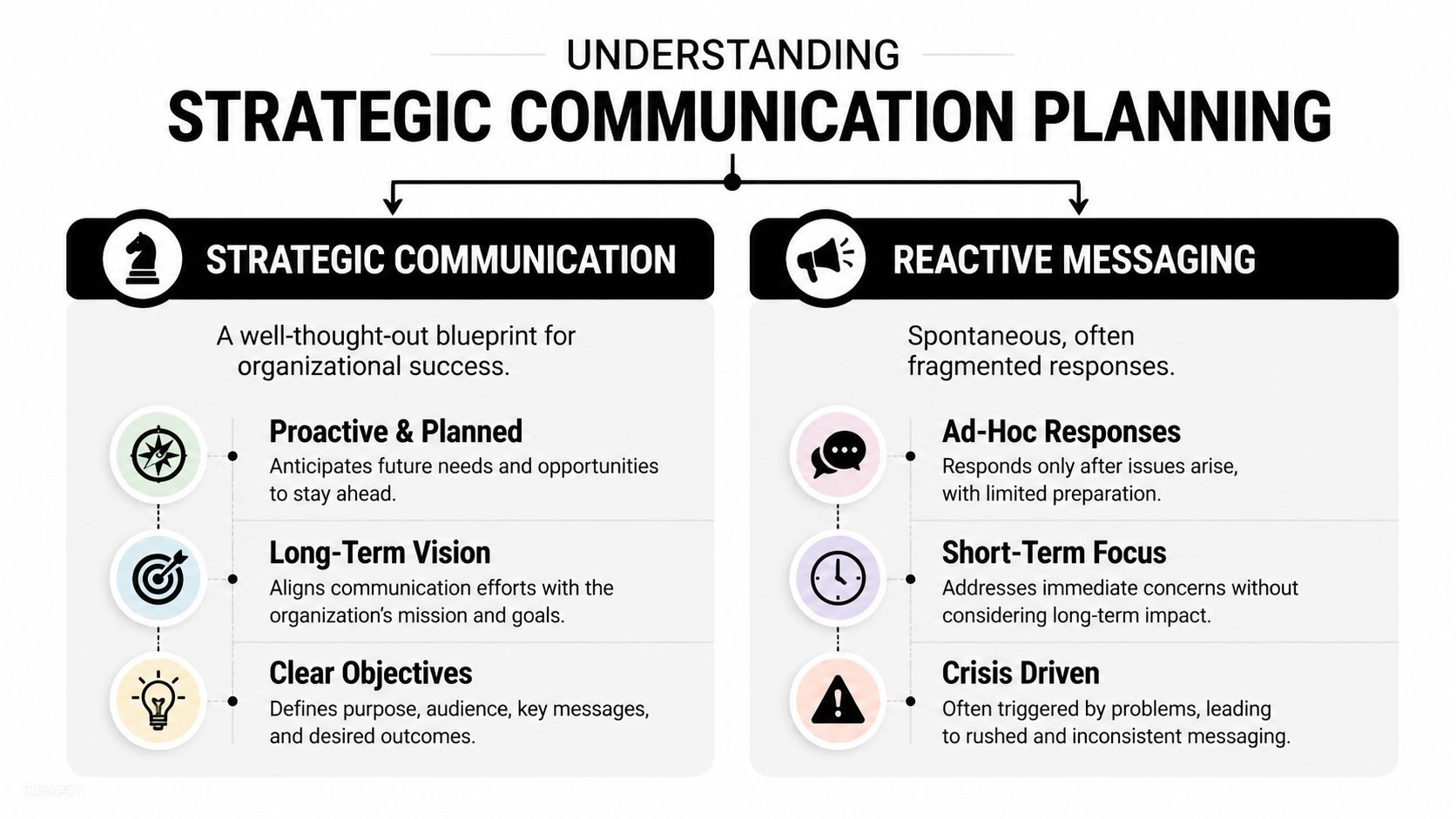
Strategic versus reactive
Reactive messaging looks familiar in most organizations:
- A rushed CEO note: Sent after people have already heard fragments of the decision.
- An overloaded slide deck: Full of facts, thin on meaning.
- A generic all-hands message: Written for everyone, which means it lands with no one.
Strategic communication planning works differently. It asks tougher questions first.
- Why this message now: What business outcome depends on stakeholder understanding or buy-in?
- Who matters most: Which audiences can accelerate, block, distort, or champion the initiative?
- What must change: Do you need awareness, alignment, commitment, or visible action?
The real shift for executives
This is the mindset change many senior leaders need. Tactics are the visible artifacts. The email, speech, board memo, Q&A, media interview, and manager cascade are all tactics. Strategy is the logic connecting those tactics to an organizational objective.
A strong plan answers the why before it touches the what.
If you skip that step, communication turns into motion without direction. Teams become busy producing assets, but nobody can explain how those assets move a decision, reduce resistance, or build confidence.
The best executive communicators think like architects. They don't begin with bricks. They begin with the structure that allows everything else to stand.
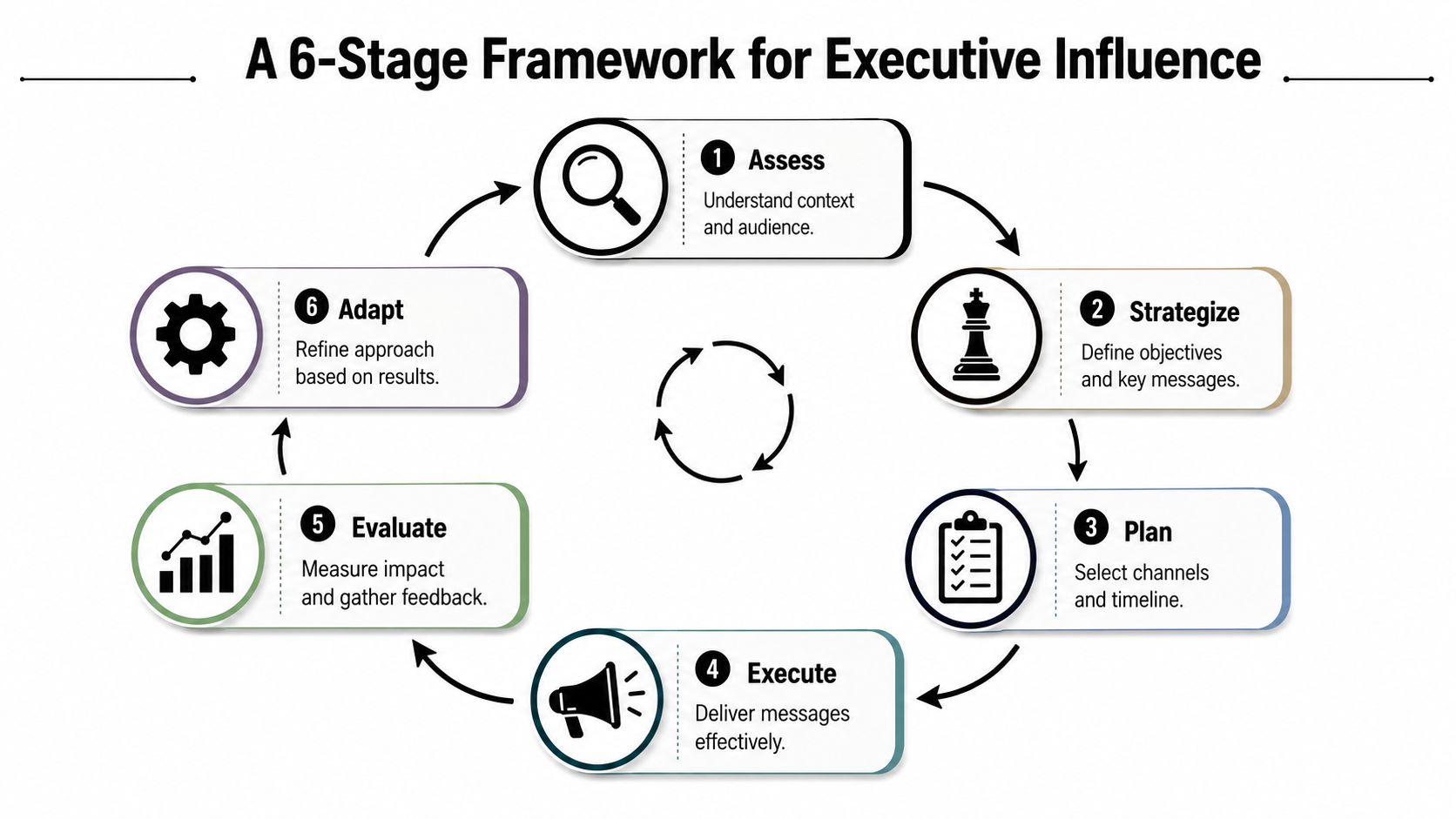
A 6-Stage Framework for Executive Influence
The most useful planning models are practical. They help a leader move from ambiguity to action without overcomplicating the process.
One strong model is the six-stage control loop for strategic communication frameworks: Situation Analysis, Objectives, Strategy, Tactics, Action, and Control. It's disciplined enough for enterprise decisions and flexible enough for a board presentation, change initiative, investor update, or market announcement.
Situation analysis
Start with reality, not aspiration.
Executives often rush to messaging before they've assessed the actual communication terrain. That's a mistake. A situation analysis forces you to identify the pressure points around the initiative. What's changing? What's politically sensitive? Which assumptions are already circulating? Where is trust fragile?
A simple SWOT can help. It's not glamorous, but it's useful when done thoroughly.
- Strengths: Existing credibility, strong sponsorship, market momentum.
- Weaknesses: Low trust, message complexity, unclear ownership.
- Opportunities: Timing advantages, stakeholder appetite, strategic alignment.
- Threats: Internal resistance, mixed incentives, competing narratives.
For a leader preparing a high-stakes announcement, this stage often surfaces the issue that matters most. Not “what should I say,” but “what will they fear, question, or misinterpret?”
Objectives
The second stage is where many plans become vague. “Increase awareness” sounds reasonable, but it doesn't create accountability.
Your objectives need to be SMART. Specific, Measurable, Achievable, Relevant, and Time-bound. That doesn't mean every communication outcome can be reduced to a spreadsheet. It means you define success clearly enough that your team can tell whether the message worked.
Useful objective language sounds like this:
- Secure executive alignment: So regional leaders repeat the same rationale and decision criteria.
- Build manager confidence: So managers can answer team questions without escalating basic concerns.
- Increase board confidence: So directors view the proposal as controlled rather than speculative.
A good objective links directly to organizational intent. If the business goal is a smoother transformation, the communication objective might center on stakeholder understanding and adoption, not merely message distribution.
For leaders who want templates for structuring these plans, reviewing strategic framework examples for executive communication can help translate theory into a working draft.
Strategy
At this stage, the plan starts to gain shape.
Strategy defines how you'll move each audience from its current position to the one you need. It's the bridge between the problem and the tactic. In practical terms, this means deciding which audiences matter most, what each group values, and how your core message should flex without becoming inconsistent.
Don't write one master message and force everyone to consume it the same way. Senior teams, frontline managers, investors, and external partners don't listen for the same thing.
Use a few disciplined questions:
- What does this audience care about most?
- What are they likely to resist?
- What evidence or framing will make the message credible to them?
- What action do I need from them after they hear it?
Tactics
Once the strategy is set, choose tactics that fit the message and the audience.
In contrast, many organizations do the reverse. They start with the channels they already use, then stuff the message into them. A town hall becomes the answer because a town hall is available. A slide deck becomes the answer because leaders are used to presenting decks.
That's backward.
Choose the channel based on the decision you need, not the communication habit your organization already has.
Tactics might include a board memo, leadership meeting, recorded message, manager toolkit, investor call, or small group briefings. The right mix depends on complexity, sensitivity, and the need for dialogue. If the message is emotionally charged or politically delicate, a one-way blast usually fails.
A short explainer can help teams visualize this cycle in practice:
Action
A plan without ownership is just a document.
This stage answers the operational questions. Who drafts the message? Who reviews legal or regulatory language? Who briefs managers? Who handles follow-up questions? What gets released first, and what must wait until internal stakeholders are aligned?
A working action plan should include:
- Responsibilities: One owner per deliverable.
- Sequence: Internal before external when trust and coherence matter.
- Timing: Clear release windows, briefing points, and decision deadlines.
- Escalation path: A named route for handling objections or confusion.
When action plans fail, it's usually because too much remains implied. Under pressure, implied work becomes dropped work.
Control
Control is the discipline that separates serious planning from ceremonial planning.
After delivery, leaders need evidence. Did stakeholders understand the message? Are managers repeating it accurately? Did the board move closer to approval? Are the right questions surfacing, or are people still confused about the basics?
This isn't about perfection. It's about adjustment.
A strong control loop includes:
- Immediate feedback: What did people hear versus what you intended?
- Behavior signals: Are stakeholders acting differently?
- Message refinement: Which phrases created clarity, and which created drag?
The best communicators don't defend a message because they worked hard on it. They refine it because the audience response tells them what's landing.
Applying The Framework in High-Stakes Scenarios
Theory matters less than performance under pressure. Strategic communication planning proves its value when the stakes are political, financial, or reputational.

A global organizational change
Consider a senior executive leading a restructuring across multiple regions. The business case is legitimate. Reporting lines need to change, decision rights need to tighten, and duplicated functions need to be reduced.
The failure mode is predictable. Leadership sends one polished announcement and assumes consistency will follow. It won't. Different regions will hear different implications. Some will focus on job security. Others will focus on authority loss. Local managers will fill in blanks with their own interpretations.
In this scenario, stakeholder mapping comes first. According to the strategic communication guidance that uses Domino's 2009 response as an example, expert execution requires mapping stakeholder influence and impact before designing messages, with differentiated messaging for customers, employees, and investors. The lesson for executives is simple. Different groups need different emphasis, even when the strategic narrative stays coherent.
A leader handling this well might organize messages around:
- Regional leaders: Decision rights, implementation expectations, and local flexibility.
- People managers: Team questions, escalation routes, and immediate next steps.
- Employees: What's changing, what isn't, and how support will be provided.
If one audience needs reassurance and another needs operational precision, don't split the difference. Build both messages deliberately.
A skeptical board proposal
Now take a different case. A founder or division head presents a bold proposal to the board. The idea is strong, but directors are cautious. They worry about timing, exposure, and execution capacity.
Weak communication planning often looks polished. The deck is well-designed, but it answers the wrong questions. The presenter spends too long explaining the opportunity and too little time addressing risk, sequencing, and governance.
A better plan starts before the meeting. Stakeholders are mapped by influence and probable objections. The message architecture is tightened into a few decision buckets. Why this matters. How execution will be controlled. What success looks like. For many leaders, sharpening that structure also improves how to structure a presentation so that directors can process the logic quickly under scrutiny.
In the room, the executive does more than present. He manages decision-making. He knows where support is soft, where opposition is principled, and where a director just needs evidence that the team has thought through downside scenarios.
That's what strategic communication planning does in practice. It turns a message into a decision tool.
Measuring Success With The Right KPIs
If communication can't be evaluated, it can't be managed well.
This matters even more because communicators are operating under pressure. Within the global communications field, budget constraints and too few people to do the work were each named by 20% of global communicators as a top obstacle in the 2023 State of Global Communications and Marketing report. When resources are tight, leaders need measures that justify effort and help teams focus.
Output isn't the same as outcome
Many executive teams still default to easy counts. Number of emails sent. Number of slide decks produced. Attendance volume. Those figures may help with operational reporting, but they don't tell you whether communication changed understanding, alignment, or behavior.
A stronger KPI set separates output metrics from outcome KPIs.
| Communication Goal | Outcome KPI | Output Metric (To contextualize) |
|---|---|---|
| Change management | Manager message consistency in team discussions | Number of cascade toolkits distributed |
| Crisis communication | Stakeholder confidence in the response approach | Number of holding statements or updates issued |
| Leadership visibility | Clearer understanding of strategic priorities among key audiences | Number of executive appearances or internal posts |
| Board proposal support | Decision readiness and quality of board questions | Number of pre-read materials sent |
| Cross-functional alignment | Fewer conflicting interpretations across teams | Number of workshops or briefings held |
What to watch in practice
The best KPIs are close to the behavior you need.
- For internal change: Track whether managers can explain the rationale, not just whether they attended the briefing.
- For executive alignment: Listen for message consistency across leadership forums.
- For major proposals: Evaluate the quality of objections. Better objections usually mean stakeholders understood the case and moved to real evaluation.
If you need a starting point, a structured communication audit example can help identify where your current reporting is too activity-heavy and too light on impact.
Good measurement doesn't reward noise. It rewards movement.
Your Roadmap from Plan to Presence
Most senior leaders don't need a year to improve their communication discipline. They need a usable operating rhythm.
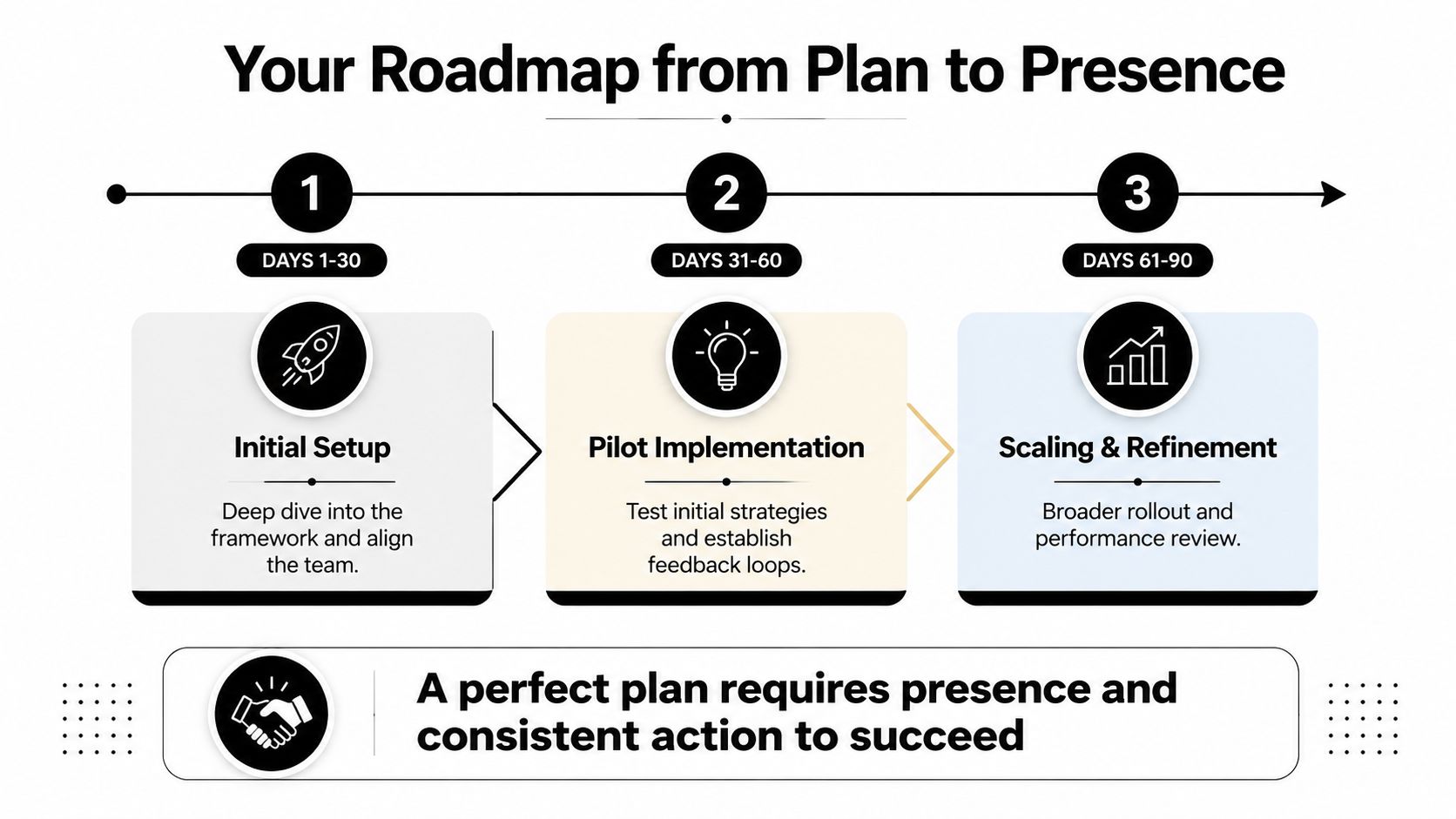
A practical roadmap can run over 90 days, with check-ins at Day 30, Day 60, and Day 90 as part of executive presence development guidance from Stretch Learn's executive presence course. That cadence works because it creates enough time to test, review, and refine without letting the effort drift.
Days 1 to 30
Use the first stretch to build the core plan. Clarify one priority initiative, identify key stakeholders, write SMART objectives, and pressure-test your message against likely objections.
This is also the moment to assess your own delivery habits. Many leaders discover that the message is logically sound but verbally crowded. They over-explain, rush transitions, or bury the headline.
Days 31 to 60
Pilot the communication in lower-risk settings before the highest-stakes forum. Test the narrative with trusted peers, direct reports, or a smaller leadership group.
Refine based on what people understood. If you work across functions, this is also a good point to study adjacent disciplines where communication and positioning have to stay tightly connected. For example, teams working on launches or thought leadership can borrow useful audience and sequencing lessons from a strong book marketing strategy approach, where message clarity, timing, and audience targeting all matter.
Days 61 to 90
Scale what works. Tighten supporting materials, prepare for harder questions, and review whether your communication is producing the intended actions.
A difficult truth shows up at this juncture. A perfect plan can still fail in the room.
The biggest gap I see with international leaders is not intelligence, preparation, or ambition. It's executive delivery. In one cited dataset, 75% of international senior executives reported that their strategic messages are “lost in translation” due to delivery gaps rather than weak content, as noted in this strategic communications planning reference. That gap shows up in rushed pacing, weak vocal projection, flat emphasis, or a lack of pause discipline under pressure.
Why presence decides whether the plan lands
Gravitas isn't a vague quality. It can be broken into six components: self-awareness, expertise, authenticity, presence, connection, and projection, based on this gravitas framework video. And one of the clearest delivery signals is the pause. Professionals with gravitas use the power of the pause to let ideas land and to project thoughtfulness and control.
That's the final mile most planning frameworks ignore. They help leaders decide what to say, but not how to say it so people trust it.
If executive presence is the missing piece, developing executive presence skills for career growth is often what turns a competent message into an influential one.
If you want an outside view on how your communication lands, start with the free Executive Communication Assessment from Intonetic. It's the clearest entry point if you're an international professional preparing for bigger rooms, tougher stakeholders, and higher-stakes visibility. For leaders who need deeper support, The Gravitas Method is a 12-week one-on-one executive presence coaching program for international professionals who want to communicate with more authority and influence at senior levels. The program is priced at $8,200 paid in full or $9,000 across three installments. Coached by Nikola, it covers vocal authority, strategic framing, executive body language, and high-stakes communication.