Master Performance Review Phrases: Elevate Your Career In
Giving a review is hard. Receiving one can feel worse. A manager is trying to be fair, specific, and useful under time pressure, while the employee is listening for what affects credibility, progression, and trust.
That tension is exactly why phrase lists fall short.
A strong performance review is a leadership tool. It should clarify what the person did, how that work was experienced by others, and what changes will increase their influence and readiness for bigger scope. In senior roles, that goes beyond output. Reviews also shape how someone is seen in the room, in cross-functional decisions, and in moments where communication carries as much weight as analysis.
The shift many companies have made away from generic annual appraisals reflects a practical problem, not a trend. Standard templates often produce safe wording, mixed signals, and feedback that is too broad to change behavior. Managers who want better conversations need structure, not nicer adjectives.
If you want examples of conventional wording, these UK manager performance review comments show the standard format. They are useful as a reference point. They are not enough if your goal is to strengthen judgment, presence, and leadership impact.
That is why this article focuses on eight review models, not a bank of interchangeable lines. Each framework helps you generate context-specific feedback that fits the role, the stakes, and the behavior you need to address. If you are also working on communication skills for managers, this shift matters even more, because the quality of the review often determines whether feedback is accepted, resisted, or acted on.
1. The SBI (Situation-Behavior-Impact) Model
The fastest way to improve performance review phrases is to stop describing personality and start describing moments. SBI works because it forces precision. You name the situation, describe the observable behavior, and explain the impact on outcomes, people, or credibility.
That structure matters in senior environments because vague feedback creates argument. Specific feedback creates movement. It also reduces cultural guesswork for international professionals, who are often trying to decode whether a comment reflects real performance, communication style, or someone else's preference.
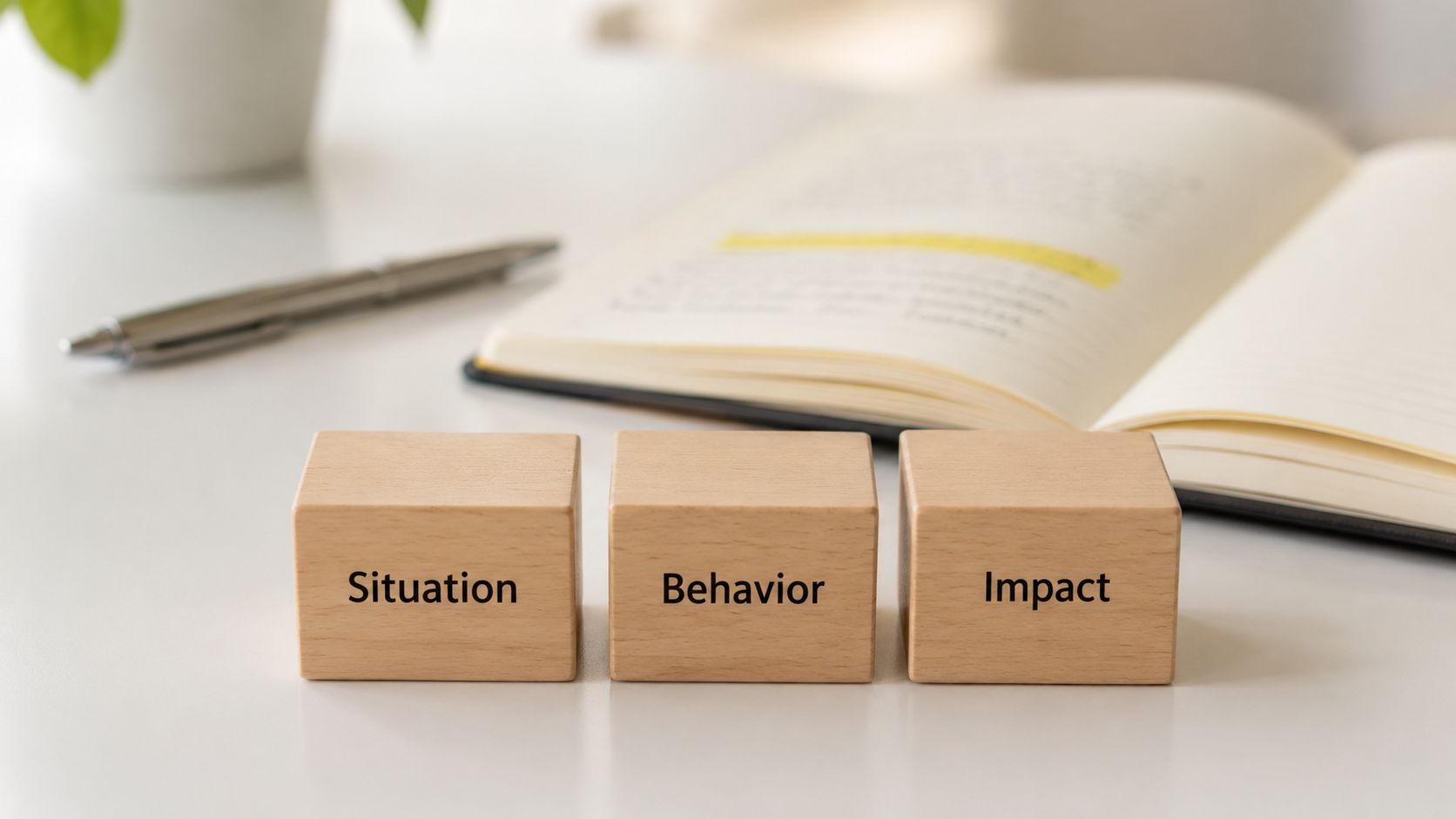
What strong SBI language sounds like
A product manager might hear: During the Q3 roadmap presentation, you presented the data accurately but moved into implementation detail before framing the strategic implications. That left the executive team unclear on the business value and slowed decision-making.
A finance director might hear: In last week's investor call, you gave accurate numbers, but your delivery was flat and hesitant when discussing the forecast. That made listeners less confident in your conviction, even though the analysis was sound.
Practical rule: If the sentence would still make sense with the employee's name removed and a date inserted, you're probably giving useful feedback.
Research cited in broader HR literature reports that 68% of employees in large organizations who received structured, behavior-anchored feedback found it more useful and motivating than vague opinion-based comments, as summarized in these performance review phrase examples.
Where managers get SBI wrong
The mistake isn't usually the model. It's the laziness inside the model. “In meetings, you need more executive presence” isn't SBI. Neither is “your communication can be clearer.” Those are still abstractions.
Use SBI right by doing three things:
- Capture events quickly: Write notes right after presentations, stakeholder meetings, and escalations.
- Stay inside observable behavior: Focus on what the person said, did, omitted, or emphasized.
- Define the next behavior: Explain what better would look like in the next similar moment.
Managers who want better review conversations usually need better language habits first. That's why training in communication for managers has such direct payoff.
2. The GROW Model (Goal-Reality-Options-Will)
A familiar review problem looks like this: the manager gives thoughtful feedback, the employee agrees with all of it, and 90 days later the same patterns are still showing up. The issue usually is not honesty. It is structure. GROW turns the conversation from a verdict into a disciplined coaching process with four steps: Goal, Reality, Options, and Will.
This model is especially useful when the person is already capable, but not yet showing the judgment, presence, or consistency the next role requires. I use it most with high-potential professionals whose results are credible, but whose advancement is slowed by how they frame ideas, handle stakeholders, or translate expertise into influence.
How to run a GROW review that leads to action
Start with the goal, and make it specific enough to create pressure. “You want to be seen as ready for director scope within the next review cycle.”
Then test reality with evidence. “Your technical judgment is respected. In cross-functional meetings, though, you often lead with detail instead of direction. Senior stakeholders leave with the data, but not always with a clear recommendation or sense of your conviction.”
That opens the right discussion. Options can include rehearsing recommendation-first openings, asking a trusted peer to observe stakeholder meetings, reviewing recordings, or working with a coach on executive communication. Will is the commitment point. “Over the next quarter, you'll open three business reviews with a one-minute recommendation summary, close each one with an explicit decision request, and collect feedback after each session.”
If the employee also needs sharper planning discipline, pair this framework with stronger development goals for work. Ambition alone rarely changes visible behavior.
Good GROW conversations create ownership. The employee should leave with a decision, not just an impression.
Why GROW works better than a phrase bank
A list of review phrases can help a manager get started. It does not solve the harder problem: getting the employee to recognize the gap, generate workable responses, and commit to one. That is the advantage of GROW. It gives you a repeatable way to build context-specific feedback around the actual role the person wants next.
The quality of the conversation depends on sequence. Managers often jump straight to solutions because advice feels efficient. In practice, that shortcut weakens buy-in. If the employee has not accepted the reality of how they are currently perceived, even good options sound theoretical.
Use this sequence instead:
- Goal: Define the next standard in terms of scope, influence, or readiness.
- Reality: Use current evidence from meetings, decisions, projects, and stakeholder interactions.
- Options: Focus on behaviors the person can practice and repeat.
- Will: End with a clear commitment, timeline, and follow-up point.
Keep the tone developmental, not soft. Recognition still matters here, especially when you need the employee to hear a hard truth without becoming defensive. Well-chosen examples of positive feedback to a colleague can help you balance credibility with challenge.
Many organizations now expect performance conversations to include goal-setting, development planning, and accountability in the same discussion. If you are refining that part of your process, the HubEngage platform for goal setting offers a useful operational reference point.
3. The 360-Degree Feedback Model
When someone says, “I'm a strong communicator,” and three stakeholder groups experience them differently, a standard review won't catch the gap. A 360 review will.
This model matters because senior leadership is partly about consistency of perception. You don't just need your boss to understand you. Your peers, direct reports, and cross-functional partners need to experience you as clear, credible, and steady under pressure.
What perception gaps actually look like
Consider an international CFO candidate who sees themselves as direct and clear. Their manager experiences them as strong in one-to-one briefings. Peers say they're harder to follow in complex discussions. Direct reports say expectations sometimes feel ambiguous. That pattern doesn't mean the person lacks expertise. It means their message lands differently across contexts.
Or take a tech director who believes they're collaborative. Their manager praises strategic thinking, but peers say they dominate discussions and direct reports say they don't feel heard. That's not one issue. It's a pattern around influence style, listening, and room awareness.
A useful way to balance this process is to pair hard messages with well-phrased recognition. Strong examples of positive feedback to a colleague can help leaders avoid turning 360 input into a document that reads like an indictment.
How to keep 360 feedback useful
The value of 360 feedback depends on design, not volume. Too many raters who barely know the person create noise. Poorly worded questions create personality judgments instead of leadership insight.
Use these guardrails:
- Choose relevant raters: Include people who've seen the person in meaningful work, not just visible settings.
- Frame it as developmental: People give better input when they know the process is for growth, not score-settling.
- Focus on a few patterns: Two or three repeated perception gaps are enough to drive a serious plan.
- Look at communication through context: Accent, pacing, directness, and cultural style can all affect how authority is perceived.
That last point gets ignored too often. Existing guidance on performance review phrases rarely addresses how non-native English speakers can receive more behavior-focused criticism and fewer leadership-oriented compliments, even when their performance is strong. In practice, 360 feedback is often where that bias becomes visible.
4. The Competency-Based Performance Review
A competency-based review is what you use when “good work” is no longer a precise enough standard. At senior levels, people don't advance because they're generally capable. They advance because they demonstrate the competencies the next role requires.
That means you review against a defined set of capabilities such as strategic thinking, influence, decision-making, communication, and executive presence. The benefit is simple. You make unwritten leadership expectations visible.
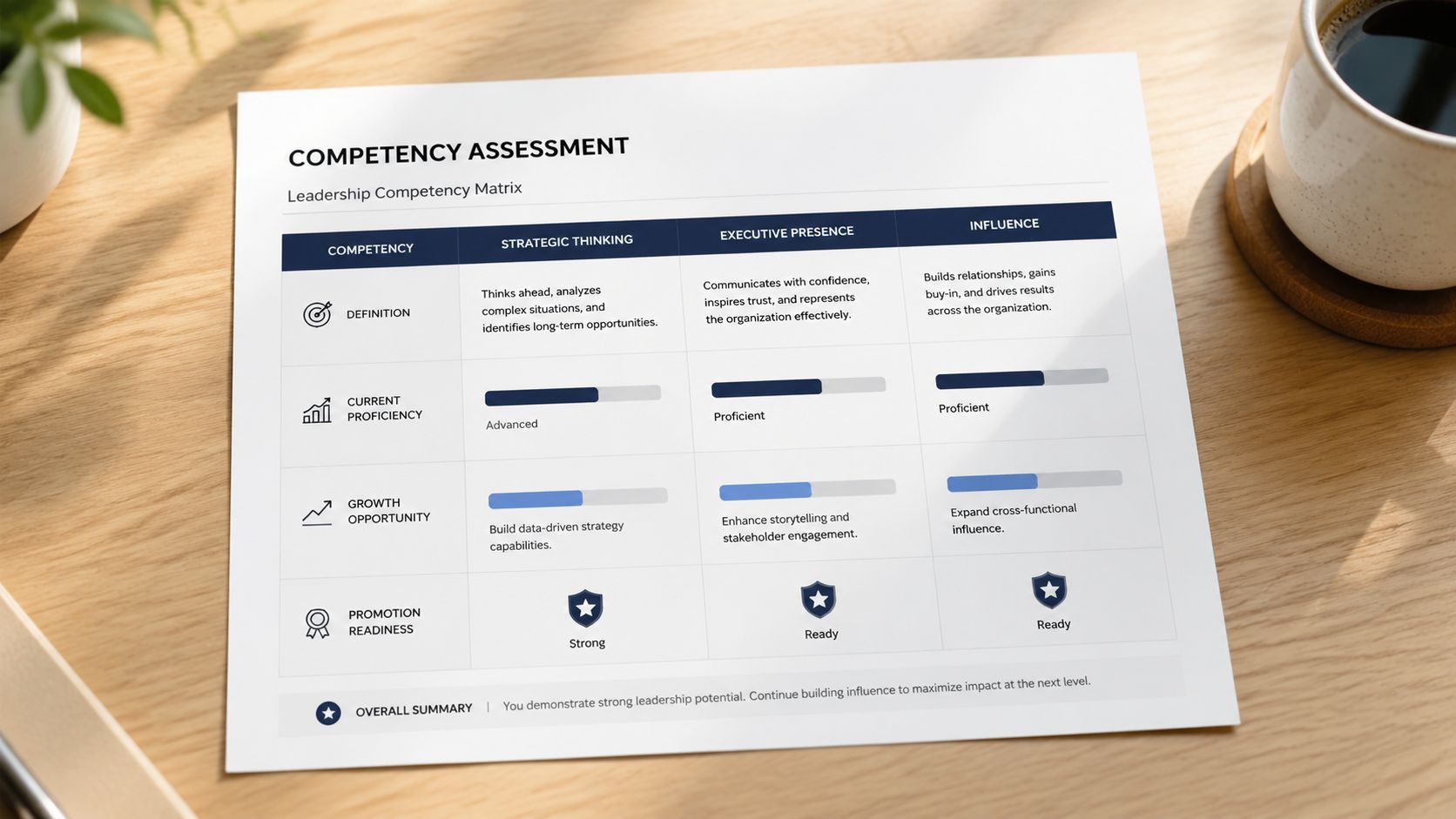
What this looks like in practice
A director-level review might say executive presence is “emerging.” The supporting language matters more than the label: communicates with technical accuracy, but doesn't consistently frame recommendations strategically for senior audiences and doesn't reliably command attention in group settings.
For someone on a VP track, you might rate strategic thinking as proficient for current scope while marking influence and persuasion as underdeveloped for next-level readiness. That tells the employee something useful. The issue isn't raw intelligence. It's that they present ideas clearly but hesitate to advocate, so others experience them as tentative.
Competency reviews work best when every rating is tied to behavior, not impression.
Why this model is gaining ground
A 2020 SHRM benchmarking review found that 52% of surveyed U.S. companies had updated performance management systems in the previous five years to emphasize specific, observable behaviors and examples, as reported in this overview of performance review comments and phrases.
That shift matters because competency models break a common review failure. They stop managers from writing comments like “great attitude” or “needs more polish,” which aren't measurable and often hide bias.
Build stronger competency reviews with a few rules:
- Define each competency behaviorally: Describe what “meets” and “exceeds” look like in real work.
- Include senior communication markers: Presence, framing, persuasion, and stakeholder confidence belong in the rubric.
- Separate skill gaps from perception gaps: The fix for each is different.
- Tie development to action: Coaching, stretch assignments, mentoring, and formal learning all solve different problems.
5. The Critical Incident Technique (CIT) Review
Some reviews become bland because they average everything together. CIT does the opposite. It asks: which moments shaped outcomes, reputation, or trust most clearly this cycle?
That's often where the best performance review phrases come from. Not from broad summaries, but from the few incidents people still remember months later because they changed a decision, exposed a weakness, or revealed leadership under pressure.
Use moments that mattered
A strong positive incident might read like this: During the Q4 budget challenge, you reframed the discussion from what the business was losing to where it could invest strategically. That shift changed the tone of the executive conversation and positioned you as a strategic leader rather than just a cost controller.
A developmental incident might be sharper: During last month's town hall, when asked about organizational direction, you deferred immediately to your manager instead of synthesizing what you knew and offering a point of view. Several senior leaders left unsure whether you had the conviction to operate at broader scope.
If you want to sharpen this kind of example writing, behavioral questions and STAR techniques are useful because they train the same discipline of evidence, action, and outcome.
How to avoid turning incidents into anecdotes
Critical incidents are powerful only when they reveal a pattern. One awkward moment could be nerves. Three similar moments across different settings usually point to a real development issue.
Many HR resources recommend documenting feedback around specific situations, behaviors, and outcomes over time rather than relying on memory alone, as described in this guidance on useful performance review phrases.
Use CIT well with a short discipline:
- Collect incidents continuously: Don't trust year-end recall.
- Record context and consequence: Note what happened and why it mattered.
- Balance positive and developmental examples: People need reinforcement as much as correction.
- Check for repetition: Repeated incidents tell you where coaching belongs.
For international professionals, this method is especially helpful because it helps separate communication style from actual effect. A concise answer, for example, may strike one audience as confident and another as disengaged. The incident gives you a real moment to analyze rather than a stereotype to defend.
6. The Balanced Scorecard Approach (Business Impact + Behavioral Assessment)
A lot of high performers get mixed reviews for one reason. They deliver results, but the way they deliver them limits trust, collaboration, or readiness for bigger roles. The balanced scorecard approach makes that tension visible.
It looks at performance through more than one lens: business outcomes, stakeholder experience, internal process discipline, and learning or development. That's useful because senior leadership isn't just about hitting numbers. It's about producing results in ways that increase confidence in your judgment and your ability to lead at scale.
When strong results aren't enough
Take an engineering director on a VP track. Product launches are on time. Budget control is strong. Internal execution is excellent. But sales and product leaders say getting alignment feels harder than it should because discussions can come across as dismissive. The review shouldn't ignore the delivery success, but it also shouldn't pretend the stakeholder issue is minor. At senior levels, that issue is the job.
The same pattern shows up in finance. A director may exceed targets and improve process efficiency, while the CEO still experiences them as hard to read in board discussions. The problem isn't analytical rigor. It's that uncertain delivery can weaken confidence in otherwise strong judgment.
A practical scoring logic
This method works best when expectations are explicit. If managers say they value “how results are achieved” but only reward output, employees won't take the behavioral side seriously.
A sound review using this framework should include:
- Business results: What was delivered, solved, stabilized, or improved.
- Stakeholder impact: How peers, leaders, clients, and teams experienced the person.
- Operational discipline: How reliably they managed process, cadence, and follow-through.
- Growth behavior: How they learned, adapted, and increased scope.
A leader who gets results while weakening stakeholder confidence is not yet operating at full senior capacity.
Modern review guidance consistently recommends gathering evidence from metrics, customer feedback, peer input, self-evaluations, and regular check-ins before drafting comments, a workflow described in this employee performance review process guide. That evidence mix is what makes the balanced scorecard credible instead of political.
7. The Future-State Readiness Review
One of the hardest moments in a review happens when a manager knows the employee is strong, but also knows they would struggle in the next role today. Generic praise does not help in that conversation. Clear readiness language does.
A future-state readiness review measures current performance against the standards of the role ahead. It asks a sharper question than “How did you do this year?” It asks whether the person is building the judgment, visibility, communication range, and decision-making pattern required at the next level.

The language that changes careers
This framework matters because promotion decisions are rarely based on output alone. Senior leaders look for evidence that someone can carry more ambiguity, influence a wider group, and represent the business with confidence.
Weak feedback sounds like this: “You're doing well. Keep developing leadership skills.”
Useful readiness feedback is specific about the gap between strong performance now and credible performance later. For example: Your technical contributions are exceptional. To operate credibly as a tech lead, you need to run meetings with more structure, explain trade-offs clearly to non-technical stakeholders, and defend recommendations with greater conviction. Or: You manage your team well and deliver results. To be seen as director-ready, you need to influence peer leaders, communicate board-ready insights, and show stronger executive presence in cross-functional forums.
That gives the employee a map. It also gives the manager a defensible basis for succession decisions.
What to assess for the next level
As noted earlier, many organizations have shifted away from annual appraisals toward more frequent check-ins. That change creates a better setting for readiness reviews because the conversation can track pattern, not just recent wins.
I advise leaders to assess four dimensions:
- Next-level standards: Define what success looks like one role up in your actual company, not in a generic competency library.
- Visibility of capability: Separate “can do it” from “is seen as able to do it.” At senior levels, perception affects opportunity.
- Development horizon: Some gaps close with rehearsal and coaching. Others require broader scope, conflict exposure, or higher-stakes decisions over time.
- Targeted support: Match the intervention to the gap. Stretch assignments build judgment. Sponsorship builds exposure. Practice in workplace communication that strengthens executive presence improves how capability is received.
This is one of the clearest differences between a phrase list and a real framework. A phrase list may help you comment on past work. A future-state readiness review helps you state whether someone is becoming promotable, what is still missing, and which experiences are most likely to close the gap.
That is the kind of feedback ambitious employees remember. It is also the kind senior teams can use.
8. The Narrative/Storytelling Performance Review
Not every strong review should read like a form. Some of the most useful evaluations are narratives that explain who the person is becoming, what patterns define their work, and where their trajectory is heading.
Narrative reviews are especially valuable when you're assessing professionals whose growth can't be captured cleanly by a rating scale. That includes international talent whose communication style, cultural adaptation, and increasing authority may be visible in nuance before it's obvious in a score.
What a strong narrative includes
A strong narrative might sound like this: Ravi has built strong technical credibility and consistently leads projects from conception through delivery. Over the past year, he's shown stronger strategic thinking, connecting project decisions to business priorities more clearly than many peers. In cross-functional settings, he's become more willing to state a point of view early, and others increasingly seek his input on strategic questions. Continued work on speaking with conviction in high-stakes settings would accelerate director readiness.
For an earlier-career professional, it may read differently: Maria brings strong analytical skill and trust-based one-to-one relationships. In group settings, she can be quiet, and peers sometimes misread that as disengagement rather than thoughtful processing. As she moves toward management, developing a more assertive group presence will help others recognize the leadership capacity she already demonstrates.
If you want to sharpen the communication side of these narratives, the advice in how to improve workplace communication is directly relevant.
Why narrative reviews matter more at senior levels
Narratives help managers do what phrase banks can't. They connect strengths, limitations, and future potential into one coherent picture.
Several HR resources recommend reviews that balance recognition and development, use specific examples, and lead into concrete future goals, as outlined in these performance review examples and comments.
Use narrative reviews well by following a few principles:
- Center the major themes: Don't try to document everything.
- Show the through-line: Explain how strengths and development areas interact.
- Acknowledge perception openly: Especially where communication style affects leadership credibility.
- Tie today to tomorrow: Make clear what continued growth would make possible.
Narrative language is where managers can finally say something many review systems leave unsaid. Not just “this person performs well,” but “this person is becoming believable at higher altitude.”
Performance Review Phrases: 8-Model Comparison
| Model | Implementation Complexity 🔄 | Resource Requirements ⚡ | Expected Outcomes ⭐ | Ideal Use Cases 📊 | Key Advantages 💡 |
|---|---|---|---|---|---|
| The SBI (Situation-Behavior-Impact) Model | Low–Moderate: straightforward three-part structure; needs observer discipline | Low: manager time to observe & document; minimal tools | High clarity & actionability; measurable behavior change ⭐⭐⭐ | Post-presentation feedback; short-term behavior correction; cross-cultural clarity | Reduces ambiguity; focuses on observable actions; easy to track progress |
| The GROW Model (Goal‑Reality‑Options‑Will) | Moderate: requires coaching skill and structured dialogue | Moderate: longer conversations, manager/coach training, follow-ups | Strong ownership, strategic thinking, and commitment to action ⭐⭐⭐ | High‑potential development; coaching culture; promotion readiness | Fosters agency; co‑created solutions; builds strategic self-assessment |
| The 360‑Degree Feedback Model | High: multi‑rater design, validated instruments, facilitation needed | High: many raters, analysis, possible external vendor support | Deep insight into blind spots and stakeholder perceptions ⭐⭐⭐ | Diagnosing perception gaps; leadership readiness; cross‑stakeholder influence | Comprehensive, multi-source view; baseline metrics for change |
| Competency‑Based Performance Review | Moderate–High: needs defined competencies and calibration | Moderate: framework design, rater training, behavioral anchors | Clear promotion criteria and objective comparisons ⭐⭐⭐ | Promotion decisions; role-based development; standardizing expectations | Makes expectations explicit; links competencies to development |
| Critical Incident Technique (CIT) Review | Moderate: ongoing incident capture and narrative analysis | Low–Moderate: relies on observers documenting notable moments | Highlights high‑impact behaviors and memorable examples ⭐⭐ | High‑stakes moments (crises, presentations); targeted coaching scenarios | Produces concrete, consequential feedback tied to outcomes |
| Balanced Scorecard Approach (Business + Behavioral) | High: integrates multiple dimensions and weighting decisions | High: metric collection, stakeholder surveys, synthesis effort | Holistic view connecting results and leadership style ⭐⭐⭐ | Senior leadership assessment; roles requiring sustainable influence | Balances outcomes with "how" results were achieved; reveals sustainability risks |
| Future‑State Readiness Review | Moderate: compares current to next‑level competencies and builds roadmap | Moderate: manager time to define next‑level, create development plan | Clear readiness verdict and focused development roadmap ⭐⭐⭐ | Succession planning; targeted promotion gating; ambitious candidates | Crystal‑clear advancement criteria; actionable development timeline |
| Narrative / Storytelling Performance Review | Moderate: requires strong writing and contextual judgment | Moderate: time‑intensive to craft high‑quality narratives | Nuanced, memorable assessment that captures trajectory ⭐⭐ | Capturing cultural nuance; developmental feedback for international pros | Conveys complexity and context; motivates via coherent story |
Your Next Move: Turn Feedback into Authority
You finish a review conversation with clear examples, a fair rating, and a reasonable development plan, yet the employee leaves unsure how to sound more senior, influence cross-functional peers, or show readiness for a bigger role. That gap is common. Feedback often identifies the issue accurately but stops short of changing how a person is perceived.
The eight models in this article solve the first half of the problem. They give leaders better ways to generate specific, credible, context-sensitive feedback instead of relying on generic performance review phrases. Used well, they sharpen judgment, reduce vague commentary, and connect performance to business outcomes and leadership expectations.
The second half is application.
Strong reviews translate into authority only when the person can convert feedback into different behavior in real meetings, high-pressure conversations, and decision-making moments. I see this trade-off often. Written feedback can be precise, but if the employee does not change how they structure recommendations, handle pushback, or communicate under scrutiny, the organization still experiences the same level of presence.
That matters even more for international professionals. The barrier is often not capability. It is interpretation. A leader may deliver strong work and still be read as less strategic, less decisive, or less ready for senior scope because their communication patterns do not yet signal executive presence consistently.
A focused coaching process helps close that gap. It turns review themes into practice targets, such as clearer top-line messaging, stronger vocal authority, more deliberate body language, and better control in high-stakes discussions. That is how feedback starts working as a career tool rather than a record of past performance.
The Gravitas Method is a 12-week one-on-one executive presence coaching program for international professionals who want to communicate with more authority and influence at senior levels. The program is priced at $8,200 paid in full or $9,000 across three installments. Coached by Nikola, it covers vocal authority, strategic framing, executive body language, and high-stakes communication.
If your reviews keep pointing to presence, influence, or readiness for bigger scope, start by identifying the communication habits that shape those perceptions.
[CTA] Take the Free Executive Communication Assessment
If you want performance reviews to do more than document the past, explore Intonetic. It helps international professionals turn strong expertise into communication that carries authority in senior rooms.