
Intonation Exercises That Build Executive Authority
You're in the meeting already. The deck is clean, the recommendation is defensible, and the room still feels oddly cautious. A few people lean back, someone asks a soft follow-up, and the decision that should be straightforward starts to drift, not because your content is weak, but because your intonation didn't land as executive-level authority.
That's the problem most non-native professionals run into. Vocabulary can be strong, grammar can be accurate, and the message can still sound tentative if pitch, stress, and pausing don't match the moment. Intonation exercises matter because they train the part of speech that signals confidence before anyone has finished evaluating your argument, which is why the best practice is never just “sounding different,” but sounding clear, decisive, and appropriate to the room. For a useful primer on the wider prosody layer, see what prosody means in speech.
Why Intonation Decides Whether the Room Listens
A senior leader can put forward a solid recommendation and still feel the room hesitate. That pause is usually not about the quality of the idea. It is about delivery, because listeners decide fast whether a speaker sounds certain, collaborative, defensive, or unsure. David Crystal's framework, summarized in Cambridge materials, treats intonation as a system for signaling attitude, discourse structure, and sentence function rather than decorative melody, and that is why it changes how authority is perceived in the room.
Why content alone doesn't carry authority
In executive settings, people do not only hear what you say. They also hear whether you are closing a point, inviting response, or leaving the decision open. That is why the standard classroom rules, falling tone for statements and wh- questions, rising tone for yes/no questions, still matter, because they shape whether your sentence sounds like a conclusion or an invitation. A useful overview of how pitch, stress, and pausing work together sits in this prosody primer.
A room can tolerate imperfect vocabulary. It is much less forgiving of pitch patterns that make a recommendation sound like a question. That is the gap between general pronunciation work and role-specific executive intonation, where the goal is not just correctness, but a delivery that lets the room move with you.
Practical rule: if the sentence is a decision, do not let the end of the line drift upward unless you actually want discussion.
A simple way to check your own pattern is to find your vocal pitch and listen for where your voice rises when you intended closure. That small adjustment changes how the room receives the same content. Train intonation deliberately, and the message starts to sound more settled, more deliberate, and more senior.
The Core Pitch Patterns That Drive Perceived Authority
Before any drill helps, you need to hear the contours you're producing. Teaching materials commonly organize practice around falling, rising, choice or fall-rise, list, and double-rise patterns, because those are repeatable shapes learners can identify and produce in short lines (intonation worksheet). The executive question isn't whether the pattern is “correct” in the abstract, it's whether it matches the communicative job.
The contours that matter in meetings
A falling tone on a statement sounds settled. In a board update, “My recommendation is to delay launch” lands as a conclusion when the pitch drops cleanly at the end. The same line with a rise can sound like you're seeking permission rather than presenting judgment.
A rising tone works best when you want a response. “Do we have the latest legal review?” invites dialogue without sounding weak, especially when the rise belongs on the yes/no question rather than leaking into declarative statements (Cambridge materials). A fall-rise contour is the useful middle ground for disagreement. “I see the concern, but the data still points to a different option” says, in effect, I'm open, but I have a position.
A simple way to hear your own pitch
If you want a quick self-check, use a tool that shows where your pitch is landing while you speak. A practical place to find your vocal pitch is on a line you already use in meetings, because the point isn't abstract phonetics, it's whether your voice sounds settled on the words that carry authority.
The point of these contours is not to make you sound theatrical. It's to make your intention unmistakable. When the room can hear whether you're deciding, asking, or conceding, you need fewer words and create less friction.
For a broader view of how pitch interacts with stress and phrasing, the relationship is also discussed in voice and intonation.
A Progressive Exercise Sequence From Listening to Spontaneous Use
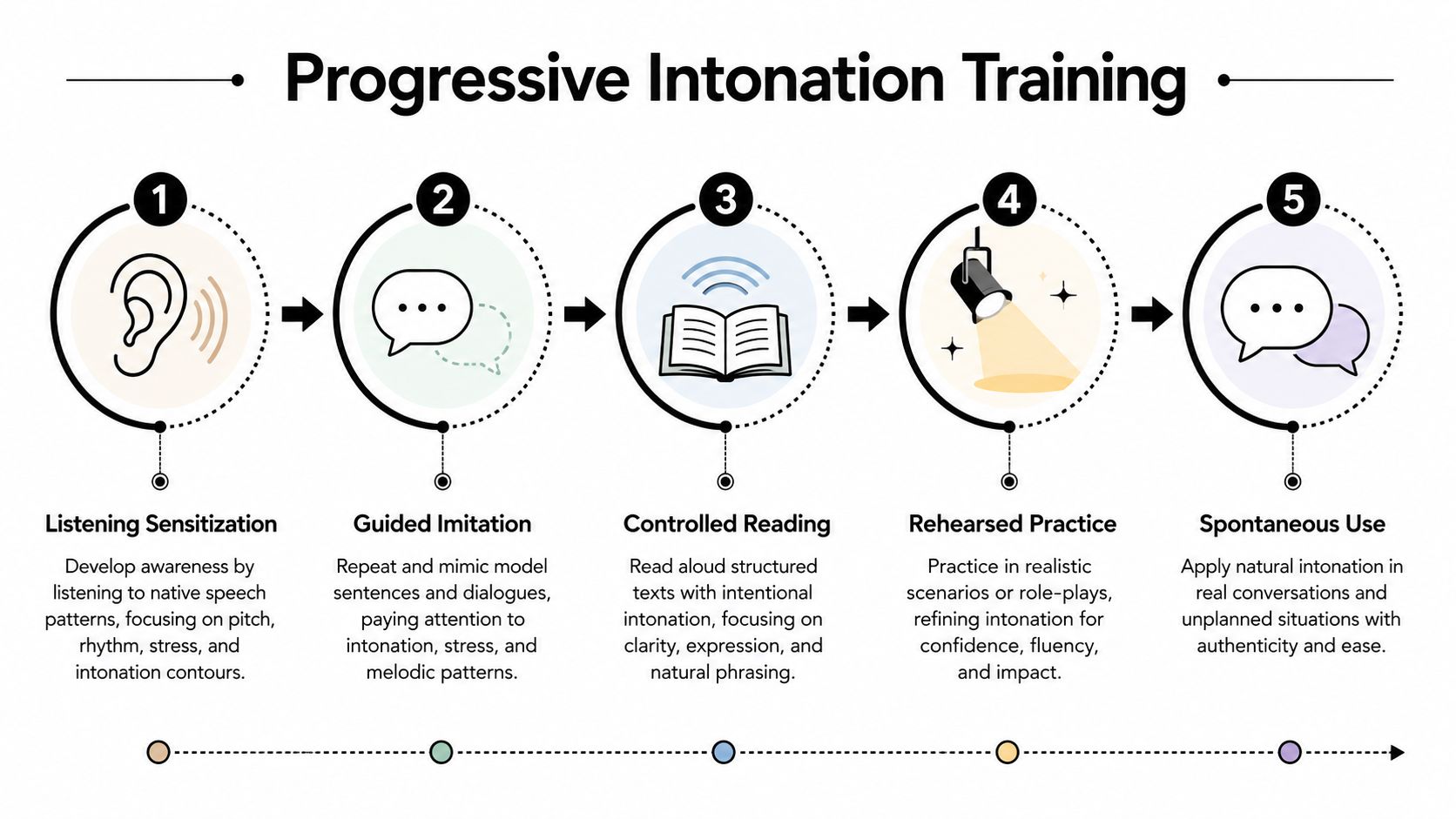
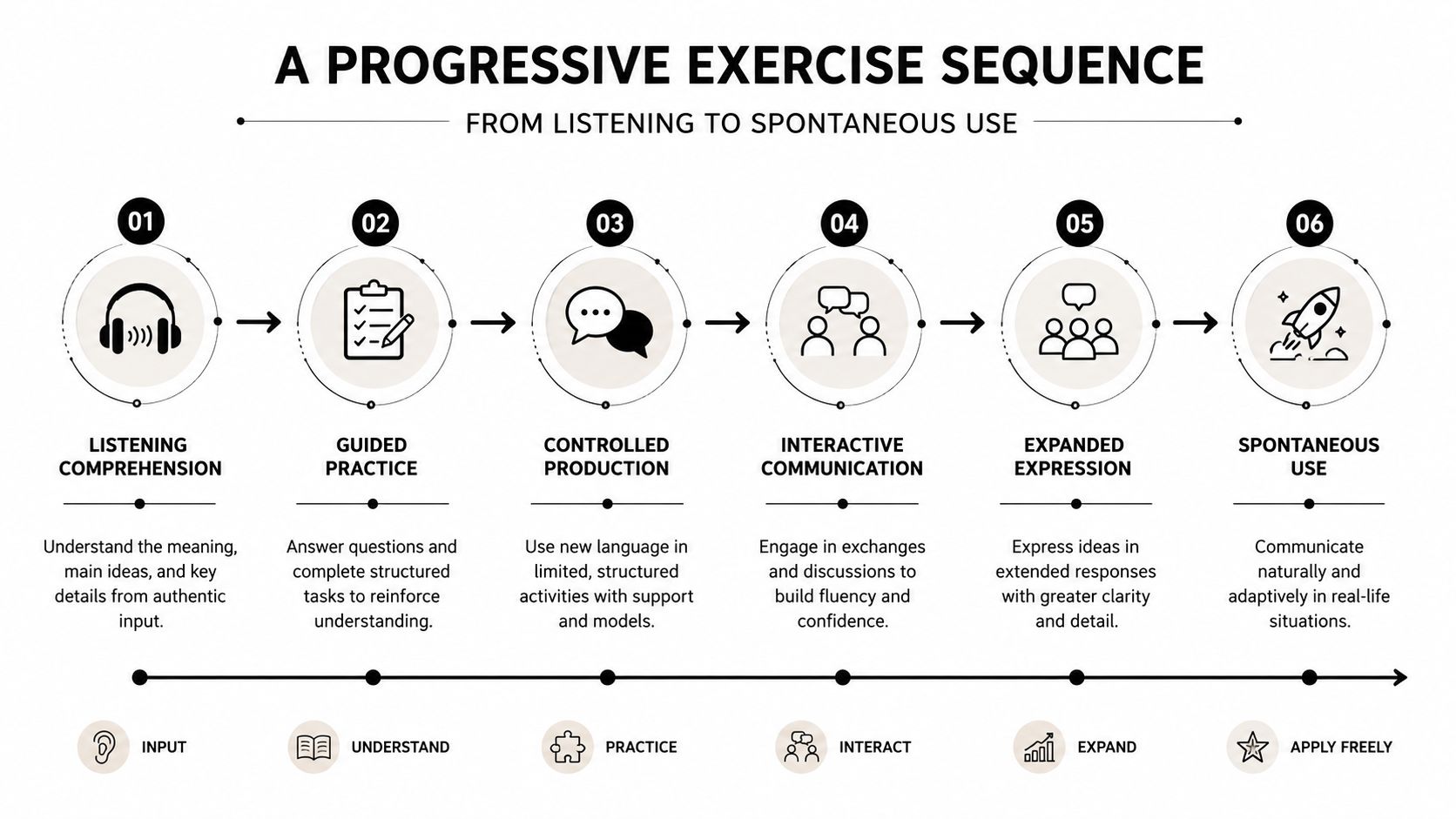
The most useful intonation exercises move from external reference to internal production. That progression is built into teaching materials that begin with listening sensitization, then move through imitation, controlled speaking, rehearsed practice, and finally spontaneous communicative use (intonation worksheet). The reason this works is simple, the ear gets a model first, then the body learns how to reproduce it.
From discrimination to production
Start with discrimination. Read three lines aloud and decide whether each one rises or falls. That sounds basic, but it builds the perceptual habit behind every later drill, and it keeps the work anchored in actual pitch movement instead of vague “naturalness.”
Then shift to shadowing. Repeat a model immediately after hearing it, not later, because the ear-to-mouth connection is stronger when the timing stays tight. The training logic mirrors ensemble pitch work, listen to the reference first, then match it, then produce it on your own once the sound is stable.
What to rehearse on the same day
Use short workplace lines instead of textbook sentences. Try, “I recommend we hold,” “I'm not fully convinced,” and “Do we want to revisit the timeline?” Then say each one three ways, first as a fall, then as a controlled rise on the question, then as a fall-rise when you need to signal openness without surrendering the point.
For a more structured speaking routine, you can pair this with vocal exercises for public speaking, especially if your voice gets tight under pressure.
Don't jump straight to full-speed performance. If the pitch shape is unstable at half-speed, it won't get cleaner when you rush it.
The key is repetition with intention. Once your ear can hear the contour and your mouth can reproduce it, the same sentence stops sounding improvised under stress.
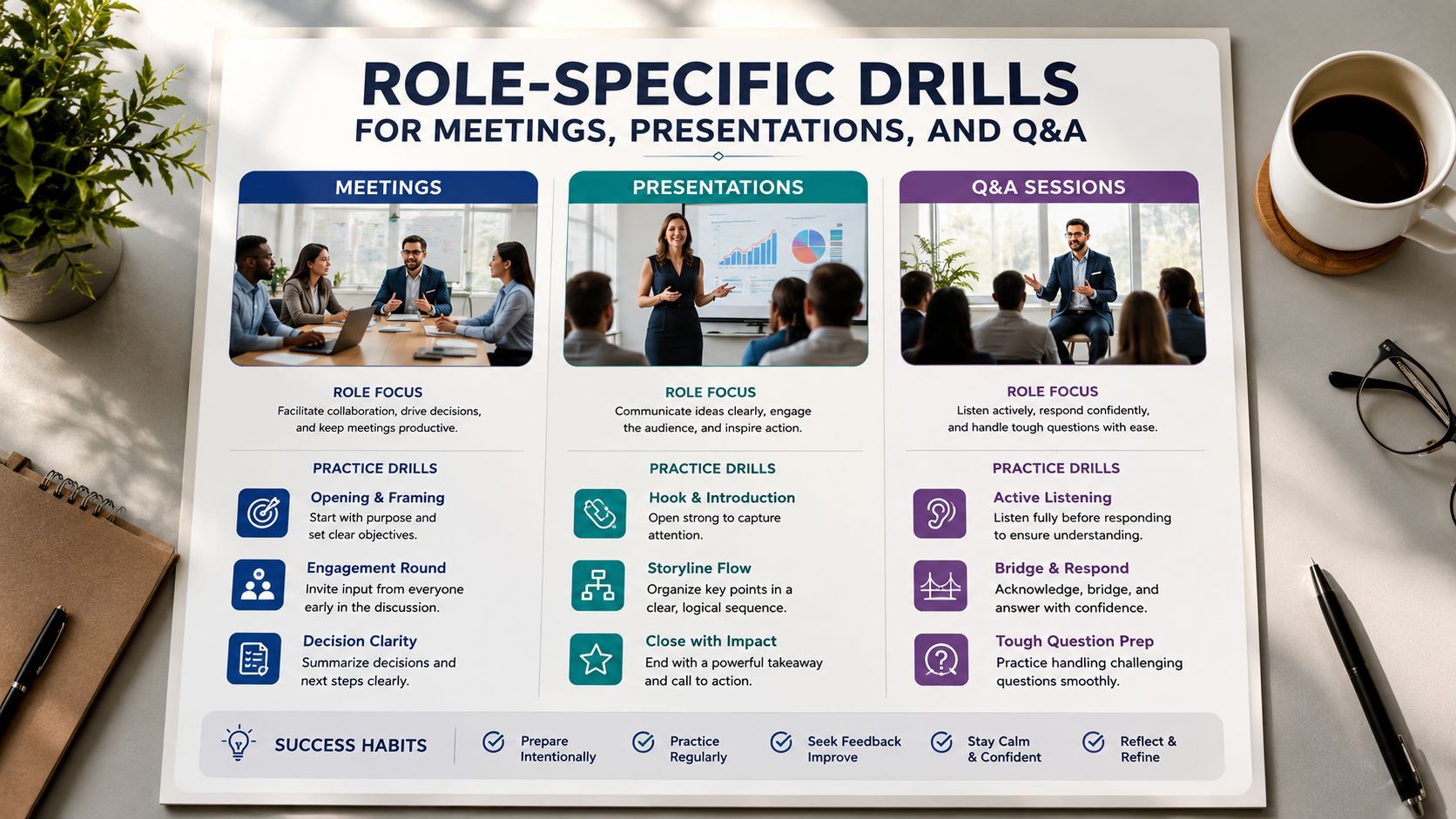
Role-Specific Drills for Meetings, Presentations, and Q&A
Generic drills usually stop at sentence level. Executive use starts where the stakes rise, disagreement, interruptions, and live questions. That's where pitch, stress, and pausing affect whether you sound composed or cornered, and it's where the standard classroom pattern needs to become a workplace pattern.
Disagreeing without sounding combative
In a meeting, “I see it differently” should usually fall at the end. That falling contour keeps the line firm, which matters because a rising ending can make the disagreement sound like a soft check rather than a real position. If you need to leave room for collaboration, use the fall-rise on the bridge line, not on the entire argument.
A clean rehearsal line is, “I see the concern, but I'd keep the launch date.” Land launch date with a clear fall. That keeps the key noun weighted and stops the sentence from floating upward at the end.
Framing uncertainty in Q&A
Uncertainty is not a problem when it's framed well. Say, “I don't have the final number yet, but I can confirm the direction,” and let the second clause settle downward. That makes you sound informed, not evasive.
If you need more practice around delivery under live pressure, tools to practice sales calls can be useful for roleplay style repetition, especially when you want to simulate interruption and recovery without having to improvise every line from scratch.
Managing interruption and turn-taking
When someone cuts in, the pitch choice changes the room's response. A short, level reset such as “Let me finish this part” sounds more controlled than a rising plea. In presentations, that same logic applies to signposting, because the phrase after the pause should fall when you're closing a point and rise only when you want the room to answer.
For presentation structure, how to structure a presentation pairs well with this kind of rehearsal because intonation works best when the argument itself is already segmented.
Useful distinction: a rise invites interaction. A fall claims space.
If your goal is to sound senior, rehearse the exact lines where you're most likely to be challenged. Those are the moments where the room decides whether your authority is real.
A 20-Minute Daily Practice Routine That Actually Fits an Executive Schedule
Consistency beats intensity here. A short daily block keeps the ear calibrated and the body ready, while long weekly sessions often produce a sharp practice session that doesn't survive into the next meeting. The routine below is built for real calendars, not ideal ones.
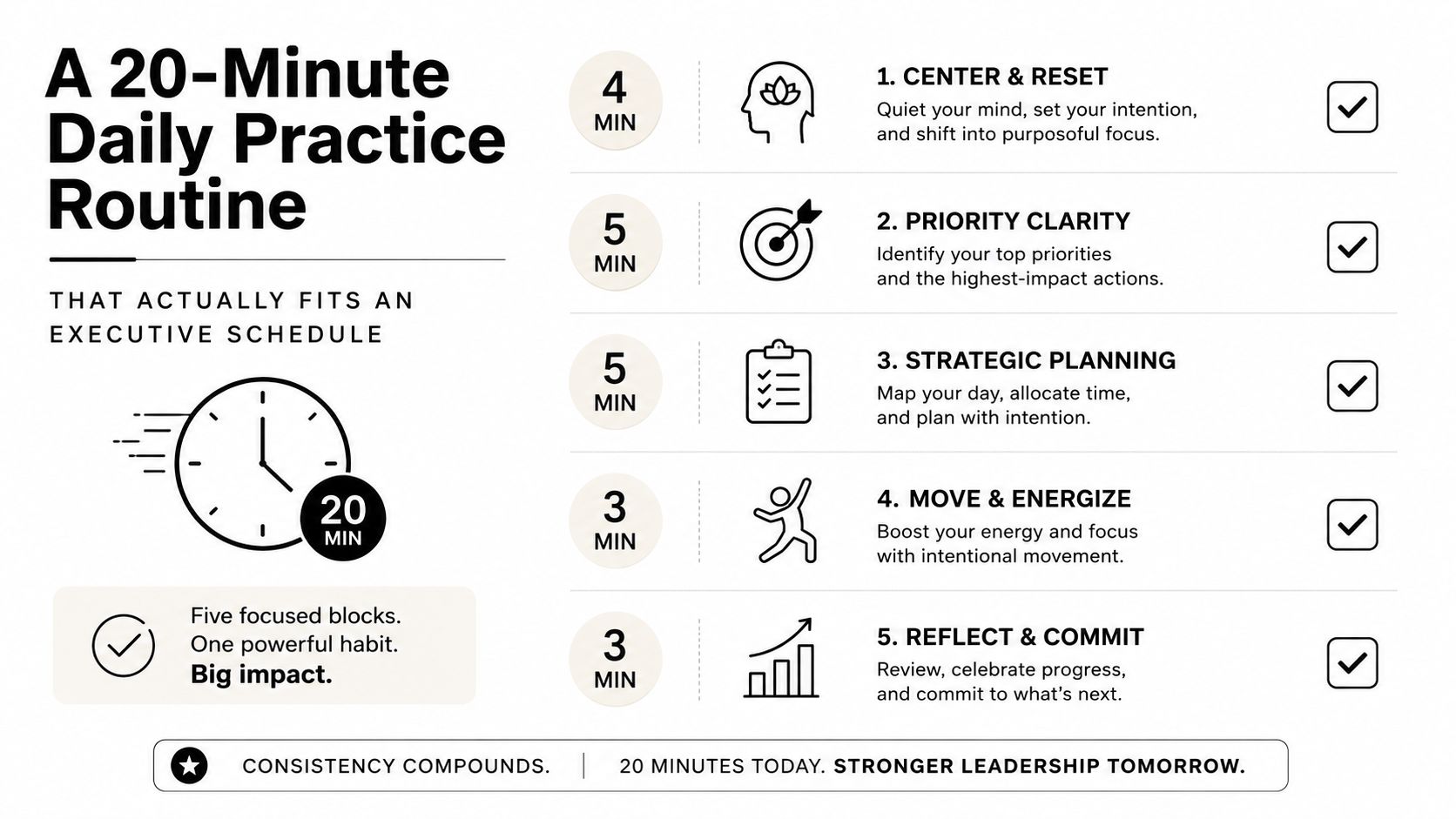
A practical 20-minute block
Spend the first five minutes on discrimination and shadowing. Read three short lines, identify whether the pitch rises or falls, then repeat them immediately after a model. This is the part that keeps your ear honest before your mouth starts improvising.
Use the next five minutes for controlled production. Say your own work lines, such as “We should move ahead,” “I'm not ready to sign off,” and “Can we revisit the assumptions?” Hold the key noun a touch longer, then let the line finish with the contour you want.
Why the routine works under pressure
The third five-minute block should be rehearsed delivery. Record a board update or a Q&A response, listen once without editing, then redo the line with one change only, usually the ending contour or the pause before the key point. The point is not to perfect everything at once, it's to isolate one failure mode.
Use the final five minutes for spontaneous use. Pick a fresh scenario, a stakeholder challenge, a budget question, a delivery delay, and answer it out loud without scripting. If you want a tool stack that supports content work alongside speaking practice, ViralBrain vs Taplio is one comparison people use when they're organizing outreach content, though the speaking work itself still needs live rehearsal.
The best warm-up before a high-stakes meeting is a compact version of the same sequence. A few clean repetitions can reset your pitch before the room ever sees you.
Common Intonation Mistakes That Undermine Seniority
More expressive isn't always more authoritative. In executive rooms, overdone pitch movement can make a speaker sound rehearsed, uncertain, or performative when the goal is steadiness. The biggest mistake is not lack of intonation, it's using the wrong contour for the role the sentence needs to play.
Three habits that flatten senior presence
A rising contour on statements is the most obvious issue. “We're ready to move ahead?” sounds like a question, even when the content is a recommendation. Replace it with a falling ending so the line lands as a decision, not a request.
Exaggerated pitch range causes a different problem. If every key word gets a large pitch jump, the sentence starts to feel theatrical, and the room spends energy on your style instead of your point. Keep emphasis selective, and let only the decision words carry the weight.
Overusing fall-rise on every clause is another trap. That contour is useful when you're open but still holding a position, yet if it shows up everywhere, it drains clarity because the listener no longer knows what you want. Use it where negotiation is real, not as a default emotional setting.
Stress and pausing matter as much as pitch
Executive presence also depends on where the sentence lands. If every word gets equal stress, the tonic syllable never arrives, and the line sounds flat even if the pitch technically moves. Put the weight on the noun or verb that matters most, then pause before the next thought so the room can absorb it.
A clean correction often looks simple. “I think we should maybe consider delaying the rollout” becomes “I think we should delay the rollout.” The second version sounds firmer because it removes the padding and places stress where the decision sits.
The easiest self-audit is to listen for two things, whether your statements rise by habit, and whether your emphasis spreads too evenly across the sentence. If either one is happening, your voice is doing uncertainty for you.
Measuring Progress So Practice Transfers to Real Meetings
A useful sign of progress is not how fluent the drill feels in isolation, but whether your voice holds up in a real meeting when the stakes are higher and the wording is less predictable. Advanced learners usually need proof that the practice carries into actual conversations, and that proof comes from recordings, comparison, and feedback on work speech, not from assuming the ear has improved in the abstract. A measurement system should make transfer visible.
A simple measurement protocol
Record a baseline clip for five scenarios: a recommendation, a disagreement, a Q&A answer, a clarification, and a recovery after interruption. Save those clips and revisit the same five lines each week, because comparing like with like is the only reliable way to hear whether the contour is settling into place.
Then ask a peer, coach, or trusted colleague to review three random clips. Keep the question narrow, does the ending sound certain, does the pause fall in the right place, and does the stress land on the key noun. Narrow feedback is more useful than broad impressions because it links directly to how you sound in the room.
What to look for in the recording
Use a simple rubric. Check pitch stability, contour accuracy, pause placement, and stress on key nouns. If one of those keeps failing under pressure, that is where the next week of practice should go.
A structured communication audit helps when the problem is subtle and hard to hear from the inside. This communication audit template gives you a practical way to map where delivery is still costing authority, because recordings often reveal a gap between what you intended and what the room heard.
If you want a guided review of how your voice, framing, and presence work together, the Gravitas Method is a 12-week one-on-one executive presence coaching program for international professionals who want to communicate with more authority and influence at senior levels. It's priced at $8,200 paid in full or $9,000 across three installments, coached by Nikola, and it covers vocal authority, strategic framing, executive body language, and high-stakes communication.
The final test is simple. Your speech should sound steady in a live meeting, without rehearsed lines in front of you, if the practice has transferred.