
How to Speak from Your Diaphragm for Stronger Clear Speech
You're in the meeting, your slides are open, and the room goes quiet just as you start the first sentence. If your voice gets thin, rushed, or tight under that pressure, you don't need more volume, you need better breath management. Learning how to speak from your diaphragm is really about steady airflow, calmer pacing, and less strain in the throat, so your voice stays clear when the stakes rise.
That shift matters because the diaphragm is the main muscle of inspiration, and voice support comes from how you manage the breath on the exhale, not from forcing sound out of your belly. In practice, voice educators treat this as a trainable skill, with clear markers like steadier exhalation and longer controlled air release. The good news is that you can feel the difference quickly, even before you speak a full sentence.

If you already notice tension in your voice during presentations, this guide on voice use and projection will feel familiar. We'll start with what changes in your sound, move into what your body should feel, then build a simple practice you can use before board updates, interviews, and hard questions.
Why Speaking From Your Diaphragm Changes How You Sound
A lot of professionals think the problem is that they're not loud enough. Usually, the issue is that the breath runs out too fast, so the voice starts to thin, the pace speeds up, and the throat tries to compensate.
When that happens, people hear strain before they hear your point. Your words can sound clipped or hurried, even if you prepared carefully. Speaking from your diaphragm changes that pattern because the breath stays steadier, which helps the voice ride on air instead of being pushed out by force.
Practical rule: if your voice feels pressed, stop trying to make it bigger and make the breath steadier instead.
That's why this technique shows up in public speaking, speech therapy, and voice coaching. It isn't a trick for sounding theatrical. It's a repeatable way to keep your delivery grounded when stress would otherwise pull you into shallow breathing and tight phrasing.
A useful way to think about it is this. More stable breath support usually means fewer voice breaks, cleaner projection, and a calmer pace under pressure. If you've ever started a sentence strongly and then faded at the end, you've felt the exact problem this skill solves.
If you want a useful outside practice space for calming the nervous system before bed or before a demanding day, the resource on diaphragmatic breathing exercises for sleep can help you see how the same breath pattern shows up in recovery work too. The physical cue is the same, slower, more deliberate exhalation.
The rest of the guide builds in this order, first the anatomy, then posture, then drills, then the mistakes that sabotage progress.
How Diaphragmatic Breath Support Actually Works
The diaphragm is the main muscle that helps you inhale. That sounds technical, but the feeling is simple, when it works well, the lower torso expands and the upper body stays relatively quiet. When it doesn't, the shoulders lift, the chest tightens, and the voice often feels less stable.
What you should feel
The common misunderstanding is that you “speak from the diaphragm” by pushing sound downward. That's not the point. The task is to let the breath come in efficiently, then release it in a controlled way while you speak.
A quick self-check helps make that visible. Place one hand on your chest and one on your belly, then inhale through the nose and notice which hand rises more. As described in the biofeedback check, the belly hand should rise while the chest hand stays relatively still, which tells you the lower breath pattern is doing the work. See the full explanation in the reference on speaking from your diaphragm not your throat.
The belly doesn't need to be dramatic. It just needs to be more active than the chest.
That simple distinction helps in real conversations. If you're about to answer a senior leader's question, a quieter lower breath usually gives you more room to shape the sentence before the air disappears. You don't need more effort, you need a cleaner path for the air.
Why this feels different from shallow breathing
Shallow breathing tends to move fast and high in the body. Diaphragmatic support feels lower, calmer, and less urgent. You're not trying to inflate your torso, you're creating a steadier base for speech.
That's also why the same breath pattern supports clearer English delivery for international professionals. The sound becomes easier to pace, because the breath and voice are working together instead of competing. If you want a related explanation of breath and speech pacing, this breathing guide for better English speech connects the same idea to spoken fluency.
Posture and Breath Setup That Makes Support Possible
Good breath support starts before the first word. If your ribs are compressed, your chin is forward, or your shoulders are already raised from tension, the diaphragm has less room to do its job.
Stand or sit tall without turning rigid. The aim is not military posture, it's space. Let the crown of your head feel lifted, keep your chest open but not puffed, and allow your lower ribs to stay free enough that the breath can move without a fight.
A simple pre-speaking setup
Before a meeting, try this short checklist.
- Plant both feet: Keep them steady so your body doesn't chase balance while you speak.
- Soften the shoulders: Drop them away from the ears without collapsing the chest.
- Inhale through the nose: Let the breath come in low and calm.
- Keep the neck loose: If the neck tightens, the throat usually joins in.
- Start the exhale gently: Don't blast the first word out of the mouth.
That last point matters more than many expect. If the exhale starts with force, the sentence often starts with pressure. A calmer release gives the voice a smoother landing.
Meeting cue: if you feel yourself rushing before you've even answered, reset the breath before you reset the sentence.
This also shows up on camera. People often brace the neck when they think they need to sound more authoritative, but the result is usually a tighter, less resonant voice. A cleaner setup gives you authority without strain, which is why posture and breath should always be treated as one system.
For a visual parallel on posture and delivery in professional settings, the guide on body language on camera is a useful companion. The same calm alignment that helps your voice also helps how you're read physically in the room or on screen.
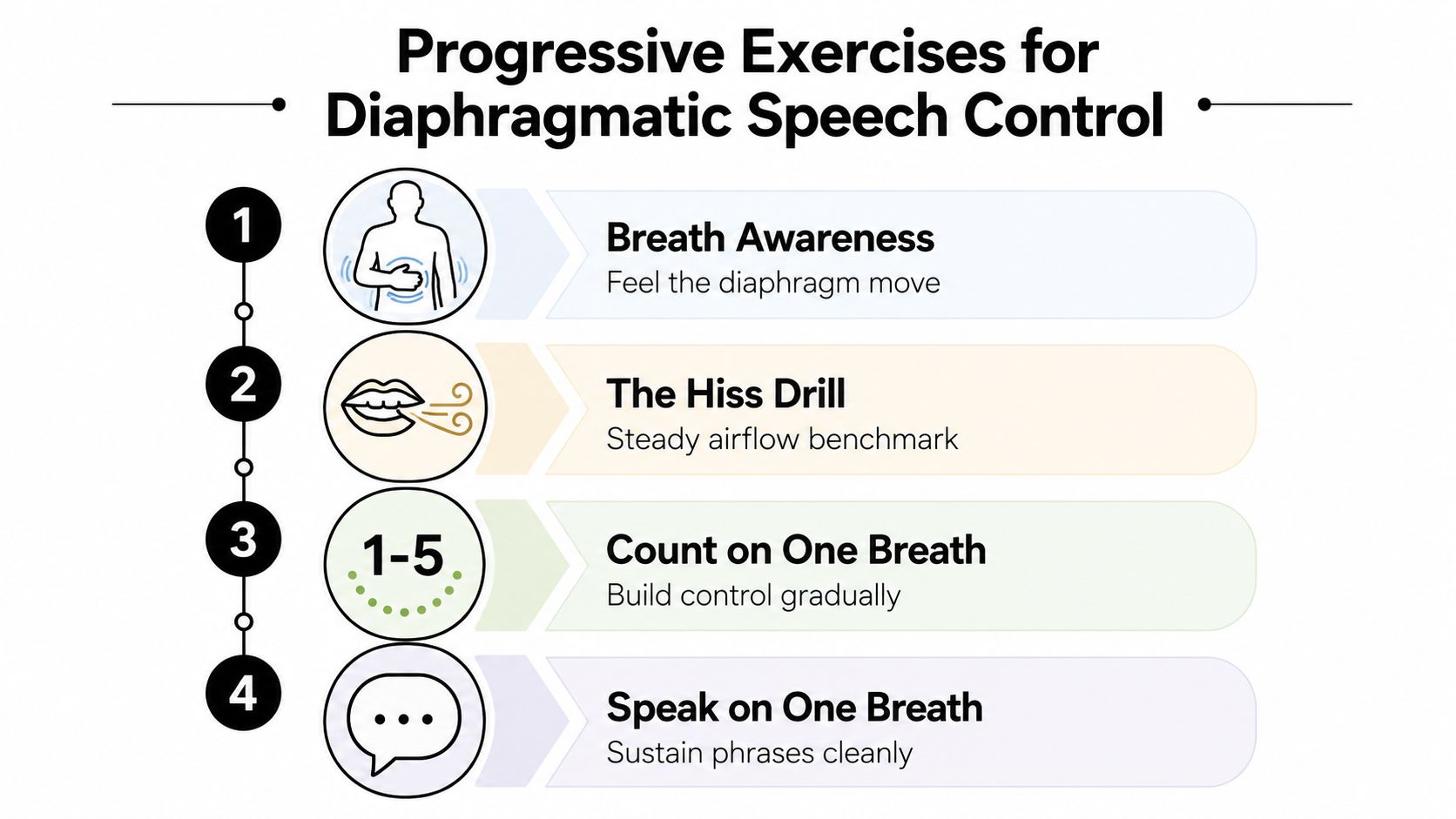
Progressive Exercises to Build Diaphragmatic Speech Control
Start with airflow before you add words. If the air stream is uneven, the voice can't stay steady for long, so the first goal is not performance, it's control.
The easiest benchmark is a hiss. Take a low, quiet breath, then let out a steady “S” or “F” sound, or a smooth “AH”, and listen for whether the airflow stays even. The University of Mississippi Medical Center recommends practicing the basic breathing drill 10 times, three times per day, and voice educators often use a hiss target of 15 to 20 seconds, then work toward 30 seconds or more as control improves, all of which gives learners a concrete way to track progress rather than guess. You can see that approach in the UMMC diaphragmatic breathing guidance.
Build from air to sound
- Airflow first: Hiss or hold a gentle vowel and keep the line steady.
- Counting next: Count aloud on one exhale, starting with a simple sequence like one, two, three, four.
- Short phrases after that: Use short sentences and pause where a comma would naturally fall, so you can renew the breath.
- Full delivery last: Speak a longer thought without pushing through the throat.
The rhythm matters more than speed. A common training pattern is to inhale for about four seconds, then exhale for four to six counts, repeated for two to five minutes. That kind of timing gives your body something concrete to follow, instead of leaving you to improvise under pressure.
A useful rule comes from breath-first speaking. Let the breath dictate the rate, not the other way around. When the exhale gets low, pause, refill, and continue. In a presentation, that often sounds more composed than trying to force one long sentence through with no break.
If you want more drill ideas that fit into a short routine, the page on voice lesson exercises can give you a practical starting point. The best practice is still the simplest one, repeat the same airflow pattern until it feels calm, then add speech on top.
Common Mistakes That Block Your Progress and How to Fix Them
Many people don't fail because they aren't trying. They fail because they're trying in the wrong part of the body.
Three habits that quietly sabotage the sound
- Over-inhaling: You take in a huge breath, then freeze. The fix is to inhale naturally and keep the setup quiet, so the body doesn't lock before the sentence begins.
- Chest-dominated breathing: The shoulders and upper chest rise, but the lower body stays passive. The fix is to let the belly expand and feel the lower ribs open instead of chasing a big top-of-chest breath.
- Neck and tongue tension: You brace before speaking, especially when answering difficult questions. The fix is to relax the jaw, soften the throat, and let the exhale start the sentence.
These problems show up fast in meetings. Someone asks for an update, you inhale too much, and the first part of the answer sounds strong while the end falls apart. Or you get a challenge from a stakeholder, hold your breath for a second too long, and then the reply comes out tight and pressed.
Speak in sync with your breath. Don't push through the end of the sentence just because you want to sound certain.
That's the key correction. For speech projection, the technical target is breath-to-voice coordination on exhaled air, so you can sustain voiceless fricatives like “S” or “F”, or a steady “AH”, before you add words. Expert guidance also emphasizes letting the breath dictate speaking rate and using comma-like pauses to renew air rather than forcing sound through the throat, which is exactly what helps you avoid that strained, squeezed tone. The reference on talking from your diaphragm for a stronger voice lays out that coordination clearly.
If nerves are the actual trigger, it helps to separate the physical issue from the emotional one. You can also use the resource on how to calm nerves before a speech to support the breath work with a steadier mindset. The goal is not to eliminate pressure, it's to stop pressure from hijacking the airway.
Your Daily Practice Plan and Next Steps for Confident Delivery
Keep the routine short enough that you'll do it. A good daily pattern is a few minutes of quiet breath setup, then a hiss or vowel sustain, then a short counting drill, then one or two spoken phrases with comma-like pauses. That sequence keeps the work practical instead of turning it into a separate performance.
The reason this pays off is simple. Breath support directly affects how long and how steadily you can speak under pressure, and training protocols often use timing goals like counting on a single diaphragmatic exhale or inhaling on a count of ten and controlling the exhale from ten to one, which gives you a measurable way to notice change in your own delivery. That same steadiness matters when you're trying to overcome language anxiety, because a calmer breath usually makes the next sentence easier to start.
Use the skill in the places where it counts most. Try it before board updates, during negotiation pauses, and at the beginning of high-stakes answers. If your exhalation feels longer and your pacing feels less rushed, you're moving in the right direction.
The Gravitas Method is a 12-week one-on-one executive presence coaching program for international professionals who want to communicate with more authority and influence at senior levels. Coached by Nikola, it covers vocal authority, strategic framing, executive body language, and high-stakes communication, and it's offered at $8,200 paid in full or $9,000 across three installments.
If you want to make your voice steadier in real meetings, start with the free Executive Communication Assessment. Intonetic helps international professionals build more authority in the room by improving breath support, vocal delivery, and executive presence, so your next important conversation sounds as composed as your ideas.