
How to Influence Others at Work with Confidence
You walk into the meeting with the right numbers, the right logic, and a recommendation you've rehearsed three times. Then someone with less context, but more room control, speaks first, the conversation bends around their framing, and your point arrives late, buried under caveats. That's the moment most professionals realize influence at work isn't just about being right, it's about being read correctly before the room has already moved on.
Influence is a diagnostic skill. Senior people don't just ask, “What should I say?” They ask, “What is this room responding to, and what signal am I sending before I even finish my first sentence?” That's why how to influence others at work has so little to do with tricks and so much to do with executive presence, sequencing, and reading the problem under the surface. Robert Cialdini's framework for persuasion, organized around reciprocity, commitment, social proof, authority, liking, and scarcity, became influential because it translated behavioral research into practical use across leadership and communication training, and because it matched what happens in organizations when people decide whether to listen or resist (McKinsey's discussion of influence and execution).
The hard part is that many professionals diagnose the wrong failure. They assume they need more data, more airtime, or a sharper argument. Often, the issue is that their delivery never earns the right to be heard, or they pick the wrong influence move for the room they're in. If you've ever left a meeting thinking, “I said the right thing, but it landed wrong,” that's the gap this article closes.
Why Most Professionals Struggle to Influence Others at Work
A senior manager sits in a boardroom with a solid recommendation, a clean deck, and enough context to answer the predictable questions. Another person opens with a concise view, sounds certain, and gets the room leaning forward before the first slide is even visible. By the time the original speaker reaches the actual ask, the energy has shifted, not because the idea was weak, but because the room has already assigned status and direction.
The common diagnosis is always the same. People say they need better data, a bigger title, or more time to explain themselves. In practice, influence is usually lost in the first ninety seconds, in how someone enters, opens, frames the issue, and decides whether to sound like a peer with a point or a petitioner asking for permission.
The first read happens before the first argument
That first read is brutal and fast. Listeners notice posture, pace, tone, and whether the speaker seems to know where the conversation is going. If you sound apologetic, over-explain your own role, or begin with a long setup before making the actual point, the room starts working against you.

This is why generic influence advice feels hollow. It talks about “being persuasive” without naming the delivery layer that decides whether anyone is available to be persuaded. If workplace friction is being misread as a communication problem, the pattern usually shows up in the same places, especially in meetings where hierarchy, time pressure, and ambiguity all collide. A useful starting point is to examine the recurring misfires in workplace communication, especially when the issue is less about content and more about how the message is received, as discussed in this guide on miscommunication in the workplace.
The gap is not volume. It's structure, authority, and timing. Once you start seeing influence that way, the rest of the room's behavior becomes much easier to interpret.
Building Credibility Before You Open Your Mouth
Credibility starts before your first sentence. People read grooming, posture, how you carry materials, and whether you seem settled or scattered long before they process the content of your message. In senior rooms, that first impression is not vanity, it's part of the authority signal.
The five-minute pre-meeting check
A strong pre-meeting routine does not need theatrics. It needs consistency. Walk in as if you belong there, because hesitation shows up quickly in the pace of your entry, where you sit, and how much you fidget with papers or devices.
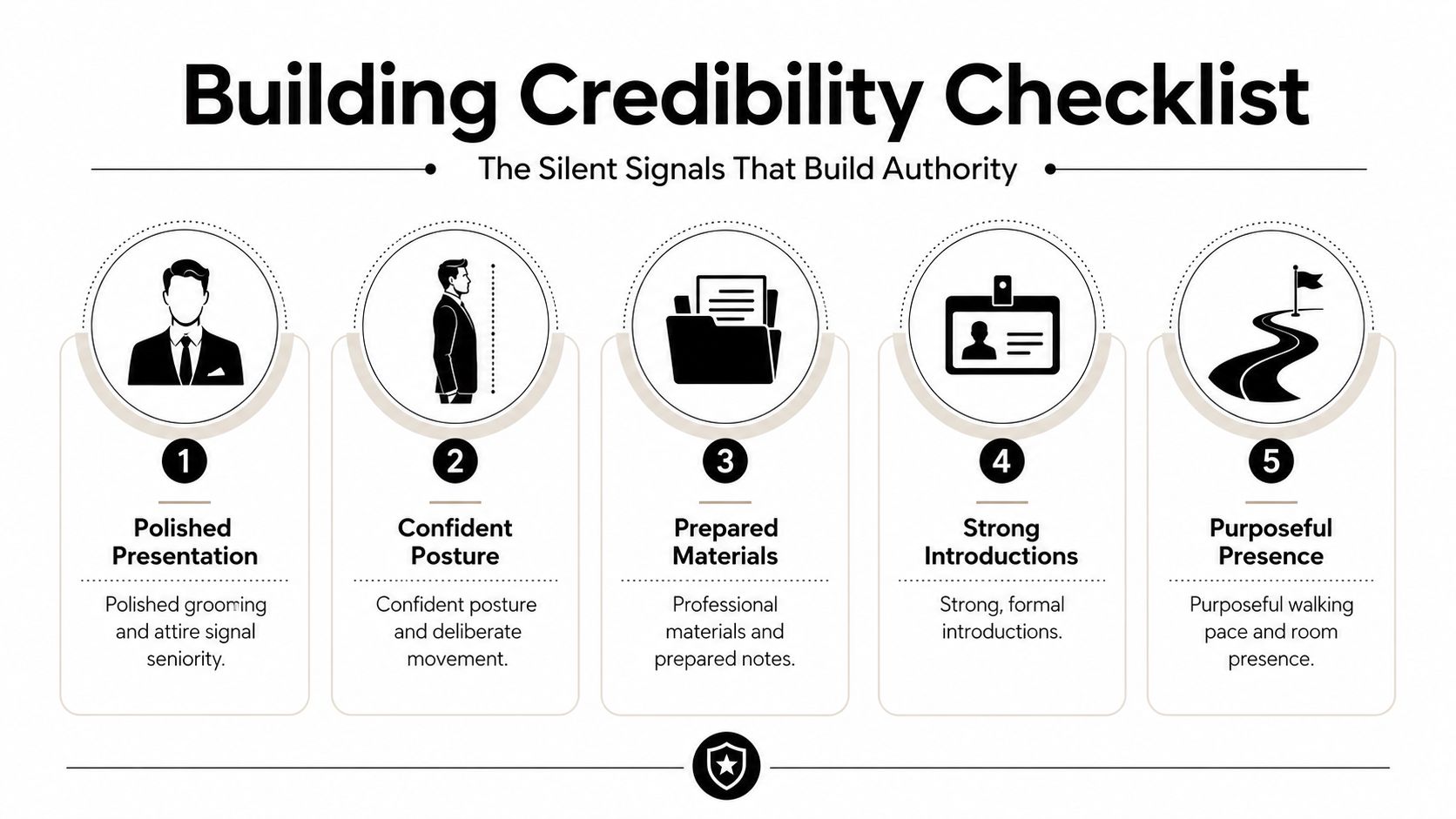
- Polished appearance: Dress and grooming should match the seniority of the room, not the anxiety of the speaker.
- Stable posture: Stand and sit with deliberate stillness, because constant movement can read as uncertainty.
- Prepared materials: Bring notes or a one-page summary that shows you've done the work.
- Clear introduction: Say your name and role plainly, without softening it or translating your title downward.
- Purposeful presence: Walk in, sit down, and orient yourself with intention instead of hovering at the edge of the conversation.
A lot of international professionals lose credibility in invisible ways. They open with too much apology, they explain why they deserve the floor, or they dilute their own title as if seniority needs to be made less noticeable. That reads as hesitation in any language, and it makes listeners work harder to place them.
Practical rule: If you have to spend the first minute proving you should be in the room, you've already spent your best leverage.
The best pre-meeting habit is simple. Before you go in, ask yourself whether your appearance, posture, and opening will make people think “this person is prepared” or “this person is asking to be taken seriously.” If the answer is unclear, fix the signal before you fix the slide deck. For a deeper view of the trust side of authority, it helps to review this leader credibility guide.
When the room already sees you as composed, your words don't have to work as hard.
Framing Your Message So the Right Point Lands First
A strong message can still fail if the room has to dig for the point. Senior listeners want the bottom line up front, because they're scanning for relevance, risk, and decision shape. If you bury the recommendation under context, your audience spends its energy decoding your structure instead of evaluating your idea.
Lead with the decision, not the path to the decision
BLUF, bottom line up front, works because it respects the listener's attention. Say what you want, why it matters, and what you're asking for in one or two sentences before you add detail. An executive summary is not a status update, and a status update is not persuasion.
A weak opening sounds like this. “I wanted to share some thoughts about the vendor review, and there are a few considerations we should maybe think through before deciding.” A stronger version sounds like this. “I recommend we stay with the current vendor for one more quarter, because switching now would slow implementation. I'm asking for approval to revisit the decision after the next milestone review.” Same facts, different authority.
Clear rule: The sentence that contains the ask should arrive early enough that people can decide whether they agree before they get tired.
Hedging is expensive. Openers like “I just wanted to,” “maybe,” and “I could be wrong, but” put the speaker in a secondary position before the actual point is even made. Silence after the ask is often stronger than a follow-up sentence, because it lets the recommendation stand on its own instead of being weakened by rescue language.
For speakers who need to move from story to influence, it helps to study how narrative structure affects trust and recall. A useful companion resource is how to tell your story effectively, especially if your message depends on getting people to see the issue in a specific sequence. Strategic framing is not about sounding polished. It's about making the right judgment easier to make.
For a closer look at how message structure shapes persuasion in practice, see this communication as persuasion guide.

Using Voice and Body Language to Project Authority
People read your voice and body at the same time. If the words say confidence but the delivery says uncertainty, the body wins. That's why vocal authority and executive body language have to work together, not compete for attention.
Vocal authority is a tempo decision
Most weak speakers finish statements with upward inflection, which can make a declaration sound like a question. A flatter, steadier end to the sentence signals that you're not asking the room to authorize your point as you make it. Controlled pauses do the same thing, because they show you set the pace instead of racing to fill silence.
Pitch range matters too. A voice that sits too high or jumps around can sound nervous even when the content is strong. You don't need to sound theatrical, you need to sound settled.
Body language should reduce friction, not create it
Keep your hands still when you're making a point, and let your shoulders stay relaxed rather than lifted. In a small group, eye contact can rotate naturally from one person to another. In a boardroom, it needs to be more deliberate, because too much scanning can make you seem unsure of where the conversation belongs.
Checking a laptop or phone mid-discussion is especially costly. It tells the room that the device has your attention, even if you think you're just verifying a detail. That tiny interruption can weaken the sense that you're fully present and in control of the exchange.
If you want to practice, try this before the next meeting. Read a two-sentence recommendation out loud three times. On the first pass, cut every filler word. On the second, lower your pace. On the third, pause for one beat after the ask. Then deliver it once to a colleague and watch where your voice drops or rises.
For a broader set of exercises on nonverbal communication, the United We Transform movement tool gives teams a simple way to notice what their bodies are signaling before they speak.
A strong presence is trainable. It's not a personality trait you either have or don't have.
Handling Objections and Steering the Conversation
The first objection is where many smart professionals lose the room. They start defending too quickly, add more slides, and accidentally signal that their own position can't survive scrutiny. That reaction is usually driven by anxiety, but the room reads it as fragility.
Label the objection before you answer it
Not every objection is a concern. Some are status moves, some are stress responses, and some are legitimate requests for more detail. If you answer too fast, you flatten those differences and miss the opening.
Use a four-step micro-script. First, acknowledge the concern plainly. Second, isolate what the objection is really about. Third, reframe the issue around the decision at stake. Fourth, confirm whether your read is right before you move on.
A budget discussion is a good example. If someone says, “This feels expensive,” don't immediately justify every line item. Say, “I hear the cost concern. Is the issue total spend, timing, or uncertainty about the outcome?” That question separates a real concern from a vague objection and gives you a way to respond without sounding combative.
Match the move to the problem
The research matters here. In a meta-analysis of 49 workplace studies with nearly 9,000 participants, rational persuasion succeeded only about 12% of the time, and a separate review found that pressure was negatively correlated with outcomes while rational persuasion was the only tactic that consistently showed positive relationships with both task and relationship outcomes (AACSB summary of persuasion research). The message is not that logic is useless. It's that logic alone is a weak default when trust, politics, or identity are in the room.
That's why diagnosis comes before deployment. A logic problem needs evidence. A trust problem needs credibility and consistency. A politics problem needs coalition-building and timing. An identity problem needs a framing that doesn't threaten the other person's status or competence.
The fastest way to lose influence is to use the same tactic for every objection.
The evidence also points to compounding. One review summarized by MIT Sloan found that people using four or more sources of influence were 10 times more successful at driving substantial, sustainable change than those using a single source, and in one case success moved from 4% to 40% (MIT Sloan Review on influence). The practical lesson is simple. Don't lead with data alone. Layer analytic evidence with social proof, personal credibility, and a clear request.
That same principle is why conversation skills matter so much in senior settings. If you want a useful set of conversation frameworks for high-stakes discussions, the ForumSpace collection on crucial conversations is worth revisiting because it keeps the focus on navigating tension without escalating it.
Concede the right thing
Influence collapses when you refuse to admit a point that is valid. If the objection is correct, acknowledge it fast and move to the adjustment. That doesn't make you weaker. It makes you trustworthy enough for the room to stay with you.
The strongest speakers don't win every objection. They keep the conversation pointed at the decision instead of turning it into a contest of ego.
Influencing Across Cultures, Languages, and Remote Rooms
A lot of influence advice assumes everyone shares the same communication norms. They don't. The same directness that reads as confident in one setting can read as abrupt in another, and the same restraint that signals respect in one region can look like uncertainty in another. That matters even more when the speaker is working in a second language.
Remote influence changes the whole signal
In a global team, a senior professional may need buy-in from three regions with different expectations about hierarchy, speed, and directness. If they open with a long preamble in a live call, one group may see tact, another may see delay. If they follow up only with a dense email, people who rely on verbal nuance lose the emotional cues that help them commit.
That's why asynchronous writing has become its own influence skill. The message has to be clearer, shorter, and more explicit about the ask, because nobody gets the benefit of hallway context or informal repair.
Authority has to travel well
For internationally mobile professionals, the challenge isn't just persuasion, it's projecting authority when accents, hierarchy expectations, and communication styles differ across regions. The earlier research on rational persuasion matters again. If logic alone rarely moves people in a room, it's even less likely to do the job when language, time zones, and culture all reduce the richness of the signal (KU guidance on influence in different settings).
The adjustment is practical. Open with the decision. State the context only as much as the audience needs. Use direct written follow-up with clear action owners. In conversation, slow down just enough to sound deliberate, not tentative.
A useful internal check is this. If your message works only when delivered by a native speaker, in a live room, with perfect rapport, then it isn't strong enough for senior leadership. Influence has to survive distance.
Practice Plan and Your Next Step
A product lead in Singapore gets a late-night call with finance colleagues in London and a regional director in Toronto. If she uses a Western-style, highly verbal pitch, the Toronto colleague may respond quickly, the London finance lead may wait for the numbers in writing, and the Singapore side may interpret the pace as overly aggressive. The fix isn't more force, it's cleaner structure, better sequencing, and a follow-up that respects each audience's norm.
One week of deliberate practice
Pick one high-stakes meeting this week and treat it like a live lab.
- Run a pre-meeting credibility check. Look at your dress, posture, notes, and opening.
- Choose one framing structure. Use BLUF and lead with the recommendation.
- Plan one objection in advance. Decide whether it's likely to be a logic, trust, politics, or identity issue.
- Pause after the ask. Don't rush to rescue the silence.
- Debrief with three questions. Did I sound credible before speaking? Did the right point land first? Did I respond to the objection or just the loudest one?
Screenshot this checklist: prepare your presence, lead with the ask, label objections accurately, and stop defending too early.
The bigger pattern is clear. Most influence failures are delivery failures, not strategy failures. International leaders feel that gap most sharply because the room reads their authority before it fully understands their expertise. Intonetic works with that problem directly through a free executive communication assessment that identifies the specific gaps in vocal authority, strategic framing, and executive body language that weaken senior presence. The Gravitas Method is a 12-week one-on-one executive presence coaching program for international professionals who want to communicate with more authority and influence at senior levels, it is priced at $8,200 paid in full or $9,000 across three installments, and it is coached by Nikola.
If you're ready to stop losing influence in the first minute of the room, visit Intonetic and book the free Executive Communication Assessment. It's the fastest way to see whether your next step is stronger vocal authority, sharper framing, or cleaner body language at senior level.