
Mastering Communication with Managers
You’re in a meeting with your manager and two senior stakeholders. You know the issue. You’ve seen the pattern before. You offer the right recommendation, but it lands flat.
Your manager moves on. Five minutes later, someone else says a simpler version of your point and the room responds as if the insight just appeared.
That’s one of the most frustrating forms of communication with managers. Not because you lacked expertise, but because your expertise didn’t arrive with enough authority, clarity, or strategic framing.
I work with international professionals who face this constantly. They are strong operators. They know their field. But in high-pressure moments, language processing, accent bias, cultural norms around hierarchy, and delivery habits all interfere with how their message is received. The result is subtle, but expensive. You get seen as capable, not influential. Reliable, not ready for bigger scope.
The High Cost of Being Misunderstood
A lot of professionals treat communication with managers like a soft skill. It isn’t. It affects promotion speed, trust, decision quality, and your ability to shape what happens around you.

I’ve seen the same scene in coaching again and again. A senior engineer gives too much background before the point. A finance lead sounds hesitant when challenging a weak assumption. A product manager softens every recommendation so much that their manager hears “optional” instead of “strategic.”
None of these people lack intelligence. They lack delivery that matches their level.
What poor communication costs
The business cost is not theoretical. Poor communication with managers and within organizations is estimated to cost $10,000 to $55,000 per employee per year in lost productivity, according to these workplace communication statistics.
That figure matters, but the personal cost is what ambitious professionals feel first:
- Your ideas get delayed: Good recommendations don’t get traction when they sound uncertain.
- Your manager misreads your readiness: You may be performing at senior level while sounding less decisive than you are.
- You spend energy repairing perception: After one muddled update, you often need several strong interactions to restore confidence.
Practical rule: If your message requires your manager to do extra interpretive work, you’ve already lost influence.
Why this hits international professionals harder
For non-native English speakers, the problem often isn’t just vocabulary. It’s processing speed under pressure. It’s choosing the right level of directness. It’s deciding whether to interrupt, challenge, summarize, or defer.
It’s also bias. If you’ve experienced people reacting more to your delivery than your substance, that experience is real. If you want a deeper explanation of that hidden layer, this piece on accent bias in the workplace is useful.
In practical terms, being misunderstood usually looks small in the moment. Your update sounds less crisp than you intended. Your concern sounds emotional instead of strategic. Your manager leaves the conversation with an incomplete picture of your judgment.
What your manager actually needs from you
Managers don’t need a perfect speaker. They need someone who can make thinking easy to follow.
That means:
| Manager need | What authority sounds like |
|---|---|
| Clear direction | “My recommendation is option B because it reduces delivery risk.” |
| Fast understanding | “There are two issues. One is urgent, one is structural.” |
| Calm judgment | “I see the trade-off. Here’s how I’d handle it.” |
When your communication with managers improves, you don’t just sound better. You become easier to trust with larger decisions.
Why Standard Communication Advice Fails International Professionals
Your manager asks for a quick update in a meeting. You know the issue, you know the recommendation, and you know the risk. But while you are choosing the right level of directness, checking your wording, and deciding how firm to sound in English, someone else states a simpler version first and gets credit for clarity.
That is why standard advice falls short for international professionals. It usually assumes the speaker and the listener share the same instincts about tone, hierarchy, interruption, and confidence.

Generic advice misses the conditions you are speaking under
“Speak up more,” “be concise,” and “be confident” sound useful until you try to apply them in a cross-cultural workplace.
I see the same pattern in coaching. A native speaker can be vague, interrupt awkwardly, or recover mid-sentence and still be read as capable. An international professional often gets judged more harshly on delivery. Small hesitations can be mistaken for weak judgment. Careful phrasing can be mistaken for lack of conviction.
Researchers at the University of Queensland examined workplace communication across cultures and found that communication norms differ in directness, turn-taking, and interpretation, which helps explain why advice built for one cultural context often breaks down in another in cross-cultural management research.
That gap matters because you are not only trying to express an idea. You are also handling several performance demands at once:
- Converting fast thinking into clear English under pressure
- Choosing a level of directness your manager will respect
- Managing self-consciousness about accent or pronunciation
- Reading status and hierarchy in real time
- Protecting warmth without diluting authority
This is not a confidence problem. It is a performance design problem.
Clarity and likability often pull in opposite directions
Many ambitious international professionals have learned to protect relationships by softening their message. That can help in one cultural setting and hurt in another.
A manager may hear “Maybe we could revisit this timeline” and miss that you are flagging delivery risk. Another may hear a direct recommendation and read it as too sharp. The trade-off is not imaginary. It is one of the hardest parts of communicating upward across cultures.
I tell clients to replace one question with another. Stop asking, “Did I sound nice?” Ask, “Did I make my judgment easy to trust?”
That shift changes everything.
Accent is part of the picture, but rarely the whole issue
Many professionals blame their accent for every difficult interaction with senior leadership. In some cases, accent bias is part of the story. More often, the bigger issue is how the message is carried. Pace gets rushed. Key words lose stress. Sentences trail off at the end. The listener hears uncertainty even when the thinking is solid.
That is why “sound more native” is a poor target. Clearer targets are easier to train and far more useful at work: slower pace, cleaner structure, firmer sentence endings, and stronger emphasis on the words that carry the decision.
If accent has become tangled up with confidence or visibility, this piece on how your accent really affects your career and what you can do about it gives a more accurate frame.
What standard advice gets wrong
Here is where generic guidance breaks down in practice:
| Common advice | Why it fails | Better approach |
|---|---|---|
| “Be concise” | Shorter is not clearer if your point arrives too late or sounds too blunt | State the recommendation first, then give the business reason |
| “Speak confidently” | Confidence is too abstract to apply in a live conversation | Train pace, pauses, vocal finish, and sentence structure |
| “Just be yourself” | Your default style may be shaped by norms your manager does not share | Adapt delivery to the context while keeping your judgment intact |
International professionals gain authority faster when they stop chasing broad personality advice and start building specific communication behaviors that senior leaders recognize immediately.
The Strategic Preparation Framework for High-Stakes Conversations
Authority is built before the meeting starts.
If you wait until you’re in front of your manager to figure out your main point, your language will get longer, softer, and less precise. Preparation fixes that. Not by scripting every sentence, but by reducing decision-making in the moment.
Prepare the message, not a performance
I use a simple preparation framework with clients before skip-level meetings, performance reviews, budget conversations, and moments of disagreement.
1. Define the outcome
Start with one question: what do I want my manager to think, decide, or do after this conversation?
That gives shape to the entire discussion. Without it, many professionals over-explain. They bring context, not direction.
Write one sentence:
- Decision-focused: “I want approval to move ahead with option B.”
- Visibility-focused: “I want my manager to see that this delay is structural, not executional.”
- Relationship-focused: “I want to reset expectations around response times and ownership.”
2. Reduce your message to three moves
For upward communication, three moves are usually enough:
- State the point
- Give the business reason
- Name the next step
Example:
“I recommend delaying the release by one week. The current version creates avoidable support risk. If you agree, I’ll align product and engineering this afternoon.”
That structure works because your manager hears judgment, logic, and action in that order.
3. Pre-load useful language
Don’t memorize a full script. It will make you sound stiff. Prepare phrases for moments that usually make you lose composure.
Here are examples I give clients.
Example framing phrases for upward communication
| Situation | Example Phrase |
|---|---|
| You need to challenge a plan | “I see the intention. My concern is the execution risk if we move before resolving X.” |
| You need more time | “I can give you a fast answer now or a better answer by tomorrow. I recommend the second.” |
| Your manager is dismissing a concern | “I want to flag this early because the downstream impact may be larger than it looks today.” |
| You disagree but want to stay collaborative | “I’m looking at it differently. Can I walk you through the trade-off I see?” |
| You need to sound more decisive | “My recommendation is…” |
Rehearse pressure, not perfection
The best rehearsal is short and targeted.
- Say your opening out loud: The first twenty seconds matter most.
- Practice likely interruptions: Your manager may challenge your logic before you finish.
- Trim weak openings: Remove phrases like “I just think” or “maybe.”
I also recommend recording yourself before important calls. If you work remotely, this guide on speaking English more clearly on video calls and presentations is a practical place to tighten delivery.
What structured coaching looks like
For professionals who want a more systematic approach, The Gravitas Method is a 12-week one-on-one executive presence coaching program for international professionals who want to communicate with more authority and influence at senior levels. It’s priced at $8,200 paid in full or $9,000 across three installments. Coached by Nikola, it covers vocal authority, strategic framing, executive body language, and high-stakes communication.
I mention it here because preparation then becomes individual. One person needs cleaner framing. Another needs stronger vocal endings. Another needs to stop over-explaining under pressure. Generic practice won’t catch those differences.
Strong preparation doesn’t make you rigid. It makes you available for real thinking in the room.
Commanding the Room with Vocal and Physical Gravitas
Once your message is clear, delivery decides whether it carries authority.
Many professionals assume executive presence is mysterious. It isn’t. In communication with managers, authority is usually conveyed through signals your listener processes before they fully analyze your words.
Why delivery affects leadership perception
When leaders communicate openly and clearly, organizations perform better. McKinsey found that organizations where senior managers communicate openly are 8.0 times more likely to succeed, according to McKinsey’s research on successful transformations.
That finding is about organizational communication, but the implication is personal too. People follow clarity. They trust calm direction. They resist leaders who sound vague, rushed, or hard to read.
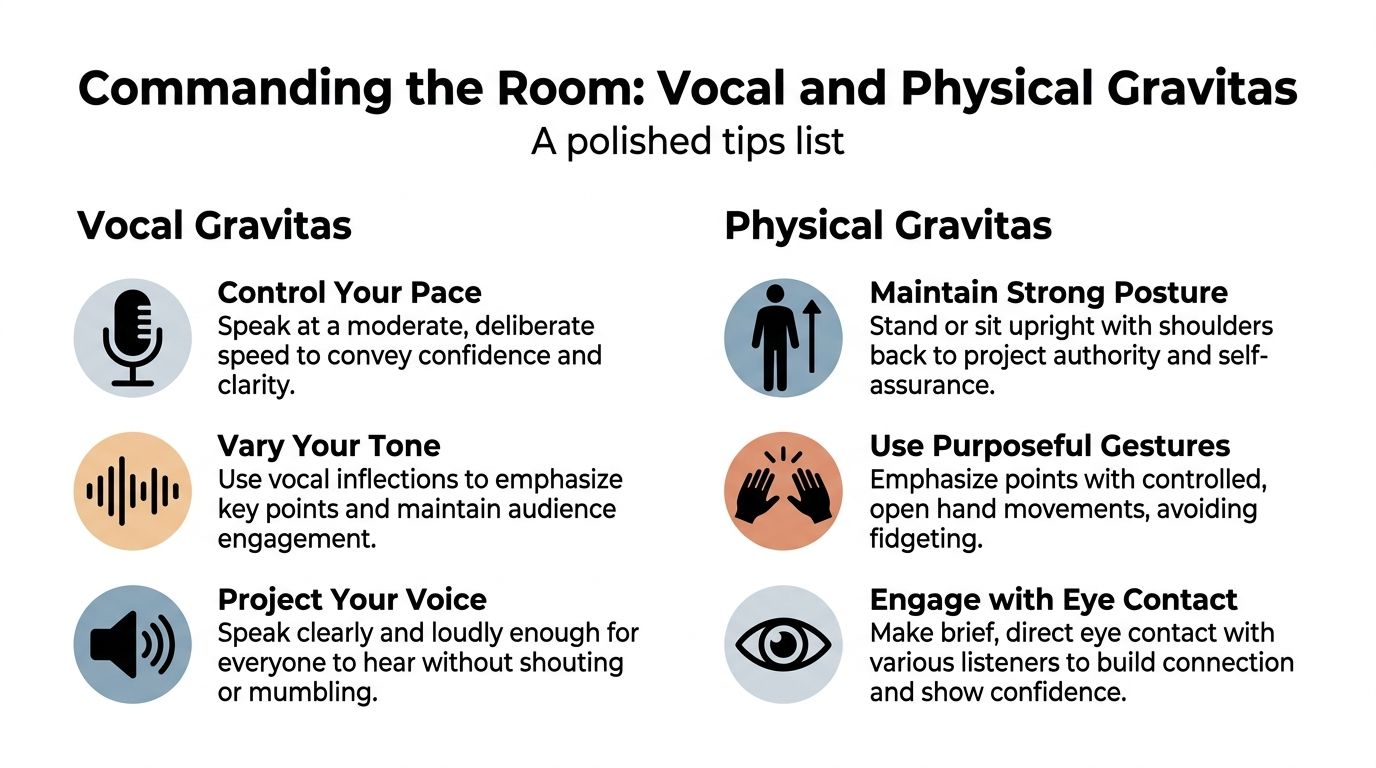
Vocal gravitas you can practice
Many individuals try to improve by speaking more. I usually ask them to do less.
Slow the first sentence
Your first sentence sets the frame. If you rush it, you signal tension. A measured start gives you control and gives your listener time to settle into your voice.
Try this in practice:
Read your first line aloud. Then say it again at a slightly slower pace, with a full pause before your key point.
Finish sentences cleanly
A lot of international professionals let the end of the sentence fall away. The sound gets softer, less certain, less complete.
Practice ending statements as statements. Not as apologies. Not as questions.
Use pause as authority
Silence is one of the clearest leadership signals when used well. It tells the room you are not scrambling.
A good pause works in three places:
- Before the recommendation
- After a key point
- Before answering a challenging question
Here’s a short video that reinforces several of these delivery habits in practice.
Physical gravitas on video and in person
Executive body language doesn’t mean looking stiff. It means removing behaviors that drain authority.
| Habit to reduce | Stronger alternative |
|---|---|
| Constant nodding | Hold still and respond after the person finishes |
| Looking down while speaking | Keep your eye line level |
| Fidgeting with hands | Rest hands calmly, then gesture on purpose |
| Folding into your chair | Sit tall with your chest open |
On video, framing matters too. Put the camera at eye level. Don’t speak while looking at your own image. Let your face stay composed while others are talking.
What not to do
I’m firm on this point. Don’t try to manufacture authority by becoming colder or louder.
That usually backfires. You’ll sound performative.
Instead, aim for these qualities:
- Steady pace
- Clear sentence endings
- Economical gestures
- Direct eye line
- Calm transitions under pressure
If you want a structured starting point for assessing those behaviors, the Executive Communication Assessment is designed for that kind of analysis.
How to Navigate Feedback and Disagreement with Composure
The hardest part of communication with managers isn’t presenting an update. It’s staying composed when the conversation becomes uncomfortable.
That happens in two situations most often. You receive feedback that feels unfair, vague, or badly delivered. Or you need to disagree with your manager without damaging trust.
Handle feedback without collapsing or fighting
Some managers under-explain. They hint instead of stating the issue clearly. Stanford GSB notes that undercommunicators suffer steeper employee perception penalties than overcommunicators, as discussed in Stanford’s piece on undercommunication.
That matters because many professionals assume poor feedback is their fault. It often isn’t. Your job is to get clarity anyway.
Use this sequence:
-
Listen for the actual issue
Don’t react to tone first. Extract the concern. -
Reflect the point back
“So the main concern is that my updates came too late. Is that right?” -
Ask for one concrete example
This keeps the conversation grounded. -
Name your adjustment
“Understood. I’ll send a shorter progress note earlier, even if all details aren’t finalized.”
If feedback is vague, your composure is demonstrated by how well you clarify it.
Disagree in a way managers can hear
Many talented professionals sabotage themselves here. They either become too passive and say nothing, or they become too forceful because they’ve stored frustration for too long.
Productive disagreement sounds structured.
Use the agree-concern-recommend format
This is one of the most reliable ways to challenge upward without sounding combative.
- Agree on the goal: “I agree we need to move quickly.”
- State the concern: “My concern is that the current sequence creates handoff risk.”
- Make a recommendation: “I’d suggest we decide ownership first, then accelerate execution.”
That format helps your manager hear partnership instead of resistance.
Separate judgment from emotion
Don’t say:
“This won’t work.”
Say:
“I see two implementation risks that make this harder than it appears.”
The second version keeps your authority while lowering defensiveness.
Build a two-way feedback habit
If your relationship with your manager only becomes direct during problems, every difficult exchange carries too much pressure.
A healthier pattern is regular, specific upward input. If you want a useful primer on the concept, this guide to upward feedback explains how employees can give managers constructive input without turning it into a confrontation.
In practice, that can sound like:
- On priorities: “It helps me move faster when I know which trade-off matters most.”
- On communication rhythm: “A brief check-in earlier in the week would help me catch risk sooner.”
- On decision quality: “I can give better recommendations when I understand the absolute requirements.”
Keep your authority even when English feels shaky
Many international professionals lose ground when they know what they mean, but in a tense moment they rush, soften, or abandon the point halfway through.
When that happens, simplify. Shorter sentences. Cleaner verbs. Lower pace.
If confidence drops when you’re under scrutiny, this piece on speaking English with confidence even with an accent offers practical adjustments that help in live conversation.
Composure isn’t the absence of stress. It’s the ability to stay organized while stress is present.
Conclusion Your First Step Toward Authoritative Communication
Your manager asks for an update in a meeting with senior leaders. You know the work. You know the risk. But your point comes out softer than you intended, and the room responds to your delivery instead of your judgment.
I see this pattern often with international professionals. The problem is rarely capability. It is how capability sounds under pressure.
Communication with managers is a professional skill that improves with deliberate practice. The people who gain trust faster usually make their thinking easy to follow, especially when the stakes rise. They frame the issue early, state the recommendation clearly, and respond to pressure without losing shape.
That matters because work now runs through constant conversation across meetings, chat, email, and presentations. Many professionals feel the strain between how much communication the job requires and how little direct coaching they receive on doing it well. If that gap has slowed your visibility or influence, the problem is real.
For international professionals, the challenge has another layer. You are often judged not only on the quality of your idea, but on cultural framing, vocal steadiness, pacing, and whether your message matches the leadership style around you. Generic advice misses this. Senior leaders do not reward effort alone. They respond to clarity, judgment, and presence.
Small changes can shift how you are perceived. A shorter opening. A cleaner recommendation. A lower speaking pace when the room gets tense.
Over time, those adjustments affect more than one conversation. They shape whether your manager sees you as someone who needs direction or someone who can carry weight. They influence whether senior leaders remember hesitation or sound decision-making.
If you also lead a team, study the relationship from both sides. This article on being a good boss is a useful reminder that clarity, consistency, and trust shape leadership at every level.
Start there. Aim to sound clear, grounded, and senior.
If you want a personalized view of what strengthens your authority and what weakens it, start with the free Executive Communication Assessment from Intonetic. You’ll get a focused look at how your vocal delivery, framing, and executive presence come across, plus a clearer path for improving how you communicate with managers at senior level.