
Communication Coaching for Executives: The Complete Guide
You've prepared the numbers, anticipated the objections, and rehearsed the recommendation. Then the board meeting begins, and something feels off. A colleague interrupts before you finish, your strongest point gets reframed by someone else, and a less-informed voice receives the room's attention. You know the business. The problem is that your expertise isn't landing with the authority it deserves.
Communication coaching for executives becomes more than presentation training. For international and non-native English-speaking professionals, perceived leadership can depend on details that native speakers may absorb more casually, including pacing, strategic framing, directness, silence, eye contact, and the cultural meaning of confidence. The work isn't about erasing your identity or imitating a native speaker. It's about making your judgment easier to recognize under pressure.
Why High-Level Experts Lose the Boardroom Room
You've spent years developing specialized knowledge, leading teams, and earning your place at the table. In a critical boardroom or investor meeting, however, preparation alone may not protect your authority. If your opening takes too long, your recommendation arrives after too much context, or your voice rises at the end of key statements, listeners may experience uncertainty even when your analysis is sound.
For a non-native English speaker, the challenge can be more layered. You may be translating ideas mentally, selecting culturally appropriate phrasing, and monitoring pronunciation while also reading the room. A pause that feels thoughtful in one culture may be interpreted as hesitation in another. A respectful indirect answer may sound evasive to listeners expecting a firm position. These aren't intelligence problems. They're perception gaps created by language, culture, and pressure.

The invisible cost of being technically correct
Consider an accomplished product leader presenting a market-entry recommendation. The leader begins with background, qualifies each conclusion, and uses careful language to avoid appearing too forceful. By the time the recommendation arrives, the board has already formed a weaker impression: knowledgeable, perhaps, but not decisive.
A targeted coach won't advise this person to “sound confident.” The coach will identify the specific behaviors creating the impression, then rehearse alternatives:
- Lead with the decision: State the recommendation before the supporting context.
- Reduce protective language: Replace unnecessary qualifiers with precise judgments.
- Use deliberate silence: Pause after the central point instead of filling the space.
- Control the handoff: Finish an answer cleanly before inviting another question.
- Make disagreement usable: Acknowledge the concern, then explain the decision logic.
Practical rule: Your authority is often judged before the room evaluates the full quality of your ideas.
The boardroom doesn't reward expertise in the abstract. It responds to expertise that arrives with structure, composure, and a clear point of view. That combination can be trained without flattening your accent, personality, or cultural perspective.
What Executive Presence Actually Is and How It Is Built
Executive presence isn't a mysterious aura, and it isn't a personality type reserved for naturally charismatic people. Communication science describes it as a group of observable behaviors that can be identified, measured, and trained, commonly evaluated through vocal delivery, physical composure, and verbal precision (communication science perspective on executive presence).
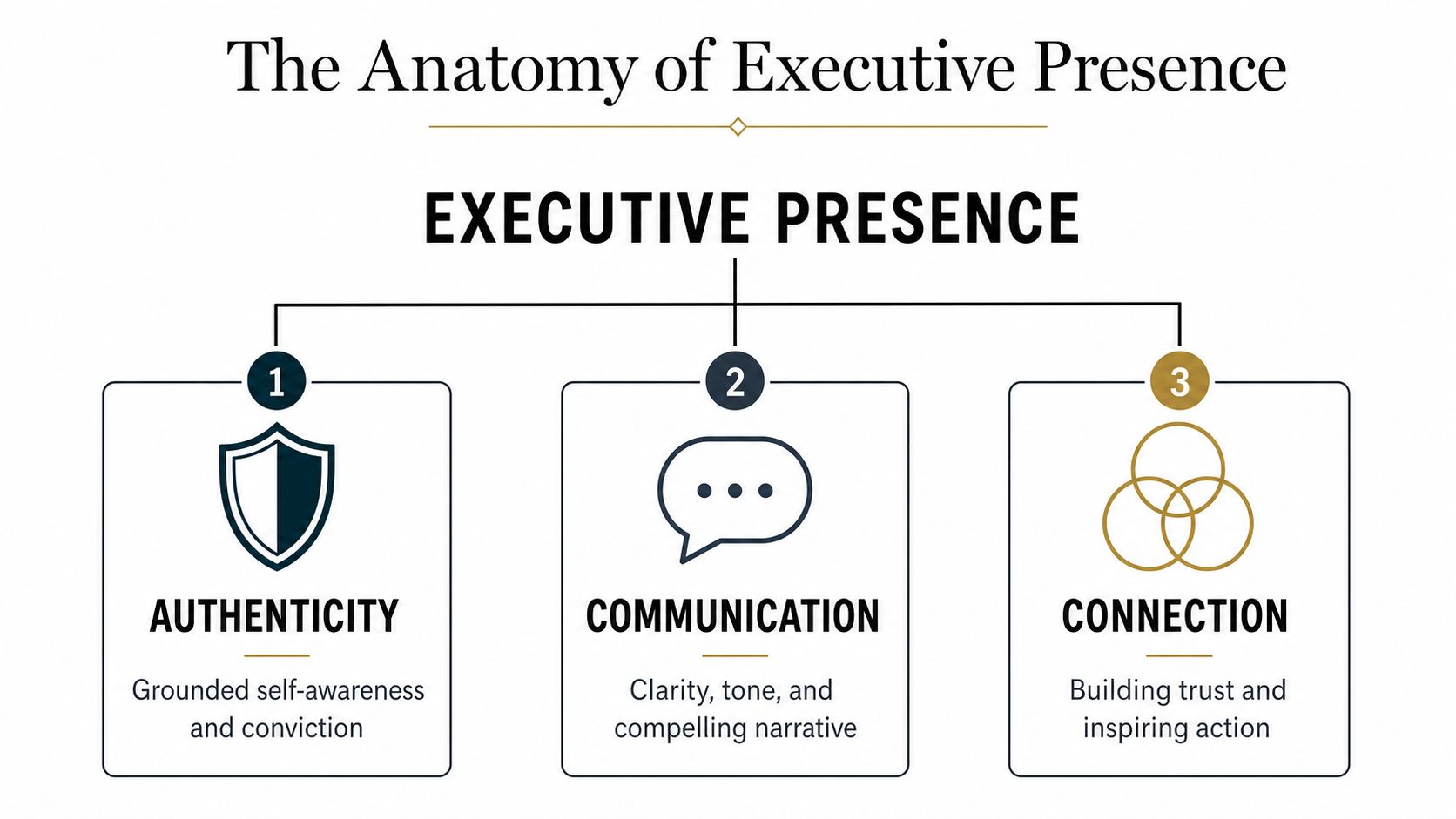
Three domains, one integrated impression
Vocal delivery includes pace, pitch, tone, volume, articulation, and silence. A senior leader who speaks quickly through complex recommendations may appear anxious or underprepared, even when the content is excellent. Slowing down at decision points, lowering unnecessary pitch variation, and allowing a short pause after a key sentence can make the message easier to absorb.
Physical composure covers posture, gestures, facial expression, eye contact, and the way you occupy space. Composure doesn't mean becoming rigid. It means ensuring that movement supports the message rather than revealing unmanaged pressure. A leader who repeatedly looks down while answering a challenge may unintentionally communicate withdrawal. A leader who leans toward a participant and keeps an open orientation may signal engagement.
Verbal precision is the ability to structure and express thought clearly, especially when challenged. It involves a strong headline, a limited number of supporting points, and a conclusion that tells listeners what matters or what happens next. For international professionals, precision can reduce the cognitive load of speaking in a second language because a reliable structure takes some improvisational burden away.
A practical training loop
Start by recording a short answer to a realistic board question. Review it for one behavior in each domain: vocal pace, physical stillness, and message structure. Then repeat the answer with one deliberate adjustment, rather than attempting to change everything at once.
A useful next step is a free executive presence assessment that helps identify which behaviors are already supporting your authority and which ones are creating friction. The aim isn't polished performance for its own sake. It's a consistent way of making your thinking visible, credible, and actionable.
The Roots and Evolution of Professional Executive Coaching
Executive communication coaching has a professional history rather than being a recent label attached to presentation advice. Executive coaching began to flourish in the UK in 1992, according to an academic history of the field, and the International Coach Federation was founded in 1995, helping coaching develop into a more formal discipline within leadership development (academic history of coaching).
That professionalization changed the coach's role. Informal advice from a mentor could be useful, but it often depended on personal instinct and focused on broad encouragement. A structured coaching engagement can examine specific behaviors, define a development objective, create practice conditions, and use feedback to refine performance. That shift matters for executives because boardroom communication is too consequential for vague guidance.
From accent correction to leadership impact
Early conversations about non-native English speakers often centered narrowly on pronunciation or accent reduction. Clear speech can help, but it doesn't solve every authority problem. A leader may pronounce every word accurately and still bury the recommendation, over-explain the context, avoid productive disagreement, or lose composure when challenged.
Modern executive communication coaching looks at the complete leadership signal. It considers how a leader frames a trade-off, uses silence, responds to interruption, adjusts language for a frontline audience, and communicates certainty without becoming inflexible. For international professionals, that broader lens protects an important distinction: the goal is greater influence, not cultural imitation.
The field's maturity also makes it easier to connect communication development with wider leadership work. A coach may work alongside organizational development, succession planning, or leadership assessment while staying focused on how the executive's behavior affects trust and decisions. Professionals building a broader leadership library can also explore Baslon Digital's book recommendations for additional perspectives on leadership practice.
Beyond Confidence Why Communication Coaching Matters Now
Many executives begin coaching by saying, “I want to feel more confident.” That's understandable, but confidence is an unstable target. You can feel nervous and still communicate with authority. You can feel confident and still sound dismissive, unclear, or disconnected from the people you need to lead.
The more useful question is: What does your audience experience when the stakes rise? Do employees understand the decision? Do frontline teams feel visible? Do global colleagues hear respect for their context? Can stakeholders challenge you without the conversation becoming defensive?
The audience experience is the leadership test
Recent survey findings point to a problem that extends beyond speaking polish. The IoIC 2025 IC Index found that only 13% of employees gave their organization top marks for internal communication, only 51% felt leaders understood their challenges, and 56% believed difficult changes were communicated with care. The same reported research notes that 26% of frontline workers said they received too little communication from leadership, compared with 17% of office workers (reported IoIC and Ketchum findings).
These findings expose the limitation of generic advice such as “speak more clearly.” A leader can deliver a polished message and still fail to show presence, empathy, or visibility. Communication coaching for executives should therefore include audience adaptation:
- Frontline teams: Use concrete implications, acknowledge operational reality, and make space for questions.
- Hybrid teams: Create visibility through intentional turn-taking, concise written follow-up, and active inclusion of remote participants.
- Global audiences: Explain assumptions, avoid culture-specific shorthand, and check how directness will be received.
- Board and investor audiences: Lead with the decision, frame risk clearly, and distinguish facts from judgment.
Where AI helps, and where it doesn't
AI-assisted feedback can accelerate practice, especially when a leader needs repeated rehearsal between sessions. A 2026 IMD summary of research involving 167 global executives reported that 55% of AI feedback fell into a “zone of learning,” where it revealed surprising and useful communication blind spots (IMD summary of AI communication coaching research).
AI works best when you give it a specific prompt, a defined framework, and a real communication sample. It can flag patterns in pacing, filler language, structure, or repeated hedging. It can't reliably determine whether a pause reflected thoughtful judgment, cultural politeness, or anxiety in a particular organizational context. Human interpretation remains essential because behavior only matters in relation to audience, power dynamics, and purpose.
How Executive Communication Programs Are Structured
A serious coaching engagement follows a diagnostic cycle rather than a sequence of motivational conversations. The coach first identifies the gap between intention and audience experience, then builds practice around situations where the executive must perform, decide, persuade, or respond under pressure.
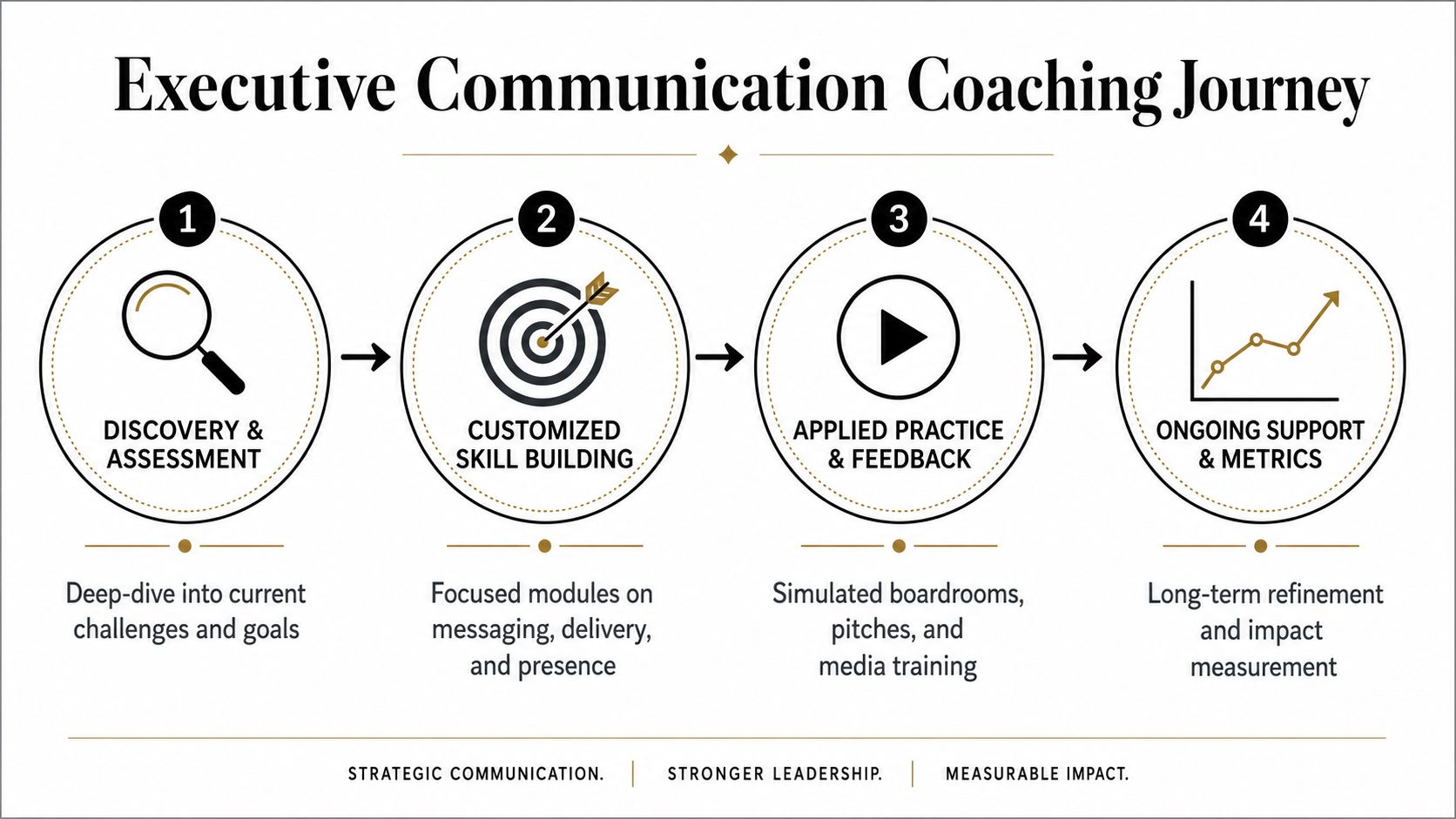
The four-part coaching cycle
Discovery and assessment establish the actual challenge. This may include recordings, stakeholder observations, structured interviews, and review of upcoming communication events. A useful assessment distinguishes between a language issue, a message issue, a nonverbal issue, and a pressure response.
Customized skill building translates the diagnosis into a focused development blueprint. The work might target opening statements, strategic framing, vocal authority, executive body language, listening, or responses to hostile questions. Strong programs don't assign every executive the same curriculum.
Applied practice and feedback brings the work into realistic conditions. Role-play should use the executive's real environment, such as a board challenge, investor question, restructuring announcement, or disagreement with a peer. Rehearsing generic speeches won't prepare you for the moment someone interrupts your recommendation.
Ongoing support and metrics turn insight into a repeatable habit. Between-session experiments might involve leading a meeting with a new structure, pausing before answering, or replacing a long explanation with a headline and two reasons. The next session then examines what changed in the room.
A 2025 study introduced the Measure of Interpersonal Apprehensions in High-Stakes Situations, or MIPHSS, an assessment instrument designed to examine how interpersonal apprehension affects behavior and performance under pressure (study introducing MIPHSS). That kind of lens is valuable because nerves aren't only an internal feeling. They can alter eye contact, vocal steadiness, timing, and willingness to state a clear position.
For a practical overview of skill areas and leadership application, review executive communication skills training. The right program should leave you with observable behaviors to practice, not just encouraging feedback.
Selecting the Right Coach or Program for Your Needs
The most persuasive coaching website can still conceal a weak methodology. Evaluate the coach by asking how the program identifies problems, how practice resembles your real work, and how progress becomes visible to other people.
One useful assessment framework comes from Business and Professional Communication Quarterly. The study describes three concrete methods for executive communication assessment: panel-based interviews, guided discussion, and executive writing (executive communication assessment study). Together, these methods test more than presentation polish. They reveal how you respond to questions, build meaning in dialogue, and communicate when you have time to shape your language.
Questions worth asking before you commit
Ask a prospective coach to explain what happens after the initial conversation. If the answer stays at the level of confidence, charisma, or “finding your voice,” ask how those ideas become measurable behaviors.
You should also ask:
- What will you observe: Will the coach review a presentation, meeting recording, written message, or simulated interaction?
- Who is the audience: Does the coach understand board dynamics, global teams, technical communication, or the expectations placed on non-native English speakers?
- How does practice work: Will you rehearse your actual scenarios, including interruptions, disagreement, and difficult questions?
- What changes first: Can the coach identify an early behavioral target, such as a stronger headline, cleaner pauses, or more decisive answers?
- How is progress reviewed: Will you compare recordings, gather stakeholder feedback, or assess performance against a defined communication objective?
A coach shouldn't treat your accent as the problem by default. The relevant question is whether listeners understand you, trust your judgment, and know what you want them to do. Accent work may help in specific cases, but it should sit inside a broader plan that includes framing, composure, cultural nuance, and influence.
Professionals seeking a remote format can compare the structure of executive presence training online with other options, then choose based on coaching depth rather than delivery format alone.
Measuring Impact and Return on Investment
The market context shows why organizations increasingly treat executive communication as a leadership capability rather than a cosmetic service. One 2026 industry estimate values the global executive coaching and leadership development market at USD 112.98 billion, up from USD 103.56 billion in 2025, and projects it to reach USD 174.53 billion by 2031 at a 9.11% CAGR (Mordor Intelligence market estimate). The same estimate says large enterprises held 57.61% of market share in 2025, North America accounted for 40.88%, and Asia-Pacific was the fastest-growing region at an 11.12% CAGR through 2031.
Those figures describe a broad market, not the guaranteed return from any individual program. For an executive, the useful ROI question is more specific: has your communication changed the quality of decisions, attention, trust, or action around you?
Track behavior before you track outcomes
Suppose an executive routinely loses the room during complex updates. A useful coaching plan might first track whether the executive leads with the recommendation, pauses after the headline, answers the question asked, and closes with a decision or next step. Those behaviors are closer to the intervention than a broad claim that “the presentation went better.”
Then track audience response qualitatively and consistently:
- Do stakeholders interrupt less often?
- Do questions become more strategic instead of clarification-heavy?
- Do colleagues repeat the recommendation accurately?
- Do meetings move toward decisions more quickly?
- Do people raise concerns earlier and more directly?
- Does the executive remain composed when challenged?
Nonverbal work can be part of this measurement. Research summaries identify distinct cues associated with executive presence, including power posture, eye contact, steepling the hands, leaning in, fronting the body toward the audience, and removing barriers between speaker and listener (body language in executive presence). The point isn't to perform a checklist mechanically. It's to notice which physical behaviors reinforce or weaken the message.
A communication audit can make this process concrete by showing how a leader's delivery, structure, and presence appear in practice. A useful communication audit example should lead to priorities you can apply in real meetings, not an abstract personality label. For broader context on the business case, Synopsix's guide to executive coaching for leaders offers another perspective on how communication connects with leadership effectiveness.
Your Path to Senior Leadership Presence
You don't need to become a different person to communicate like a senior leader. You need a more reliable way to make your judgment visible when the language, culture, and stakes all create friction. That usually starts with one or two behaviors that produce disproportionate confusion, then expands through deliberate practice across the situations that matter most.
The Gravitas Method is a 12-week one-on-one executive presence coaching program for international professionals who want to communicate with more authority and influence at senior levels. The program is priced at $8,200 paid in full or $9,000 across three installments. Coached by Nikola, it covers vocal authority, strategic framing, executive body language, and high-stakes communication.
The work is designed for professionals who already perform at a high level but want their communication to reflect that level more consistently. You'll examine how you speak, pause, structure ideas, respond to pressure, and occupy the room, using scenarios drawn from senior leadership, technology, finance, consulting, and enterprise environments.
Start with evidence, not a large commitment. The free Executive Communication Assessment can help identify the specific blind spots affecting your perceived authority and clarify whether focused coaching is the right next step. You can also explore practical guidance on building executive presence skills as you decide which behaviors deserve attention first.
Intonetic helps international and non-native English-speaking professionals strengthen vocal authority, strategic framing, executive body language, and high-stakes communication through focused one-on-one coaching. Visit Intonetic to take the free Executive Communication Assessment, identify the gap between your expertise and how it lands, and choose your next step with greater clarity.