Question Tell Me About Yourself: Executive Answers
You’re in a final-round interview for a senior role. The panel has your résumé. They’ve read your LinkedIn. Then someone leans in and says, “Tell me about yourself.”
Most international professionals still answer this as if they’re being asked for a biography. They start at the beginning, explain each move, add context no one asked for, and hope the interviewer will connect the dots.
That’s the mistake.
The question tell me about yourself isn’t a request for your history. It’s a request for your judgment. Can you choose what matters, frame it clearly, and speak like someone who belongs at a senior level?
For leadership roles, your answer needs to do three things fast. It needs to establish relevance, signal authority, and make the listener trust your thinking. If you get that right, the rest of the interview becomes easier. If you miss it, you spend the next forty minutes recovering from a weak opening.
Why "Tell Me About Yourself" Is Your First Leadership Test
You are sitting in a final interview for a senior role. The panel already knows your background on paper. The first live test is whether you can frame that background with judgment, restraint, and authority when someone says, "Tell me about yourself."

Across major markets, this opener appears in over 90% of interviews according to Indeed’s guide to the question. This is significant because interviewers are not using it as a casual warm-up. They are deciding, early, whether you communicate at the level of the role.
For senior hires, this question works like a short leadership simulation. The interviewer is assessing whether you can set a direction, choose signal over noise, and make other people trust your thinking quickly. That is why this moment carries more weight for international professionals in particular. If your first answer is too detailed, too chronological, or too cautious, listeners may misread language patterns as lack of executive readiness.
What senior interviewers evaluate
A hiring manager at this level is rarely looking for a life story. They are testing whether you can do four things in real time:
- Set the frame: Can you define who you are professionally before the panel defines you by your résumé?
- Show business judgment: Can you identify which parts of your background matter for this role and leave out the rest?
- Project executive presence: Can you sound composed, concise, and credible under pressure?
- Represent the company well: Can they picture you speaking with clients, regulators, investors, or senior internal stakeholders?
This is why "just be natural" is weak advice. Under stress, many accomplished candidates become overly explanatory. At executive level, explanation is not enough. Selection is the skill.
Why this question carries extra stakes for international professionals
I see this often with highly qualified international candidates. They add context to avoid being misunderstood. They explain title differences across markets, justify career moves, or soften strong achievements so they do not sound arrogant.
Those instincts are understandable. In an interview, they often work against you.
Senior interviewers are not grading your biography for completeness. They are asking whether you can lead attention. If your answer starts with background the company does not need yet, you hand over authority in the first two minutes. If you frame your experience around outcomes, scope, and decision-making, you establish seniority before the technical questions begin.
That shift is one reason spoken delivery matters as much as content. Strong framing can still lose force if it sounds hesitant, overpacked, or overly deferential. For candidates who need to strengthen that layer, targeted executive presence coaching can help identify where authority drops in the first answer.
Why résumé summaries weaken your position
A résumé summary feels safe because the facts are familiar. In practice, it often signals a lower level of leadership maturity.
Chronology is easy. Prioritization is harder.
Senior candidates are hired for the problems they can solve, the scale they can handle, and the confidence they create in the room. A good opening answer makes those points visible early. A weak one forces the interviewer to infer them, and busy senior interviewers often will not do that work for you.
If you want a baseline structure before you refine your executive framing, How to Answer 'Tell Me About Yourself' in a Job Interview is a useful reference. The difference at senior level is that your answer must do more than summarize. It must signal leadership from the first sentence.
Adopt a Strategic Mindset Before You Speak
Most weak answers are written too early.
The candidate hears “Tell me about yourself,” opens a blank document, and starts drafting sentences. That’s backward. Before you script anything, you need a point of view about the role.
Stop summarizing your past
If your answer is built around chronology, you’ll sound descriptive. Senior candidates need to sound directional.
The better question is this: What future problem am I being hired to solve, and which parts of my background prove I can solve it?
That shift changes everything. It helps you decide what stays in your answer and what gets cut.
A useful way to prepare is to mark up the job description and isolate three priorities that keep appearing. Often they’re not hidden. They show up in phrases like stakeholder management, transformation, revenue ownership, operational scale, risk control, client leadership, or cross-functional influence.
Once you identify those themes, your answer needs to revolve around them, not around your full career history.
Build around business relevance
Use this simple filter before you include any detail:
- Does this prove capability at the level I’m targeting?
- Does this connect to a problem this company likely cares about?
- Would a board-level or senior stakeholder consider this relevant?
If the answer is no, remove it.
That means many candidates should cut long explanations about university, early career transitions, or technical details that don’t support the role. Strong content is often shorter than you expect.
A senior answer doesn’t say, “Here’s everything I’ve done.” It says, “Here’s why my background makes sense for this mandate.”
Framing beats tailoring
People talk about tailoring as if adding a few keywords is enough. It isn’t.
Tailoring is surface-level adjustment. Framing is strategic positioning.
For example, two candidates may both have led a regional team. One says, “I managed a distributed team across markets.” The other says, “I’ve spent the last several years leading cross-market teams where alignment, speed, and stakeholder trust mattered as much as technical execution.”
The facts may be similar. The second candidate sounds more senior because the framing communicates business judgment.
For international professionals, pronunciation and pacing can either support that framing or weaken it. If spoken clarity is getting in the way, this guide on how to improve English pronunciation for job interviews is a useful place to sharpen intelligibility before you rehearse your final version.
The pre-work that makes your answer stronger
Before you practice, prepare these four inputs:
- The mandate: What does this role exist to improve, protect, build, or scale?
- The proof: Which two or three parts of your track record best demonstrate that capability?
- The language: Which words from the company’s own materials reflect how they think about success?
- The bridge: Why is this role the logical next step, not a random move?
Do that work first. Then your answer becomes a business case, not a life story.
Crafting Your High-Impact Career Narrative
A strong answer needs structure. Without it, even impressive experience sounds messy.
The most reliable format is Present, Past, Future. According to SynergisticIT’s interview guide, 33% of interviewers make a decision within the first 90 seconds, and structured Present-Past-Future responses correlate with 46% higher advancement rates in tech and finance interviews.
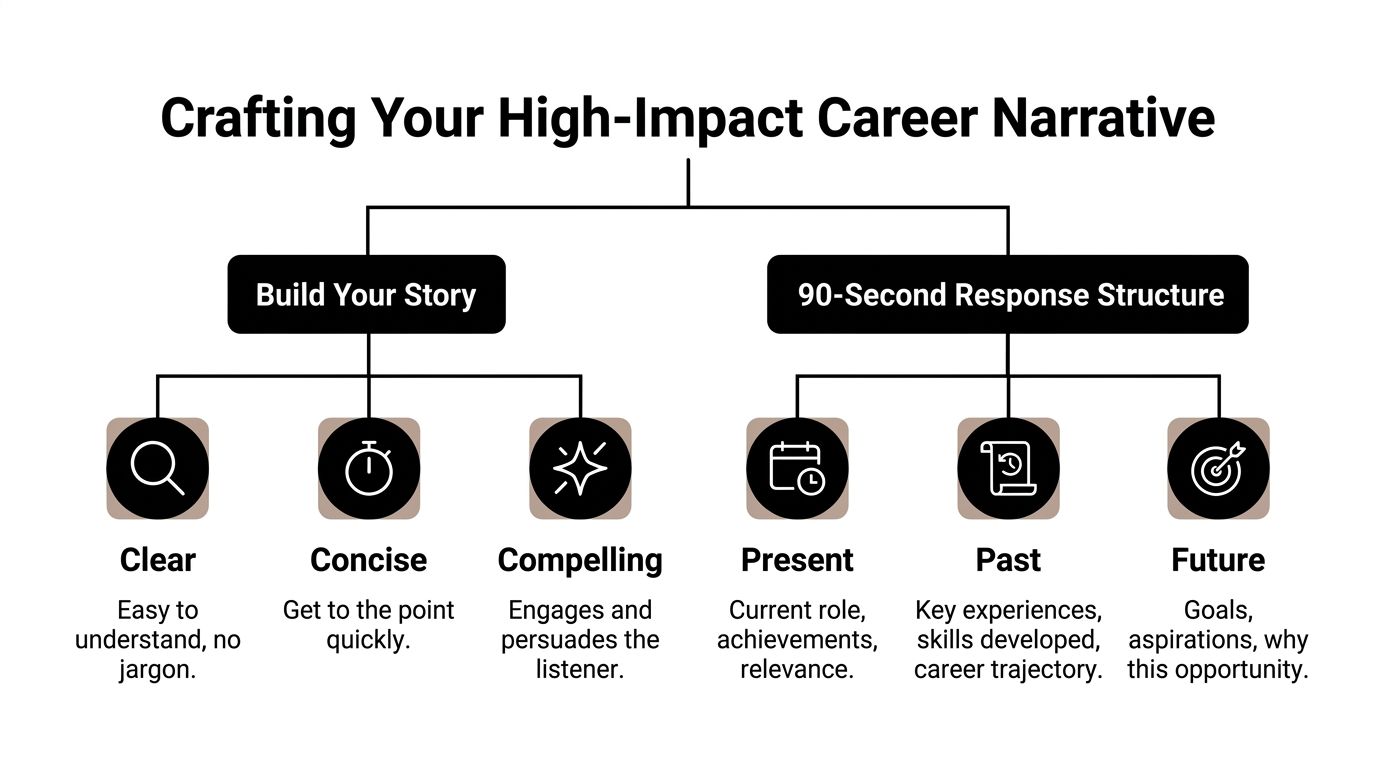
That’s why this framework works so well for the question tell me about yourself. It gives the interviewer a logical sequence, and it stops you from sounding scattered.
Present first
Start with who you are professionally now. Not your title alone. Your scope, your specialty, and your business value.
A weak opening:
“I’m currently a senior manager at a technology company, and I’ve been there for a few years.”
A stronger opening:
“I’m a senior operations leader in enterprise technology, focused on scaling cross-functional programs and improving execution across complex stakeholder environments.”
That opening does two things. It establishes identity, and it signals level.
If you have a quantified achievement that is part of your real experience, use it. If you don’t, stay qualitative rather than inventing numbers.
Then move to the past selectively
Your past section is not your full timeline. It’s the evidence that supports your current positioning.
Choose one or two career moves that explain how you built the strengths this role needs. For senior candidates, the most useful proof usually falls into one of these categories:
- Leading through complexity: Mergers, restructures, large transformations, difficult stakeholder environments
- Owning outcomes: Revenue, operating performance, delivery quality, major accounts, strategic initiatives
- Building trust at scale: Cross-market leadership, executive communication, client-facing influence, board exposure
Here’s the difference in practice.
Instead of:
“I started in analytics, then moved into project management, then into product, and now I lead a team.”
Say:
“My background started in analytics, which gave me a strong operating discipline. I then moved into program and product leadership, where I learned to align technical teams, commercial stakeholders, and senior decision-makers around execution.”
That version has a narrative arc. It explains development, not just sequence.
For anyone thinking seriously about the idea of narrative itself, this piece on what is brand narrative and how to build one is useful because the same principle applies to careers. People remember a coherent story more than a list of facts.
End with the future
The future section is where many candidates get vague. They say they’re “excited for a new challenge” or “looking for growth.” That language is weak because it centers your needs, not the company’s.
A stronger future statement ties your background to the opportunity in front of you.
Try language like:
- For transformation roles: “What interests me here is the opportunity to apply that experience in a business where alignment and execution speed clearly matter.”
- For commercial roles: “I’m interested in this position because it brings together client leadership, strategic growth, and the kind of cross-functional influence I’ve built my career around.”
- For operational leadership roles: “This role feels like a strong fit because it requires both operational rigor and the ability to lead through ambiguity.”
Your future statement should answer one silent question: Why does this move make sense for them, not just for you?
A practical blueprint you can draft today
Use this sequence:
- Present
State your current role identity, scope, and core value. - Past
Mention one or two relevant career experiences that built your credibility. - Future
Connect directly to the mandate of the role.
Keep the language spoken, not written. Read it aloud. If it sounds like a press release, rewrite it.
For professionals who struggle with spoken clarity even when the content is strong, this guide on how to speak English clearly and confidently can help you make the answer sound clean and controlled rather than rehearsed.
Sample senior-level answer
Here’s a model you can adapt:
“I’m currently leading regional operations in a multinational technology environment, where my focus is on improving execution across cross-functional teams and translating strategy into consistent delivery. Earlier in my career, I built a foundation in analytics and program leadership, which taught me how to solve operational problems while managing senior stakeholder expectations. Over time, that evolved into broader leadership responsibility across teams and markets. What interests me about this opportunity is that it sits at the intersection of scale, complexity, and influence, which is where I do my best work.”
That answer is not flashy. It is useful. It tells the interviewer what level you operate at.
Tailoring Your Story for High-Stakes Industries and Contexts
The same answer won’t land the same way everywhere.
A polished response for a venture-backed tech company can sound too loose for finance. A finance-style answer can sound rigid in consulting. And the version you use in a networking conversation should not sound like a rehearsed panel interview script.
A 2025 Harvard Business Review analysis cited in Tufts’ interview advice article says 74% of VP and C-suite promotions stem from informal “tell me about yourself” chats. That’s the trade-off many candidates miss. The formal version needs structure. The informal version needs range and warmth.

Tech, finance, and consulting require different emphasis
Here’s how a generic answer changes by context.
Tech
Generic:
“I’m a senior manager with experience leading teams and delivering projects.”
Sharper for tech:
“I lead cross-functional teams in technology environments where speed, product judgment, and alignment across engineering and business partners matter. My background has centered on turning complex initiatives into clear execution.”
This works because tech leaders are often judged on clarity amid moving priorities.
Finance
Generic:
“I’ve managed operations and worked with different stakeholders across the business.”
Sharper for finance:
“My background is in building disciplined execution across regulated, high-stakes environments, where risk awareness, control, and stakeholder confidence are as important as performance.”
This version sounds more credible in firms where precision and trust matter.
Consulting
Generic:
“I’ve worked with clients and led teams on a range of projects.”
Sharper for consulting:
“I’ve built my career around diagnosing business problems quickly, structuring practical solutions, and leading client conversations with enough clarity to move decisions forward.”
That answer highlights thinking and client leadership, not just activity.
Networking needs a different structure
In an interview, Present-Past-Future works well because the listener needs a concise professional summary.
In networking or internal promotion conversations, a Hook-Journey-Impact version often works better.
Use it like this:
- Hook: One sentence on the type of leader or operator you are
- Journey: A brief explanation of the path that shaped that perspective
- Impact: The kind of value you now create or want to create
Example:
“I’m someone who usually gets pulled into complex environments that need clearer execution. I started in technical roles, then moved into broader leadership where I had to align different functions and personalities. At this stage, I’m most useful when the business needs calm direction and follow-through.”
That sounds more human in informal settings. It still carries weight.
If you use your exact interview script in a networking conversation, you may sound prepared. You may also sound guarded.
One core story, multiple versions
You don’t need five different identities. You need one core narrative with multiple versions.
Build these three:
| Context | Best format | What to emphasize |
|---|---|---|
| Formal interview | Present-Past-Future | Relevance, credibility, role fit |
| Networking | Hook-Journey-Impact | Relationship, judgment, future value |
| Video introduction | Compressed summary | Clarity, composure, memorability |
The content stays related. The emphasis changes.
That’s what senior professionals do well. They don’t repeat the same script everywhere. They read the room and adjust without losing coherence.
Mastering Your Delivery for Executive Presence
You can watch two candidates deliver the same career story and get two very different reactions. One sounds credible and ready for senior scope. The other sounds qualified but harder to trust in the room. The difference is usually delivery.
For a senior interviewer, "Tell me about yourself" is not only a content check. It is an early read on how you will brief a board, lead a cross-functional discussion, or represent the company with clients. Your answer has to show judgment under pressure.

Pace and pause shape authority
Candidates who feel pressure often rush the first 20 seconds. That creates two problems at once. The listener has to work harder to follow the message, and your voice starts to signal tension rather than control.
Executive presence usually sounds measured and intentional.
Use a simple standard:
- Open more slowly than feels natural: Your first sentence establishes authority.
- Finish your endings clearly: Do not let the final words disappear.
- Pause at transition points: A short pause between major ideas helps the interviewer track your logic.
- Keep your breathing low and steady: Shallow breathing makes the answer sound tight.
I often tell clients to mark pause points directly in the script and rehearse them out loud. Silent editing does not fix rushed delivery.
Tone should sound decided
Senior candidates lose ground when their key statements sound tentative. This happens often with polished but overly careful speakers, especially international professionals who are trying to be respectful and precise at the same time.
Respect matters. So does conviction.
Your tone should settle on the lines that carry your leadership message:
- your current professional identity
- your strongest capability statement
- your reason for being interested in this role
If those lines rise at the end or fade out, the answer can sound less certain than you intend.
Body language should support the message, not compete with it
Strong delivery is quiet. It does not require performance.
On video, frame yourself so your shoulders are visible, keep the camera at eye level, and look into the lens for your opening and closing lines. In person, walk in at a measured pace, sit with an open posture, and let your hands move only when they help emphasize a point.
Small habits change how senior you appear. Constant nodding, smiling through serious points, or shifting in your seat can weaken an otherwise strong answer.
International professionals need clarity, not imitation
A common mistake is trying to sound like a native speaker. That is the wrong target. The goal is to sound clear, credible, and easy to follow.
In practice, I see four delivery problems repeatedly:
- Over-explaining because of accent anxiety
- Speaking too quickly to get through the answer
- Using language that is so formal it sounds memorized
- Softening achievements until impact becomes vague
The fix is disciplined clarity. Stress the important words. Shorten the supporting detail. Let your statements end cleanly. If pronunciation affects how easily people follow you, this guide on how to improve English pronunciation for public speaking gives practical exercises that help in interview settings.
Calm delivery signals self-trust. In senior interviews, that reads as leadership.
Common Mistakes and How to Practice Effectively
Many candidates already know the obvious mistakes. The problem is they haven’t diagnosed how those mistakes sound to a senior interviewer.
Here’s a practical breakdown.
Common "Tell Me About Yourself" Mistakes and Fixes
| Mistake | Why It Hurts You | The Strategic Fix |
|---|---|---|
| Starting from university or your first job | It delays relevance and makes you sound junior | Start with your current professional identity and value |
| Repeating your résumé line by line | It creates no interpretation or leadership signal | Curate only the experiences that support the target role |
| Giving too much context before making a point | The listener works too hard to understand you | Lead with the conclusion, then add brief proof |
| Sounding overly humble about achievements | Your impact becomes invisible | State your contribution clearly, without apology |
| Memorizing every word | You sound stiff and less present | Memorize the structure and key phrases, not the full script |
| Using the same version everywhere | It feels tone-deaf in networking or internal conversations | Adapt the story to the setting while keeping the same core narrative |
Practice like a senior candidate
Repetition alone won’t fix this. You need feedback loops.
Use a short practice system:
- Timer practice: Deliver the answer out loud and keep it within a disciplined range. If you can’t finish cleanly, the content is too long.
- Video review: Record yourself. Watch once with sound off to assess posture and facial tension. Watch again with sound on to assess pace and clarity.
- Keyword rehearsal: Practice from bullet prompts instead of a full script. This helps you sound natural while staying structured.
- Peer challenge: Ask a trusted colleague to interrupt you with follow-up questions. Senior interviews rarely reward perfect speeches. They reward composure.
What “good practice” sounds like
You’re aiming for an answer that feels:
- Clear enough to follow on first listen
- Focused enough to remember
- Flexible enough to adjust in real time
Rehearsal should remove friction, not personality.
One more point matters for international professionals. If your accent has made you overly cautious, you may have trained yourself to speak defensively. That habit can make even strong content sound smaller than it is. Your task is not to erase identity. It’s to make authority audible.
Turn Your Answer Into Your Greatest Asset
The room forms an impression before the interview has really started. Your answer to "tell me about yourself" often decides whether you are heard as a senior operator, a functional expert, or someone still trying to prove basic fit.
That is why this answer deserves more respect than it usually gets. It is your first leadership test. You are showing how you set context, how you direct attention, and how clearly you communicate your value under pressure. For senior international professionals, that challenge is often sharper because listeners may judge fluency, accent, and authority at the same time.
If that dynamic has affected how your level is perceived, read this article on how your accent really affects your career and what you can do about it. It gives a useful frame for separating real communication issues from unhelpful self-monitoring.
Treat your answer as an asset you can use across interviews, internal promotion discussions, board-facing introductions, and high-stakes networking. A well-built version does more than summarize your background. It positions your leadership story before anyone else does.
If you want a clearer view of the habits that may be weakening your authority in interviews, presentations, or promotion conversations, start with Intonetic’s free Executive Communication Assessment. It helps you identify the specific patterns affecting your executive presence and gives you a more precise starting point for improvement.