
Leadership and Communication Styles: Boost Your Influence
You are in the meeting for a reason. You know the numbers, the risks, the dependencies, and what should happen next. But someone else says a simpler version of your point, and the room suddenly pays attention.
That gap is rarely about intelligence. It is often about leadership and communication styles.
For international professionals, the gap can feel sharper. You may be operating in a second language, adjusting to different expectations around directness, and managing how your voice, pacing, or accent gets interpreted before people fully process your ideas. That does not mean you need to become louder or imitate a native speaker. It means you need to communicate in a way senior stakeholders recognize as clear, steady, and credible.
A lot of capable professionals misdiagnose the problem. They think they need more expertise, more slides, or more preparation. In high-stakes environments, that is not usually the missing piece. The missing piece is delivery: how you frame a point, how you signal confidence, how you involve others without losing authority, and how you stay composed when challenged.
If that sounds familiar, you are not imagining it. Perception matters. Delivery matters. And if you have ever wondered how much your speech patterns shape senior-level perception, this breakdown on how your accent affects your career and what you can do about it is a useful place to ground that reality without turning it into self-doubt.
When Your Expertise Is Not Enough
The most frustrating career plateau is not incompetence. It is being highly competent and still not being fully seen as leadership material.
This often shows up in ordinary moments. You present a recommendation, but you over-explain before getting to the point. You answer a challenge with too much detail and not enough stance. You ask for input in a way that sounds uncertain rather than collaborative. None of those habits make you weak. But together, they can reduce the authority your expertise should carry.
The issue is not content alone
Senior environments reward more than accuracy. They reward interpretive control. That means people trust you to make sense of complexity, not just describe it.
A senior leader does three things at once:
- Frames the issue: They tell the room what matters.
- Guides attention: They keep people focused on the core decision.
- Signals steadiness: They sound composed, even under pressure.
Many international professionals already do the first part privately. They think clearly. They see patterns early. They often outperform peers in substance. But if the message arrives with hesitant pacing, softened language, or a scattered structure, the room may not register the same level of leadership.
What gets misread in the room
In global workplaces, people often confuse communication habits with capability.
A pause can be read as uncertainty.
Careful wording can be read as lack of conviction.
Politeness can be read as lower status.
Those interpretations are not always fair, but they are common enough to matter. Strong leadership and communication styles help you prevent that misreading.
Key takeaway: If your ideas are strong but your influence is inconsistent, the problem is probably not what you know. It is how your leadership signal lands.
The good news is that style is trainable. You do not need a different personality. You need a better command of the moments that shape senior-level perception.
The Two Halves of Your Leadership Voice
People often use “leadership style” and “communication style” as if they mean the same thing. They do not.
Leadership style is how you guide, motivate, and make decisions.
Communication style is how you express those decisions, shape conversations, and influence people in the moment.
When you separate the two, your options expand. You stop asking, “What kind of leader am I?” and start asking, “How should I lead and communicate in this situation?”
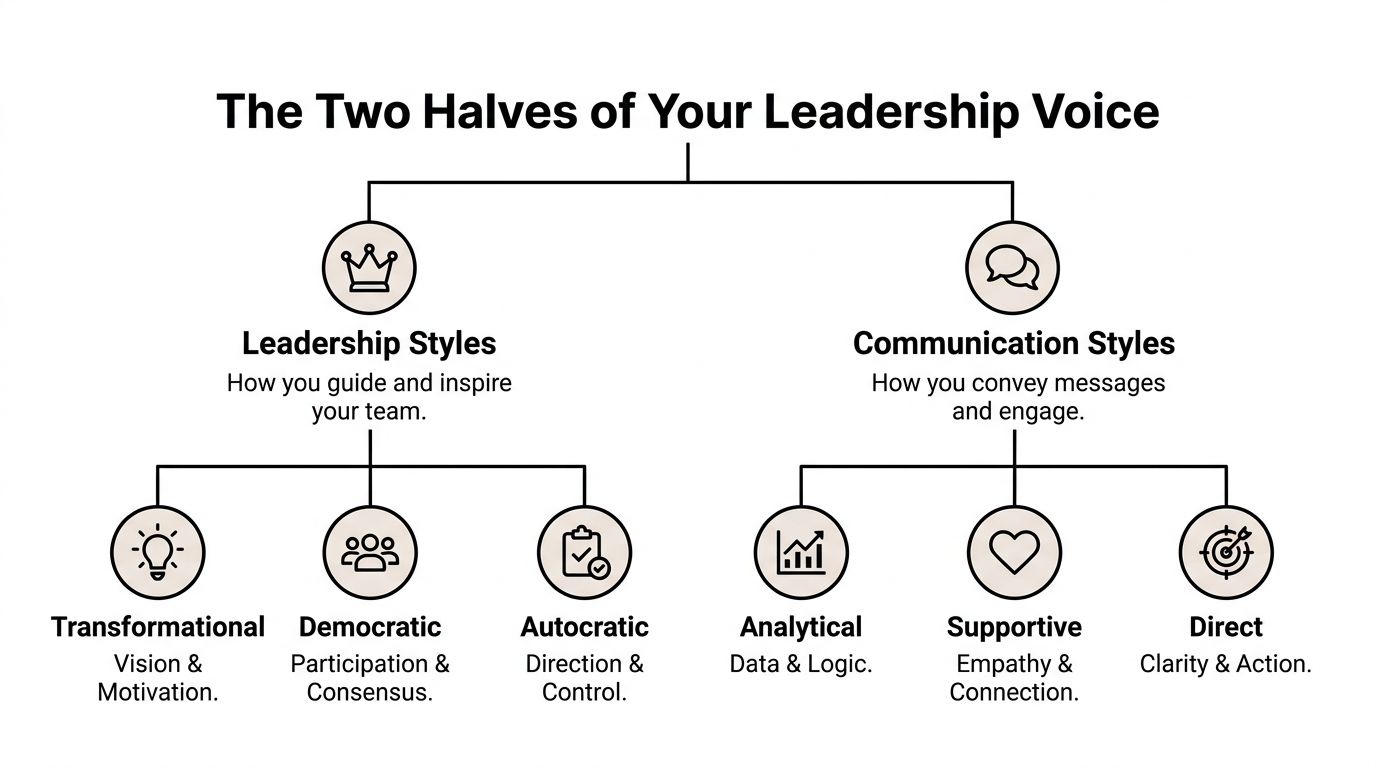
Leadership styles shape direction
A useful way to think about leadership style is this: it defines the role you play in moving a group forward.
A 2023 global leadership survey found that 86.3% of leaders predominantly use communicative approaches, especially democratic at 46.9%, affiliative at 20.6%, and charismatic at 18.8%. That matters because senior leadership today is less about command alone and more about visible coordination, persuasion, and trust.
Here are the core styles worth knowing.
-
Democratic leadership
This leader acts like a strong meeting chair. They invite input, test assumptions, and build buy-in before making a call. This works well when the team has expertise you need and the decision benefits from ownership. -
Affiliative leadership
This leader protects cohesion. They focus on relationships, morale, and trust, especially when teams are under strain. Used well, it creates safety. Used too much, it can avoid hard conversations. -
Charismatic leadership
This leader creates movement through vision and energy. They help people believe in the direction, not just understand the plan. This is powerful in change, launches, and moments where confidence is fragile. -
Authoritative or directive leadership
Think of a captain in a storm. The point is not consensus. The point is clarity. This style is useful when speed matters, confusion is expensive, or accountability must be explicit. -
Task-oriented leadership
This style focuses on process, standards, and execution discipline. It can stabilize teams, but on its own it rarely creates the same level of commitment as more relational approaches.
Communication styles shape delivery
Communication style is more granular. It shows up in your word choice, pace, tone, and structure.
-
Direct
Clear, concise, and action-oriented. This style reduces ambiguity. It is effective in deadlines, decisions, and executive updates. -
Supportive
Warm, relational, and attentive to impact. This style helps people stay engaged when the message is difficult. -
Analytical
Structured, evidence-led, and detail-aware. This is useful when your audience wants logic, risks, and trade-offs. -
Passive
Low-imposition and highly deferential. This can keep interactions smooth, but in senior roles it often weakens your perceived authority. -
Aggressive
Forceful and controlling. It may create short-term compliance, but it usually damages trust and reduces candor.
Why this distinction matters for international professionals
Many international professionals get trapped in one communication setting. They become analytical in every context, or supportive in every context, because it feels safer in a second language.
That predictability can cost you. A senior leader needs a wider range.
If pronunciation and word endings blur your message, your communication style may come across as less decisive than you intend. Practical speech work matters for this reason. This guide on how to enunciate better is especially relevant if your ideas are strong but your delivery loses sharpness under pressure.
Practical rule: Choose your leadership style based on the decision. Choose your communication style based on the audience and the moment.
When those two halves align, people experience you as much more senior.
How Senior Leaders Fuse Styles for Maximum Impact
The best leaders do not stay in one mode all day. They adjust without looking inconsistent.
A leader might open a strategy session with a charismatic leadership stance, then shift into analytical communication when the CFO asks about risk. Later, in a tense one-on-one, the same leader may become affiliative in leadership approach while staying direct in delivery. That flexibility is not theater. It is judgment.

A useful anchor comes from a 2010 study on leaders’ communication and effectiveness. It found that charismatic and human-oriented leadership styles were perceived as most effective, with strong links between positive outcomes and a leader’s supportiveness (r = .87) and assuredness (r = .64) in communication in the study published here. In practice, that means people respond not only to what leaders decide, but to whether they communicate with steadiness and human awareness.
Three combinations that work in real organizations
The data-driven visionary
This leader uses charismatic leadership with analytical communication.
They say where the team is going, why it matters, and what the business case supports. This works especially well with executive audiences that want both momentum and discipline.
A weak version sounds like inspiration without proof.
A strong version sounds like: “This is the move we should make. Here are the risks, the assumptions, and the point at which we revisit the decision.”
The empathetic operator
This leader uses directive leadership with supportive communication.
They are clear about what has to happen, but they acknowledge effort, friction, or concern. Teams usually accept difficult direction better when they feel respected while hearing it.
This combination is often underused by ambitious professionals who think authority requires emotional distance. It does not. In many environments, authority lands better when it is paired with visible steadiness and regard.
The consultative closer
This leader uses democratic leadership with direct communication.
They invite discussion, but they do not let the conversation drift. They make clear when input is shaping the decision and when the decision has been made.
This style is especially effective in matrixed organizations, where alignment matters but meetings can become circular.
What fusion looks like in one day
A senior leader may do all of the following before lunch:
- Team kickoff: charismatic leadership, supportive communication
- Budget review: task-oriented leadership, analytical communication
- Performance conversation: affiliative leadership, direct communication
- Board update: authoritative leadership, concise analytical communication
That is why “What is my style?” is not the best question. A better one is: what mix of clarity, warmth, structure, and decisiveness does this moment require?
If you want outside feedback on how your current mix lands, the Executive Communication Assessment gives a direct read on patterns that either strengthen or dilute your authority.
Senior-level communication is not about sounding the same in every room. It is about sounding appropriate, deliberate, and credible in each room.
Situational Mastery Matching Your Approach to the Moment
Most communication mistakes happen because the message does not match the context. People are either too soft for the stakes or too hard for the emotional temperature.
A simple way to choose the right blend is to assess two variables: urgency and sensitivity.
Urgency asks, “How fast does this need resolution?”
Sensitivity asks, “How much emotional, political, or reputational weight does this carry?”
In high-urgency, high-sensitivity situations, pairing directness with empathy can improve team compliance and morale by 25-40%, according to the workplace guidance summarized by Simpplr’s analysis of communication styles in leadership. The practical lesson is simple. Clarity works better when people also hear that you understand the cost.
Situational style matrix
| Scenario Quadrant | Example Situation | Primary Leadership Style | Supporting Communication Style |
|---|---|---|---|
| High urgency, high sensitivity | Major client escalation, failed launch, board-level issue | Directive | Direct with empathy |
| High urgency, low sensitivity | Deadline reset, operational bottleneck, quick decision | Task-oriented | Concise and direct |
| Low urgency, high sensitivity | Performance feedback, stakeholder tension, role change discussion | Affiliative or democratic | Supportive and structured |
| Low urgency, low sensitivity | Brainstorming, planning session, process improvement discussion | Democratic | Open, exploratory, lightly analytical |
High urgency and high sensitivity
Such situations often reveal where many leaders fail by choosing only one side of the equation.
If you go direct without empathy, people may comply while disengaging. If you go empathetic without directness, people feel heard but remain unclear.
Use language like this:
“We need to rework this before tomorrow. I know that creates pressure, and I appreciate the extra effort. Let’s split the work now and confirm owners before we leave.”
That structure does three things:
- States the current situation
- Acknowledges the human impact
- Moves immediately to action
Low urgency and high sensitivity
Think about promotion disappointment, trust repair, or a conversation about underperformance. Here, speed is less important than precision and emotional control.
Do not ramble. Do not over-cushion. Do not hide the message inside excessive politeness.
A strong pattern is:
- Start with the point
- Give the rationale
- Invite response
- Define the next step
That sequence keeps the conversation respectful without becoming vague.
High urgency and low sensitivity
High urgency and low sensitivity. Brevity is key here.
A missed deadline, a decision bottleneck, or a blocked approval chain usually does not need a long emotional preface. People need direction, owners, and timing.
Use short sentences. Ask fewer open-ended questions. Confirm understanding. Then move.
If video calls make your speech less crisp under pressure, this practical guide on how to speak English more clearly on video calls and presentations can help tighten the delivery side of these moments.
Low urgency and low sensitivity
This zone allows for inclusion and range.
When the stakes are lower, leaders can create space for ideas, dissent, and experimentation. The mistake here is controlling too tightly. If you dominate a low-risk discussion, people stop contributing candidly.
A better approach:
- Open with the objective
- Ask for multiple perspectives
- Synthesize aloud
- Close with a clear decision path
Use calm structure, not constant intensity. Senior leaders do not sound urgent in every situation. They sound proportionate.
Situational mastery is what turns communication from habit into strategy.
The International Leader's Toolkit for Projecting Authority
International professionals do not only manage content. They also manage interpretation.
The same sentence can sound concise and executive from one speaker, and hesitant from another, based on pacing, intonation, posture, and how the point is framed. That is why advice about “just be yourself” is incomplete. In senior roles, your communication must be authentic, but it also must be legible to the room.

A useful reminder comes from the RAIS discussion of leadership style differences. It notes a significant tension for non-native English speakers: general advice often ignores how accent bias and cultural delivery differences can weaken perceived authority, and it also highlights that effective female leaders are often seen using more dominant and clear styles while followers respond strongly to emphatic and open styles as discussed in this RAIS paper. For international women in leadership, that creates a particularly delicate balancing act.
Vocal authority
Authority is not shouting. It is controlled sound.
Three vocal habits matter most in executive settings:
-
Finish sentences cleanly
Do not let the end of the sentence disappear. If your final words drop in volume or blur together, your point can sound less settled than it is. -
Pause before the key line
Fast speakers often sound anxious, especially in a second language. A short pause before your recommendation makes you sound more deliberate. -
Use downward inflection on decisions
If every sentence rises at the end, statements can sound like questions. Downward inflection helps recommendations sound owned.
A simple before-and-after:
Weak: “I was thinking maybe we could prioritize the enterprise rollout first?”
Stronger: “We should prioritize the enterprise rollout first.”
The difference is not aggression. It is commitment.
Strategic framing
Senior leaders rarely begin with background. They begin with orientation.
That means your message should usually follow this order:
- State the headline
- Give the business reason
- Offer supporting detail
- Name the decision or next step
For example:
“We should delay the launch by one week. The current version creates avoidable client risk. The main issue is instability in the reporting layer. I recommend we fix that first and communicate the revised date today.”
That structure signals judgment. It also helps if English is not your first language, because it reduces the chance of getting lost in subordinate clauses and over-explanation.
If you have dealt with subtle bias around your speech or delivery, this article on what accent bias is and how it affects non-native speakers at work gives language to something many professionals feel but struggle to name.
Executive body language
Body language does not replace substance. It helps people trust the substance faster.
Focus on three things:
-
Stillness before movement
Do not fidget into your point. Settle first, then speak. -
Purposeful gestures
Use your hands to mark structure, contrast, or sequence. Random motion weakens executive presence. -
Eye placement
In groups, finish a strong point while looking at the decision-maker, not at your notes or screen.
A useful test: Record yourself answering one difficult question. Watch it on mute first. Then listen without looking. You will hear quickly whether your authority is coming from words alone or from the full delivery.
This is also the work many professionals need support with most. The Gravitas Method is a 12-week one-on-one executive presence coaching program for international professionals who want to communicate with more authority and influence at senior levels. The program is priced at $8,200 paid in full or $9,000 across three installments. Coached by Nikola, it covers vocal authority, strategic framing, executive body language, and high-stakes communication.
A short demonstration helps make this practical:
Phrasing that sounds senior
Many capable professionals soften their message too early. They use “just,” “maybe,” “I think,” or long disclaimers before they make a point.
Try these replacements:
-
Instead of “I just wanted to add something”
Say “There is one issue we need to address.” -
Instead of “Maybe we can consider”
Say “I recommend.” -
Instead of “Sorry, this may be a silly question”
Say “I want to clarify one assumption.”
These are small changes. In senior settings, small changes alter perceived command.
Industry Spotlight Style in Tech Finance and Consulting
Leadership and communication styles look different once they hit real industry pressure. The same person may need a different style combination in a product review, an investor meeting, and a client escalation.

Tech
A tech lead is in a roadmap debate. Engineering wants stability work. Sales wants promised features. Product wants speed without increasing risk.
The weak move is staying purely analytical. That gives the team information but not direction.
The stronger move is democratic leadership combined with direct communication. The lead invites technical input, names the trade-off clearly, then closes the loop: “We are protecting platform stability this cycle and narrowing feature scope. Here is why.”
In technical teams, endless debate often masquerades as rigor. Senior leaders know when to absorb input and then decide.
Finance
A finance VP presents to skeptical investors after a rough quarter. The room is alert to risk, but it is also watching for composure.
Here, charismatic communication alone is not enough. Neither is a dry recitation of details. The effective mix is authoritative leadership with analytical communication. The VP leads with the conclusion, frames the risk transparently, and keeps the tone controlled.
In finance, over-explaining can signal defensiveness. Too much warmth can sound evasive. Precision and steadiness usually carry more weight.
Consulting
A senior consultant has to tell a client that the current project scope is no longer realistic. This is a relationship moment and a commercial moment at the same time.
The best move is often affiliative leadership with structured directness. The consultant protects trust, but does not blur the message. They make the client feel partnered with, not handled.
Here, the Inform, Involve, Inspire, Instruct logic becomes useful. Maxwell Leadership’s discussion of the framework notes that involving teams in decisions increases engagement by 35%, and that transparent “Involve” loops in global consulting correlate with an 18% higher promotion rate for senior managers. That aligns with what strong consultants do well. They do not just present conclusions. They bring the client into the thinking without surrendering control of the process.
Industry reality: In tech, clarity prevents drift. In finance, composure protects credibility. In consulting, trust and structure must travel together.
The details change by sector. The principle does not. Influence grows when your style matches the commercial context, not just your personal comfort zone.
Conclusion Your Next Step to Executive Presence
Leadership and communication styles are not personality labels. They are working tools.
That matters because tools can be sharpened. If you have been relying on raw expertise, careful preparation, or good intentions alone, you have probably already seen the ceiling that creates. Senior influence depends on more than being right. It depends on sounding clear, steady, relevant, and appropriately decisive in the moments that matter.
The professionals who rise fastest usually do not have one fixed style. They know how to adjust. They can be democratic without sounding indecisive, direct without sounding abrasive, analytical without losing the room, and supportive without giving away authority. That flexibility is especially important for international professionals, who are often judged not only on substance but on how fluently they project leadership under pressure.
You do not need to erase your identity to build that range. You need stronger command over vocal delivery, sharper framing, cleaner body language, and better situational judgment. Those are learnable skills.
If this article gave you language for what has felt off in your own communication, the next useful step is not more generic advice. It is specific feedback on how you currently come across. The fastest progress usually starts when someone can identify the exact habits that make you sound more junior, less certain, or less influential than they are.
Book a complimentary Executive Communication Assessment with Intonetic at https://intonetic.com/executive-presence-coaching/. It is the best starting point if you want a clear view of how your communication currently lands, where your authority is leaking, and what to fix first to sound more credible and influential at senior levels.