
Unprofessional Email Examples: Improve Your Emails
You send a thoughtful update to a senior leader. The reply comes back short, cooler than expected, and focused on the wrong issue. That moment often has less to do with the quality of your thinking and more to do with how the email framed your judgment.
Email is one of the fastest tests of executive presence because readers make decisions from cues you did not explicitly name. Tone signals maturity. Structure signals preparation. Framing signals whether you understand the business context and the audience in front of you.
For international professionals, the challenge is often misunderstood. The problem usually is not grammar or vocabulary. It is calibration. A message can be technically correct and still sound too casual, too indirect, too emotional, or too deferential for the situation. That gap is where capable professionals lose authority.
I see this often in executive coaching. Small language choices change how senior stakeholders read confidence, ownership, and strategic judgment. That is one reason leaders invest in executive presence coaching for high-stakes communication, especially when the stakes involve visibility, promotion, or cross-cultural communication.
The examples below go beyond etiquette. Each unprofessional email example is examined through the lens of executive presence, with a clear rewrite and coaching insight on why the original message weakens authority.
1. The Casual Tone in Executive Communications
You send a status note to a senior leader five minutes before a meeting. The content is accurate, but the email reads like a chat message. What the leader questions is not only the update. They question your judgment.
Unprofessional email example:
Hey John, just wanted to give you a quick heads up that we're kinda behind on the Q4 stuff :) but I think we'll prob figure it out. Lmk what you think. Thanks!
Nothing here is openly disrespectful. The problem is calibration.
Words like "kinda," "prob," and "lmk" reduce precision. The smiley face softens a business issue that needs ownership. "Q4 stuff" sounds unprepared, especially when the reader is responsible for risk, timeline, or budget. In executive communication, casual tone often reads as casual thinking.

Why this weakens executive presence
Senior stakeholders look for signals of control. They notice whether you name the issue clearly, use language that matches the stakes, and show that you understand the audience. An overly casual email does the opposite. It creates avoidable doubt about discipline, seriousness, and readiness.
I see this often with international professionals. The goal is usually to sound warm and collaborative, which is reasonable. The trade-off is that friendliness can slip into under-positioning, especially with executives in more hierarchical or formal cultures. A technically correct message can still sound too relaxed for the moment.
Even small presentation choices shape credibility. Details such as email subject line capitalization influence how polished and intentional a message feels before the body is even read. Tone works the same way. Readers make fast judgments from small cues.
A stronger rewrite
Try this instead:
Hello John,
I want to update you on the Q4 initiative. We are currently behind the original timeline in two workstreams. I recommend a review of the revised sequence today so we can protect the final delivery date.
Best regards,
[Name]
This version improves authority because it does three things.
- It frames the purpose immediately. The reader knows why the message exists in the first line.
- It names the issue with precision. "Behind the original timeline in two workstreams" is clearer and more credible than vague softening.
- It shows ownership. The recommendation gives the recipient a path forward instead of a loose concern.
That does not mean every executive email must sound stiff. It should sound deliberate. Professionals who want to improve that balance often study the patterns that help them be understood the first time, every time.
A simple test helps. If the language would feel too casual in a leadership meeting, it is too casual for an executive inbox.
2. Vague Subject Lines and Missing Strategic Framing
An executive opens an inbox between meetings and sees a subject line that says only, “Update.” That message has already lost ground.
Vague subject lines create friction before the first sentence is read. They make the recipient sort, interpret, and prioritize your message for you. In executive communication, that reads as weak judgment, not just weak wording.
Unprofessional email example:
Subject: Update
That subject gives the reader nothing useful. No issue. No timeline. No decision. No reason to open it now instead of later.
Why vague subjects weaken authority
A strong subject line does more than label the message. It frames the business context and tells the reader how to think about what follows.
That matters even more for professionals working across cultures or in a second language. If the subject line clearly signals the purpose, the reader enters the email with the right mental frame. Small imperfections in phrasing inside the body become less costly because the message already has direction. This principle is explored well in this guide on being understood the first time, every time.
I often coach clients to treat the subject line as the first act of executive presence. It shows whether the sender has identified the core issue, the required level of urgency, and the audience’s decision burden.
Better versions:
- Decision needed by Friday on Q4 vendor selection
- Action required for client rollout timeline
- Revised budget assumptions for leadership review
- Approval needed on product launch messaging
Each one does a specific job. It names the topic, signals the expected action, and helps the recipient prioritize without guessing.
Strategic framing starts before the first line
A weak subject line usually points to a deeper problem. The sender has not decided what the email is for.
Is it a status update, a decision request, a risk alert, or a recommendation? If that is unclear in your own thinking, it will be unclear to the reader. The subject line exposes that confusion fast.
Presentation also matters. Small choices such as email subject line capitalization affect whether a message feels deliberate or careless. That may sound minor, but senior readers make fast judgments from small cues.
Practical rule: Write the subject line last. By then, you can state the real purpose with precision.
3. Unclear Request with No Explicit Call-to-Action
Some emails are grammatically clean and still fail because the recipient can't tell what they're supposed to do.
Unprofessional email example:
Hi team,
I've been reviewing the rollout plan and there are a few concerns around timing, dependencies, and creative alignment. There are several moving parts and a few open questions from product and legal. I wanted to share this and get everyone's thoughts.
Thanks
That email creates work for everyone else. "Get everyone's thoughts" is not a decision request. It's an invitation to drift.
What effective requests sound like
A strong email makes the action unmistakable. The reader should be able to answer one question in seconds: What do you need from me?
A cleaner version:
Hi team,
I need two decisions today to keep the rollout on schedule.
- Marketing: please confirm final creative approval by 3 p.m.
- Legal: please approve the disclaimer language or send revisions by end of day.
If either item slips, I'll move launch sequencing to Plan B.
Thanks
This works because it separates context from action. It also clarifies ownership.
Here’s a quick walkthrough on making your ask explicit:
Why buried requests feel junior
When you hide the ask in a paragraph, you signal that you haven't prioritized the reader's perspective. Senior communicators don't make stakeholders hunt for the decision point.
Use a simple pattern when stakes are high:
- State the purpose first: "I need approval on the revised budget."
- List actions by owner: Name who needs to do what.
- Set a deadline: Make timing visible.
- Name the default path: Explain what happens if there's no response.
This is one of the fastest fixes for people who are smart, thoughtful, and still seen as less decisive than they are.
4. Emotional Language and Lack of Composure Under Pressure
You open your inbox after a tense meeting, type while irritated, and hit send before your judgment catches up. Ten minutes later, the problem is still there, but now your tone is part of the problem too.
Unprofessional email example:
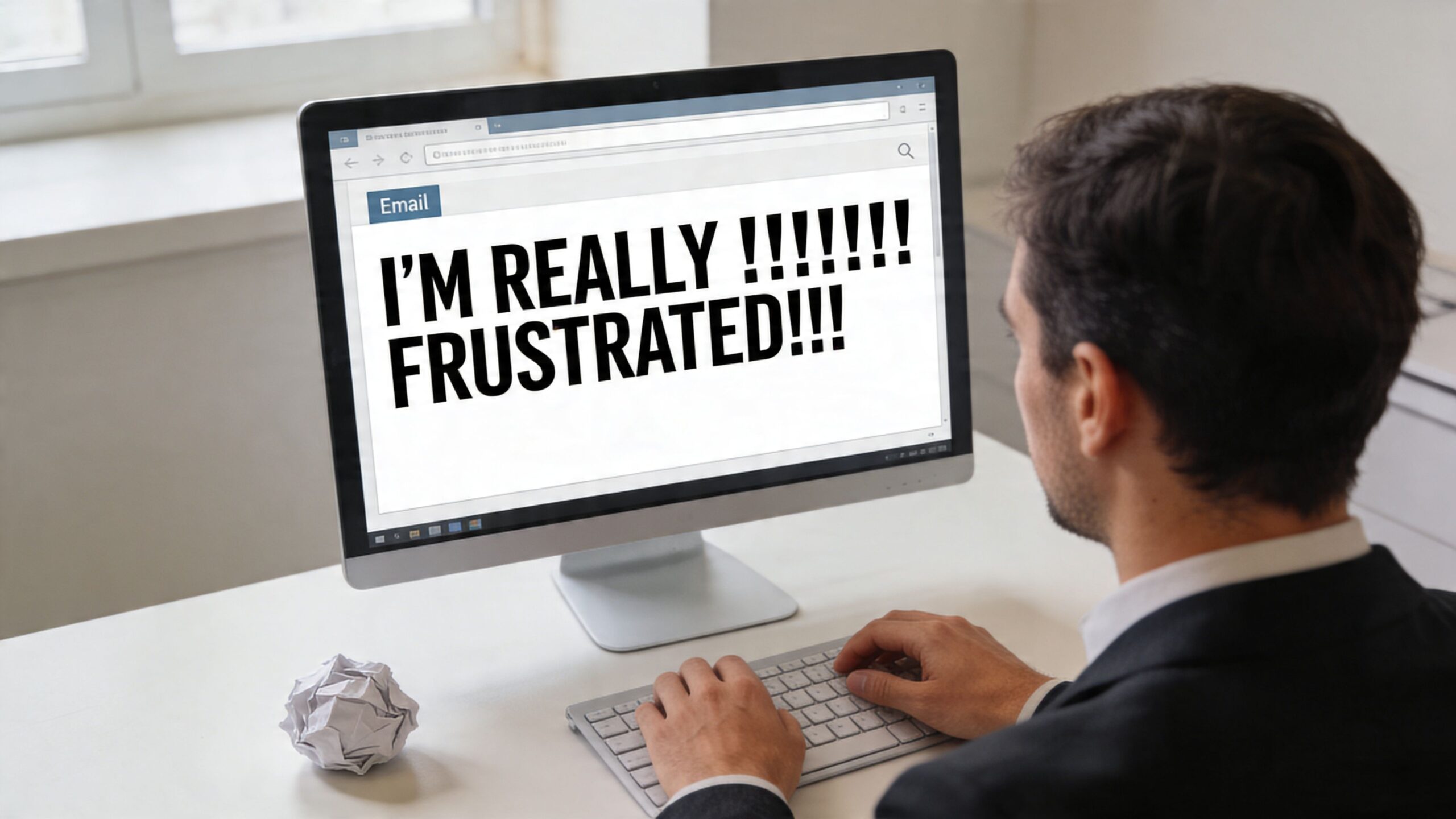
I already explained this several times and I'm honestly frustrated that we're still going in circles. This delay is making everything harder and I really need you to respond ASAP because this is becoming a serious problem.
The issue is not that the emotion exists. The issue is that the email makes your frustration the headline. Once that happens, the reader stops focusing on the decision, timeline, or risk. They start reacting to you.
What emotional writing does to your authority
Under pressure, many capable professionals try to signal urgency by sounding more intense. In practice, that often lowers their executive presence. Strong leaders sound steady when stakes are high. They name the issue, the consequence, and the required action without sounding personally flooded.
This matters even more for international professionals. If a reader is already making quick judgments about fluency, confidence, or status, emotionally loaded phrasing can amplify the wrong impression. A message like "Did you see my last email?" may sound neutral to the sender, but in a cross-cultural context it can read as impatient, accusatory, or passive-aggressive.
I coach clients to separate heat from signal. Keep the urgency. Remove the emotional spillover.
A composed rewrite
Use language that is factual, calm, and directional:
Hello Sarah,
We still need confirmation on the revised timeline. Without that decision today, the team will need to delay the next phase. Please confirm by 4 p.m., and if timing has changed, I'll adjust the plan accordingly.
Best,
[Name]
This version protects your authority because it does three things well. It states the issue clearly. It names the consequence without drama. It gives the recipient a concrete path to respond.
Calm writing carries more weight than agitated writing, especially when the situation is urgent.
For professionals working to strengthen spoken and written executive presence at the same time, this often connects to the broader skill of speaking English clearly and confidently in high-stakes situations. The goal is the same in both settings: sound composed enough that people trust your judgment under pressure.
5. Unprepared or Stream-of-Consciousness Structure
Some emails don't sound casual or emotional. They sound scattered.
Unprofessional email example:
Hi all,
I wanted to send a note about the client meeting because there were a few things from yesterday and also some budget questions, and before that I was talking with operations about staffing, which may affect onboarding, although maybe not immediately, and I also think we should revisit the timeline because the client mentioned expansion.
By the second line, the reader is already doing extraction work. That's the core problem. Disorganized emails make the recipient assemble your thinking for you.
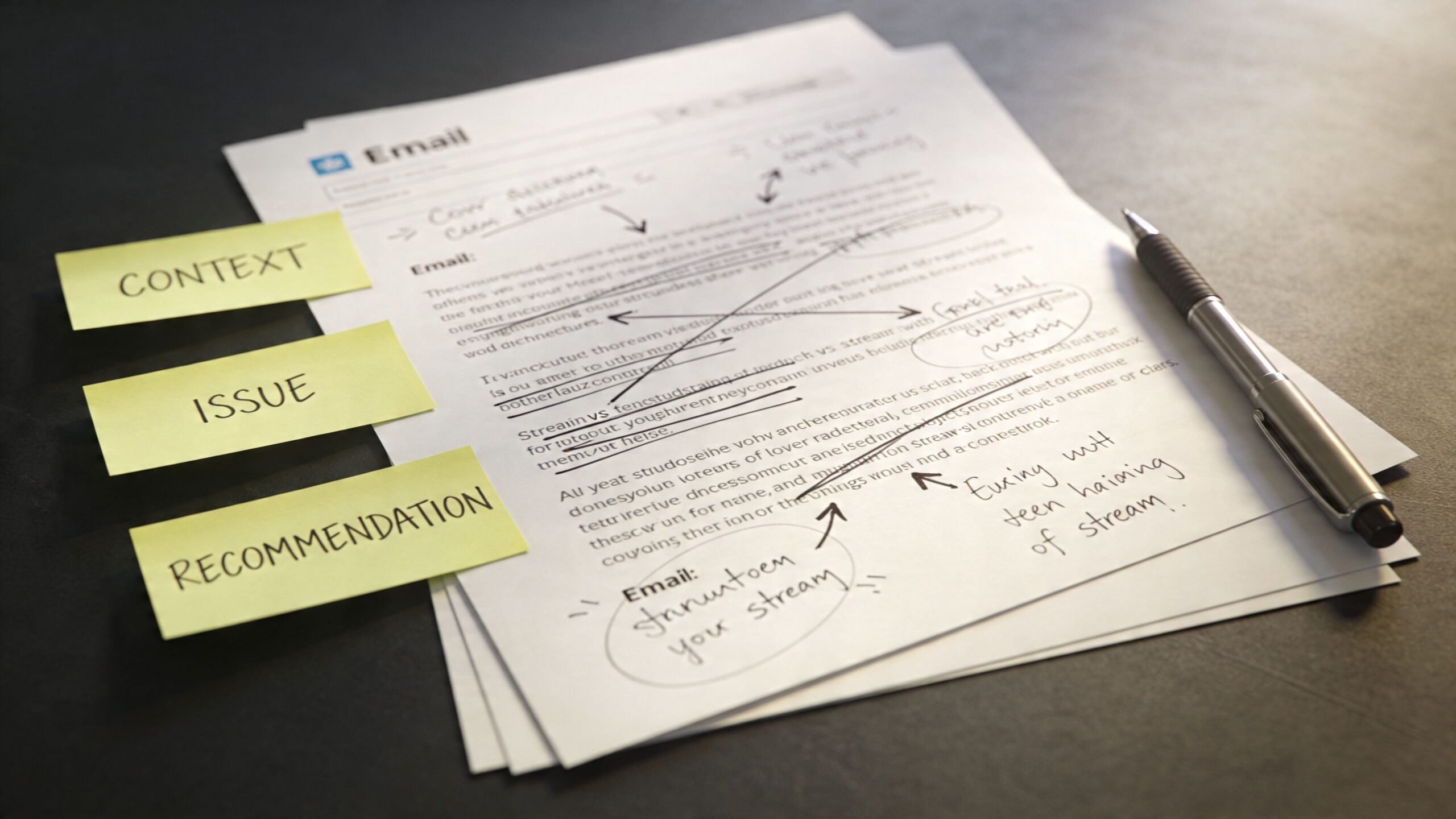
Structure is a leadership signal
People often assume executive presence is mostly about confidence or voice. In writing, structure is one of the clearest signals of seniority.
A more effective version might look like this:
Hi all,
Summary: The client is considering expansion, which affects budget, staffing, and timeline.Context
The expansion idea came up in yesterday's meeting.Key issue
Operations may need additional onboarding support if the client moves forward.Recommendation
I recommend we revisit the timeline and budget assumptions before Friday's review.Decision needed
Please confirm whether we should prepare an expansion scenario for the client by tomorrow noon.
That email is easier to trust because the logic is visible.
A practical structure to use
When your message is complex, use this sequence:
- Context: What changed or happened
- Issue: What problem or risk exists
- Analysis: What matters and why
- Recommendation: What you think should happen
- Decision needed: What the recipient must approve or answer
This matters even more for international professionals. Strong structure can compensate for minor phrasing imperfections because your reasoning remains easy to follow. This guide on speaking English clearly and confidently applies to writing too. Clarity is often less about vocabulary and more about sequencing.
6. Over-Apologizing and Excessive Self-Deprecation
A surprising number of unprofessional email examples sound polite on the surface but weak underneath.
Unprofessional email example:
Sorry to bother you. I may be wrong here, but I just wanted to mention that maybe we could consider changing the approach if that makes sense. Sorry if I've misunderstood.
This language doesn't make you sound respectful. It makes your recommendation easy to dismiss.
Why this habit backfires
Over-apologizing transfers confidence away from your idea before the reader has evaluated it. You frame your contribution as interruption, uncertainty, or inconvenience.
This issue gets sharper for international professionals because language insecurity often shows up as over-softening. Some people try to avoid sounding rude and end up sounding unsure. In practice, senior leaders are usually more comfortable with direct clarity than with hesitant politeness.
A better rewrite:
Hello Priya,
Based on the current timeline, I recommend changing the sequencing of the rollout. This would reduce dependency risk between product and operations. If you agree, I'll send the revised plan this afternoon.
Best regards,
[Name]
What to remove from your draft
Look for these phrases and cut them aggressively:
- Apology fillers: "Sorry to bother you," "Sorry for the email"
- Weak qualifiers: "I may be wrong," "maybe," "kind of"
- Permission-seeking language: "If that makes sense," "just wanted to ask"
- Self-undermining disclaimers: "This may be a stupid idea"
Direct language isn't rude when it's specific, respectful, and solution-focused.
There's an important trade-off here. You don't want to swing from hesitant to blunt. The target is confident neutrality. State your point, support it briefly, and move the conversation forward.
7. Lack of Cultural or Hierarchical Awareness in Tone and Address
The same email can sound appropriate in one setting and unprofessional in another.
That's where many smart professionals get trapped. They use a tone that worked with peers, then send the same style to a senior client, a founder, or a regional executive. The wording isn't technically wrong. It's context-blind.
Unprofessional email example:
Hey Maria, you must send the report now. We need this fixed today.
That message may come from urgency. But depending on culture, hierarchy, and relationship, it can sound abrupt, accusatory, or disrespectful.
The executive presence issue underneath
Most online advice about unprofessional email examples focuses on obvious issues like grammar, slang, or formatting. It usually misses the more difficult problem of cross-cultural interpretation. This analysis points out that common guidance under-serves the needs of non-native English speakers, especially around cultural and linguistic nuance.
In executive settings, tone calibration matters because readers evaluate not just what you want, but whether you understand status, diplomacy, and context.
A stronger version:
Hello Maria,
Could you please prioritize the report today? We need it to finalize the next review package. If timing is tight, let me know what is feasible and I'll adjust the sequence.
Best regards,
[Name]
How to calibrate without sounding stiff
Use a simple hierarchy rule:
- With peers: You can be warmer and slightly more relaxed.
- With senior leaders: Increase formality and reduce improvisational phrasing.
- With external partners or clients: Aim for polished, clear, and measured.
- Across cultures: When in doubt, start more formal. You can always warm the tone later.
Ask yourself one question before sending: would this sound appropriate if I said it aloud in a high-stakes meeting?
For professionals refining spoken and written business English together, this resource on improving English pronunciation for business professionals supports the same larger goal: sounding credible across hierarchy, pressure, and cultural difference.
7 Unprofessional Email Examples Comparison
| Issue | Implementation complexity 🔄 | Resource requirements ⚡ | Expected outcomes ⭐ | Ideal use cases 📊 | Key advantages / Tips 💡 |
|---|---|---|---|---|---|
| The Casual Tone in Executive Communications | Low, adjust diction, salutations and remove slang | Minimal: proofreading, simple style guide; optional coaching for non-native speakers | ⭐⭐⭐⭐ Improved credibility and alignment with leadership expectations | Internal peer chats or informal team channels; avoid for executives/boards | 💡 Use formal salutations, spell out contractions, read aloud before sending |
| Vague Subject Lines and Missing Strategic Framing | Moderate, requires reframing messages to lead with purpose | Low: templates and brief training to craft specific subjects | ⭐⭐⭐⭐ Higher open rates and faster decisioning when clear | Time-sensitive updates, requests requiring quick prioritization | 💡 Lead with decision/outcome, include deadline and business impact |
| Unclear Request with No Explicit Call-to-Action | Low, add explicit asks, deadlines and ownership | Minimal: formatting (CTA section), checklist; occasional alignment | ⭐⭐⭐⭐⭐ Increases response rates and speeds execution | Approval requests, resource decisions, anything needing a clear reply | 💡 Use "ACTION REQUIRED," assign owners, state exact deadline |
| Emotional Language and Lack of Composure Under Pressure | Moderate, requires self-regulation and review workflows | Medium: cooling-off time, peer review, coaching for high-stakes contexts | ⭐⭐⭐ Restores authority and reduces escalation when replaced with facts | Rarely appropriate; may be acceptable in tightly trusted peer debriefs | 💡 Wait before sending, replace emotion with facts and a clear remediation plan |
| Unprepared or Stream-of-Consciousness Structure | Moderate, adopt clear structure and executive-summary habit | Low–Medium: templates, brief outlining time, occasional coaching | ⭐⭐⭐⭐ Clarifies thinking and enables faster, accurate action | Complex issues, cross-functional updates, executive summaries | 💡 Start with CONCLUSION, then CONTEXT→ISSUE→RECOMMENDATION→DECISION |
| Over-Apologizing and Excessive Self-Deprecation | Low, change phrasing and remove unnecessary qualifiers | Minimal: awareness training and feedback from peers/coaches | ⭐⭐⭐⭐ Increases perceived confidence and strengthens recommendations | All executive communications, especially when proposing actions | 💡 Eliminate unnecessary apologies; state recommendations confidently |
| Lack of Cultural or Hierarchical Awareness in Tone and Address | High, requires cultural intelligence and situational adaptation | Medium–High: mentorship, localized guidance, observation of norms | ⭐⭐⭐⭐⭐ Prevents offense and builds stronger senior/stakeholder relationships | CEO/board communications, external stakeholders, cross-cultural interactions | 💡 Observe leader norms, default to more formality with seniority, research cultural expectations |
From Unprofessional to Unforgettable Mastering Executive Email
A capable professional sends an email meant to sound efficient. The note is brief, casual, slightly rushed. Ten minutes later, the reply from a senior stakeholder is colder than expected, or worse, there is no reply at all. The problem usually is not intelligence or intent. It is signal management.
Executive email works as a visible proxy for judgment. Leaders do not only evaluate the content of a message. They also read the framing, the emotional control, the level of preparation, and the respect shown for hierarchy, culture, and time. That is why unprofessional email examples matter. They reveal how small choices in tone and structure can subtly diminish authority.
Earlier examples in this article showed the pattern. A weak subject line creates friction before the email is opened. A buried ask forces the reader to hunt for the decision. Casual wording can sound careless in a high-stakes context. Over-apologizing shrinks the writer's position. Under pressure, emotional language can make a competent person look less steady than they are.
For international professionals, this matters even more. Email often carries more weight when accent, pace, and real-time clarification are absent. A message has to do the full job on its own. If the structure is loose or the tone misses the cultural expectation, readers may judge fluency, confidence, or seniority incorrectly. I see this often in coaching. The underlying thinking is strong, but the email does not present that thinking in a way senior stakeholders can trust quickly.
The standard is not stiffness. The standard is disciplined clarity.
Strong executive emails do four things well. They frame the issue fast, show the reader why it matters, make the request explicit, and maintain composure throughout. That combination improves response quality because it reduces effort for the recipient and increases confidence in the sender.
The shift from unprofessional to memorable communication is usually not dramatic. It comes from repeated corrections to a small set of habits. Replace loose openings with strategic context. Replace emotional phrasing with observable facts. Replace self-protective apologies with accountable action. Replace stream-of-consciousness writing with a sequence the reader can scan in seconds.
That is also why example-based practice works so well. Studying bad emails in isolation helps, but its full value comes from diagnosing why each message weakens executive presence, then rewriting it with stronger framing. That process trains judgment, not just etiquette.
The Gravitas Method is a 12-week one-on-one executive presence coaching program for international professionals who want to communicate with more authority and influence at senior levels. The program is priced at $8,200 paid in full or $9,000 across three installments. Coached by Nikola, it covers vocal authority, strategic framing, executive body language, and high-stakes communication.
If you want to identify the habits that are weakening your authority in email, meetings, and stakeholder conversations, start with the free Executive Communication Assessment. It shows the gap between how capable you are and how senior you sound.
Book your Executive Communication Assessment.
If you're ready to communicate with more clarity, authority, and influence, Intonetic is a strong place to start. The free Executive Communication Assessment is the best entry point if you want specific feedback on how your communication style is affecting how senior, credible, and persuasive you sound.