
Silent Vowels in English: A Guide to Vocal Clarity
You’re in a meeting you’ve prepared for carefully. The analysis is solid. The recommendation is right. You start explaining it, then someone interrupts with, “Sorry, could you repeat that?” Another person leans in, trying to catch the word you just said. Nothing is wrong with your thinking. The friction is happening in delivery.
For many international professionals, that friction comes from a small part of English that gets dismissed as “just pronunciation.” It isn’t just pronunciation. It’s how English hides sound inside spelling, especially through silent vowels in english.
That matters more than is often realized. Senior leaders are judged on clarity under pressure. If your listener has to decode your words while also processing your idea, your authority drops even when your expertise is high. The good news is that silent vowels are not random. They follow patterns. Once you learn those patterns, your speech gets cleaner, faster, and more controlled.
The Invisible Barrier to Your Vocal Authority
A product director once described a problem I hear often. She said the hardest part of presenting in English wasn’t strategy, data, or pushback. It was the moment a simple word came out slightly wrong and the room’s attention shifted from her idea to her accent.
That’s the invisible barrier. Your audience may not consciously think, “That vowel was off.” But they do register hesitation, extra syllables, or a sound that doesn’t match the word they expected. In executive settings, that tiny disconnect can weaken presence.
Why smart professionals get stuck here
Non-native speakers usually learn English through a mix of reading, grammar, and exposure. That builds strong comprehension. It does not always build reliable sound patterns. English spelling looks informative, but it often misleads the speaker.
A word appears to contain a vowel you should pronounce. In real speech, that vowel may be silent, reduced, or only there to shape a neighboring sound. If you pronounce every visible letter, your delivery starts to sound effortful.
Practical rule: If a word feels crowded in your mouth, the problem often isn’t speed. It’s that you’re trying to pronounce letters native speakers don’t fully voice.
This is why adults with strong professional vocabulary still stumble on basic delivery. They know the word. They use it in writing. But in live speech, they are decoding it in real time.
The shift that changes everything
The useful mindset is not “I keep making mistakes.” It’s “I’m learning the sound system behind the spelling.”
That shift reduces frustration fast. Once you stop treating each word as an isolated exception, you start seeing recurring patterns. This is also why early phonetic training matters so much across age groups. Even resources designed for younger learners, such as Encore Academy’s article on voice lessons for children, point to the same principle: vocal confidence grows when sound production becomes deliberate instead of guessed.
For professionals, the stakes are different, but the mechanism is the same. If you want a structured way to identify where pronunciation is weakening authority, an Executive Communication Assessment gives you a clearer starting point than generic accent advice.
Why English Has So Many Silent Vowels
English spelling is a layered city. New districts were built over old streets, but the old map never disappeared. That’s why so many words look one way and sound another.
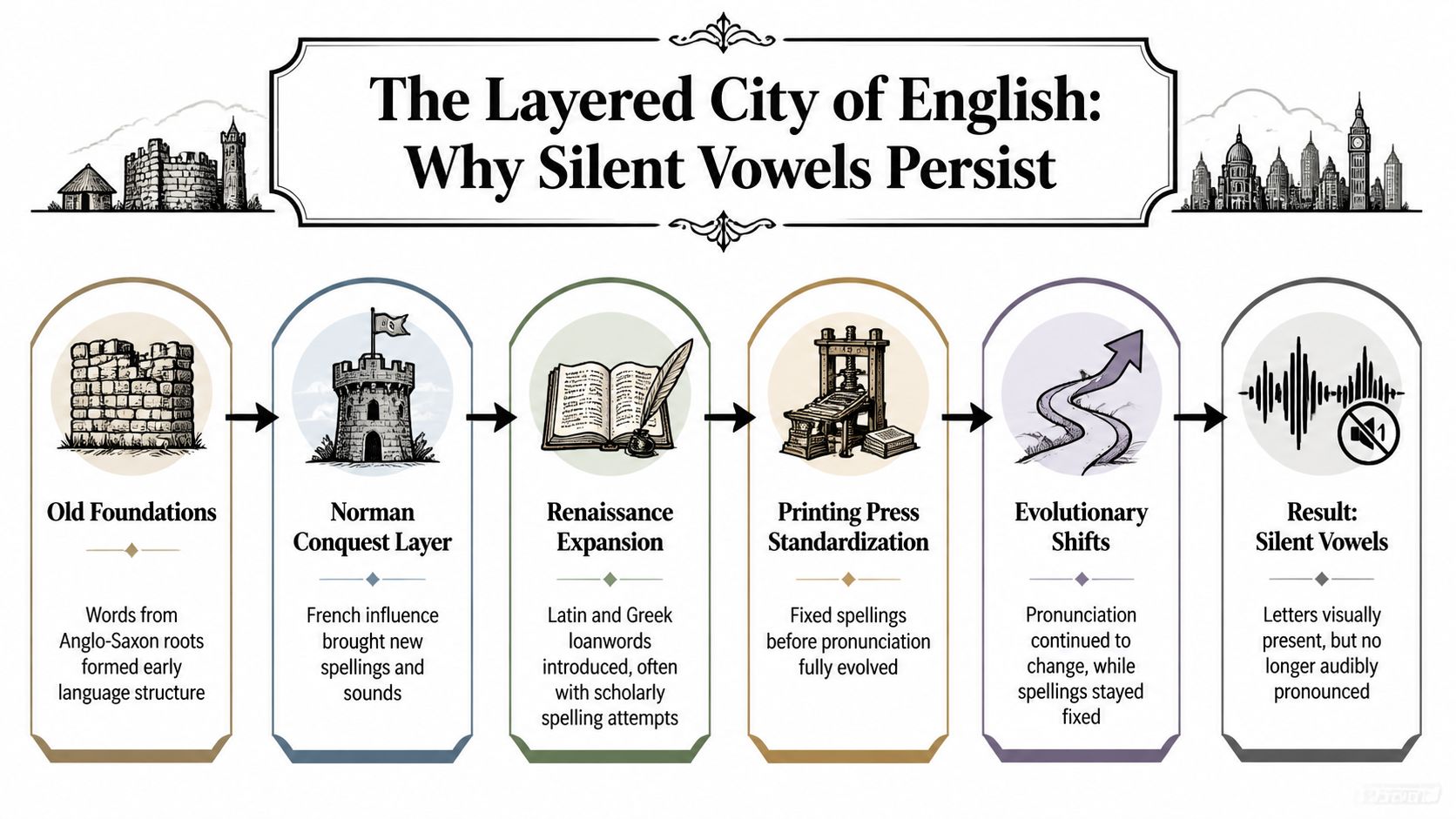
Spelling froze while speech kept moving
According to this explanation of silent letters in English, silent letters comprise approximately 70% of the English language, and many letters now considered silent were pronounced in the 15th and 16th centuries. As spoken English changed, spelling remained standardized, so written forms kept older sounds that everyday speech dropped.
That history matters because it explains why your intuition keeps failing you. You see a letter, expect a sound, and your mouth prepares for something English no longer says.
A logical learner usually improves faster once this clicks. The system is messy, but it isn’t arbitrary.
Silent vowels often preserve older structure
Think about words that seem inefficient on the page. They often carry traces of earlier pronunciation, foreign influence, or spelling conventions preserved by print. That’s why sounding words out letter by letter works poorly at senior speed. You don’t have time in a boardroom to reconstruct a word from spelling.
Instead, you need chunk recognition. That means learning the common vowel patterns as whole units rather than trusting the page.
Here’s a useful way to look at it:
| Pattern you see | What often happens in speech | What this means for you |
|---|---|---|
| Final silent vowel | It changes the earlier vowel sound | Don’t pronounce it separately |
| Vowel pair | One vowel carries the sound | Learn the pair as a chunk |
| Older borrowed spelling | Modern speech drops part of the written form | Memorize the spoken shape, not the visual one |
If your current method is “read it carefully and pronounce all the letters,” that method will keep slowing you down.
Pattern recognition beats word-by-word correction
This is why I prefer teaching professionals by sound families, not by long exception lists. Once you understand how English vowel systems behave, you stop treating every difficult word as a fresh problem.
If you want a stronger foundation before tackling business vocabulary, this guide to English vowel sounds and how many there are helps clarify the sound inventory that English spelling often hides.
English doesn’t reward literal reading. It rewards pattern recognition under pressure.
That’s also why confidence rises when pronunciation training is practical. The goal isn’t to become academic about language history. The goal is to reduce hesitation when a high-visibility word appears on a slide and you have to say it cleanly the first time.
Mastering the Magic E Rule for Executive Presence
The most useful silent vowel pattern to master first is the final silent e. It seems elementary, but in executive communication it has an outsized effect because it changes the length and shape of the stressed vowel before it.

What the final e actually does
According to this phonetics overview of silent letters, the silent e in words like name, bake, and time works as a prosodic marker that lengthens the preceding vowel. Mispronouncing that pattern can create perceptual markers of non-native speech within milliseconds.
That’s the practical point. The final e doesn’t disappear harmlessly. It changes the sound architecture of the word.
Consider these pairs:
- rid / ride
- plan / plane
- hop / hope
- fin / fine
- not / note
If you compress the long vowel into the short one, your speech sounds clipped. In professional settings, clipped vowels often read as rushed, uncertain, or under-rehearsed.
Why this affects authority
Executive presence depends partly on vocal timing. Long vowels create more controlled rhythm. Short vowels produce a sharper, tighter sound. Neither is better in itself, but the wrong one changes the word and disrupts listener trust.
A mispronounced “We need to scale” can land closer to “We need to scal” in the listener’s ear. They recover quickly, but not without cost. You’ve created a tiny repair moment in their attention.
This is especially common in business words such as:
- pipeline
- timeline
- framework
- baseline
- update
- restate
For focused practice on one of the most common vowel contrasts inside this system, this guide to short and long i sounds is worth studying.
Your listener should spend their energy evaluating your idea, not decoding your vowels.
A quick visual explanation can help lock this rule in before you practice it aloud.
A better way to drill it
Don’t memorize isolated rules. Use contrast sets. Say each pair slowly, then in a sentence:
| Short vowel | Long vowel with silent e | Business sentence |
|---|---|---|
| plan | plane | “Let’s plan the rollout.” |
| fin | fine | “The numbers look fine.” |
| not | note | “Please note the change.” |
Record yourself. Then listen for whether the stressed vowel has enough space. If it feels flattened, the issue is usually not volume. It’s vowel length.
That one correction often makes a professional speaker sound calmer immediately.
Decoding Silent Vowels in Word Middles
Final silent e is only the first layer. The next challenge is the vowel in the middle of a word that appears visible but doesn’t behave the way your spelling instinct expects.
These patterns matter because they show up in professional vocabulary all the time. If you try to sound out every vowel separately, fluency breaks.
The problem with vowel teams
Many learners grow up hearing a neat rule about two vowels sitting together. It helps at the beginning, then starts failing on real business language.
Words like bread, people, liaise, colleague, and bureau don’t invite a simple one-rule reading. The visual form suggests one sound. The spoken form often follows a different pattern.
According to Grammarly’s discussion of silent letters, silent vowels in combinations like ea in bread require learners to suppress the expected “ee” sound, and mishandling these patterns can increase audience cognitive load by 15-23% while reducing message retention by approximately 12-18%. The same source notes that adverbs ending in -ically, such as basically, also expose this issue because the silent vowel must be handled smoothly.
That aligns with what shows up in senior communication. The word isn’t always fully wrong. It’s often just effortful enough to distract.

Group words by spoken behavior
Professionals improve faster by grouping words into sound families.
The ea group
The spelling ea does not always produce the sound you expect.
- bread
- spread
- dread
These need pattern memory, not letter-by-letter reading. If you default to an “ee” sound, the word lands wrong immediately.
The hidden-vowel workload group
Some words look like they should carry a fuller middle vowel than they do in speech.
- people
- jeopardy
If you over-pronounce the silent or weakened vowel, the word becomes heavier than native rhythm expects.
The adverb compression group
Professional speakers use these constantly.
- basically
- logically
- frantically
These are dangerous because they often appear in spontaneous explanation. If the internal vowel pattern isn’t automatic, you’ll stumble exactly when you’re trying to sound composed.
What works better than sounding it out
I don’t recommend reading difficult words aloud for the first time from slides. That trains hesitation. A better method is to build spoken chunks before the meeting.
Use this sequence:
-
Mark the stressed syllable
Say the strongest beat first. That gives the word shape. -
Mute the nonessential vowel visually
On paper, lightly cross out the vowel that tempts you to over-pronounce. -
Practice in phrase units
Don’t say “basically” alone ten times. Say, “Basically, the issue is timing.” -
Rehearse with decision language
“Our colleague in finance.” “Revenue pressure remains.” “We need to liaise with legal.”
For a broader map of the sound system behind these patterns, this guide to the 44 sounds in English, including vowels, consonants, and diphthongs is a strong reference.
The primary skill isn’t pronunciation in isolation. It’s retrieving the correct spoken shape fast enough that your thinking stays fluent.
Practical Drills to Eliminate Common Errors
Most professionals don’t need more theory. They need drills that fit real speech pressure.
The first distinction to make is fundamental. A silent vowel is not the same as a reduced vowel. According to this explanation of reduced and unstressed vowels, reduced vowels are weakened phonemes, not fully silent ones. In words like separate, that unstressed vowel is still present, just less clear. When senior leaders miss that distinction, listeners often hear hesitation or uncertainty rather than confident control.
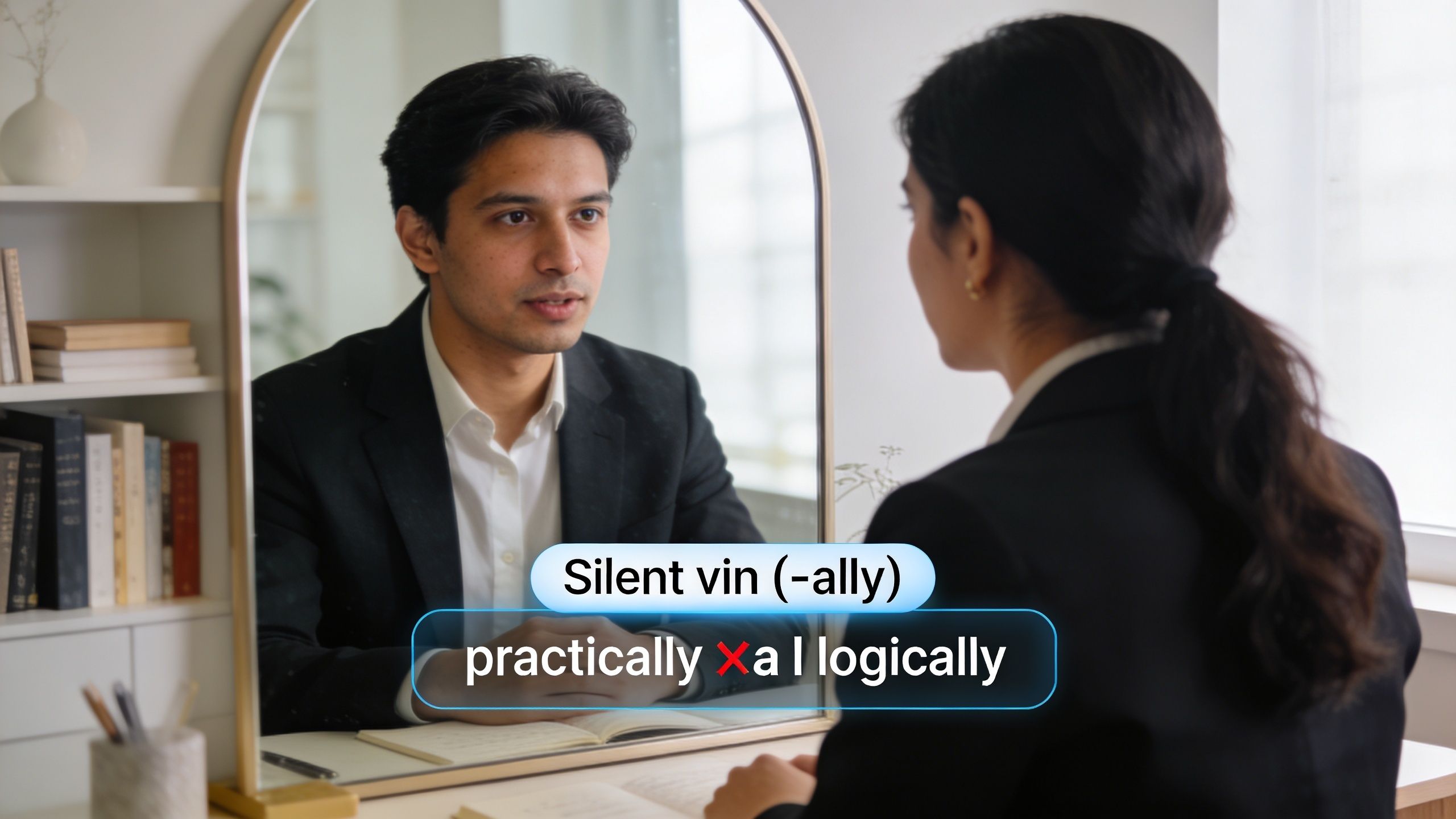
Drill one for silent versus reduced vowels
Use a two-column page.
| Truly silent or shaping vowel | Reduced but still present vowel |
|---|---|
| name | separate |
| time | government |
| note | private |
Say the left column with clean omission of the final shaping vowel. Say the right column with light, fast unstressed syllables. Don’t delete them.
This stops one of the most common executive speech errors. People either pronounce too much or erase too much.
Drill two for overpronounced adverbs
Take five adverbs you use in meetings:
- basically
- logically
- practically
- strategically
- technically
Now put each inside a sentence you say at work.
- “Basically, we have two options.”
- “Logically, the team escalated it.”
- “Strategically, this is the wrong quarter.”
Repeat each sentence three ways: slow, conversational, then presentation speed. The goal is consistency of shape, not speed itself.
If a word only works when you say it slowly, you don’t own it yet.
Drill three for recording and diagnosis
Record one minute of yourself summarizing a slide deck. Don’t script it. Then listen back for three things:
-
Extra syllables
Did you add a vowel that native rhythm would suppress? -
Flattened long vowels
Did a word with silent e lose its length? -
Heavy unstressed syllables
Did reduced vowels sound too full?
This kind of review is more effective than repeating isolated word lists because it catches the error where it happens, inside professional thought.
If you want material for articulation and rhythm work before recording, these vocal warm-ups and tongue twisters are useful as prep, especially before high-stakes calls.
Drill four for shadowing under pressure
Choose a short clip from a speaker whose pace feels natural, not theatrical. Listen to one sentence. Pause. Repeat it with the same vowel suppression and timing. Then move to your own sentence on the same topic.
Many professionals can imitate correct pronunciation briefly, but lose it when they return to spontaneous speech. Shadowing addresses this by building the bridge between model and real use.
What usually doesn’t work
Three habits waste time:
- Memorizing giant word lists without practicing them in phrases
- Over-focusing on accent reduction while ignoring executive rhythm
- Reading slides aloud as your main form of speaking practice
Those methods feel productive because they are familiar. They rarely create durable change in live meetings.
For professionals who want direct feedback on these exact patterns, The Gravitas Method is a 12-week one-on-one executive presence coaching program for international professionals who want to communicate with more authority and influence at senior levels. The program is priced at $8,200 paid in full or $9,000 across three installments. Coached by Nikola, it covers vocal authority, strategic framing, executive body language, and high-stakes communication.
Turning Pronunciation Practice into Vocal Presence
Silent vowels matter because they change more than pronunciation. They change how quickly your audience trusts your delivery.
When you handle final silent e cleanly, your vowels sound more controlled. When you stop overpronouncing vowel teams in the middle of words, your rhythm becomes easier to follow. When you distinguish truly silent vowels from reduced ones, you sound less effortful and more composed.
That’s why this work has career value. Senior communication isn’t only about what you know. It’s about whether people can absorb your message without friction.
Treat patterns as leverage, not correction
English kept accumulating layers over time. As Merriam-Webster’s discussion of silent-letter history notes, the phenomenon intensified after the 1600s with Greek and Latin influence, and even the m in mnemonic was still pronounced until the late 1800s before becoming silent. For professionals, that history is useful because it reinforces the right mindset: these patterns are inherited structures, not personal failures.
You do not need perfect speech. You need speech that carries authority without making the listener work.
If you want extra self-study beyond this article, Luca Lampariello’s piece on building a bridge to active fluency with pronunciation is a practical complement because it connects pronunciation work to fluent use rather than isolated drills.
The professionals who make the biggest gains are rarely the ones chasing a flawless accent. They’re the ones who close the gap between expertise and delivery. Silent vowels are one of the clearest places to start.
If you want a precise view of how your pronunciation, pacing, and vocal delivery affect your executive presence, start with the free Executive Communication Assessment from Intonetic. It’s the most practical first step if you’re serious about sounding as senior as your expertise already is.